The Iron Lion of Cangzhou
The Iron Lion of Cangzhou, also called the Sea-suppressing Howler, stands in the old town of Cang County about 18 kilometres southeast of central Cangzhou. Cast in the Later Zhou in 953, it is widely described as the largest and oldest surviving iron-cast sculpture in China and is listed among the Four Treasures of Hebei. The on-site visit is short. Pair it with canal edges or the Cangzhou Museum. Skip inventing a half day of gift shops.
Casting and size
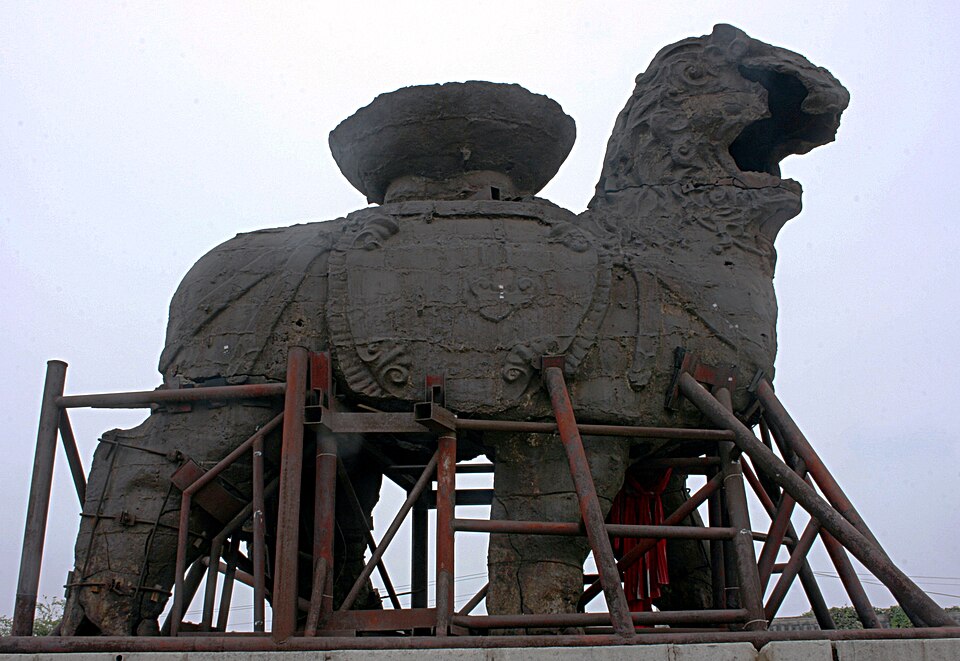
County records and inscriptions long associated with the sculpture give the year as Guangshun 3 of the Later Zhou, 953. A craftsman named Li Yun of Shandong is named in surviving readings of the cast marks. The hollow body was made by piece-mould stacking, with hundreds of clay mould sections leaving seam impressions on the surface. Published measurements vary slightly across surveys. Chinese conservation summaries commonly cite a length a little over 6 metres, a width near 3 metres and a height around 5.5 metres, with weight estimates in the tens of tonnes. An iron lotus basin still sits on the back.
Scholars debate why it was cast. Local legend treats it as a sea-quelling guardian, which supplies the nickname Zhenhaihou. Another reading places it inside a Buddhist temple as the mount for a Manjusri figure whose bronze image may have been removed during Later Zhou campaigns against temple metal. A third tradition links the casting to frontier defence under the Zhou court. The open mouth, wave-like mane and striding stance still dominate photographs even after a millennium of corrosion and repair.
Damage, moves and the new replica
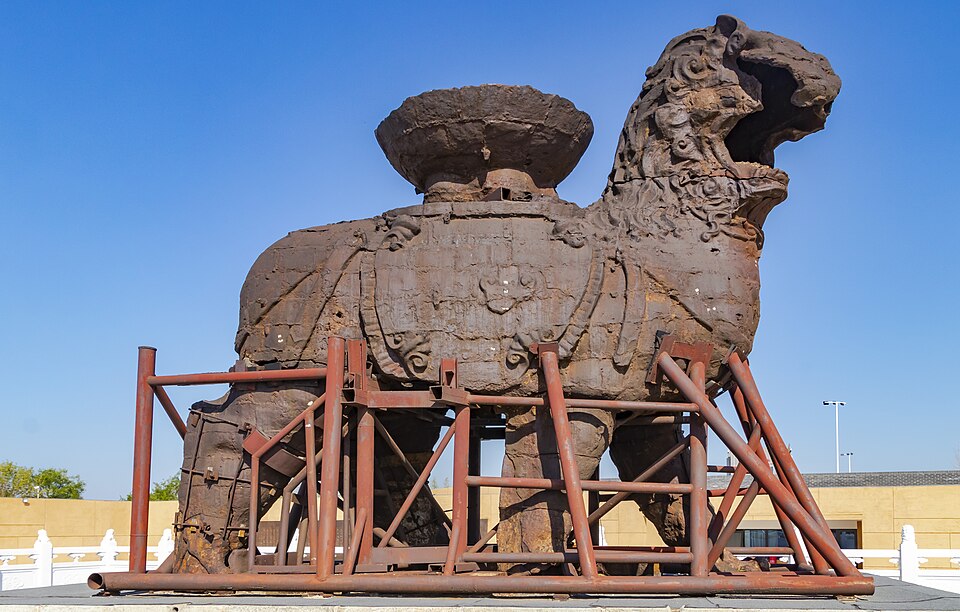
Wind threw the lion down in 1803. It was hauled upright again in 1893 by digging a pit and dragging it with ropes, which left the base lower than the surrounding fields. Twentieth-century shelters, cement bases, coatings and internal fills sometimes slowed water damage and sometimes worsened cracking. In the early 1980s the sculpture was shifted several metres north and later braced with external steel because the legs could no longer carry the load alone. It entered the first national key cultural relics list in 1961.
In 2010 and 2011 Cangzhou cast a larger one-piece replica for Shicheng Park in the modern city. The replica is useful if you stay downtown and cannot reach the old-county site, yet it is a modern work. Serious visitors still go to the original in Cang County.
Visit timing and light
Arrive early or late for softer light on the dark iron. Midday glare on the open plaza is hard. Thirty to sixty minutes covers the sculpture, the protective setting and photographs. Do not pad the stop with every nearby stall. If rain closes outdoor plans, shift to the Cangzhou Museum in the canal district.
Tickets, hours and getting there
Site hours, scaffolding notices and ticket rules change, so check the day's board or local tourism channel. Carry ID. From Cangzhou's rail stations, taxis or hired cars reach the Cang County old town in roughly half an hour depending on traffic. Confirm return buffers if you continue north or south on the same day.
Cangzhou sits on the Hebei rail corridor between Beijing, Tianjin and Shandong. Neighbours such as Baoding hold denser heritage days. The Cangzhou travel guide keeps the lion as a short signature stop inside a one-day frame.
Before you go
- Soft morning or late light helps photographs.
- Pair the original lion with one canal walk or the city museum.
- Confirm any temporary covers or walkway closures.
- Read the Cangzhou travel guide for eating and onward rail.
Frequently asked questions
Is the lion in downtown Cangzhou?
The original stands in Cang County's old town southeast of the modern urban core. A large replica stands in Shicheng Park in the city.
How long should I stay?
Under an hour at the lion itself. Add museum or canal time if you have a full day.
Why is Cangzhou called the Lion City?
Local branding takes the sculpture as a civic emblem, and products and park names echo it.
Are exact ticket prices listed here?
No. Prices and hours follow official notice on the day.
Reading the sculpture on site
Walk a full circle if barriers allow. Seams from the piece moulds show how stacked pours built the hollow body. The lotus basin on the back supports the temple-mount reading even when the bronze rider is long gone. Conservation steel and patched legs are part of the present object. Photographers who want clean silhouettes should accept that modern bracing stays in the frame.
If scaffolding or covers appear, ask staff which viewpoints remain open. A rainy morning is a good cue to swap order and start at the museum.
Sources
Facts in this article were checked against the following sources, retrieved 19 October 2026.
- Iron Lion of Cangzhou, English Wikipedia
- 沧州铁狮子, Chinese Wikipedia
- Cangzhou Museum notes on the Iron Lion
- Cangzhou travel guide on this site
Photos are from Wikimedia Commons under the licences shown in each caption.