Guangfu Ancient City, the Walled Town in the Marsh
Guangfu is a walled town in Yongnian District, roughly 20 kilometres northeast of central Handan. It sits on a low island in the Yongnian Marsh, ringed by a brick wall about 4.5 kilometres round and a wide moat, with reed beds and lotus ponds beyond. It was the seat of Guangping prefecture under the Ming and Qing, and it is also the birthplace of two styles of tai chi, the Yang style and the Wu style. Local promoters sum it up as an old city, a water city and a tai chi city, and each part of that slogan holds up.
A long history on a small island
The town was settled in the Spring and Autumn period and appears in early texts as Quliang. Its marsh setting made it hard to attack, and it changed hands often. In 619 the rebel leader Dou Jiande made it the capital of his short-lived Xia state as the Sui dynasty collapsed, and after his defeat his officer Liu Heita held it again before Li Shimin, the future Tang emperor Taizong, broke his army by damming and then releasing the nearby Ming River. The name Guangfu is a shortening of Guangpingfu, the prefecture it served for centuries, and it was also the Yongnian county seat until 1958.
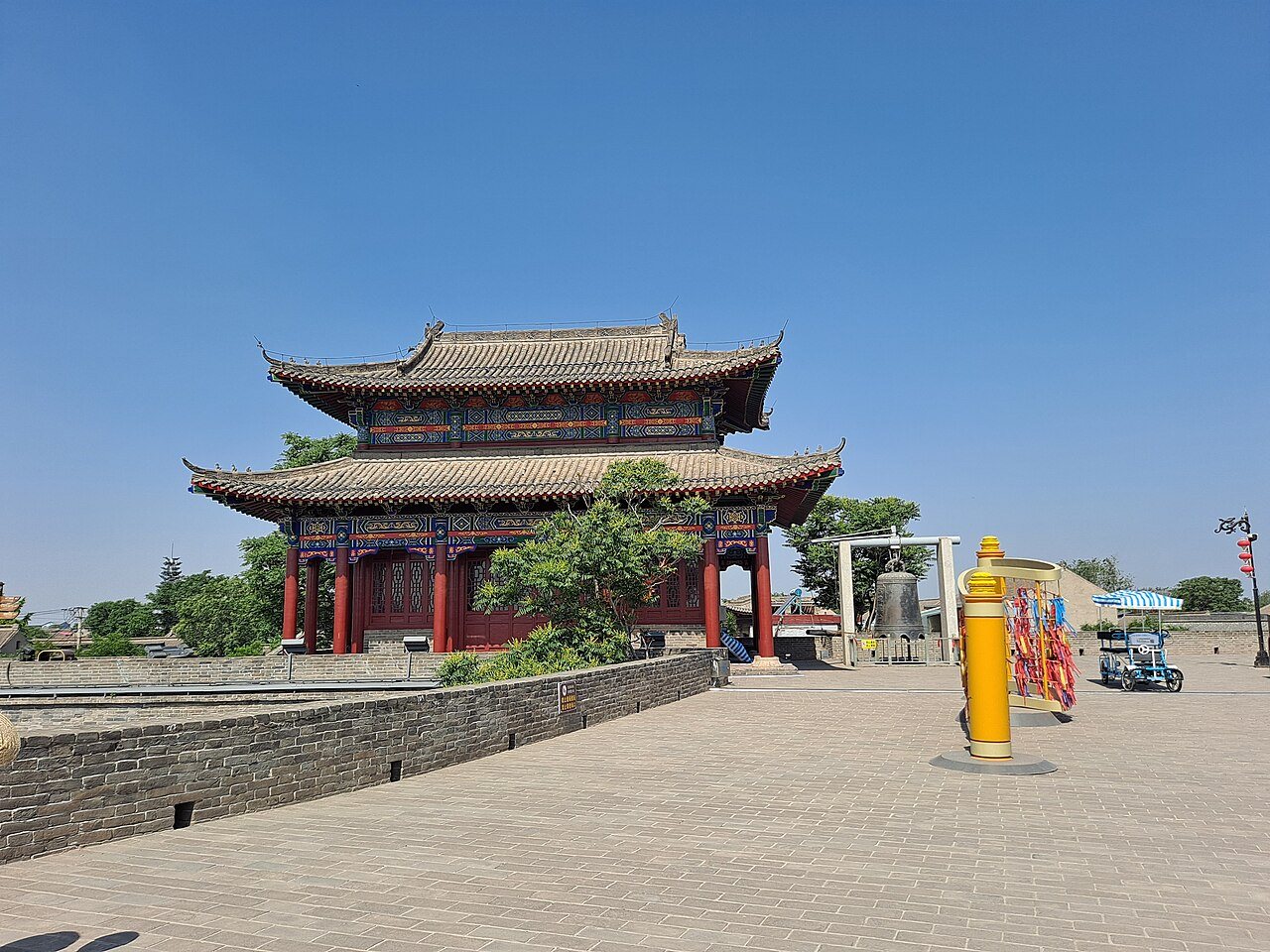
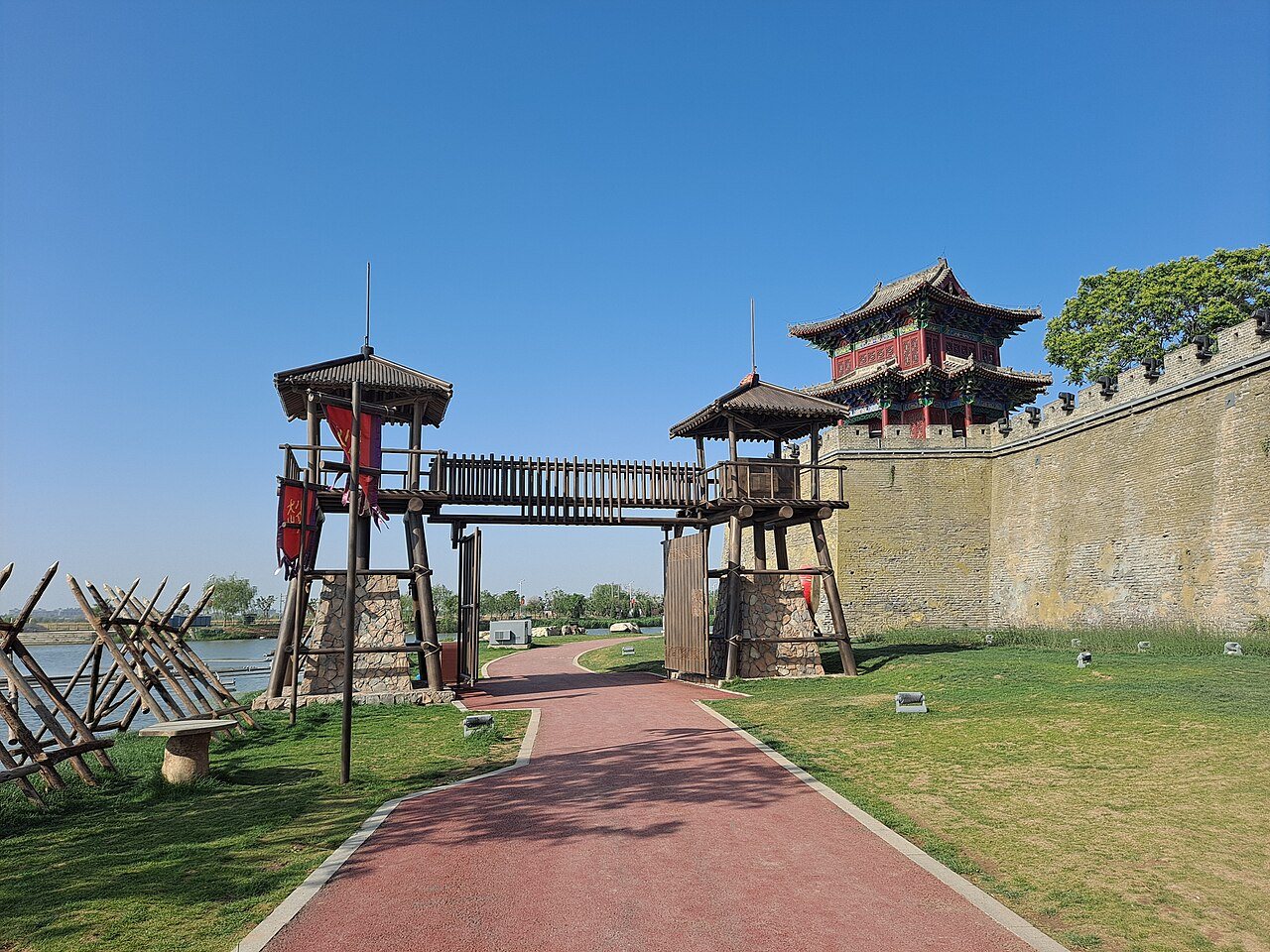
The walls started as rammed earth. Under the Yuan the governor Wang Wei enlarged the circuit to about 4.5 kilometres. In 1542 the prefect Chen Zu began refacing it in brick with labour from the prefecture's thirteen counties, a job that took thirteen years, and a stele at the west gate still records his work. In 1564 another prefect, Cui Dade, added an outer dyke and four barbicans to keep floods out. The finished wall stood about 12 metres high and 8 metres thick.
Guangfu's last siege came late. After 1945 a local commander, Xu Tieying, held the walled town for about two years with supplies dropped from the air, until his forces broke out in October 1947. The north and south barbicans were later demolished to ease traffic, so only the east and west barbicans remain.
Walls, gates and the moat
The town is laid out at an angle, facing northwest, and its outline is often compared to a reclining ox, so it is also called Woniu Cheng, the Crouching Ox City. Inside there are said to be four main streets, eight lesser streets and seventy-two winding lanes. The walls were partly ruined in the twentieth century and have since been repaired, and walking the top is the best way to read the plan, with the town on one side and the moat and marsh on the other. Small trees growing from the brickwork are one of the details visitors remember.
The moat runs about five kilometres around the walls and is roughly a hundred metres wide in places. Boats run on it by day and on evening tours, and the lotus is in flower in high summer. The marsh outside, Yongnian Wa, is now a national wetland park and one of the main bird habitats in southern Hebei.
The tai chi residences
Guangfu's other fame is martial. Yang Luchan, founder of Yang-style tai chi, and Wu Yuxiang, founder of the Wu style, both came from here, and Yang and Wu tai chi were inscribed by UNESCO in 2020 as part of China's taijiquan listing. The simplified 24-form routine practised in parks across China is based on the Yang style.
The Yang Luchan residence stands about 100 metres outside the south gate. The original buildings were lost, and the present two-courtyard house was rebuilt on the old site in 1991, with a statue of Yang and displays on how he learned the art in Chen Village. The Wu Yuxiang residence on the east street is the more complete building, a Qing house of the Daoguang period whose central axis survives with about forty rooms. Both residences are provincial protected sites. Visitors often see practice groups in the squares in the early morning.
Hongji Bridge
About 2.5 kilometres east of the town, in Dongqiao village, the Hongji Bridge crosses the Fuyang River. It is a single-span stone arch with small open arches over each shoulder, the same design as the famous Zhaozhou Bridge, and it is a national protected site. Visitor listings give its main span as about 32 metres. One local listing reported it closed for works from July 2026, so confirm it is open before making the trip.
Tickets and getting there
Entry to the walled town itself is free. The wall walk, the two residences, the Guangping prefecture office and Hongji Bridge are ticketed separately, and several combined tickets are sold. Prices and opening hours differ between sources, so check the day's notice at the ticket offices. Inside sights generally open in the daytime only.
From Handan East high-speed station, a taxi takes around half an hour. City bus 605 runs from central Handan to Guangfu. Plan four to six hours on site.
A day in Guangfu
Enter by the south gate and visit the Yang Luchan residence first, then climb the wall and walk from the south gate toward the east gate. Drop down for the Wu Yuxiang residence and lunch on the main streets, where Yongnian crisp fish is the local dish to try. Spend the afternoon on a moat boat or at Hongji Bridge, and stay for dusk if an evening show or moat tour is running. Another day can go to the Buddhist caves at Xiangtangshan, and the Handan travel guide covers Congtai Park in the city.
Before you go
- Wear flat shoes for the long wall walk.
- Bring sun protection in summer and mosquito repellent near the marsh.
- Confirm Hongji Bridge is open before going out to it.
- Carry ID for ticket purchases.
Frequently asked questions
Is Guangfu Ancient City free?
The town itself is free to enter. The wall walk and the main buildings inside charge separate fees.
How long should I spend there?
Four to six hours for the highlights, or a night in a guesthouse inside the walls for a slower visit.
Can I learn tai chi there?
Local schools and practice groups teach visitors, and the residences explain the history. Ask your guesthouse for current classes.
How do I get from Handan?
Taxi from Handan East station in about half an hour, or bus 605 from the city.
Sources
Facts in this article were checked against the following sources, retrieved 18 October 2026.
- Guangfu City, Chinese Wikipedia
- Guangfu, Hebei, English Wikipedia
- Yang Luchan and Wu Yuxiang residences, Chinese Wikipedia
- Guangfu Ancient City scenic area profile, Visit Beijing
- Yongnian District feature, Xinhua, May 2025
- Handan travel guide on this site
Photos are from Wikimedia Commons under the licences shown in each caption.