Xiangtangshan Grottoes, the Northern Qi Caves of Handan
The Xiangtangshan Grottoes, the Caves of the Echoing Halls, are a group of Buddhist cave temples cut into the limestone of the Gu Mountains in Fengfeng Mining District, southwest of central Handan. Their main caves date from the Northern Qi, a short-lived dynasty of the sixth century, and the largest were sponsored by its court. They are the biggest cave site in Hebei and were among the first sites put under national protection in 1961. For anyone interested in Chinese Buddhist sculpture between the Yungang and Longmen caves and the art of the Sui and Tang, this is a key stop.
Caves on the road between two capitals
In the mid sixth century the Eastern Wei and then the Northern Qi ruled from Ye, just south of modern Handan, while Jinyang near present Taiyuan remained their military base. The Gao family who held power, Gao Huan and his sons, travelled constantly between the two, and the road passed beside Gu Mountain. Scholars generally think Buddhist work here began at the very end of the Eastern Wei, with the main caves carved under the Northern Qi between about 550 and 577.
A stele of 1159 at the Changle Temple below the northern caves tells the local story. It says the first Northern Qi emperor, Gao Yang, saw holy monks walking on the mountain and ordered three stone chambers cut into it with Buddha images. The account was written some six centuries later, so it records local memory more than proven fact. Another story ties the caves to Gao Huan himself. The Zizhi Tongjian says that after his death in 547 he was secretly buried in a chamber cut near the top of a Buddha in the Gu Mountain caves. A small square room high on the central pillar of the North Cave has been linked to this account, but the official history places his tomb near Ye and no coffin or grave goods were found in the room, so the question remains open.
The three groups
There are three clusters. Northern Xiangtangshan is on the western slope of Tiangu Peak near Hecun village. Southern Xiangtangshan is near Zhifang village in Linshui town, on the north bank of the Fuyang River, about 15 kilometres away. A smaller site at Shuiyusi is sometimes called Little Xiangtangshan. Counts vary with method. Chinese Wikipedia gives eight caves in the north group, seven in the south and two at Shuiyusi, with more than 4,000 images, while a 2025 survey published by Handan counted 19 main caves, 37 small niches and 5,869 figures.
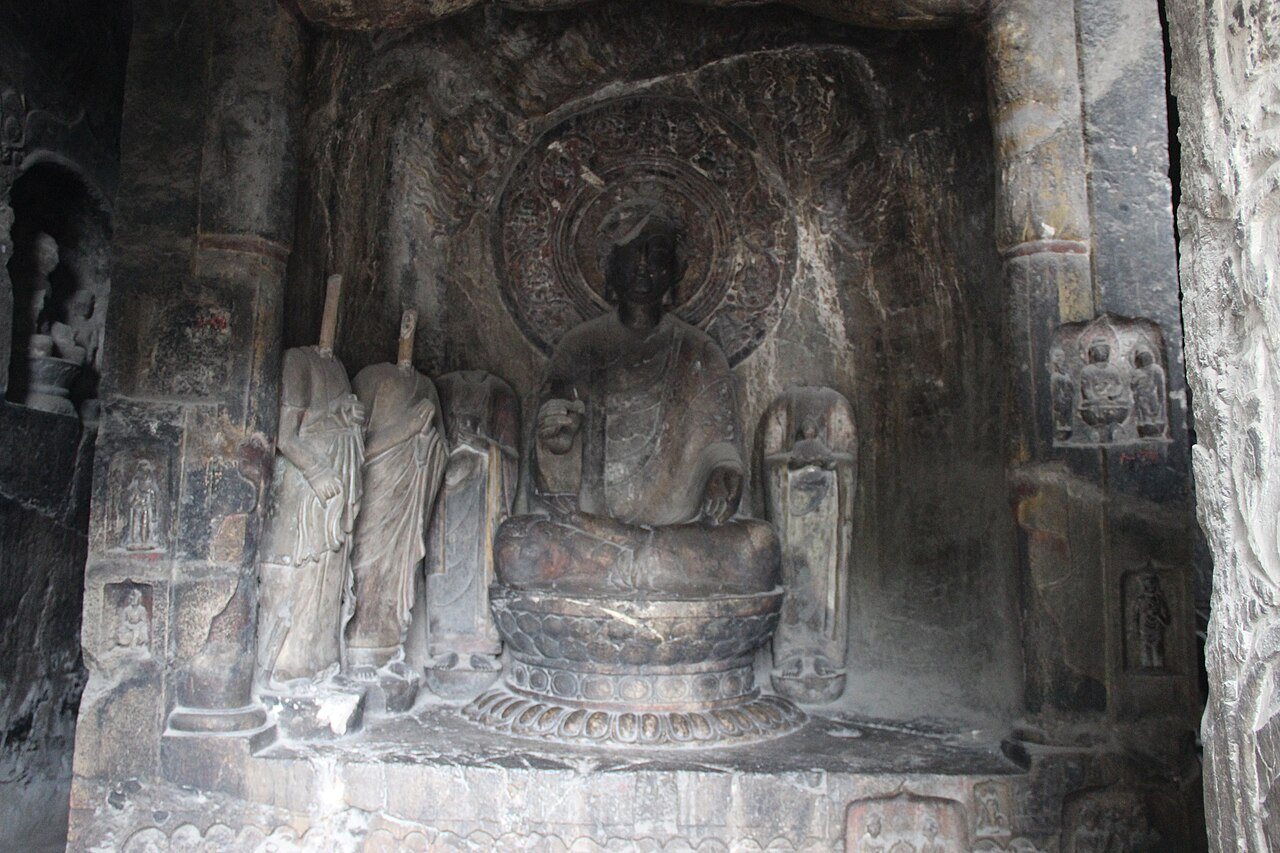
The northern group is the grandest. Its North Cave, also called the Great Buddha Cave, is the largest and usually considered the earliest, with a huge central pillar carved with a main Buddha on three sides and surrounded by bodhisattvas, guardian kings, flying figures and stupa-shaped niches. The Middle Cave also has a central pillar, and the South Cave is a hall-style cave with niches in three walls.
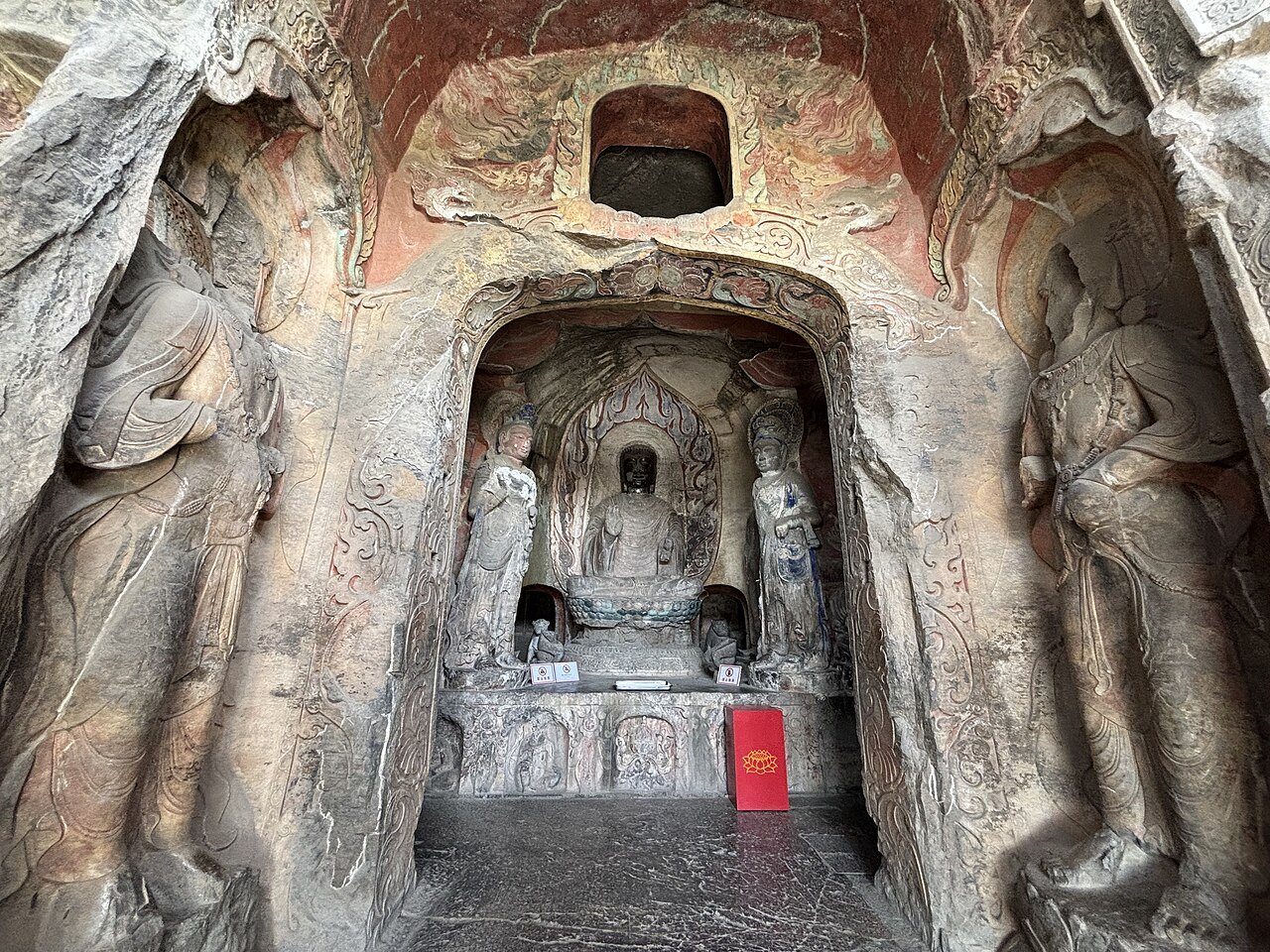
The southern group began later. A stele beside Cave 2 records that in 565 the monk Huiyi of Linghua Temple started work on what was then called the Fushan caves, and the high official Gao Anagong funded an expansion. The seven main caves sit on two levels, with central-pillar caves below and three-niche halls above. Cave 1 has a central pillar, upper wall niches and the Avatamsaka Sutra carved below, along with scenes of Amitabha's western Pure Land. By 593 a stele already used the name Xiangtang Temple.
Sutras in stone
Xiangtangshan is also one of the earliest large sites for Buddhist texts carved on rock in northern China. A stele records that the Northern Qi official Tang Yong began carving sutras here in 568 and finished in 572, explaining that paper, bamboo and silk decay while stone lasts. The South Cave of the northern group and several southern caves carry long passages, including the Vimalakirti, Lotus and Avatamsaka sutras. The square, heavy script is studied by calligraphers as well as historians.
Looting and digital reunion
From around 1910 dealers and looters cut heads, hands, statues and relief panels from the walls and sold them abroad. Many pieces are now in museums such as the Freer Gallery in Washington, the Metropolitan Museum of Art, the Penn Museum, the Victoria and Albert Museum and the Miho Museum. After the thefts, locals replaced some missing heads with new carvings and clay, so some figures today combine Northern Qi stone with twentieth-century repairs.
Starting in 2005 the University of Chicago's Xiangtangshan project scanned more than 80 scattered sculptures held in 22 collections and matched them digitally to their original places, which led to the book and touring exhibition Echoes of the Past. Peking University teams have scanned the North and South caves, and the local museum at Fengfeng uses 3D printing and digital displays to show some of the lost pieces back in context.
Visiting
The northern group is the main scenic area, and the southern group is a separate site about 15 kilometres away that needs little climbing. Ticket prices, combined tickets and opening hours vary between sources and seasons, so check the day's notice or the scenic area's official account before you go. A car or taxi from Handan is the easiest way to link both groups in one day.
Allow two hours for the northern caves, which involve stairs up the slope, and an hour for the southern group. Caves are dim, so a small torch helps, but follow any rules on photography. Spend another day at Guangfu Ancient City northeast of Handan, and see the Handan travel guide for the city itself.
Before you go
- Wear shoes with grip for the stone steps at the northern group.
- Bring a light layer, as caves are cool even in summer.
- Read a little about Northern Qi art first to get more from the damaged figures.
Frequently asked questions
Which group should I see if I only have time for one?
The northern group, for the scale of the North Cave and its imperial patronage. The southern group is smaller but easier to reach on foot.
Why are so many heads missing?
Most were cut off and sold abroad in the early twentieth century. Some are now on display in museums in the United States, Britain and Japan.
How far is it from Handan?
The caves are in Fengfeng Mining District, southwest of the city. Plan on most of a day for both groups with a car.
Sources
Facts in this article were checked against the following sources, retrieved 18 October 2026.
- Xiangtangshan Caves, English Wikipedia
- Xiangtangshan Grottoes, Chinese Wikipedia
- Xiangtangshan Caves Project, University of Chicago Center for the Art of East Asia
- Handan travel guide on this site
Photos are from Wikimedia Commons under the licences shown in each caption.