Shanhaiguan Pass, the First Pass Under Heaven
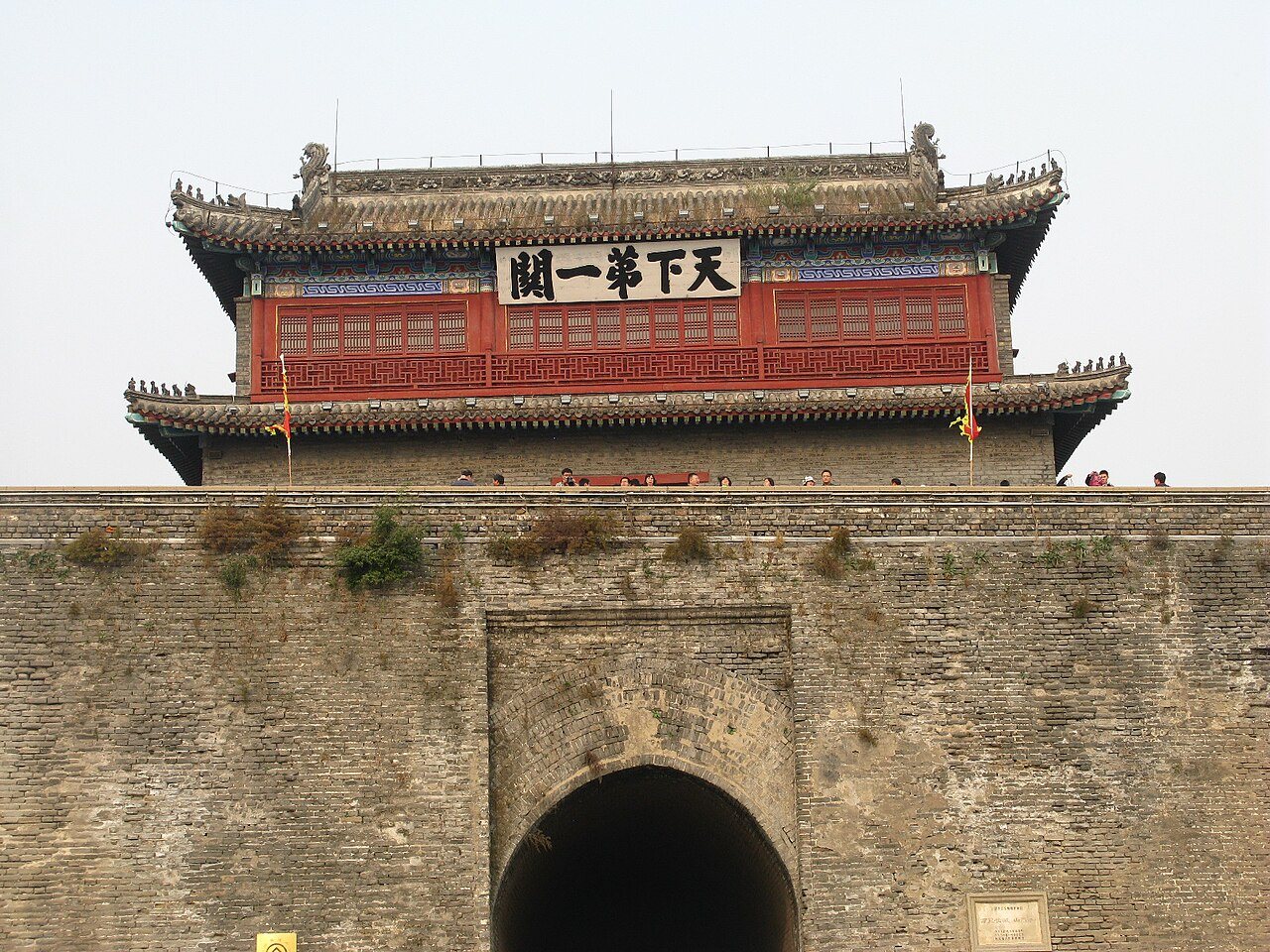
Shanhaiguan sits where the Yan Mountains come closest to the Bohai Sea, at the eastern edge of Qinhuangdao. Between the hills and the shore there is only a narrow strip of flat ground, about 7.5 kilometres wide by Chinese accounts, and for most of Chinese history anyone travelling overland between the North China Plain and the northeast had to cross it. The Ming built the present fortress in 1381. The gate tower on its east wall carries the five-character plaque that gives the place its nickname, Tianxia Diyi Guan, the First Pass Under Heaven. From there the wall runs south for a few kilometres to the sea at Old Dragon Head, and most visitors see both on the same day.
Why a pass was built here
Chinese sources trace walls and garrisons at this choke point back to the Warring States period, and later dynasties kept posts here under names such as Linyu and Yuguan. In 1381 the general Xu Da rebuilt the defences on the site of the Yuan settlement of Qianmin and named the new pass for its setting between mountain and sea. It was the easternmost pass of the Ming wall on the road to Beijing, so people began calling it the first pass under heaven. The land beyond it became known simply as guanwai, outside the pass.
The fortress grew as threats from the northeast grew. In the late sixteenth century Qi Jiguang, the general better known for fighting coastal pirates, added watchtowers along this sector, and in 1579 a stone wall was pushed out into the sea. The East Luo City, an outer enclosure in front of the east gate, followed in 1584. After the rise of the Later Jin in Liaodong, the Ming added two wing forts north and south of the town, a coastal fort at Ninghai and a lookout fort on Huanxi Ridge east of the gate.
The pass mattered most in 1644. When Li Zicheng's rebel army took Beijing, the Ming commander Wu Sangui, who held this sector, turned to the Manchu regent Dorgon. Their combined forces defeated Li's army near the pass, and the Qing marched into Beijing. After that the fortress lost its frontier role. Under the Qing the pass was opened and closed in turn as policy on settlement in the northeast changed, and the stream of northern farmers who went anyway gave rise to the phrase chuang Guandong, braving the pass to the east.
The Zhendong Gate and the plaque
The east gate tower, Zhendong Lou, is the building most people come to see. It is a two-storey arrow tower on a high brick platform, with rows of arrow windows facing out to the north, east and south. The plaque hangs under the eaves on the side facing into the town. It has been copied more than once. Chinese records describe a copy made in 1879 when the old characters had worn away and another hung in 1920, with the older boards moved inside the tower.
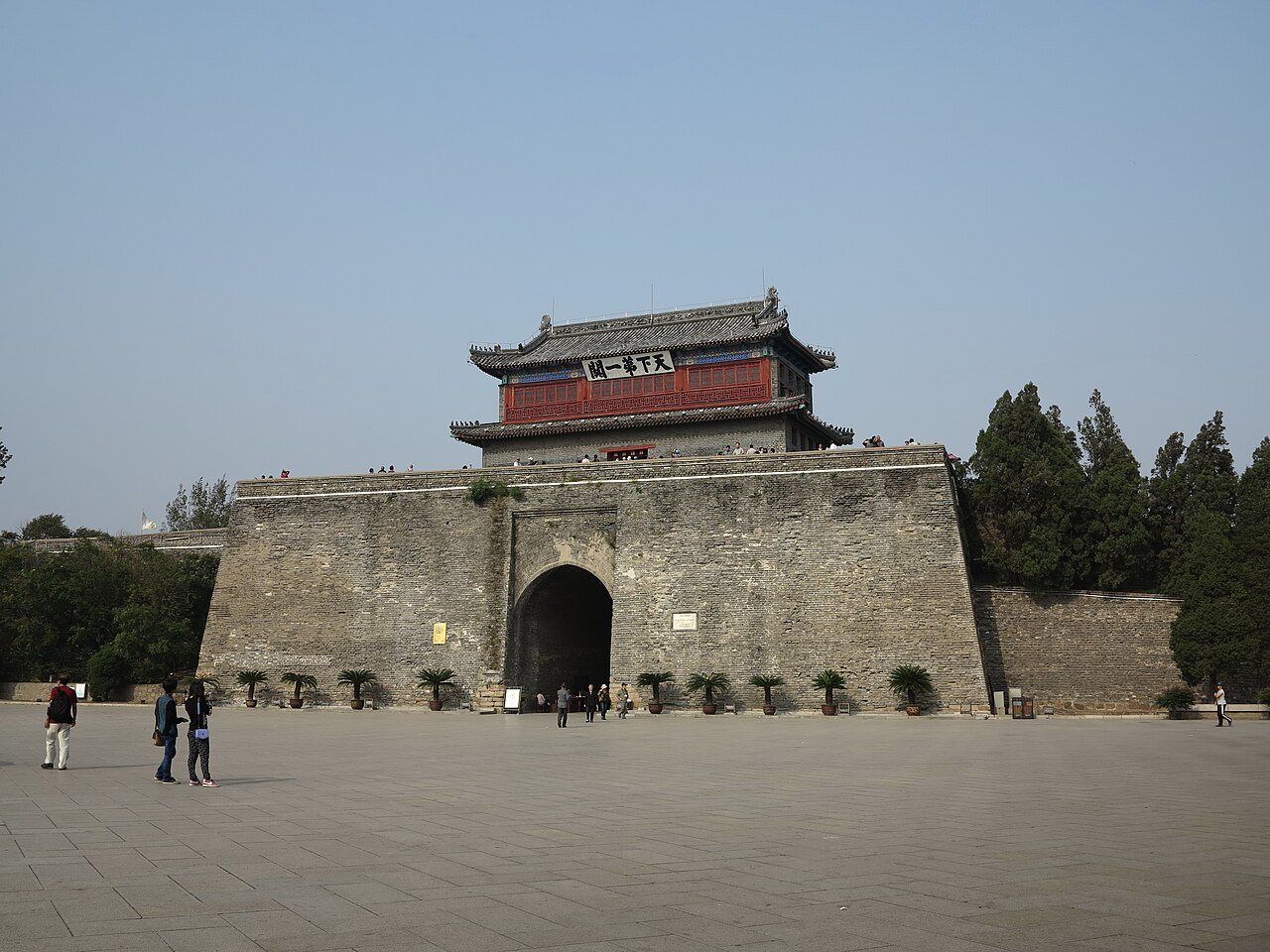
A barbican still encloses the approach to the east gate, and the brick wall on either side is the main line of the Great Wall itself. The east wall runs for about 1.4 kilometres and joins the wall heading north toward Jiao Shan and south toward the sea. Walking the top of this section shows clearly how the town and the Great Wall were planned as one work.
The walled town today
The pass town covers about 1.26 square kilometres. Its walls stand around 11.6 metres high and run almost 4.8 kilometres round, with stone footings, a rammed earth core and brick facing. Two main streets cross in the middle at the drum tower and link the four gates. Only parts of the old circuit keep their towers. The west gate tower was pulled down in 1952 and the old drum tower in 1953, and the present drum tower is a reconstruction finished in 2005. A long repair programme on the walls and landmark buildings ran from 2003 to 2008.
Inside the walls the lanes mix restored courtyard houses, snack stalls and ordinary homes. An hour of wandering here after the gate is pleasant, though the historic interest is concentrated along the east wall. The scenic area has had an uneven record. It was named one of China's first 5A sites in 2007, lost the rating in 2015 after inspectors criticised overcharging and poor upkeep, and regained it in December 2017.
Visit order
Start at the east gate, climb onto the wall and walk the stretch around Zhendong Lou while the light is low and tour groups are few. Drift back through the lanes for lunch. In the afternoon take a taxi or bus south to Old Dragon Head, where the wall ends in the sea. With a second day you can add Jiao Shan, where the wall climbs the first steep ridge north of town, or the Mengjiangnü Temple, both counted as parts of the wider Shanhaiguan scenic area.
The Qinhuangdao guide explains how to split time between this wall-and-sea end of the city and the beach resort of Beidaihe, a separate drive to the southwest.
Tickets, hours and getting there
Ticket prices and opening times for the gate, the wall walk and combined tickets with Old Dragon Head change with the season and are set by the scenic area, so check the day's notice at the gate or on the official booking channel. Carry your passport or ID, which many Chinese sights now ask for at purchase.
Shanhaiguan railway station on the Beijing to Harbin line lies about a kilometre south of the gate, so arriving by conventional train puts you within walking distance. Some faster trains stop here too, while others end at Qinhuangdao station, so check the station printed on your ticket. From central Qinhuangdao, buses and taxis reach the pass in well under an hour.
Before you go
- Spring and autumn are the comfortable seasons. Summer weekends bring beach crowds, and winter wind on the wall is harsh.
- Wear shoes with grip for the ramps up to the wall.
- Pair the gate with Old Dragon Head on the same day.
- Read the Qinhuangdao travel guide for the full three-day route.
Frequently asked questions
Is Shanhaiguan the end of the Great Wall?
It is the eastern end of the main Ming line guarding the approach to Beijing, and the wall meets the sea at Old Dragon Head a few kilometres south. Ming defences also reached into Liaoning, so some Chinese sources place the very end further northeast.
How long does a visit take?
Two to three hours covers the gate, the wall walk and the main street. Add half a day for Old Dragon Head.
Is the plaque original?
The board on show is a later copy. Records describe replacements in 1879 and 1920 after the characters wore away.
Can I visit from Beijing in a day?
It is possible by train, but the round trip eats most of the day. A night in Qinhuangdao makes the gate and the sea end far less rushed.
Sources
Facts in this article were checked against the following sources, retrieved 18 October 2026.
- Shanhai Pass, English Wikipedia
- Shanhaiguan, Chinese Wikipedia
- Old Dragon Head, Chinese Wikipedia
- Qinhuangdao travel guide on this site
Photos are from Wikimedia Commons under the licences shown in each caption.