Tangshan Earthquake Memorial Park
At 3:42 in the morning on 28 July 1976 an earthquake of moment magnitude 7.6 struck directly beneath Tangshan. The fault ran under the city centre. Within minutes about 85 percent of buildings had collapsed or become unusable, and the official death toll was 242,469. Historians generally accept a higher figure. The Tangshan Earthquake Ruins Memorial Park, on the eastern side of the city's Nanhu area, is where the city remembers the dead by name.
How the park was made
The park was built on the ruins of the steel-casting workshop of the Tangshan Locomotive and Rolling Stock Works. Construction started in April 2008, and the first sections opened that July, in time for the anniversary. Chinese Wikipedia gives the area as about 40 hectares, divided into a ruins zone, a memorial water zone, a memorial forest and a memorial plaza. The twisted remains of the factory are a national key cultural relic.
The park replaced an earlier attempt that went badly. Between 2004 and 2006 a private company built a name wall near Nanhu Park and charged families to have a victim's name carved, with different prices for the front and back faces. Critics called it commemoration for money. In 2006 the city planning bureau ruled the wall an illegal structure and ordered it demolished. The present wall was built at the new site from 2008, with the list of names compiled by the city and a public search service.
The memorial wall
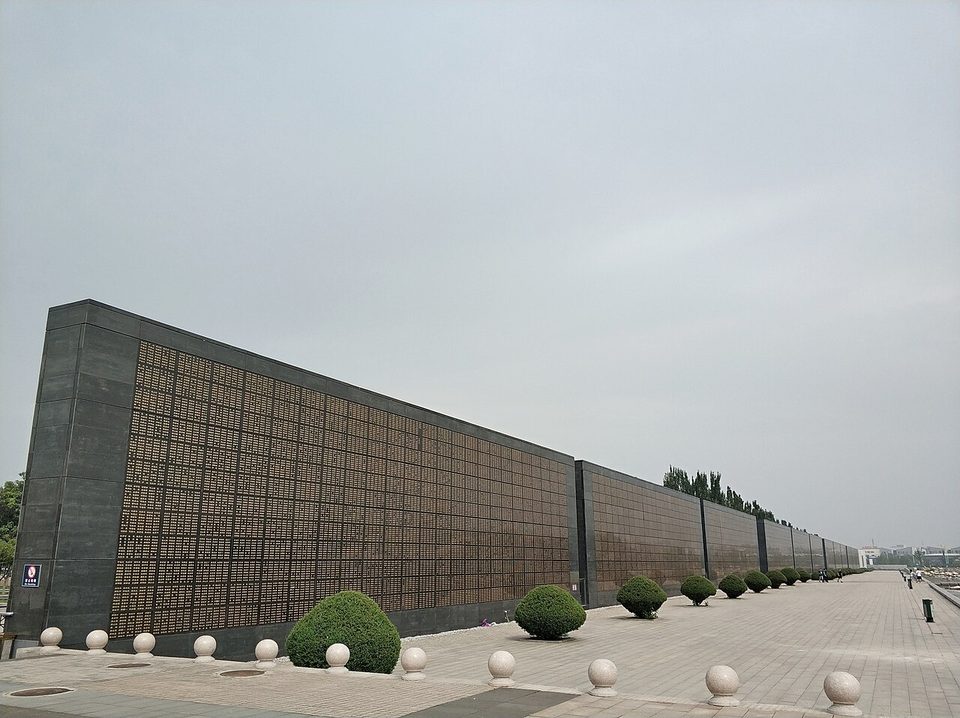
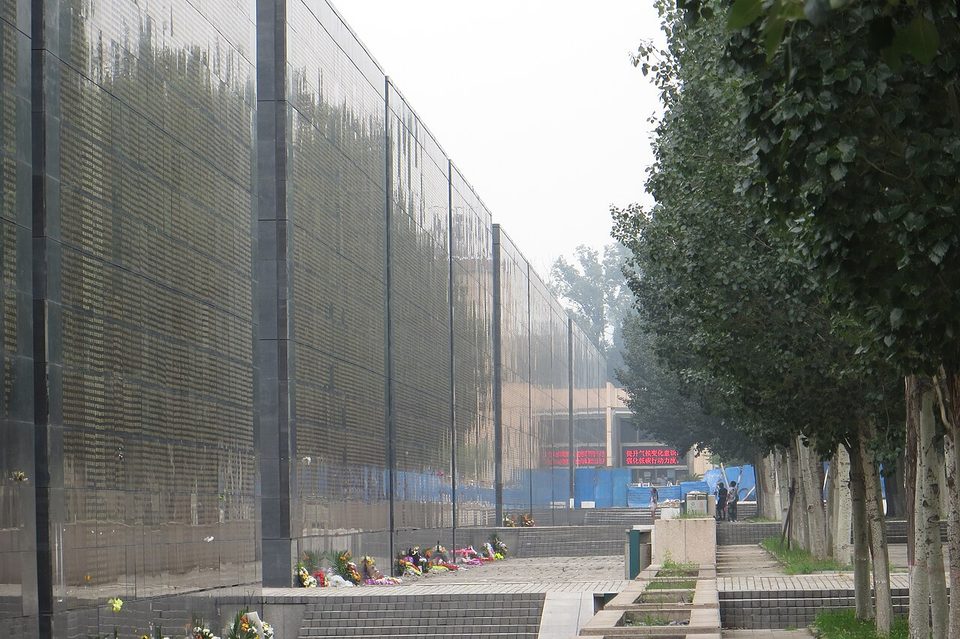
The wall is the centre of the park. It is made of 13 panels in five groups set in a single straight line, and each panel is 7.28 metres high, for the date of the earthquake, 7/28. The names of about 240,000 victims are carved into the dark stone. A memorial pool of 30,000 square metres lies to the south, its edge placed 19.76 metres from the wall, for the year. A memorial forest of 14 hectares fills the land to the north. English Wikipedia describes the wall as almost 300 metres long.
The engraving was led by Meng Qingjiang, a Tangshan calligrapher and seal carver born in 1968. The wall draws relatives on the anniversary each July, and the park can be crowded and emotional around that date.
The museum and the 2026 renovation
The China Tangshan Earthquake Museum stands west of the wall. Its memorial exhibition is underground and covers the earthquake, the rescue and the rebuilding of the city. A separate science section covers how earthquakes work, monitoring, disaster prevention and rescue, with simulation theatres and a training classroom.
The park closed for several months of works in 2026. Its management centre announced a trial reopening of the grounds from 1 July 2026, open 7:00 to 19:00 with no booking, while the museum was still being fitted out. The memorial exhibition hall followed on 26 July 2026, open Tuesday to Sunday from 9:00 to 17:00 with last entry at 16:30 in summer, free and without booking. The notice warned of queues at busy times. It did not say when the science section would reopen, so check before you go if that part matters to you.
The other memorial in town
Visitors often confuse the park with the Tangshan Anti-Earthquake Memorial Hall at 102 Xinhua East Road, beside the earthquake monument square in the city centre. That hall opened in 1986 as an archive display for the tenth anniversary and was enlarged in 1996 to about 5,380 square metres. Its permanent exhibition, Heroic City, Heroic People, is free with a ticket collected using ID, and the hall closes on Mondays except public holidays. It is the shorter visit and focuses on rescue and reconstruction. The ruins park is the place for the names and the factory remains.
A respectful visit
The wall lists real people, and relatives still come to find them. Keep voices low near the wall and do not climb on the ruins. Photograph the wall from a distance when families are searching for names. A quiet walk around Nanhu afterwards makes a natural pause before the rest of the day.
Tickets, hours and getting there
Both the park and the memorial exhibition were free and booking-free in the 2026 notices. Hours can change on anniversaries and holidays, so check the park's official account on the day.
The park is at 19 Yuegezhuang Road in Lunan District. City buses You 1, 44, 47 and 64 stop at Dizhen Yizhi Gongyuan, a two-minute walk from the gate, according to local transit listings. Tangshan's stations are on the Beijing to Shenyang and coastal Hebei corridors, and taxis run from both to the park.
Before you go
- Allow two to three hours for the wall, ruins and museum.
- Expect the museum to close on Mondays.
- Visit the city-centre memorial hall separately if you want both.
- Pair a second day with the Eastern Qing Tombs in Zunhua.
Frequently asked questions
Is the park free?
The 2026 notices described the grounds and the museum's memorial exhibition as free with no booking.
How many names are on the wall?
About 240,000, according to Chinese Wikipedia.
Which memorial should I choose with only an hour?
The city-centre memorial hall is compact. With more time, choose the ruins park.
Is it suitable for children?
It is a memorial to mass death, and parents should judge for their own children. The city-centre memorial hall has long been a designated education base for schools.
Sources
Facts in this article were checked against the following sources, retrieved 20 October 2026.
- 1976 Tangshan earthquake, English Wikipedia
- 唐山地震遗址纪念公园, Chinese Wikipedia
- Tangshan Earthquake Memorial Park, English Wikipedia
- 唐山抗震纪念馆, Chinese Wikipedia
- Trial reopening notice for the park, July 2026 (via Tangshan Bendibao)
- Trial reopening notice for the museum's memorial hall, July 2026
- Tangshan travel guide on this site
Photos are from Wikimedia Commons under the licences shown in each caption.