Kaiyuan Temple, Xingtai
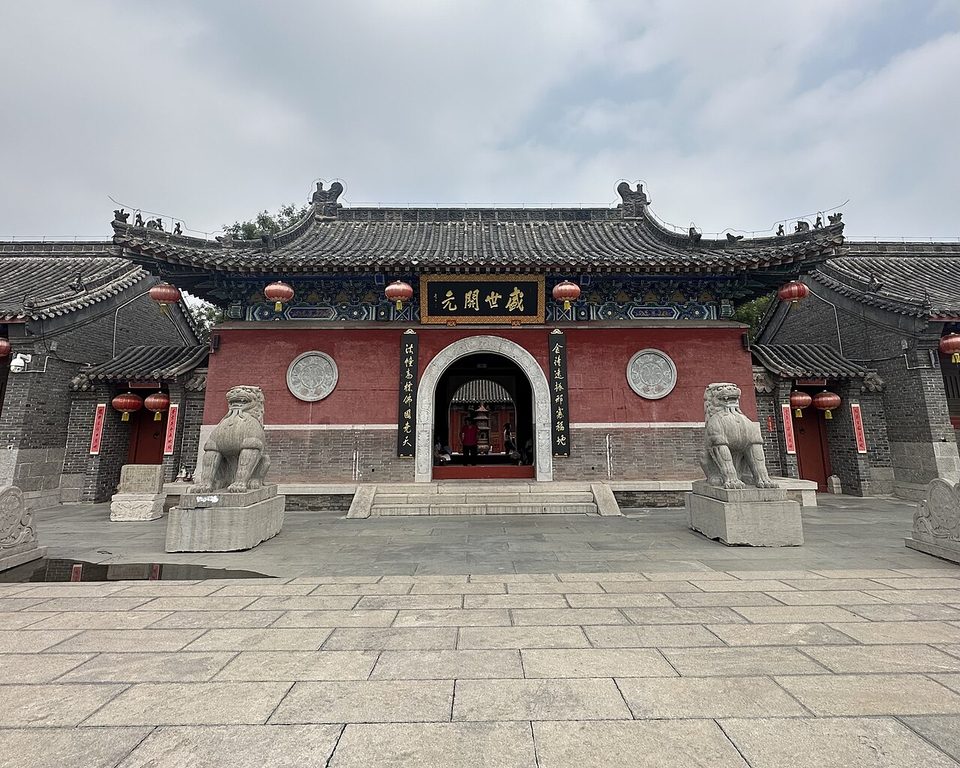
Kaiyuan Temple stands in Xiangdu District, in the old centre of Xingtai, and locals also call it the Dong Da Si, the Great East Temple. It is a national key cultural relic, listed in 2006, and its story runs from the fourth century to a shoe factory in the twentieth. The site now has two parts. The old temple on the west side keeps the Ming and Qing halls and the stone relics. The new Da Kaiyuan Temple on the east side is a modern building that followed the temple's revival in 2006, and it is the working monastery. The two make a compact half day in the city.
Origins
Xingtai was Xiangguo, capital of the Later Zhao state founded by Shi Le, and the monk Fotudeng spread Buddhism through that kingdom. In 2002 a stone lotus base carved with an inscription was dug up southeast of the main hall. The stone had started as a stele honouring Shi Le's mother, from around 313. When Ran Min sacked the city in 351 the stele was broken, and a later temple on the same ground recut the pieces into a lotus base. Chinese Wikipedia, drawing on a temple epigraphy study, suggests the Later Zhao "Middle Temple" stood here.
Other accounts trace the temple to a Sui foundation called Fan'ai Si, which received relics under Emperor Wen's pagoda campaign of 601 to 604. Empress Wu renamed it Dayun Si in 690, and Emperor Xuanzong turned the major prefectural Dayun temples into Kaiyuan temples in 738, giving the name it still carries.
The Yuan high point
War in the Jin dynasty burned the temple's great pagoda. In 1231 the Yuan general Shi Tianze invited the monk Wan'an Guang'en to lead the temple, and over nine years he rebuilt the pagoda and ordained more than a thousand monks. A school called the Da Kaiyuan sect formed around him and was placed under direct court control. Kublai Khan held a great precepts assembly here in 1276 and later visited twice more. Chinese Wikipedia describes the temple in that period as a royal monastery, spread over an area about 500 metres east to west.
The fall was quick. At the end of the Yuan a local commander killed monks and burned the wooden pagoda to seize temple property for his troops, and in 1463 a magistrate took building materials from the temple to build a Confucian school.
Ming rebuilding and later damage
Monks rebuilt from 1488 over more than forty years, and the plan that survives today took shape between then and the 1630 repair of the mountain gate. In 1518 the front columns of the main hall were replaced with stone pillars carved in high relief with coiling dragons. Repairs went on through the Qing.
The twentieth century was harder. In 1935 the architect Liang Sicheng surveyed the Wan'an pagoda, and the drawings went into his history of Chinese architecture. In 1945 an Eighth Route Army uniform workshop moved into the halls, and from 1947 the site was a shoe factory, later the Xingtai Shoe Factory. During the Cultural Revolution the Wan'an pagoda was blown up and many Yuan steles were lost. Factory workers coated the carved stone columns of the Bodhisattva Hall with mud plaster, which protected them. The factory moved out in 1997, and the halls were repaired in the late 1980s and 1990s.
What to look for
The old temple's axis runs through the mountain gate, the Heavenly Kings Hall, the Vairocana Hall, the Guanyin Hall and the main hall. The Vairocana Hall burned in 1988 and was rebuilt in 1997, so its timber is recent.
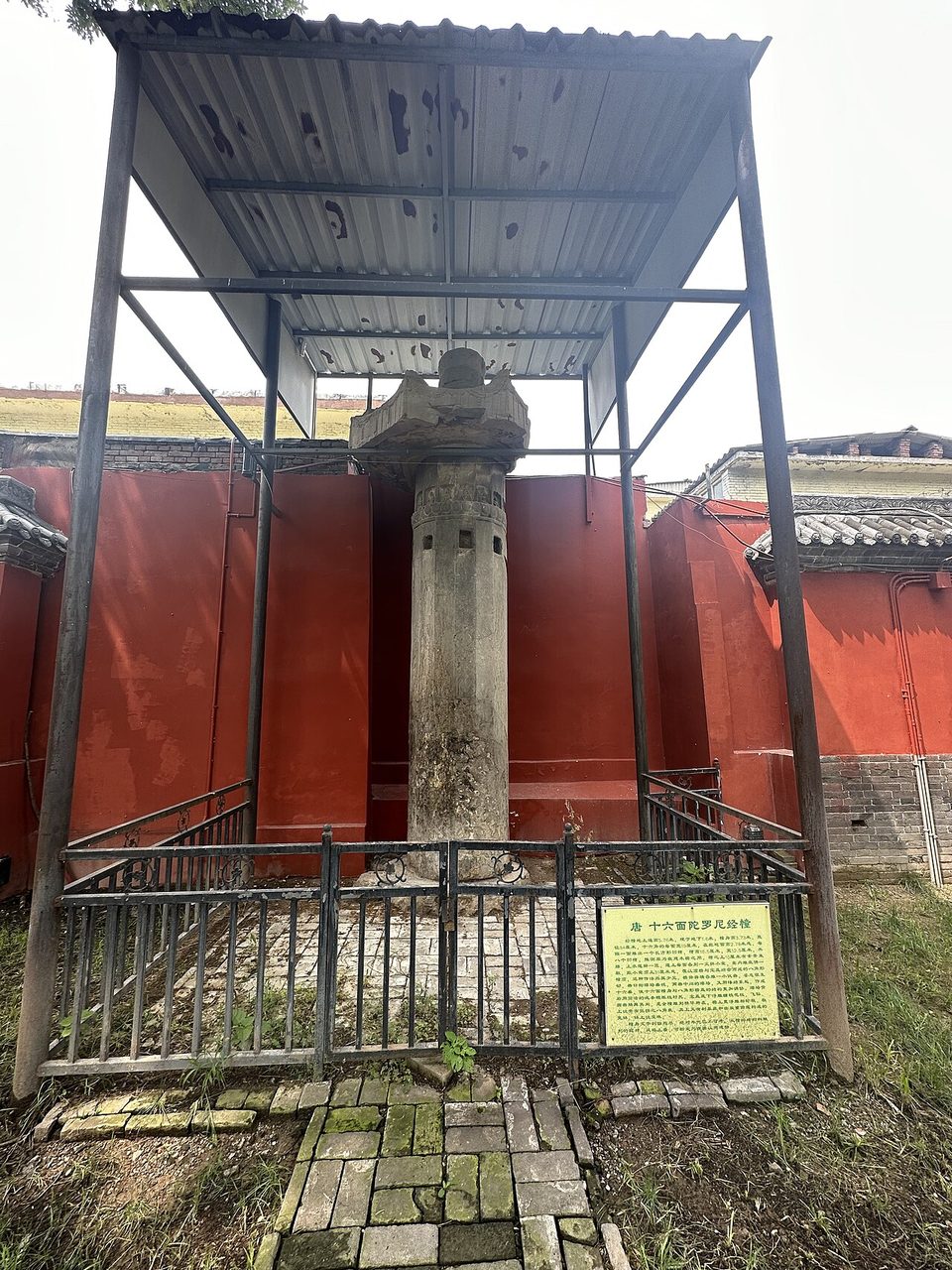
The temple's three treasures are stone and metal. A sixteen-sided Tang dharani pillar, set up in 770 or 782, still stands over five metres tall in sandstone, though its upper canopy was lost in the Cultural Revolution. A second pillar from 915, in the Later Liang, survives in two tiers and was moved into the temple in 1994. The great iron bell was cast in 1184 under the Jin. It is 3.2 metres high and about 9.1 tonnes. It spent 1977 to 2004 in Dahuoquan Park before coming home.
The new Da Kaiyuan Temple to the east is 100 metres wide and 300 metres deep, laid out as a five-courtyard monastery with an archway, gate and a run of large new halls. It is an active monastery. The old temple is where the history is.
Tickets, hours and getting there
A 2023 reopening notice for the old temple gave hours of Tuesday to Sunday with a midday break and Monday closure, with entry after registering ID. The new temple has its own hours. This page quotes no prices. Check the temple's notice on the day.
The temple is in the old city, a short taxi ride from Xingtai station on the Beijing to Guangzhou corridor. The city wall ruins and Dahuoquan Park, both in the city guide, can fill the rest of the day.
Before you go
- Allow two hours for both parts.
- Look for the dragon columns, the Tang pillar and the iron bell.
- Dress modestly in the active monastery.
- Keep a separate day for the Taihang canyons west of the city. The Xingtai travel guide covers them.
Frequently asked questions
Which part is old?
The western complex. The eastern Da Kaiyuan Temple is modern construction from the revival that began in 2006.
Is there a pagoda?
Not any more. The Wan'an pagoda was destroyed in the Cultural Revolution.
Is it worth a stop between Handan and Shijiazhuang?
Yes, for a half day on the rail corridor. Handan has the Xiangtangshan Grottoes nearby for more Buddhist art.
Are prices listed here?
No. Hours and entry rules follow the temple's notice.
Sources
Facts in this article were checked against the following sources, retrieved 20 October 2026.
- 开元寺 (邢台市), Chinese Wikipedia
- Xingtai, English Wikipedia
- Kaiyuan Temple cultural relics office reopening notice, 2023 (via Sohu)
- Xingtai travel guide on this site
Photos are from Wikimedia Commons under the licences shown in each caption.