Dajingmen, Zhangjiakou's Border Gate on the Great Wall
Dajingmen sits at the north edge of Zhangjiakou, where the Qingping River valley opens toward the highland country beyond the outer Great Wall. Chinese lists often group it with Shanhaiguan, Jiayuguan and Juyongguan as one of four major passes, and it is the only one whose name ends in "men", gate. The present brick gate rose in 1644, the first year of the Shunzhi reign. Most visitors climb the terrace, read the four-character plaque and walk a short stretch of wall before returning to the city or continuing toward Chongli.
Why the gate sits here
Zhangjiakou has long been called a northern gate of Beijing. From the late Ming, the plain just outside the wall at Yuanbaoshan became a tribute and barter market. Mongol and Central Asian herds, furs, medicinal roots and silverware changed hands for silk, tea, porcelain and sugar. Under the Qing the corridor remained a staging point for merchants who traded with Mongolia. The name of the gate itself points to a border threshold. "Jing" here means the frontier zone, so Dajingmen is the large gate of that border.
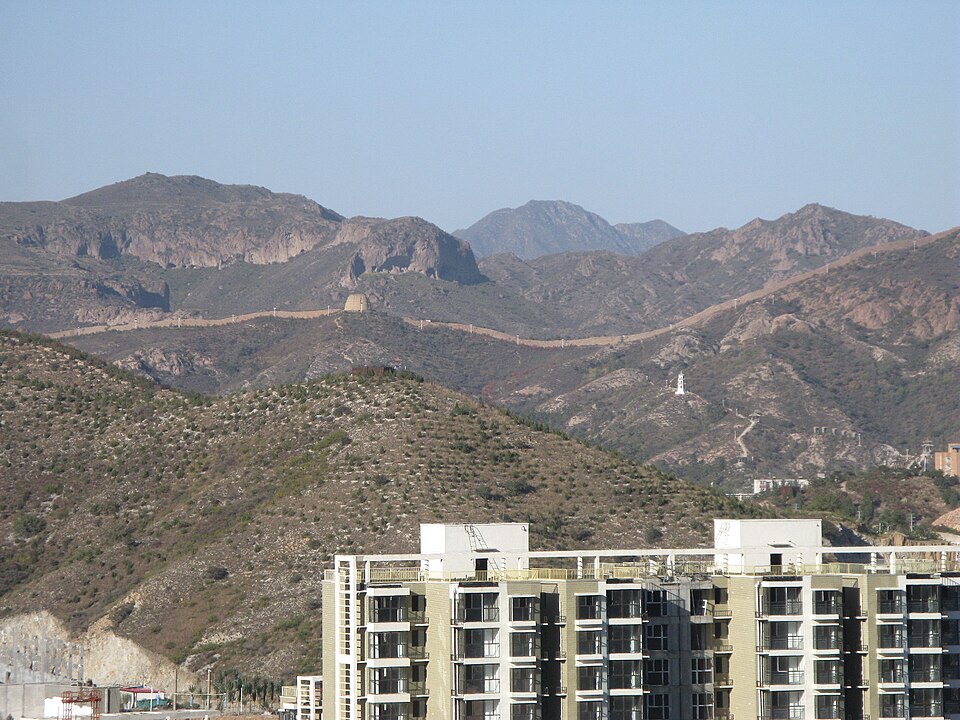
The Ming wall already controlled the ridge. The Qing rebuilt this opening as a formal gate in 1644. The brickwork stands about 12 metres high, 9 metres wide and 13 metres deep. The platform above measures roughly 12 by 7.5 metres, with outer battlements about 1.7 metres and an inner parapet about 0.8 metres. Just west of the gate a short brick-faced stretch runs across the flat ground, then the wall climbs into hard rock on the slopes of West Taiping Mountain. East across the Qingshui River, East Taiping Mountain continues the highland frame.
The plaque and the climb
In 1927 Gao Weiyue, then military governor of Chahar, had four large characters set above the lintel in Yan-style calligraphy. They read Da Hao He Shan, often rendered as Magnificent Rivers and Mountains. The plaque faces people entering from the city side and has become the signature photograph of the site. Climb onto the terrace for the view back over the urban valley and forward toward the ridges. Shoes with grip help on the brick ramps.
How long a visit takes
Plan one to two hours for the gate, the plaque and a short wall walk. That is enough for most travellers who are using Zhangjiakou as a rail hub toward Chongli or Bashang. If you want longer ridge walking, ask locally which sections of wall west of the gate are open and safe on the day. Do not treat Dajingmen as a substitute for a full mountain day in Chongli. The gate is an urban culture stop. Chongli is a separate lodging and trail logic.
Tickets, hours and getting there
Ticket prices and opening times for the gate and any paid wall walks change with season and local notice, so check the day's board or the official booking channel. Carry passport or Chinese ID for purchase where required.
High-speed trains from Beijing North reach Zhangjiakou station. From the urban core, taxis and local buses cover the north-edge gate in a short ride. If you lodge in Chongli near Taizicheng, treat Dajingmen as a morning or late-afternoon add-on on arrival or departure days. Avoid a rushed evening after a full ski day. The Zhangjiakou travel guide explains how to split Chongli resorts, this pass and the Bashang sky-road plateau.
Visit order with Chongli and Bashang
Arrive by rail, leave bags at a city hotel, then walk the gate while light is soft. Eat in the city. Next morning go to Chongli for ski or trail days. Keep Bashang grassland and sky-road driving for a clear plateau morning with fuel and wind layers. Stacking the gate, a full Chongli day and Zhangbei sunset into one exhausted evening usually fails.
Before you go
- Spring and autumn suit wall photos. Winter wind on the terrace is harsh.
- Pair the gate with Chongli on a multi-day Zhangjiakou trip.
- Confirm last buses or taxi buffers if you lodge far from the station.
- Read the Zhangjiakou travel guide for the full three-day frame.
Frequently asked questions
Is Dajingmen a Ming gate?
The wall line is Ming in origin. The present gate structure dates to 1644 under the early Qing.
How does it compare with Shanhaiguan?
Shanhaiguan guards the narrow strip between mountains and Bohai Sea at Qinhuangdao. Dajingmen sits on the highland approach northwest of Beijing and grew as a trade and garrison gate. Both matter as Great Wall junctions, in different landscapes.
Can I visit from Beijing in a day?
A day trip can cover the gate alone by high-speed rail, yet the round trip consumes most of the daylight. A night in Zhangjiakou or Chongli makes more sense if mountain time matters.
Is the plaque original to 1644?
No. The four characters were mounted in 1927 under Gao Weiyue.
Sources
Facts in this article were checked against the following sources, retrieved 19 October 2026.
- Dajingmen, English Wikipedia
- 大境门, Chinese Wikipedia
- Zhangjiakou, English Wikipedia
- Zhangjiakou travel guide on this site
Photos are from Wikimedia Commons under the licences shown in each caption.