Anshan Travel Guide: Qianshan Mountain, the Jade Buddha and Tanggangzi
Anshan, about 90 kilometres south of Shenyang, is one of China's great steel cities, the home of the Angang works. Most travellers stop for Qianshan, the "Thousand Lotus Mountains" about 18 kilometres southeast of the centre, a granite park where Buddhist and Taoist temples share the same peaks. Spend a full day there. A few hours at the Jade Buddha Temple, which houses a Buddha carved from one 260-tonne block of Xiuyan jade, fill the rest of a visit, and Tanggangzi's hot springs make a good end to a mountain day. Two days is enough for all three.
Steel and stone
Anshan takes its name from a saddle-shaped hill south of town. Iron has been worked here for two thousand years, but the modern city grew up after 1918 around Japanese-run ironworks beside the South Manchuria Railway, later the Showa Steel Works. Rebuilt after 1948 as Anshan Iron and Steel, it became the largest steel producer in the early People's Republic, and the city's nickname is still "the steel capital". The surrounding hills are full of minerals too: magnesite, talc and, in Xiuyan county, jade. You will see the industry from the train. The sights are all on the eastern and southern edges of town.
When to come to Anshan
May to October is the season for Qianshan. Late spring brings blossom on the mountain, summer is warm and green, and late September to October brings the autumn colour that draws local crowds at weekends. Winters are long and cold. Temple visits still work, but steps can be icy, and that is when the hot springs are at their best. Avoid Qianshan on public holidays if you can; the main paths become slow queues.
Getting in and where to stay
Anshan is on the main railway and high-speed line between Shenyang and Dalian, so it is easy to reach from either. A small airport southwest of the city has a handful of domestic routes; Shenyang Taoxian airport is about 90 kilometres north. Buses and taxis run from the city to the Qianshan gates, and private cars are not allowed inside the scenic area.
Stay in the city near the station if you are moving on by train, or at Tanggangzi or near the Qianshan gate if you want an early start on the mountain and a soak at the end of the day.
Places worth visiting
Qianshan
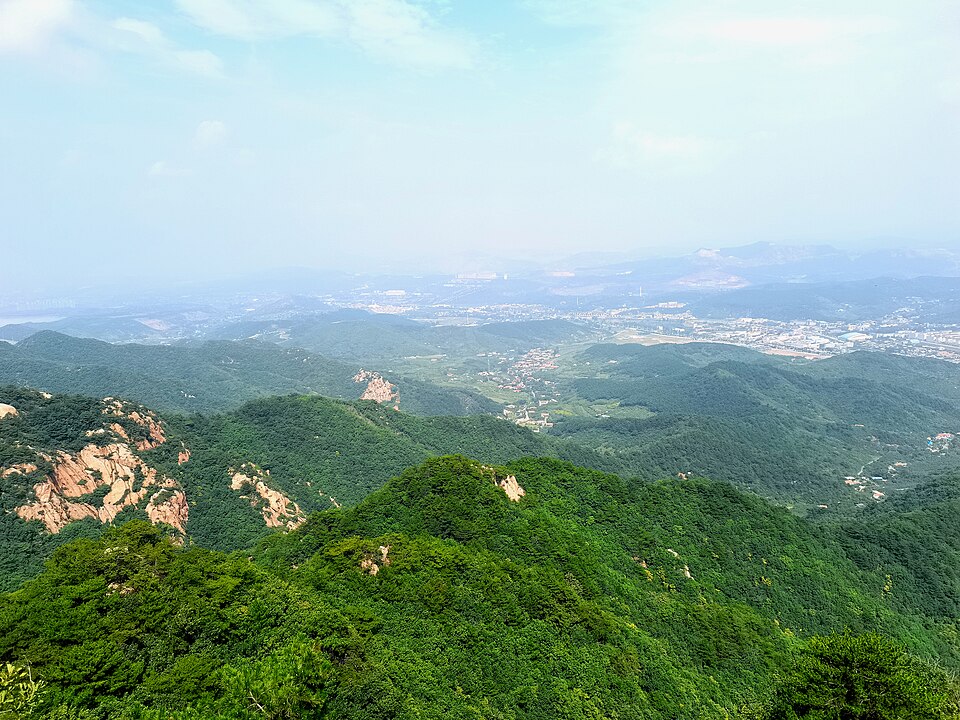
The name is a shortening of "Thousand Lotus Flower Mountains". Legend says the peaks are lotus petals dropped by a goddess. The park covers about 44 square kilometres of granite ridges and pine forest, scattered with Buddhist and Taoist temples, monasteries and nunneries, many of them protected as a national monument group. Few places in China mix the two faiths so closely on one site. Paths are mostly stone steps, steep and narrow in places. Choose a loop that suits your legs and start in the morning. There is shade under the trees, but the bare rock is hot at midday in summer.
The Maitreya peak
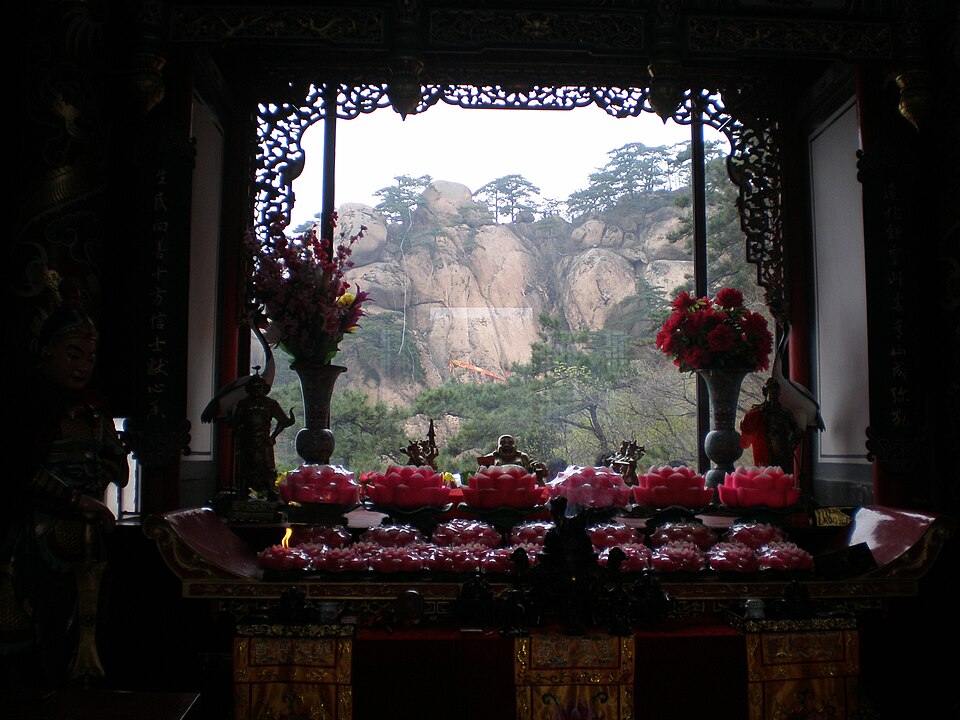
One mountain in the park is said to look like a seated Maitreya, the laughing Buddha, and is promoted as the largest natural Maitreya image in the world. Temples have been built on the surrounding peaks to face it, and there is a viewing area where most visitors stop for the classic photograph. Whether you see the Buddha depends partly on faith and partly on the light. It is clearest in the morning.
Jade Buddha Temple
The Jade Buddha Temple (formerly Jade Buddha Garden) sits on Yufo Mountain, a city park whose summit looks over the steel works. Its main hall, 33 metres high for the 33 heavens of Buddhism, holds a single block of Xiuyan jade found in 1960: 7.95 metres high, 6.88 metres wide and 260.76 tonnes. One side is carved as Sakyamuni Buddha and the other as Guanyin crossing the sea. A team of 120 carvers took 18 months over it, and the complex opened in 1996. In English the stone is properly serpentine, but nobody in Anshan calls it anything but jade. It makes a good rainy-day visit or an afternoon after a morning on Qianshan.
Tanggangzi hot springs
South of the city, Tanggangzi has been a spa since the Russo-Japanese war. In the Manchukuo years it was one of the "three great hot springs of Manchuria", and Puyi stayed here in 1932 while waiting to become head of state. The water comes out of the ground at over 70°C. Today it is a sanatorium and resort area. Expect pools and treatments, not scenery, and check the rules and swimwear requirements before you go.
Shengli Plaza and the city
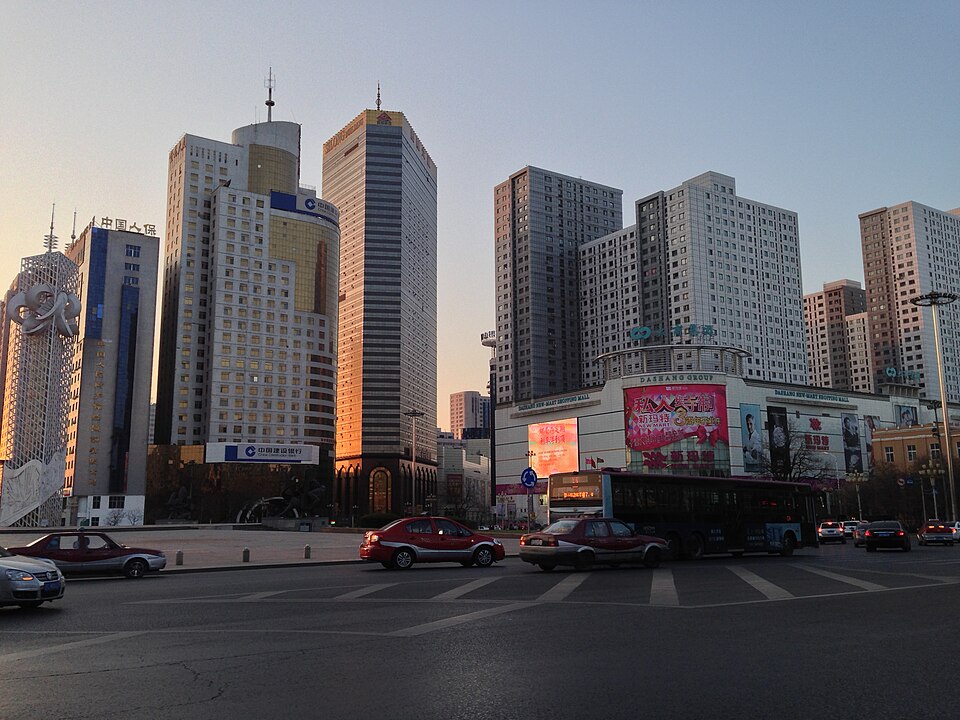
Central Anshan is a planned industrial city of wide streets and cycle lanes. Shengli Plaza gives an idea of its scale; that is enough for most visitors.
Eating in Anshan
The food is northeastern: stews with potatoes and vermicelli, dumplings, sweet-and-sour fried pork and plenty of pickled cabbage. Restaurants near the Qianshan gate are convenient but pricier; eat in the city for better value. In autumn, look for Nanguo pears, Anshan's best-known fruit, sold in markets all over town.
How to arrange the route
- Day 1: Qianshan from opening time, a loop past the Maitreya viewpoint and two or three temple groups, then a soak at Tanggangzi.
- Day 2: the Jade Buddha Temple in the morning, lunch, then a train to Shenyang, Dalian or Dandong.
Neighbours worth combining: Liaoyang, just to the north, for its White Pagoda, and Benxi to the east for the Water Cave, each on its own day.
What to cut if short on time
Keep Qianshan. Drop the city centre first, then the hot springs, then the Jade Buddha. Do not try to add Benxi's caves on the evening of a Qianshan day; they are a separate trip.
Things to confirm before you go
- Qianshan tickets, shuttle and cable car times, and any closed trails.
- The weather; rain makes the steps slippery and fog hides the views.
- Jade Buddha Temple opening hours and entry rules.
- Hot spring hours and booking if you plan to stay at Tanggangzi.
Frequently asked questions
How many days do I need in Anshan?
Two: one for Qianshan and one for the Jade Buddha and the onward journey.
Is Qianshan hard to climb?
It is steep in places, with long flights of steps, but you can choose shorter, gentler loops near the main temples.
Is the Jade Buddha really jade?
It is a single block of Xiuyan stone sold as jade in China; mineralogists class it as serpentine.
Sources
The facts in this article were checked against the following Wikipedia and encyclopedia entries, retrieved September 19, 2026, and rechecked on October 14, 2026.
- Anshan https://en.wikipedia.org/wiki/Anshan
- Jade Buddha Temple, Anshan (Chinese) https://zh.wikipedia.org/wiki/玉佛苑
- Tanggangzi hot spring (Chinese) https://zh.wikipedia.org/wiki/汤岗子温泉株式会社
- Qianshan Scenic Area encyclopedia entries (cross-checked)
Tickets for Qianshan and the Jade Buddha Temple change; check the current notice before you go.
All photos are from Wikimedia Commons, used under CC licenses; re-use requires attribution.
- anshan-qianshan.jpg from File:千山2.jpg, by 红烧腰果, CC BY 4.0
- anshan-qianshan-buddha.jpg from File:Qianshan Maitreya Buddha.jpg, by Yoshi Canopus, CC BY-SA 4.0
- anshan-shengli.jpg from File:View of Anshan on Shengli Plaza.jpg, by techyan, CC BY-SA 3.0