Anshun Travel Guide: Huangguoshu Waterfall, Karst Caves and Ming Garrison Villages
Anshun is the base for Huangguoshu, the best-known waterfall in China, and three days here covers the essentials: a full day at the falls and the Water Curtain Cave behind them, a morning on the underground river of the Dragon Palace, and time for the Ming Confucian Temple and the stone garrison village of Yunshantun. The city sits in west-central Guizhou at about 1,400 metres on the karst of the Yunnan-Guizhou Plateau, and with July averaging 21.9°C it is a summer escape from the heat. Old descriptions called it the belly of Guizhou and the throat of Yunnan. Come in the wet months, July to September, if you want the falls at full strength.
Planning a short Anshun stay
The sights are spread out. Huangguoshu is about 45 kilometres southwest of the city, in Zhenning county; the Dragon Palace is about 27 kilometres south; the Confucian Temple is in town; Yunshantun is out to the east in Qiyanqiao town. Each of the two big scenic areas needs its own ticket and its own block of time, so plan one per day and fit the smaller sights around them.
When to come to Anshun
Anshun has a highland subtropical monsoon climate. The city is a summer refuge. Around Huangguoshu the yearly average is 15.6°C, July 23.2°C, January 5.9°C, with about 1,307 millimeters of rain, almost 90 percent of it from April to October. The falls are fullest in the wet months, especially July to September, when the scenic area also holds a waterfall festival. Winter is milder than northern China but the volume of water drops. Mist and rain are common; a light shell is more useful than a heavy coat.
How to get in and where to stay
Anshun is on the high-speed line between Guiyang and Kunming, a short ride from the provincial capital, and has its own small airport; many visitors fly into Guiyang instead. From the city, tourist buses and taxis run to Huangguoshu and the Dragon Palace; check return times before you set off. Stay in the city centre if you want street food in the evenings, or near Huangguoshu if you want to be at the falls when the gates open and the tour groups have not yet arrived.
Places worth visiting in and around Anshun
Huangguoshu Waterfall
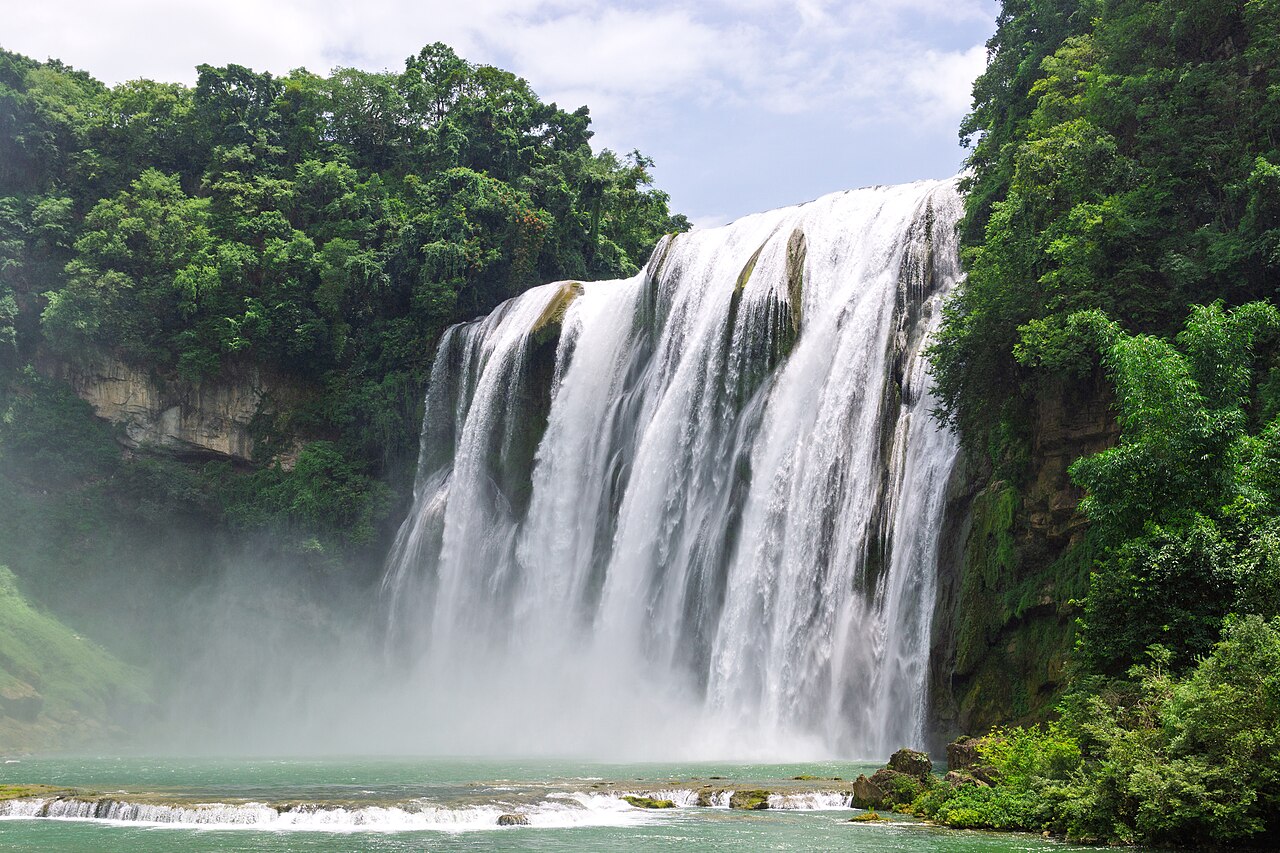
Huangguoshu Waterfall is in Zhenning Buyei and Miao Autonomous County, on the Baishui River, a tributary of the Dabang. It is the largest step in a nine-step cascade. A 2005 survey put the height at 77.8 meters, with a main drop of 67 meters, a width of 101 meters, and a crest 83.3 meters across. The pool at the base, Rhinoceros Pool, sits at 903.9 meters above sea level.
The site is often billed as the first waterfall in Asia. Wikipedia is more careful. By discharge it is smaller than Khone in Laos and China's Hukou on the Yellow River; by width it is smaller than Detian in Guangxi. What it does have is a main fall of real size and a cluster of 18 falls of different character, later listed by Guinness as the largest waterfall group. Xu Xiake passed in 1638 and wrote down the river name Baishui, not the later name Huangguoshu, which grew from a mix-up between the local banyan, huangjue, and a village called Huangguoshu.
The scenic area was among the first national parks in 1982 and among the first 5A sites in May 2007. It was also a filming location for the 1986 television Journey to the West. Water volume swings with the season. In July 2007 the fall reached 690 cubic meters a second. Give it a full day, and check the current ticket and sightseeing-bus price on the official notice before you go.
Water Curtain Cave
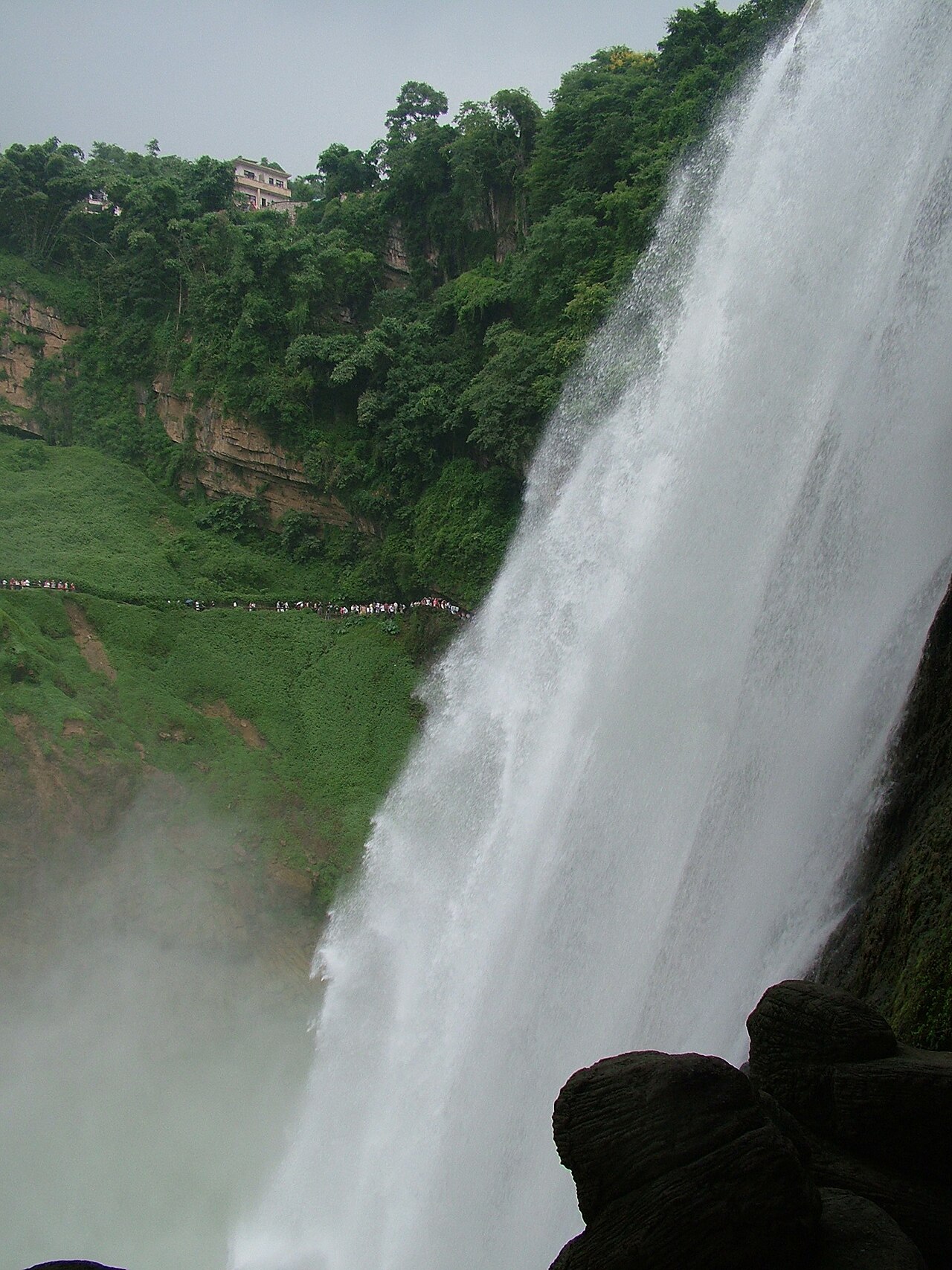
Behind the main fall, 40 to 47 meters up the cliff, a karst cave runs through the rock. It is more than 20 meters deep and 134 meters long, with six windows, five halls, three springs, and six passages. The mouth sits behind the falling water, which is why it is called the Water Curtain Cave. From the openings you look straight into the curtain; on clear days, from about nine in the morning to five in the afternoon, a rainbow often sits over Rhinoceros Pool.
The cave is part of the same Huangguoshu ticket, not a separate trip. The path is wet and the noise is constant. Wear shoes that can take spray. If you only have time for one extra inside the scenic area, this is the one.
Dragon Palace
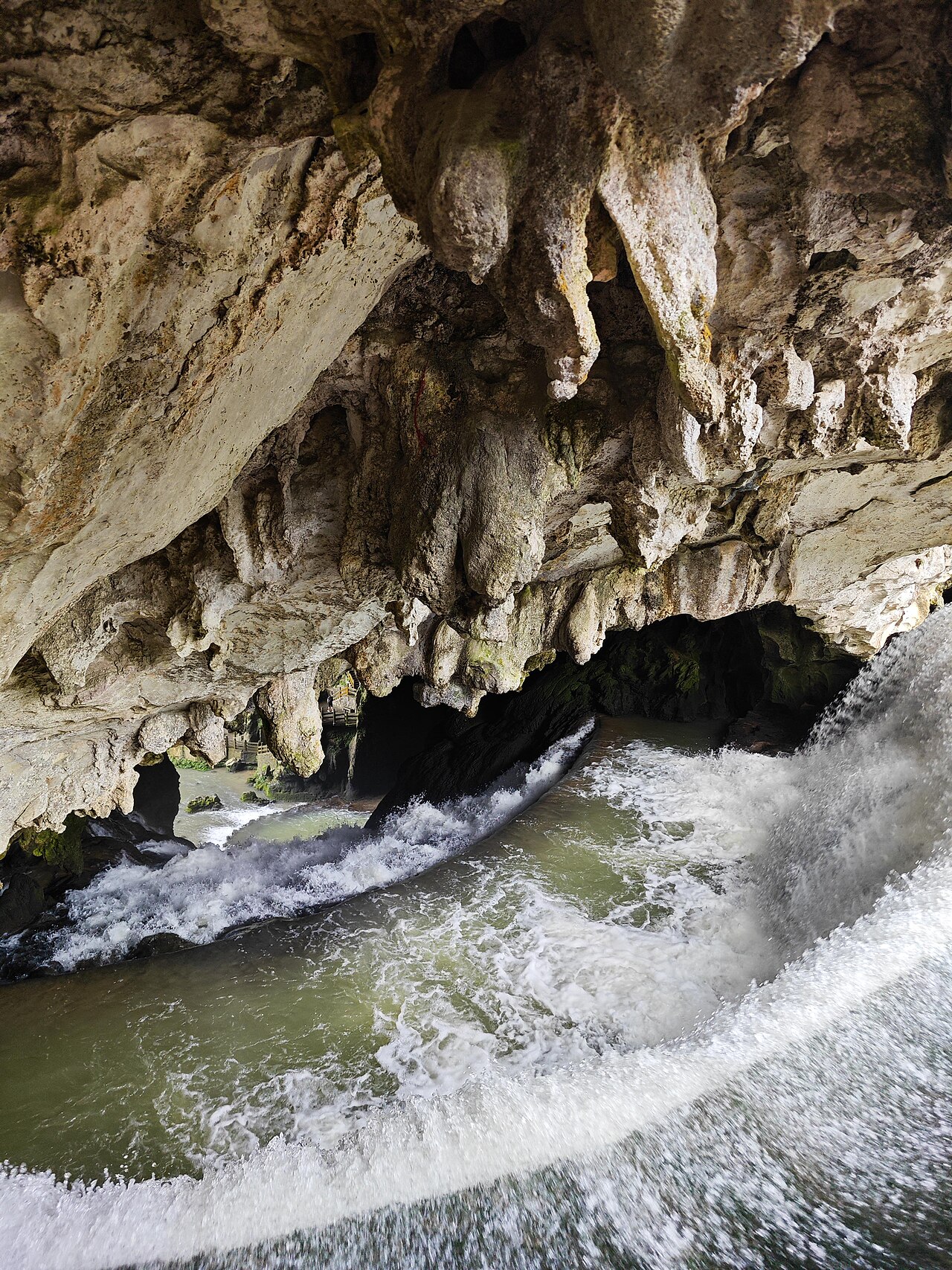
The Dragon Palace scenic area lies in the southern suburbs of Anshun, 27 kilometers from the urban area, 116 kilometers from Guiyang, and about 30 kilometers from Huangguoshu. It opened in 1984, covers 60 square kilometers, with a core of about 18. It became a national scenic area in 1988 and a 5A site in 2007. The Chinese Wikipedia page for this cave was missing when this guide was written; the distances and ratings above follow the Anshun municipal government page.
The visit is an underground river through karst halls, usually by boat for the first sections, with dry caves and a cave waterfall on the same circuit. Bring a jacket. Cave air is cooler than the plateau outside. Combined with Huangguoshu it is a long day; on a three-day trip it deserves its own morning.
Anshun Confucian Temple
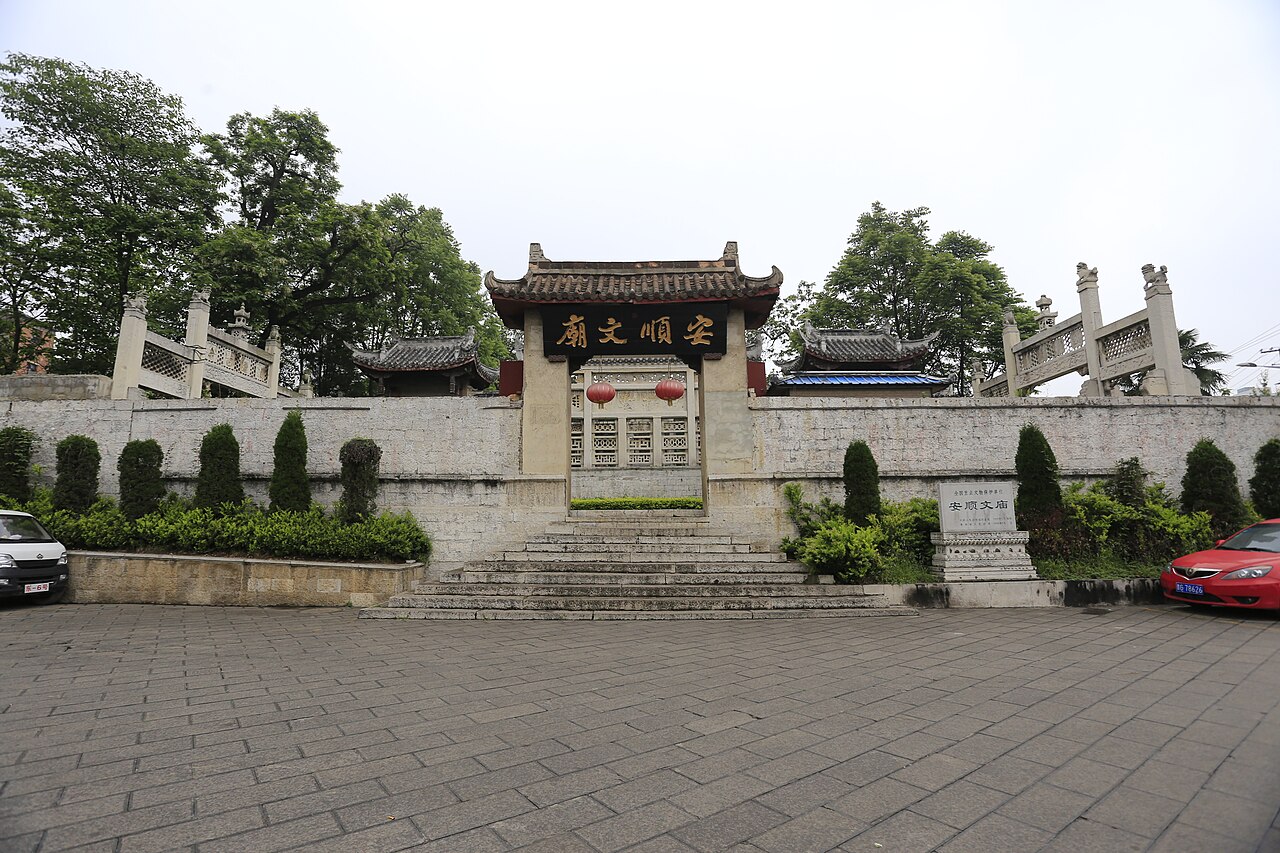
Anshun Confucian Temple stands in Xixiu District. It was founded in the twenty-seventh year of Ming Hongwu, 1394, rebuilt many times, and listed in the fifth batch of national protected relics in 2001. The stone carving is Ming; most of the timber is Qing or later. The grounds cover 8,750 square meters in five courtyards, from the screen wall and ceremonial gates through the pan pond and Lingxing Gate to the Dacheng Hall.
The hall is five bays with a single-eave hip-and-gable roof. The pair of stone columns in the central bay are carved in openwork with coiling dragons, the finest work in the temple. A quiet half day in the city after the waterfalls is the right pace.
Yunshantun
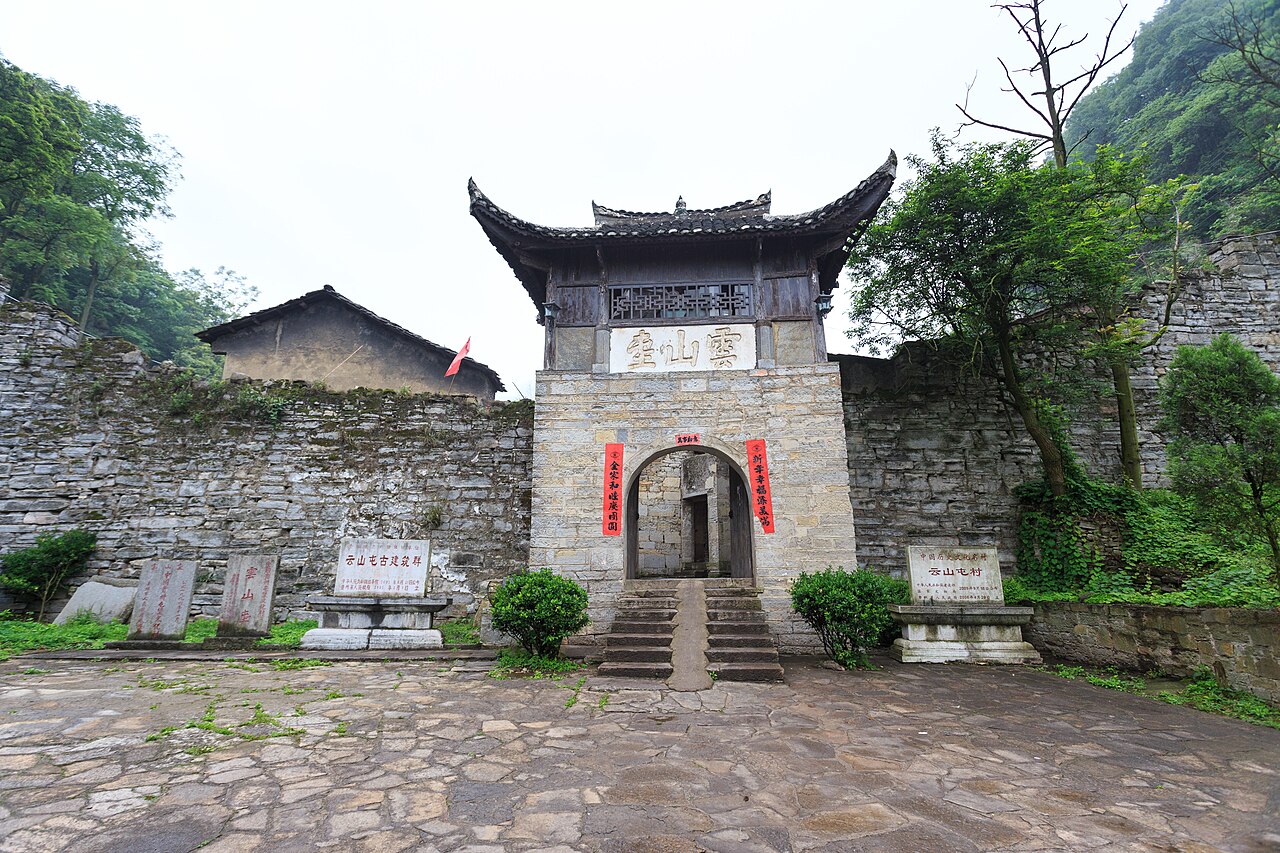
Yunshantun Village is in Qiyanqiao Town, Xixiu District, a Ming tunpu, or garrison settlement, from the early Ming campaigns that left soldiers to farm and hold the road from Guiyang to Yunnan. The Yunshantun historic buildings, together with neighboring Benzhai, joined the fifth batch of national protected relics in 2001. The village became a Famous Historic and Cultural Village of China in 2005.
Yunshantun sits in a valley of about 150,000 square meters, with garrison gates on the east and south. Benzhai covers more than 40,000 square meters on the slope. The houses mix Jiangnan timber detail with local stone. Tunpu people in the wider Anshun-Guiyang basin numbered more than 300,000 in 2001. Walk the stone street, look at the gates, and do not expect a polished old town.
Anshun at night
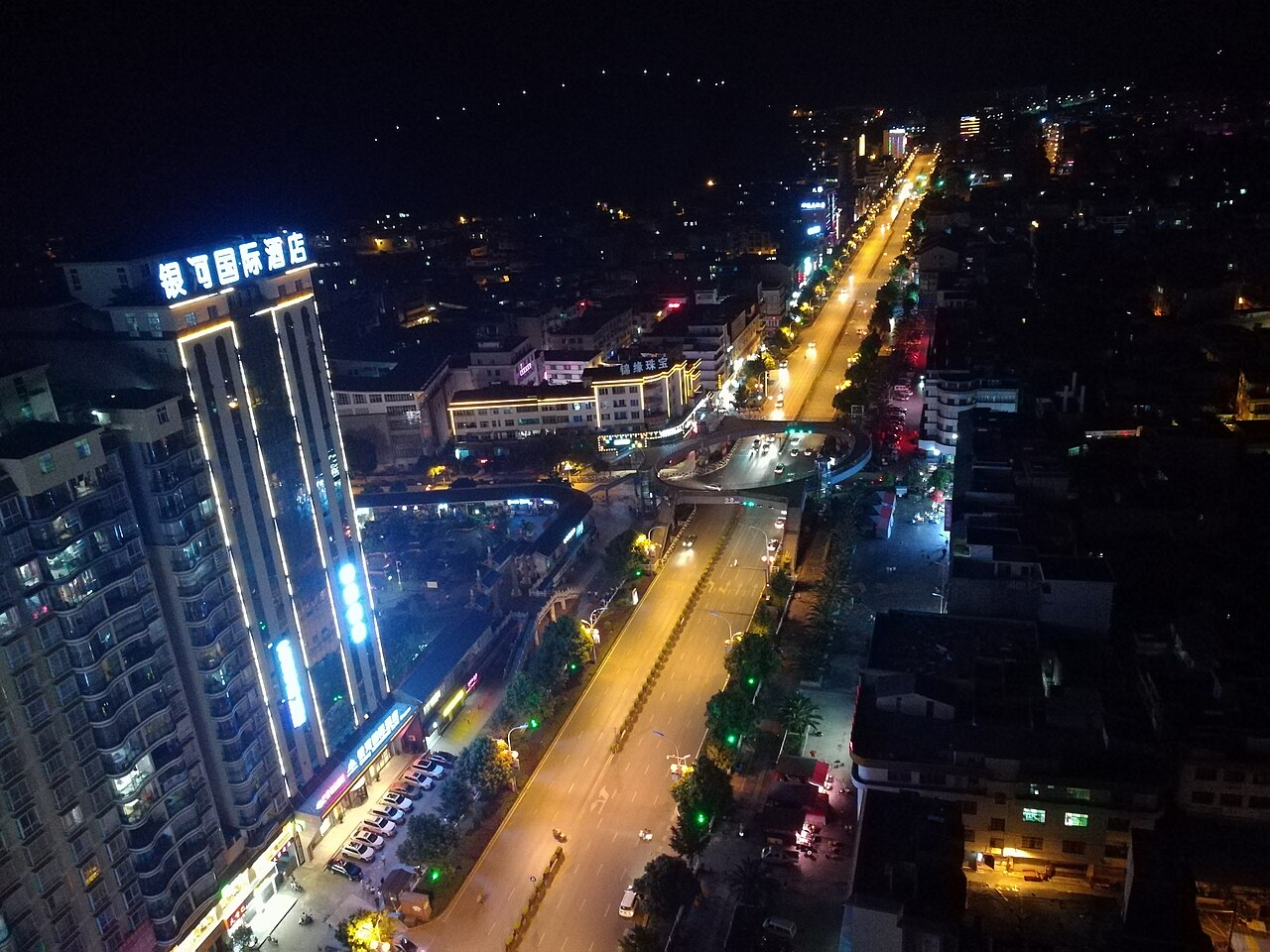
The urban night is not a monument. It is the plateau city after the day trips, when the streets around the old center fill with snack stalls. Use this evening for food rather than another ticketed site. If you still have legs, the Confucian Temple area is the calmest walk in town after dark.
Eating in Anshun
Anshun eats on the street. Guojuan wraps fillings in a thin rice sheet. Siwawa is a similar roll of shredded vegetables in a rice skin, finished with a sour-hot dip. Duoduo fen is a small hotpot of rice tofu and whatever you add. Changwang noodles, more famous in Guiyang, also show up here. Houttuynia, the local fishy herb, is in many dips; ask them to hold it if you do not like the smell. Follow a queue on Gufu Street or the nearby lanes. Shop names change; the bowls do not.
How to arrange the route
Three days covers the water, the cave, and a tunpu village.
Day one is Huangguoshu. Walk the main fall, go through the Water Curtain Cave, and stand at Rhinoceros Pool. This is a full day.
Day two is the Dragon Palace in the morning and the Confucian Temple in the afternoon. The two are not next to each other; the cave is south of the city, the temple is in town.
Day three is Yunshantun, then the city for food. If rain closes the village paths, stay in town and eat.
What to cut if short on time
With only two days, keep Huangguoshu and the Dragon Palace and drop the tunpu, or keep Huangguoshu and Yunshantun and drop the cave. With one day, it is Huangguoshu and the Water Curtain Cave, nothing else.
Onward from Anshun
Huangguoshu pairs well with a Yunnan trip. Kunming is a few hours west, and Guilin is the other famous karst landscape if you are heading east. Within Guizhou, Guiyang is the capital hinge, Liupanshui adds Cool Capital grasslands farther west, Bijie covers Zhijin Cave north, and Zunyi / Tongren open northern and eastern mountain chapters.
Things to confirm before you go
- Huangguoshu volume changes with the season. Wet months are louder and wetter; dry months can look thin.
- The Water Curtain Cave is slippery. Shoes with grip, a rain shell, and a bag you do not mind spraying.
- The Dragon Palace is a boat-and-cave visit. Confirm whether the underground river section is running.
- Ticket prices and opening hours at Huangguoshu, the Dragon Palace, the temple and Yunshantun. This guide does not list 2026 prices because they could not be confirmed; check each official notice.
- Karst paths are uneven. The Confucian Temple is the only major stop that is mostly courtyards.
Frequently asked questions
How many days for Anshun?
Three is comfortable. Two still gets the waterfall and one more site.
Is Huangguoshu worth it in the dry season?
The cliff and the cave are still there, but the fall is a different animal when the river is low. If water is the reason you came, aim for summer and early autumn.
Can I do Huangguoshu and the Dragon Palace in one day?
People do. It is a long day with two separate tickets and two separate queues. On a three-day trip, split them.
What is a tunpu village?
A Ming garrison settlement. Soldiers were left to farm and hold the Yunnan road; their stone villages and Jiangnan-influenced houses are still lived in. Yunshantun is one of the better preserved.
What should I eat?
Guojuan and siwawa first, then a bowl of duoduo fen if you want something hot.
Sources
The facts in this article were checked against the following Chinese Wikipedia entries, retrieved August 28, 2026, and rechecked on October 14, 2026. The Dragon Palace section follows the Anshun municipal government page, because the Wikipedia entry was missing. Food notes were additionally checked against public web sources.
- Anshun (city) https://zh.wikipedia.org/wiki/安顺市
- Huangguoshu Waterfall https://zh.wikipedia.org/wiki/黄果树瀑布
- Anshun Confucian Temple https://zh.wikipedia.org/wiki/安顺文庙
- Yunshantun Village https://zh.wikipedia.org/wiki/云山屯村
- Tunpu https://zh.wikipedia.org/wiki/屯堡
- Dragon Palace Scenic Area (Anshun government) https://www.anshun.gov.cn/zjas/asly/yzas/202401/t20240117_83550343.html
All photos are from Wikimedia Commons, used under CC licenses; re-use requires attribution.
- anshun-huangguoshu.jpg from File 黄果树瀑布 2026-07-31 01.jpg, by Kcx36, taken July 31, 2026, CC BY-SA 4.0
- anshun-shuiliandong.jpg from File Shuiliandong HuangguoshuFall.jpg, by WaitinZ, taken August 7, 2005, CC BY-SA 3.0
- anshun-longgong.jpg from File Anshun Longgong 20250815 101456.jpg, by Zhangzhugang, taken August 15, 2025, CC BY-SA 4.0
- anshun-wenmiao.jpg from File Anshun Wenmiao 2014.04.28 15-49-23.jpg, by Zhangzhugang, taken April 28, 2014, CC BY-SA 3.0
- anshun-tunpu.jpg from File Anshun Yunshantun 2014.04.28 12-55-41.jpg, by Zhangzhugang, taken April 28, 2014, CC BY-SA 3.0
- anshun-city.jpg from File Nightscape of Anshun city in Guizhou, China2.jpg, by Huangdan2060, taken July 22, 2018, CC0