Guilin Travel Guide: The Li River, Yangshuo and Three Days in Karst Country
Come to Guilin for the Li River. The cruise from Guilin down to Yangshuo, about four hours between limestone peaks, is the reason to visit, and the rest of the trip should fit around it. Three days works well. Spend day one in Guilin city on Elephant Trunk Hill and the evening lake cruise. Take the boat to Yangshuo on day two and sleep there. Raft the Yulong River on day three before heading back. The one booking that matters is the boat. In 2026 the three-star cruise costs 215 yuan and leaves from Mopanshan pier, while the four-star costs 360 yuan and leaves from Zhujiang pier. Both are sold through the official 漓江售票处 (Li River ticket office) WeChat account, and holiday sailings sell out.
Planning around the river
The cruise is a one-way trip. Boats go downstream from Guilin and end in Yangshuo, so plan to stay in Yangshuo that night rather than rushing back. Take your luggage with you, or arrange for your hotel to hold it.
Check the pier. The three-star and four-star boats leave from different piers south of the city, and taxi drivers need the exact Chinese name: 磨盘山客运港 (Mopanshan) or 竹江码头 (Zhujiang). Both boats arrive at Longtoushan pier in Yangshuo.
Water levels change the route. In very dry spells the boats may run a shorter section. In flood season, sailings have been suspended at short notice, which happened in 2026. Check the official account the evening before.
Mind the station names. A train ticket to Yangshuo station takes you to Xingping town on the Guiyang-Guangzhou line, not to Yangshuo's West Street. You still need a road transfer into the county town. In Guilin, Guilin station, Guilin North and Guilin West are different places. Read the name on the ticket.
Caves are for a fourth day. Reed Flute Cave is a fine lit karst cave, but on a three-day trip it costs you river time.
When to come to Guilin
Guilin's annual mean temperature is about 18.8°C. April to October usually has enough water for the full cruise and the bamboo rafts. Spring and autumn are the most comfortable seasons. June is often rainy, and the mist that hangs on the peaks after rain is part of the classic view. In winter low water can shorten the cruise, so ask which section is running. In autumn the city's osmanthus trees flower, and Guilin, whose name means "osmanthus forest", smells of them.
National holidays, especially early May and the first week of October, bring big crowds and sold-out boats. In 2026 the National Day sailings went on sale 15 days ahead.
How to get in and where to stay
By air: Guilin Liangjiang International Airport (KWL) is about 28.5 km west of the city in Liangjiang town, Lingui district. Airport buses and taxis run to the centre.
By train: high-speed trains stop at Guilin station (in Xiangshan district, which locals still call the south station), Guilin North or Guilin West. Yangshuo station is in Xingping.
Where to stay: spend the first night in Guilin city, near the Li River and the lakes, for Elephant Trunk Hill and the evening cruise. Spend the next nights in Yangshuo, near West Street for nightlife or out in the countryside along the Yulong River for quiet. Book Yangshuo early for holidays.
Places worth visiting
Elephant Trunk Hill: the city's emblem
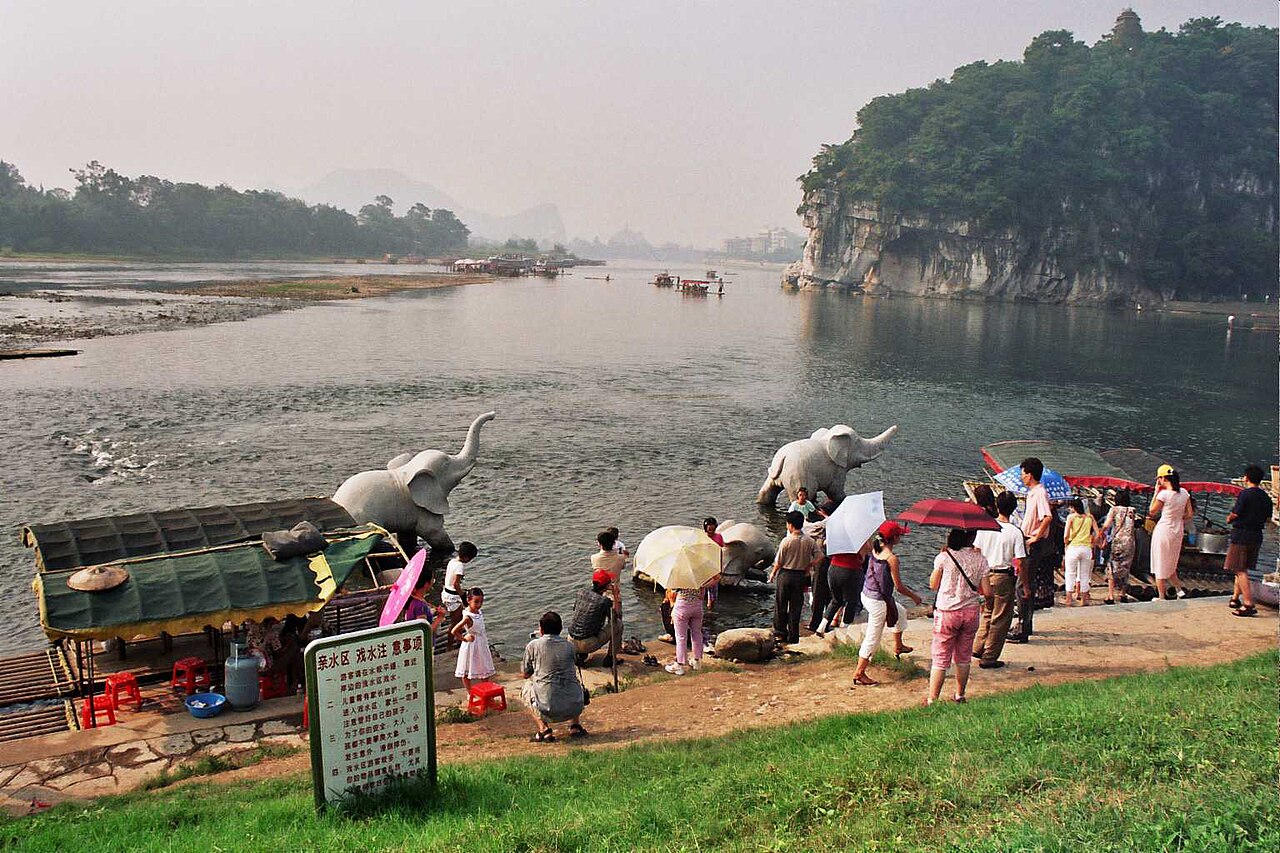
Where the Taohua River meets the Li in central Guilin, a limestone hill leans into the water like an elephant drinking, with an arch called Water-Moon Cave forming the gap between trunk and legs. The Puxian Pagoda stands on top. It has been part of a national 5A scenic area with the Two Rivers and Four Lakes since 2017. Entry has been free since 2022, but you need a free real-name time-slot booking on the 桂林市象山景区 WeChat account or a ticket app, and the last gate closes at 21:30. Allow an hour or two and come in the morning or late afternoon. The Elephant Trunk Hill page covers the viewpoints.
The Li River cruise to Yangshuo
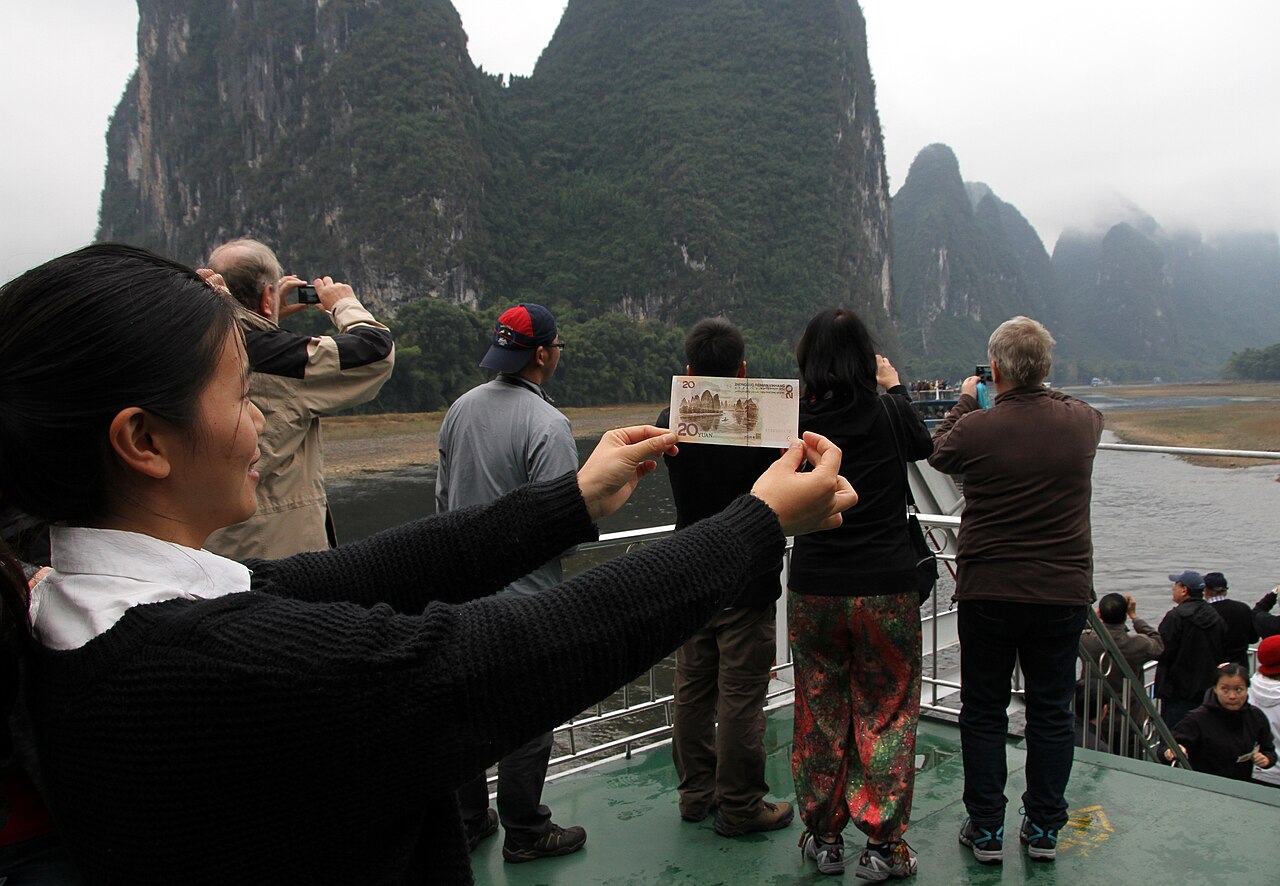
The Li is the upper course of the Gui River in the Pearl River (West River) system, about 164 km long, known for its clear water over a pebble bed. Its karst peaks are part of the South China Karst World Heritage site. The stretch between Guilin and Yangshuo is the famous one. It includes Huangbu Shoal near Xingping, the scene printed on the back of the 20-yuan note.
| Three-star boat | Four-star boat | |
|---|---|---|
| Adult fare (2026) | 215 yuan | 360 yuan, with buffet |
| Guilin pier | Mopanshan | Zhujiang |
| Yangshuo pier | Longtoushan | Longtoushan |
| Time | About 4 hours | About 4 hours |
Meals on the three-star boat cost extra, from about 30 to 60 yuan in the 2026 price list. Book through the official account under your passport name, and check whether it accepts your passport before paying. Allow time for the drive to the pier and the ID check. Details and seat advice are on the Li River page.
Yangshuo West Street
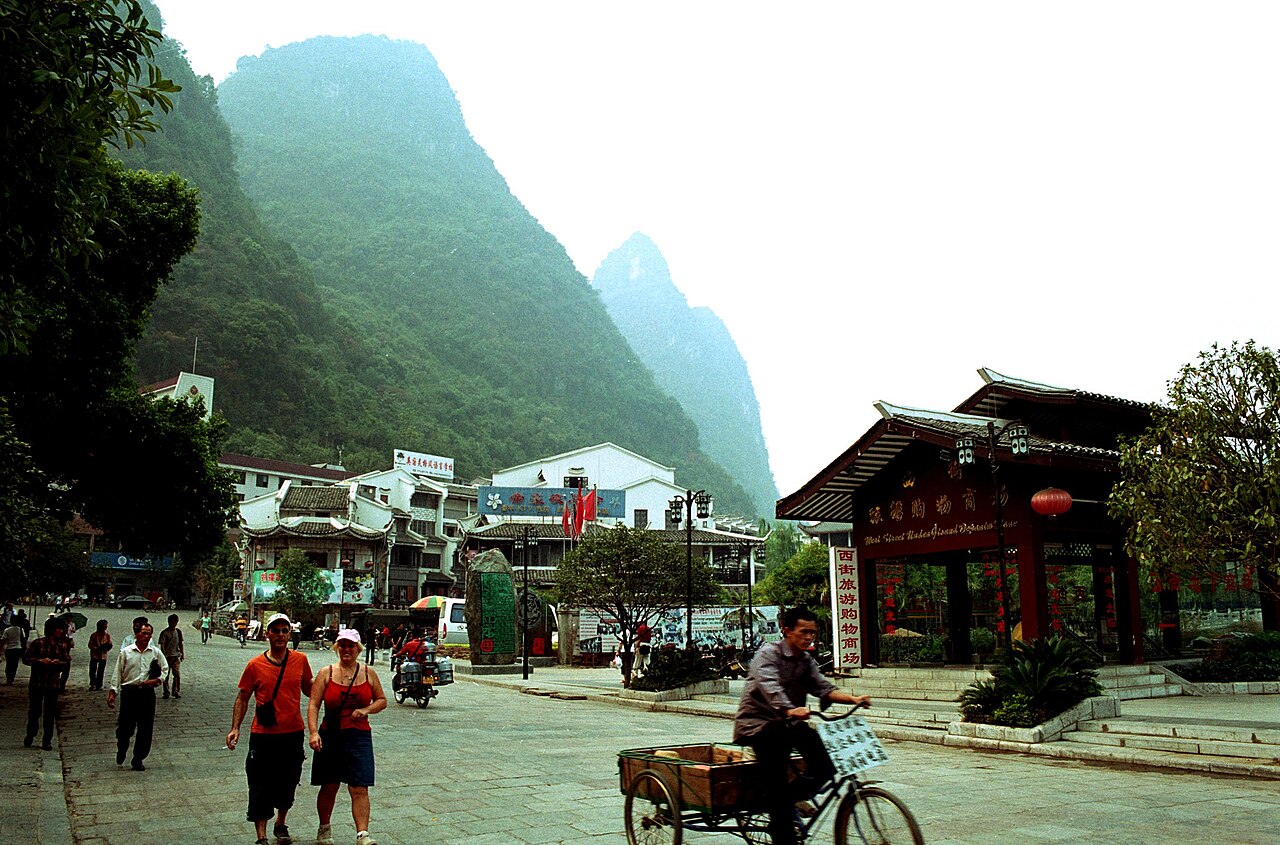
The flagstone street near the Yangshuo waterfront, nicknamed "Foreigners' Street" for its long history of backpacker cafés, is a few minutes' walk from the boat landing. By day it is shops and snacks, and after dark it is loud bars and crowds. Come for dinner and an evening walk, then sleep somewhere quieter if you're a light sleeper. See Yangshuo West Street.
Yulong River rafting
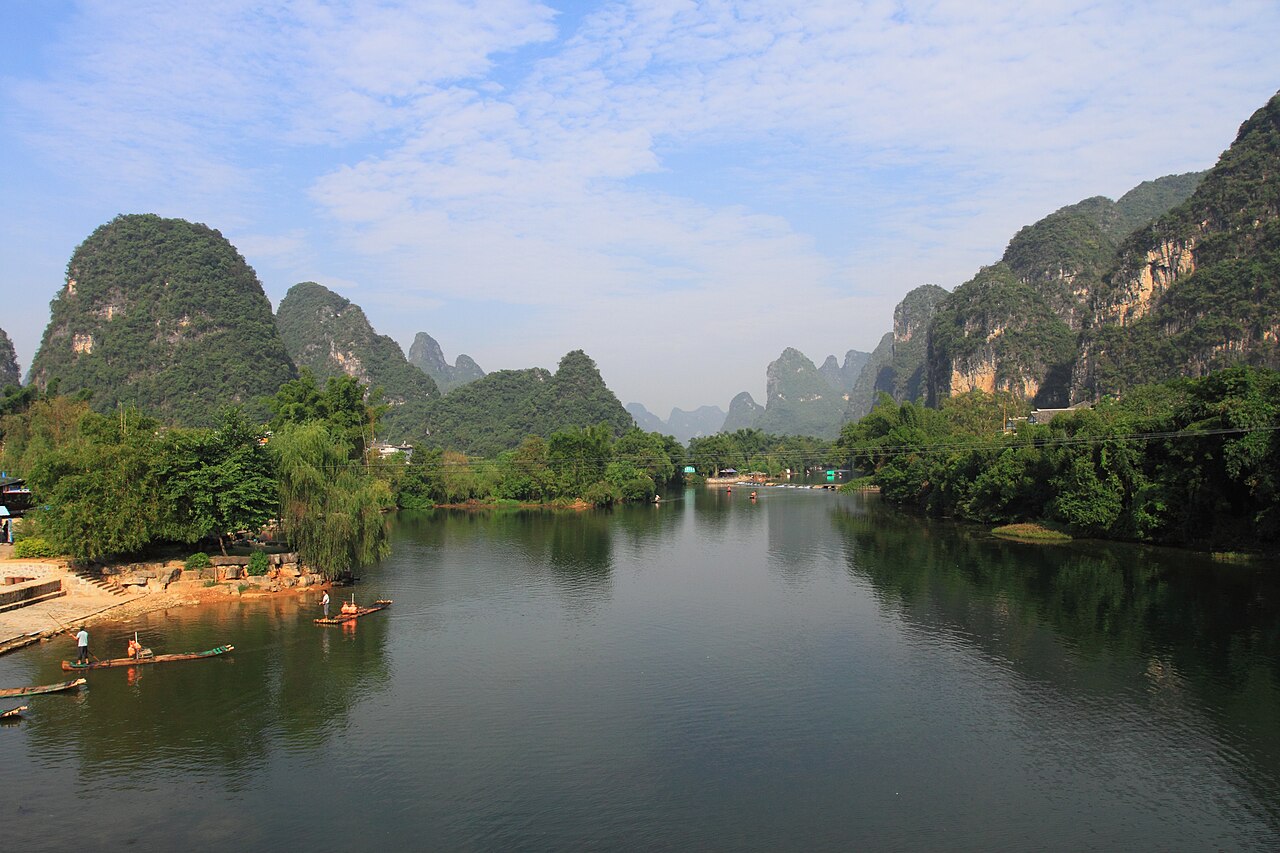
A quieter tributary of the Li, the Yulong winds through rice fields and peaks outside Yangshuo. Rafters punt you downstream on bamboo rafts over small weirs. Prices vary by section, so confirm the start and end points and the time on the water before boarding. Cycling the riverside lanes is the other way to see it. A morning raft followed by an afternoon return to Guilin fits day three. More on the Yulong River page.
Reed Flute Cave: a fourth-day option
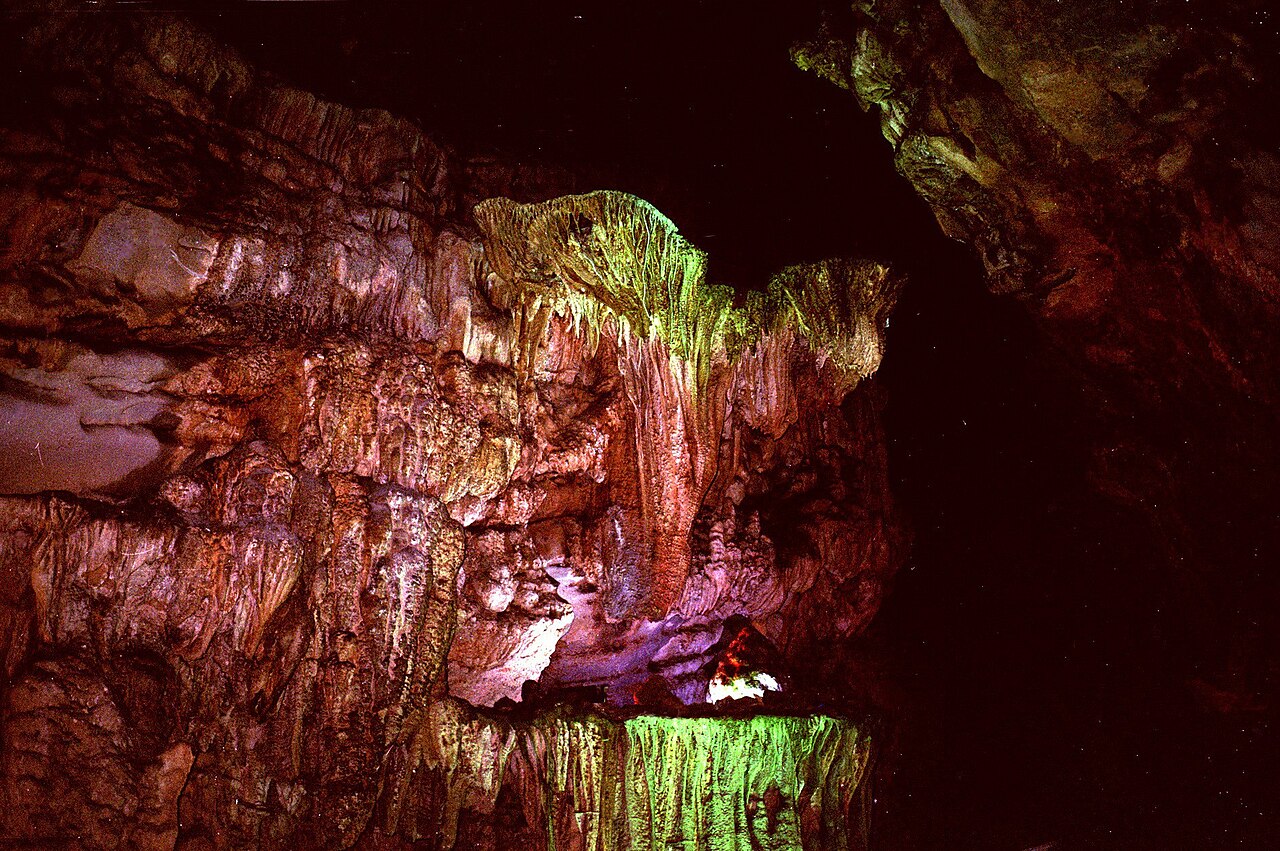
Reed Flute Cave (Ludi Yan) on Guangming Hill is Guilin's showcase cave. The lit circuit is about 500 metres and takes around 40 minutes, past stalactites, named chambers and ink inscriptions dating back to the Tang dynasty. 2026 listings show about 90 yuan and roughly 07:30 to 18:00. It is usually paired with Seven-Star Cave. The lighting is colourful rather than natural, and the paths are damp, so wear shoes with grip. See Reed Flute Cave.
Duxiu Peak and Prince Jing's Mansion
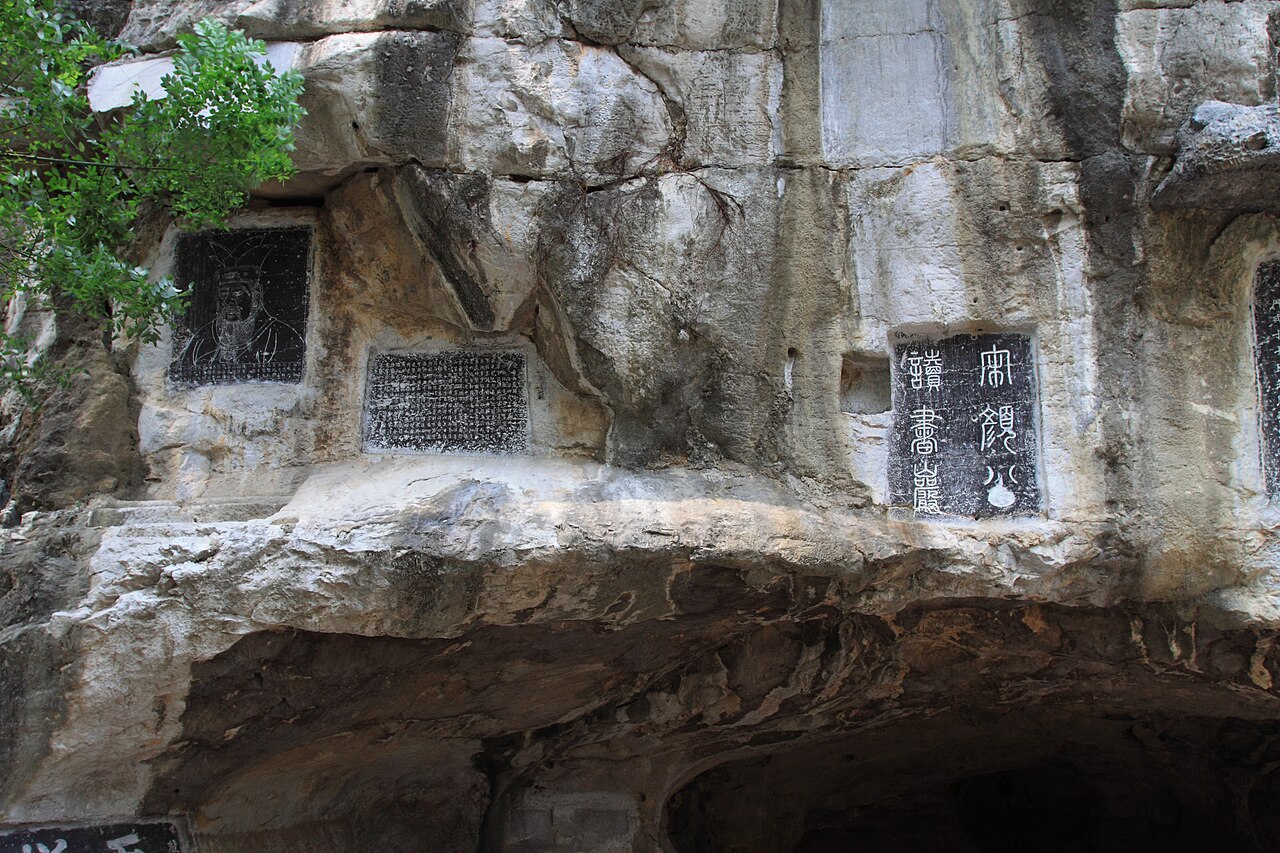
A lone peak inside the walls of the Ming dynasty princely residence of the Jingjiang princes, completed in the 15th year of the Hongwu reign. At Reading Rock below the peak, a carved inscription contains the line behind Guilin's famous saying, "Guilin's scenery is the finest under heaven". The climb to the top is short and steep, with a city view. 2026 listings show about 100 yuan. See Duxiu Peak.
Diecai Hill
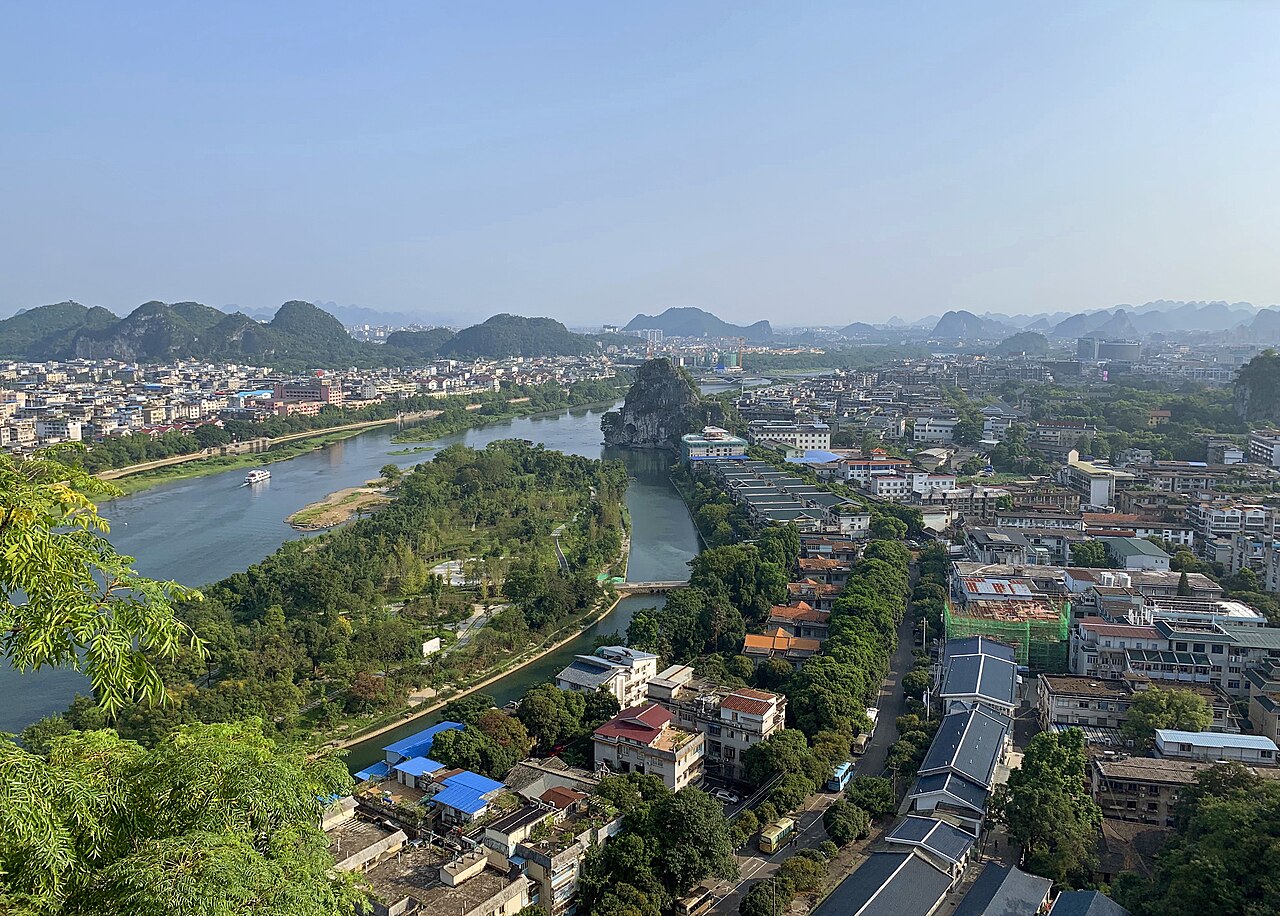
The "folded brocade" hill north of the centre is named for its layered rock. From Bright-Moon Peak at the top you look over the Li River, Fubo Hill and Duxiu Peak. It is a good climb for a city panorama, but skip it if Elephant Trunk Hill and Duxiu Peak already give you enough. See Diecai Hill.
Eating in Guilin
Start with Guilin rice noodles, eaten at breakfast and all day. The classic version is lucai fen: noodles with a little brine sauce, crisp roast pork (guoshao) and peanuts, mixed dry, with broth added from the pot if you want it. Small local shops do it best. Guilin's "three treasures" are Sanhua rice liquor, fermented bean curd and chilli sauce, all popular gifts. From Gongcheng county comes oil tea (youcha), a savoury tea pounded with ginger and peanuts and served with puffed rice. It is an acquired taste, and worth trying once.
In Yangshuo, beer fish is the local dish everyone orders, made with river fish. West Street also has plenty of Western cafés. Ask the price per weight before ordering fish.
How to arrange the route
Day 1, Guilin city. Elephant Trunk Hill in the morning, then Duxiu Peak and Prince Jing's Mansion or Diecai Hill in the afternoon. Take the Two Rivers and Four Lakes evening cruise to see the lit-up lakes and pagodas, after checking times and booking on the official channel.
Day 2, the Li River. Morning boat from Mopanshan or Zhujiang to Yangshuo, arriving in the early afternoon. Check into your Yangshuo hotel and spend the evening on West Street.
Day 3, Yangshuo. Yulong River raft or a bike ride in the morning, then back to Guilin by road or from Yangshuo station in the afternoon for your onward connection.
Day 4, if you have it. Reed Flute Cave and Seven-Star Cave, or more time in the Yangshuo countryside.
Onward travel. Guilin is the karst stop on a two-week China itinerary, usually a flight from Chengdu. Within Guangxi, Nanning is the regional capital to the south-west, reached by high-speed train. Beihai is on the coast further south, and Hezhou, with the old town of Huangyao, is to the north-east towards Guangdong. Heading into Guizhou, Anshun has waterfalls and caves.
What to cut if short on time
Drop in this order:
- Reed Flute Cave and Seven-Star Cave. A fourth-day extra.
- Diecai Hill. Elephant Trunk Hill already gives you the city view.
- Duxiu Peak and Prince Jing's Mansion, unless the Ming history and the inscription interest you.
Never cut the Li River cruise, the night in Yangshuo or, if you have a third day, the Yulong raft. With only two days, spend the first on Elephant Trunk Hill and the evening cruise in Guilin, then take the boat to Yangshuo on the second.
Things to confirm before you go
- Li River boat: your boat class, the pier name in Chinese and the departure time, all bought through the official 漓江售票处 account under your passport name. Check the evening before for weather or water-level suspensions.
- Holiday pre-sale: for national holidays, sailings go on sale ahead (15 days in October 2026), and remaining seats are updated at 11:00 and 16:00.
- Yulong raft: the section, the price and how long you'll be on the water, agreed before you board.
- Train tickets: the station name, since Yangshuo station is in Xingping.
- Rain gear: summer showers are frequent.
- Yangshuo hotel: book ahead in peak season.
Frequently asked questions
How many days do you need in Guilin?
Three days covers Guilin city, the Li River cruise and a night in Yangshuo with the Yulong River. Add a fourth for the caves or a slower Yangshuo stay.
How much is the Li River cruise from Guilin to Yangshuo?
In 2026, 215 yuan for the three-star boat from Mopanshan and 360 yuan for the four-star boat (with buffet) from Zhujiang, each taking about four hours. Prices are set by the scenic area and may change.
Should I stay in Guilin or Yangshuo?
Both. Spend one night in Guilin for the city sights, then stay in Yangshuo after the cruise, since the boat ends there.
Reed Flute Cave or Seven-Star Cave?
Reed Flute is the shorter, more spectacular lit cave and is usually the better choice for a first visit. On a three-day trip, skip both and keep the river.
When is the best time to visit Guilin?
April to October, when water levels support the full cruise and the rafts. Spring and autumn are the most comfortable. Avoid national holidays if you can.
Sources
The historical and geographic facts were checked against these Chinese Wikipedia entries. Sight pages were retrieved 11 August 2026; transport pages 5 September 2026.
- Guilin (city) https://zh.wikipedia.org/wiki/桂林市
- Li River https://zh.wikipedia.org/wiki/漓江
- Elephant Trunk Hill https://zh.wikipedia.org/wiki/象鼻山
- Diecai Hill https://zh.wikipedia.org/wiki/叠彩山
- Reed Flute Cave https://zh.wikipedia.org/wiki/芦笛岩
- Duxiu Peak https://zh.wikipedia.org/wiki/独秀峰
- Prince Jing Manor https://zh.wikipedia.org/wiki/靖江王城
- Yangshuo West Street https://zh.wikipedia.org/wiki/阳朔西街
- Yulong River https://zh.wikipedia.org/wiki/遇龙河
- Guilin Liangjiang International Airport https://zh.wikipedia.org/wiki/桂林两江国际机场
- Guilin railway station https://zh.wikipedia.org/wiki/桂林站
- Yangshuo railway station https://zh.wikipedia.org/wiki/阳朔站
Li River cruise fares, piers and booking rules were rechecked on 9 October 2026 against the Guilin Li River Scenic Area's official site (liriver.com.cn) and its 2026 price list and holiday notices, as reported by Guilin Bendibao. Elephant Trunk Hill's free-entry and booking rules were rechecked on 10 October 2026 against the scenic area's official notices (glljsh.com). Prices for Reed Flute Cave and Duxiu Peak come from 2026 ticket platform listings and should be confirmed with each scenic area. The official notice on the day takes priority.
All photos are from Wikimedia Commons, used under CC licenses; re-use requires attribution.
- guilin-xiangshan.jpg from File Colina de la trompa de elefante02.jpg, by Airunp, taken August 2004, CC BY-SA 2.1-es
- guilin-diecai.jpg from File 桂林叠彩山远眺伏波山.jpg, by 三猎, taken September 2, 2020, CC BY-SA 4.0
- guilin-ludi.jpg from File 芦笛岩.jpg, by Gisling, CC BY-SA
- guilin-duxiu.jpg from File Guilin Duxiu Feng 2012.09.28 13-26-59.jpg, by Zhangzhugang, taken September 28, 2012, CC BY-SA
- guilin-lijiang.jpg from File Li-Flussfahrt-244-Banknote-2012-gje.jpg, by Gerd Eichmann, taken November 7, 2012, CC BY-SA 4.0
- guilin-xijie.jpg from File Xijie-m.jpg, by Gisling, taken October 2005, GFDL
- guilin-yulong.jpg from File Yangshuo Yulong He 2012.09.30 09-10-15.jpg, by Zhangzhugang, taken September 30, 2012, CC BY-SA