Yonghe Temple (Lama Temple), Beijing: A Working Monastery Inside the Second Ring
Yonghe Temple, usually called the Lama Temple in English, is Beijing's largest Tibetan Buddhist monastery of the Gelug school and still a working place of worship. A visit takes one to two hours. Tickets cost 25 yuan and need no advance reservation; foreign visitors can buy with a passport on the temple's WeChat account or at the ticket office. The temple sits directly above Yonghegong Lama Temple station on Lines 2 and 5, which makes it one of the easiest major sights in the city to reach. The highlight is at the back: an 18-metre Maitreya Buddha carved from a single sandalwood trunk.
It fits the afternoon after the Forbidden City or a morning with the Temple of Heaven. The Beijing travel guide has the full plan.
Tickets and hours
From the temple's posted notices as reported by Beijing local media in September 2026:
- Price: 25 yuan full price; 12 yuan half price for eligible groups (students and some seniors).
- Buying: online through the temple's official WeChat service account (雍和宫游客信众服务), where foreign visitors can buy full-price tickets with a passport and scan the QR code at the gate; or in person at the ticket office with the original passport. If you qualify for a half-price ticket as a foreigner, the paper ticket at the office is the way to get it.
- Limit: one ticket per ID document per day. No advance reservation is required.
- Hours: in the April to October season, 09:00 to 17:00 with last entry at 16:30. In winter last entry moves earlier, around 16:00.
Religious festivals and the first and fifteenth days of the lunar month bring much bigger crowds of worshippers, and special events can change hours. The Lunar New Year period is the busiest of all, with long queues to offer incense.
Walking the five halls
The temple runs south to north. The entrance avenue starts at the south gate near the metro, and the halls grow larger as you go. Visitors move in one direction, with worshippers often moving faster through the halls than tour groups.
Hall of the Heavenly Kings. The first hall, with the four guardian kings and a laughing, pot-bellied Maitreya in the Chinese Budai form. Remember him for the comparison at the end.
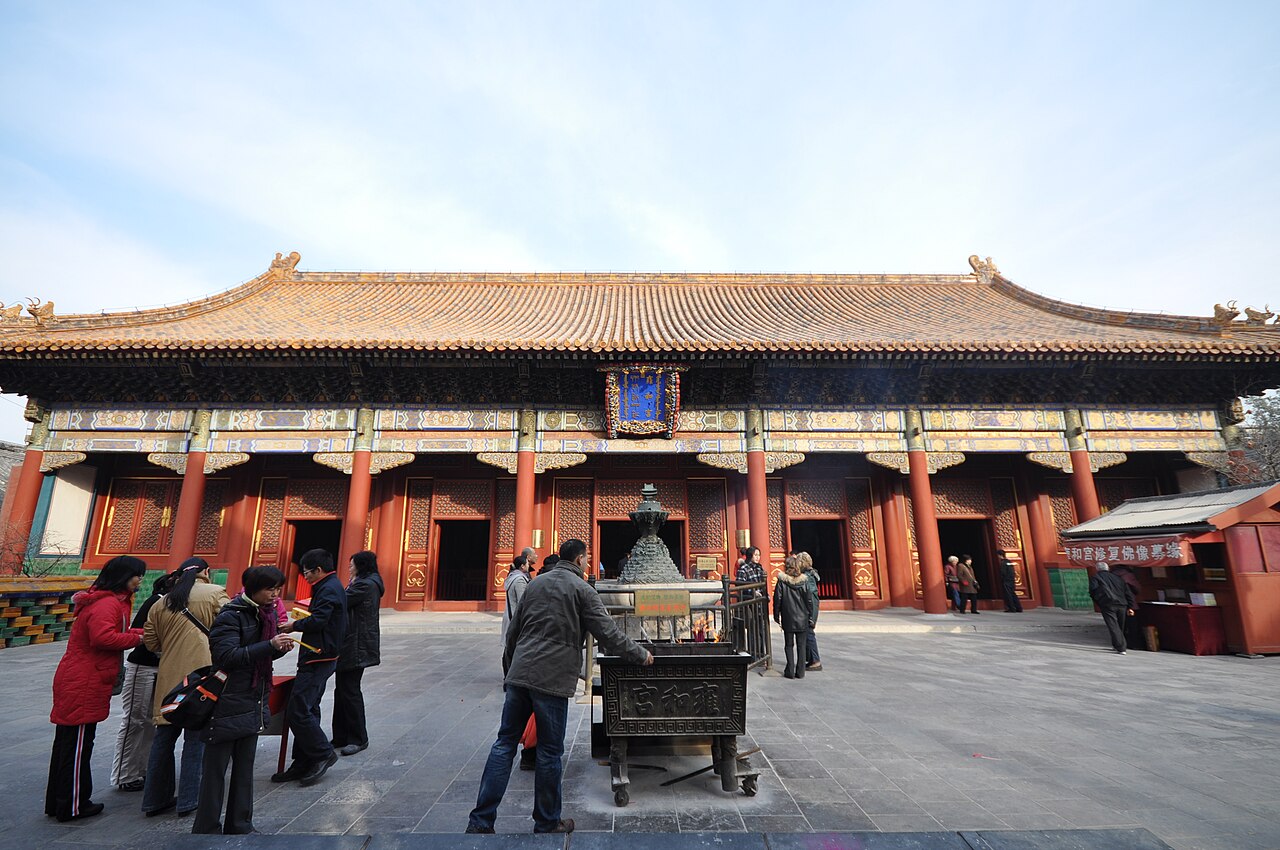
Hall of Harmony and Peace (Yonghe Hall). The main hall of the original layout, with Buddhas of the past, present and future.
Hall of Everlasting Protection (Yongyou Hall). This was the prince's living quarters when the complex was still a residence.
Hall of the Wheel of the Law (Falun Hall). The hall used for teaching and chanting, with a large statue of Tsongkhapa, founder of the Gelug school. If monks are chanting when you pass, stand back from the door.
Wanfu Pavilion (Pavilion of Ten Thousand Happinesses). The tall building at the north end houses a standing Maitreya about 18 metres above the floor, with more of the trunk below ground, carved from a single piece of white sandalwood. This is the slender future Buddha of Tibetan iconography, quite different from the laughing figure at the front. Most people find it the most impressive sight in the temple, and it is worth saving some time for.
Side halls hold thangka paintings, bronze statues and rotating exhibitions. They are quieter than the main axis and worth a look if you have time left over.
How the place came to be
The site started as a mansion for Prince Yong, later the Yongzheng Emperor, under the Kangxi Emperor. After Yongzheng's death his son Qianlong turned it into a lamasery in 1744. It played a political role too: the Qing court used it to manage relations with Tibetan and Mongolian Buddhist leaders. That mix of palace and monastery explains why the rooftops have the yellow tiles normally kept for imperial buildings.
Etiquette and photography
- No photos inside the halls. Signs at most doorways prohibit photos and video of the main images. Courtyard shots are generally fine.
- Incense is optional. Free sticks are often handed out at the entrance, and you may also see bundles for sale. You do not need either.
- Walk clockwise around stupas and prayer objects, as worshippers do, and do not touch statues or step on raised thresholds.
- Dress as you would for any active temple. Shoulders covered is the safe choice.
- Keep quiet in halls where people are praying.
Pairing it with the neighbourhood
The temple has two easy partners. Across the road to the west, the Confucius Temple and the Imperial Academy (Guozijian) share a ticket of their own and are much calmer, with stone stelae recording the names of imperial exam graduates. Allow an hour. A short walk further along, Guozijian Street is a tree-lined lane with cafés and courtyard shops, and Wudaoying Hutong has more of the same with a younger crowd. For dinner, Guijie (Ghost Street), the stretch of Dongzhimen Inner Street that starts at Beixinqiao about 15 minutes' walk south, is lined with restaurants specialising in spicy crayfish and hotpot, and it stays busy late into the evening.
From the Forbidden City, the quickest way is a taxi from Jingshan, or Line 8 from Shichahai to Guloudajie and then two stops east on Line 2. From the Temple of Heaven, Line 5 runs straight north to Yonghegong station.
Do not combine it with Mutianyu or the Summer Palace. Both are long trips in other directions.
When to skip it
Skip it if your Beijing time only covers the palace and the Great Wall, or if you are heading on to the monasteries of Lhasa or the Tibetan-style temples of Chengde, which show the same tradition at a much larger scale. Keep it if you want one living temple in central Beijing, or need something close to the metro on a day with bad weather or tired legs.
Things to confirm before you go
- Last entry time for your date, especially in winter.
- Lunar calendar dates (1st and 15th, New Year, festivals) that bring big crowds.
- Your passport, for buying tickets online or at the office.
- Whether the side exhibition halls are open.
Frequently asked questions
Do I need to book Yonghe Temple tickets in advance?
No. You can buy on the day, online through the temple's WeChat service account with a passport or at the ticket office. Each ID can buy one ticket per day.
Can you take photos at the Lama Temple?
In the courtyards, yes. Inside the halls, photos and videos of the statues are not allowed, and staff enforce it.
How long does the Lama Temple take?
About an hour for the main axis and the sandalwood Buddha, two hours with the side halls. Add an hour if you cross the road to the Confucius Temple.