Hengshui Lake
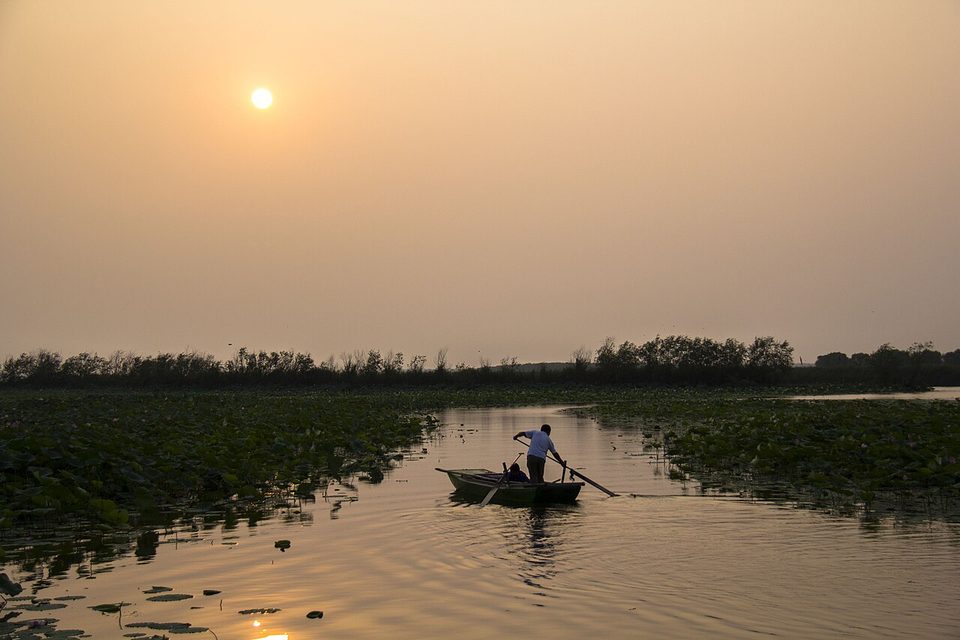
Hengshui Lake lies on the southwestern edge of urban Hengshui, with the old prefectural town of Jizhou on its southern shore. Older maps call it Qianqingwa, the "thousand-hectare hollow", and it is one of the few large freshwater wetlands left on the dry North China Plain. Most visitors come for birds. The reserve's own counts have climbed steadily since it was set up, and a dawn start with binoculars is the way to see it.
How big the lake is
Figures depend on what is being measured. Chinese Wikipedia gives a water surface of about 75 square kilometres and ranks the lake second only to Baiyangdian among the plain's natural wetlands. Hebei newspapers describe it as the largest single body of fresh water on the plain. The protected area is larger than the open water. After a boundary adjustment published by the Ministry of Ecology and Environment, the national nature reserve covers 16,365 hectares, with a core zone of 5,816 hectares. English sources still repeat an older reserve figure of 268 square kilometres, which predates that adjustment.
The lake has no large river of its own. It is topped up at irregular intervals with water diverted from the Yellow River. A long causeway runs northeast from the Nanqiao sluice to Wangkou village in Weitun town and splits the lake into two halves that do not exchange water. The smaller southern basin near Jizhou is often called the Small Lake, and it has produced some of the reserve's best bird records.
The birds
When the reserve was founded, surveys listed 283 bird species. By December 2023 the count stood at 334, and the number of species under China's top level of state protection had risen from 7 to 21, according to figures reported by Hebei Economic Daily and The Paper. National Class II species add another 63.
Baer's pochard is the bird that put Hengshui on the international birding map. The diving duck is listed as Critically Endangered, and in March 2017 observers counted 308 of them in one flock on the Small Lake, then the largest group recorded anywhere. Breeding was first filmed in 2018. The same year the East Asian-Australasian Flyway Partnership named the lake an important site for the species, and reserve staff now say the duck is present in every season. Oriental storks and white-naped cranes are also long-term residents.
Winter brings numbers. The 2022-23 synchronised winter survey, reported by Xinhua, logged more than 64,000 birds of 60 species. Bean geese alone topped 30,000, ducks of several species added over 20,000, and 3,860 common cranes were counted. Spring and autumn migration bring a wider spread of waders, herons and passerines. In late 2023 the National Forestry and Grassland Administration put the lake in its first list of 789 important terrestrial wildlife habitats.
Cleaning up the lake
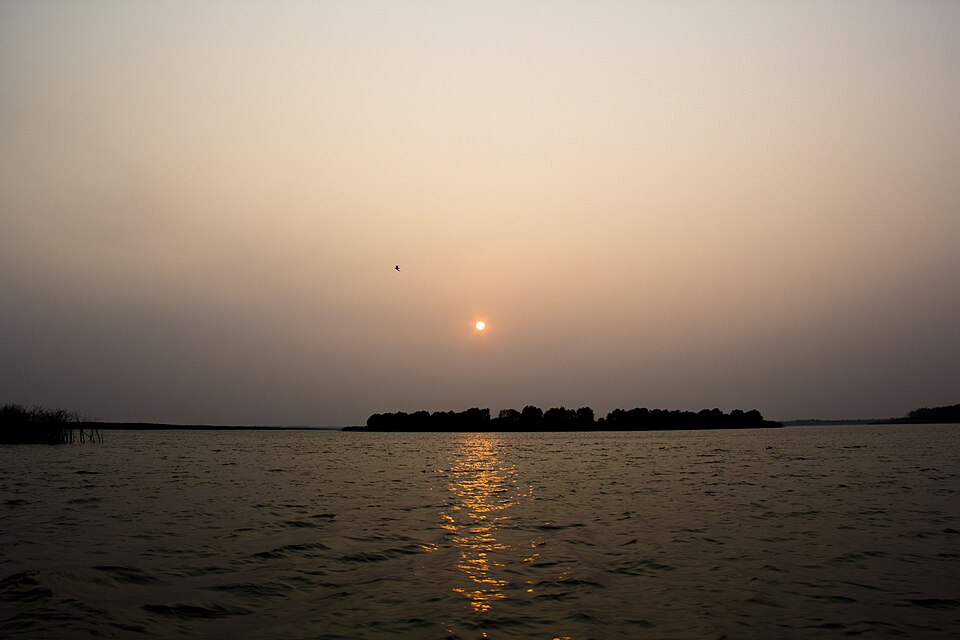
The bird numbers follow a long clean-up. Reports on the reserve describe the removal of about 13,800 mu of fish-farming net cages, demolition of roughly 600,000 square metres of illegal lakeside buildings, closure of sewage outlets and the replacement of fuel-powered boats with electric or gas boats. A Sino-German financial cooperation project funded wetland restoration and the province's first wetland monitoring network. Water quality is reported as stable at national Class III.
Sights around the shore
Near Beiguan village on the Jizhou side stand the remains of Zhulin Temple. Local history says a Ming official had the temple built after a mirage was seen over the water. Floods ruined it, villagers rebuilt it late in the Qing, and when the lake was filled the causeway to the site went under, leaving it as an island. A small hall was put up on the old foundations in 1993.
Luli Ancient Town, on the east side of National Highway 106 in Weitun town, is a modern Han-themed complex. It is useful for dinner after a day outdoors. Treat it as new construction.
When to go
Migration months give the most variety. March to May and September to November are the safest bets for birders, and local birdwatching groups post sightings that are worth checking before you travel. December to February is the time for big flocks of geese and cranes, often standing on the ice. Summer is green and quiet for birds, with heat and insects. Fog and winter haze can cut visibility across southern Hebei.
Tickets, hours and getting there
The reserve, the scenic area and the boat operators each set their own rules, and some zones close during breeding season. This page quotes no ticket prices or boat fares. Check the notice at the gate or the reserve's official channels on the day.
Hengshui North station sits on the Shijiazhuang-Jinan high-speed line, and the older Hengshui station handles conventional trains. Taxis and ride-hailing reach the north and east shores in well under an hour from the city. Cars can be scarce on the far shore late in the day, so arrange the ride back before you set out. Staying in the city works for most visitors. A lakeside hotel helps if you want to be at the water at first light.
Before you go
- Bring binoculars. A spotting scope helps for distant ducks on open water.
- Pick one or two shore areas and stay with them.
- Check which zones are closed for breeding birds.
- Pair the lake with the Jingzhou Pagoda on a second day.
Frequently asked questions
Is Hengshui Lake worth it for non-birders?
It is a pleasant reed-and-water landscape for a walk or boat ride, but the flat shore has few landmarks. Visitors without an interest in birds may find half a day enough.
Can I see Baer's pochard?
The reserve reports the species in all seasons, though numbers vary from year to year. Local guides and recent sighting reports give the best chance.
How does it compare with Baiyangdian?
Baiyangdian near Baoding is built around boats, lotus and villages. Hengshui Lake is quieter and suits birders better.
Are ticket prices listed here?
No. Fees and boat schedules follow the official notice on the day.
Sources
Facts in this article were checked against the following sources, retrieved 20 October 2026.
- 衡水湖, Chinese Wikipedia
- Hengshui, English Wikipedia
- Ministry of Ecology and Environment, boundary document for Hengshui Lake and other reserves
- Ministry of Ecology and Environment biodiversity case study, Hengshui Lake
- The Paper, Hengshui Lake listed as important wildlife habitat
- Xinhua, 2022-23 winter bird survey at Hengshui Lake
- Hengshui travel guide on this site
Photos are from Wikimedia Commons under the licences shown in each caption.