The Jingzhou Pagoda
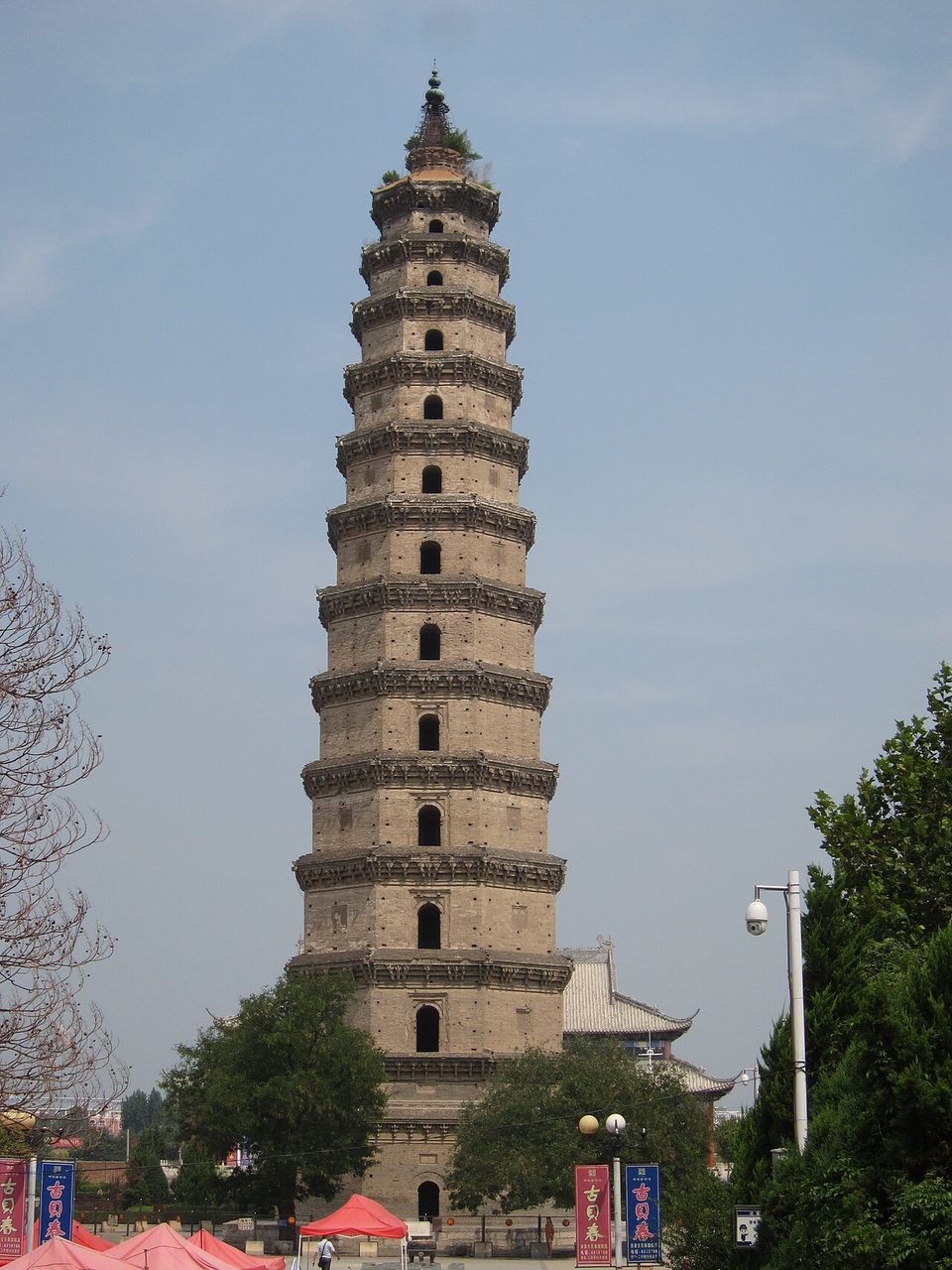
The Jingzhou Pagoda rises over the county town of Jing County in the east of Hengshui prefecture, towards the Shandong border. Its formal name is the Shakyamuni Relic Pagoda of Kaifu Temple, and locals simply call it the Jingzhou ta after the old name of the town. The brick tower stands 63.85 metres tall. Hebei counts it among the province's Four Treasures, alongside the Iron Lion of Cangzhou, the Zhaozhou Bridge and the bronze Bodhisattva of Longxing Temple. A local rhyme puts it more briefly, "Cangzhou's lion, Jingzhou's pagoda".
Fifteen centuries of rebuilding
Nobody knows exactly when the first pagoda went up. Three iron plaques hanging under the finial carry the words "Qi Sui chongxiu", rebuilt in the Northern Qi and Sui. That points to an older Northern Wei foundation, and local writing dates the site to about 1,500 years ago. The tower that stands today follows Song design. It was rebuilt in 1079, the second year of the Yuanfeng reign. A story told about that rebuild says the builders used a mound of earth as scaffolding, raising it level with each new storey and carting it away when the work was finished.
Repairs followed under the Jin in 1139 and the Ming in 1517. In 1407 a temple called Kaifu Si was built around the tower, which gave the pagoda its second name. The temple is gone. Modern repairs came in 1973 and 2003, and the State Council listed the pagoda as a national key cultural relic in 1996 under the name Kaifu Temple Relic Pagoda. A conservation plan was approved by the National Cultural Heritage Administration in 2015.
The 1973 repair turned up a cache inside the finial. Workers found nine volumes of Ming woodblock-printed sutras, six of them from the Lotus Sutra, along with a small bronze figure of the reclining Buddha entering nirvana.
How the tower is built
The pagoda is octagonal with thirteen storeys and a base perimeter of 50.5 metres. It stands on large blocks of blue stone, and Chinese Wikipedia notes a deep well beneath the base. The body is brick throughout. A Sumeru-style plinth and an upturned lotus band carry the first storey. Every storey has four arched doorways facing due north, south, east and west, and from the second storey up a vaulted corridor runs inside the walls. Brick stairs pass through the core and once let visitors climb to the top.
The finial is a stack of five bronze gourds 2.05 metres tall, with a 3.3-metre iron net cage hung below it. In a strong wind the cage and the open doorways make a roaring sound, and the effect has a name in local guidebooks, "wind and waves of the ancient pagoda". The tower also appears on a famille rose vase in the Palace Museum in Beijing, painted with the pagoda and a poem by the Qianlong Emperor, according to a 2026 feature in the Hengshui Daily.
The park and its three museums
The pagoda now stands in a landscaped park of about eight hectares on Jing'an Street. It became a national 3A scenic area in 2025. Two old Chinese scholar trees grow near the tower, reported as about 560 and 380 years old. Three small museums flank the pagoda. The Jingzhou Notables Hall, on the west side, has six galleries on the county's history and the people it produced. The best known is the Han Confucian scholar Dong Zhongshu, whom English Wikipedia lists as a native of Jing County. The Folk Customs Hall, on the east side, shows more than 3,000 objects of farm and household life from the late Qing to the 1980s. The Old Photographs Hall holds about 1,100 prints selected from a much larger archive.
Can you climb it?
No. The Hengshui Daily reported in June 2026 that the inner stairs are closed and visitors may not climb, because the bricks have weathered. The view is from the ground, and a full circuit of the base shows the doorways and corbelled eaves well. Morning light falls on the east and south faces.
Tickets, hours and getting there
Local press describes the park and museums as free. In late 2025 the Hengshui Daily gave the Notables Hall and Folk Customs Hall as open Tuesday to Sunday with a long midday break, and the photo hall at weekends only. These details change by season, so check the board at the gate or the county's official accounts.
Jing County's seat, Jingzhou town, has its own railway station, but most travellers come by car from Hengshui city or by road from Dezhou in Shandong. Allow a half day from Hengshui including the drive. The pagoda pairs well with a morning at Hengshui Lake the day before.
Before you go
- The interior is closed, so plan on a ground-level visit of about an hour, two with the museums.
- Expect the museums to close over lunch.
- Bring a zoom lens for the finial and iron plaques.
- Read the Hengshui travel guide for trains and food.
Frequently asked questions
How tall is the Jingzhou Pagoda?
Published figures give 63.85 metres overall, with a base perimeter of 50.5 metres.
Is it really Northern Wei?
The site probably is. The present brick tower is a Song rebuild of 1079 with later repairs.
What are the Four Treasures of Hebei?
The Iron Lion of Cangzhou, the Zhaozhou Bridge, the bronze Bodhisattva at Longxing Temple in Zhengding and this pagoda.
Are prices and hours listed here?
Entry has been free in recent reports. Museum hours follow the notice on the day.
Sources
Facts in this article were checked against the following sources, retrieved 20 October 2026.
- 景州塔, Chinese Wikipedia
- Hengshui Daily, Jingzhou Pagoda scenic area feature, November 2025
- Hengshui Daily, Jingzhou Pagoda scenic area feature, June 2026
- Jing County, Hebei, English Wikipedia
- Hengshui travel guide on this site
The photo is from Wikimedia Commons under the licence shown in the caption.