Jiangmen Travel Guide: Kaiping's Diaolou Towers and the Overseas Chinese Homeland
Jiangmen, in the western Pearl River Delta, is the ancestral home of around four million overseas Chinese, and the money they sent back built one of China's strangest landscapes: the diaolou of Kaiping, fortified tower houses that mix Chinese villages with Western architecture, listed by UNESCO in 2007. They're spread through the countryside around Kaiping, so plan a full day with a car or driver, ideally sleeping in Kaiping or the old town of Chikan. Jiangmen's city centre is mainly where trains arrive.
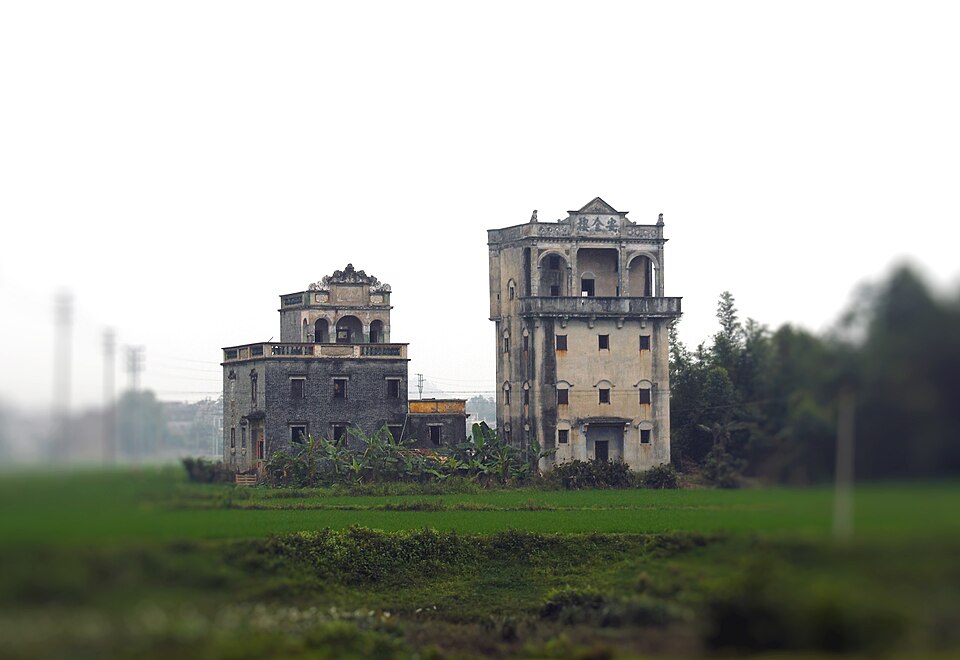
The diaolou: what and why
Kaiping was one of the poorest and most emigration-heavy parts of southern China in the late 19th and early 20th centuries. Men went to work in North America, Southeast Asia and Australia, and the remittances they sent home funded a building boom. In the lawless 1920s and 1930s, with bandits raiding villages, families pooled money for towers: reinforced concrete, iron shutters, gun holes and, on top, whatever their builders had seen abroad, from Roman domes and Gothic arches to Byzantine roofs. More than 3,000 were built; about 1,800 survive, most of them empty.
The UNESCO listing covers four village areas. You don't need all four.
Which villages to see
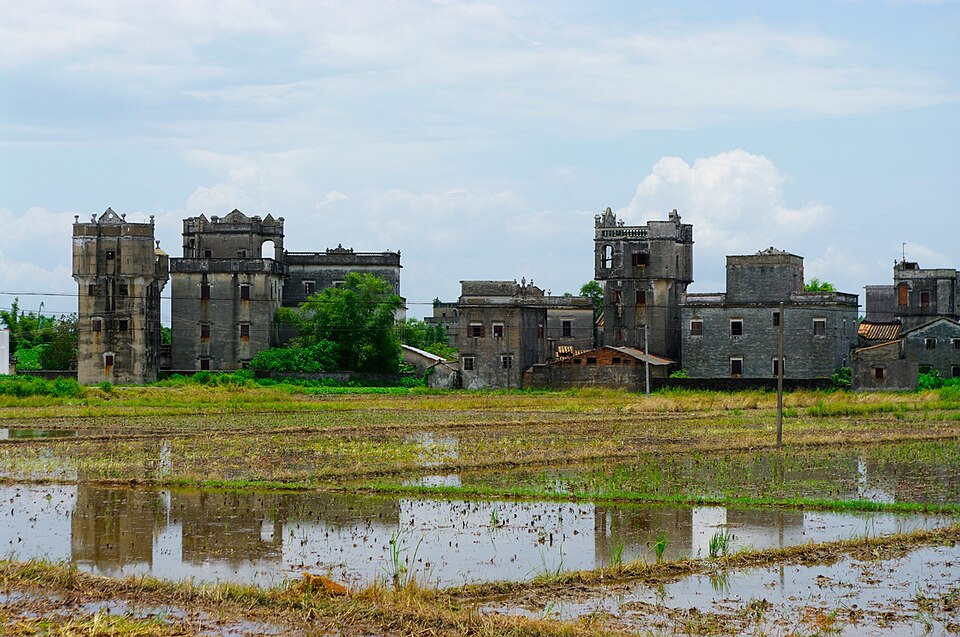
Zili Village is the classic: towers standing in open rice fields and fish ponds, with several, including Mingshi Lou, open inside to show how the families lived, with furniture, photographs and imported goods still in place. Come early, before tour buses and the midday glare.
Majianglong is a cluster of villages in bamboo groves along a river, quieter and greener, with towers half hidden among the trees.
Jinjiangli has the tallest tower in Kaiping, Ruishi Lou, built in 1921: nine floors topped with a Byzantine-style roof and a Roman dome.
Sanmenli, in Chikan township, has Yinglong Lou, the oldest standing diaolou, built by the Guan lineage in the Ming dynasty's Jiajing reign: a squat three-storey fortress with metre-thick walls, quite unlike the later towers.
A good day covers Zili and one other, plus Liyuan Garden near Tangkou, a villa and garden complex built by a returned emigrant in the 1920s and 1930s. Opening hours and combination tickets change, so check the official notice; this guide doesn't quote 2026 prices.
Chikan
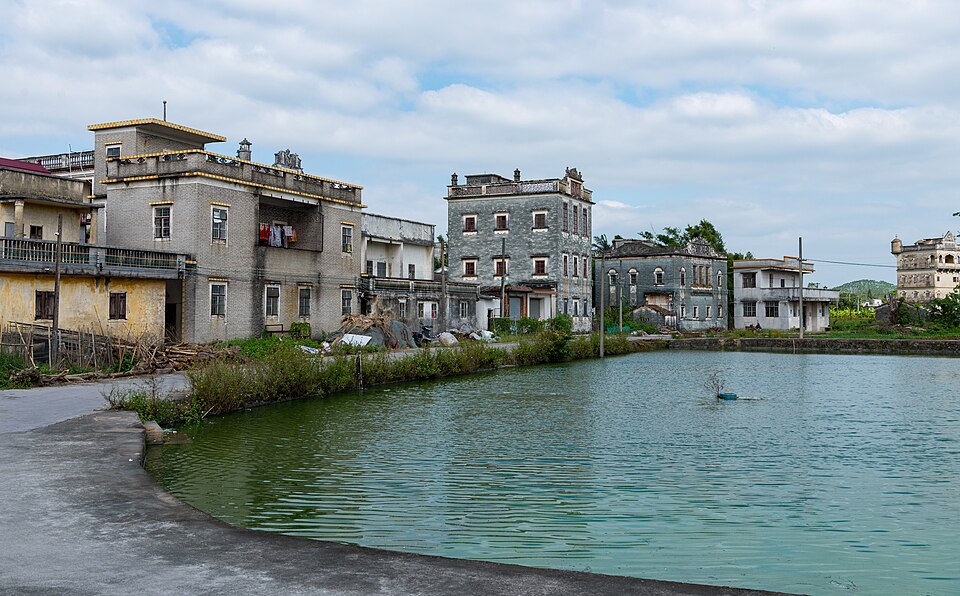
Chikan old town, on a river in Kaiping, is a long double row of arcaded shophouses (qilou) built by returned merchants in the early 20th century. Parts of the town have been used as a film set, and the diaolou region appeared in the 2010 film Let the Bullets Fly. It's at its best in the evening, when the day crowds thin and the river reflects the facades. Staying here puts you close to the villages.
Elsewhere in Jiangmen
- Xinhui: home of "Little Birds' Paradise", a single giant banyan that has spread across an island in a river and hosts thousands of egrets and herons, made famous by an essay by Ba Jin. Xinhui is also the home of chenpi, aged dried tangerine peel used in cooking and medicine, and of the reformer Liang Qichao, whose former residence can be visited.
- Taishan: heart of Taishanese-speaking emigration to the United States. Ferries from Shanzui harbour reach Shangchuan Island's beaches in about 30 minutes.
- Hot springs: resorts such as Gudou make use of the region's hot groundwater.
When to come to Jiangmen
October to December is ideal: dry, sunny and comfortable for walking between towers. Spring is mild but often humid and wet. Summer is hot, with harsh midday sun on open fields and typhoon risk; go early in the day. Weekdays are much quieter at Zili than weekends.
Getting in and where to stay
From Guangzhou, intercity and high-speed trains reach Jiangmen station and Jiangmen East; the Jiangmen–Zhanjiang high-speed line continues west with a stop at Kaiping South, the most convenient for the diaolou. High-speed ferries link Jiangmen with Hong Kong in about two and a half hours.
Public buses between the villages are sparse, so hire a car with driver or take taxis between sites. Stay in Kaiping or Chikan rather than central Jiangmen.
Eating in Jiangmen
Cantonese food with a Siyi accent. Look for dishes cooked with Xinhui chenpi, such as duck or beef, and chenpi tea. Taishan has its own rustic dishes, including yellow eel rice in season. In Chikan, simple restaurants serve local dishes and snacks. Ask prices for live seafood and river fish before ordering.
How to arrange the route
Day 1: Train to Kaiping South; Zili in the late afternoon light; overnight in Chikan.
Day 2: Early Majianglong or Jinjiangli, Liyuan Garden, then back toward Guangzhou, Foshan or on to Zhuhai.
Day 3 (optional): Xinhui's Little Birds' Paradise and Liang Qichao's residence, or Shangchuan Island.
What to cut if short on time
As a day trip from Guangzhou, do Zili and Chikan only. Drop Sanmenli and the coast first.
Things to confirm before you go
- Opening hours and ticket arrangements for the diaolou villages and Liyuan; none are quoted here.
- Car hire or taxi arrangements between villages.
- Whether your train stops at Kaiping South.
- Weather: heavy rain makes field paths muddy.
Frequently asked questions
How many days do I need for the Kaiping Diaolou?
One full day for two villages; two days to see more at a relaxed pace and stay in Chikan.
Can I visit the diaolou as a day trip from Guangzhou?
Yes, with an early train and a hired car. It's a long day.
Which diaolou village is best?
Zili for the classic towers in rice fields and interiors you can enter; Majianglong for atmosphere.
Sources
The facts in this article were checked against the following Wikipedia and encyclopedia entries, retrieved September 24, 2026, and rechecked on October 17, 2026.
- Jiangmen https://en.wikipedia.org/wiki/Jiangmen
- Kaiping Diaolou and Villages https://en.wikipedia.org/wiki/Kaiping_Diaolou
- Zili / Chikan visit summaries (cross-checked)
Tickets change; this article does not invent yuan amounts.
All photos are from Wikimedia Commons, used under CC licenses or public domain; re-use requires attribution.
- jiangmen-diaolou.jpg from File:Kaiping Diaolou (3548696583).jpg, by Kevin Poh, CC BY 2.0
- jiangmen-kaiping.jpg from File:18211-Kaiping (45743600892).jpg, by xiquinhosilva, CC BY 2.0
- jiangmen-diaolou-2.jpg from File:IGP7500s (5685373031).jpg, by Tomoaki INABA, CC BY-SA 2.0