The Iron Pagoda, Kaifeng's Song Tower of Glazed Brick
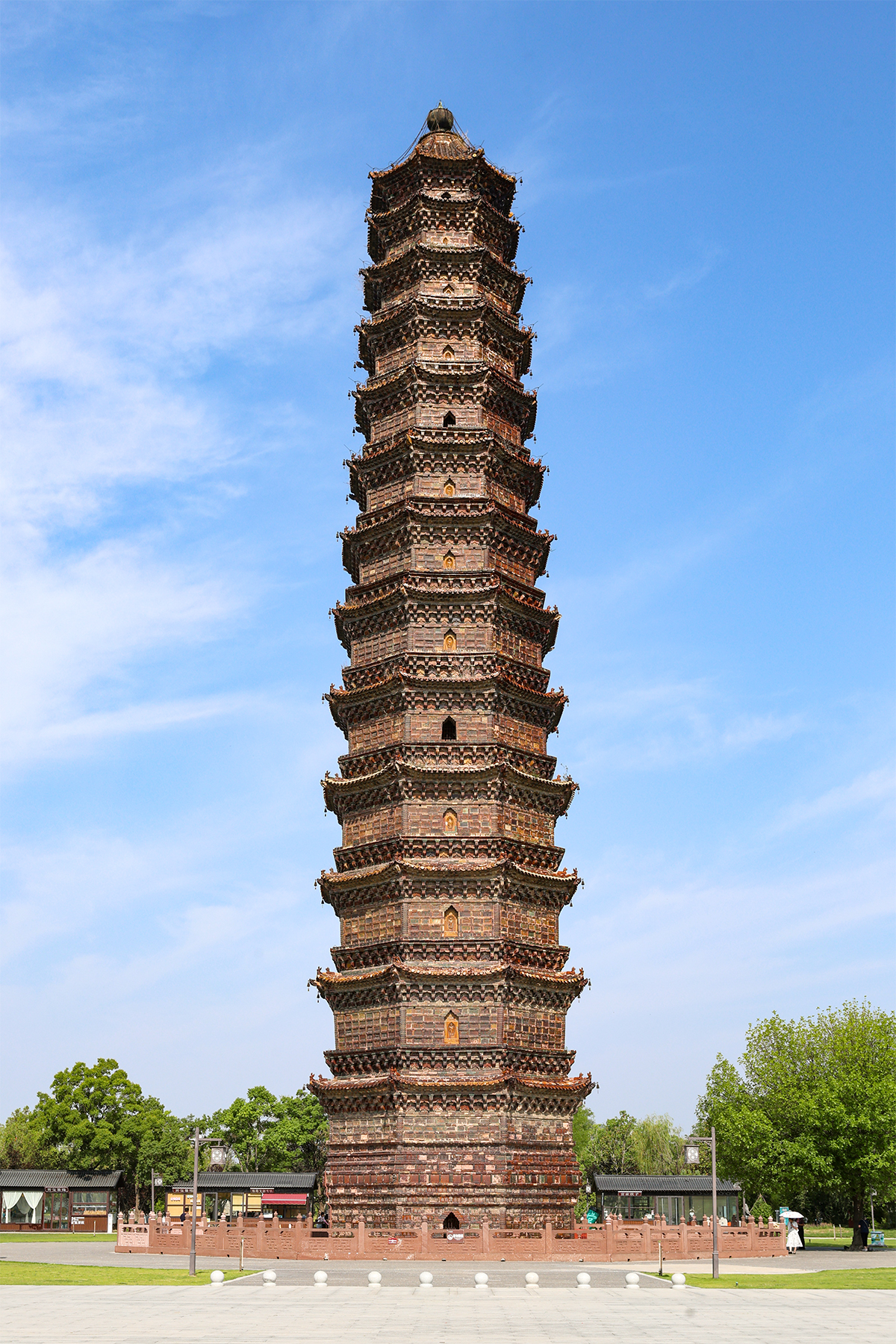
The Iron Pagoda rises in the northeast corner of old Kaifeng, the most complete building left from the years when the city was the Northern Song capital. It was finished in 1049 and has stood through floods, earthquakes and wartime shelling. It contains no iron. The name comes from its glazed bricks, mostly a reddish brown that reads from a distance like rusted metal. Chinese sources call it the earliest and tallest glazed-brick pagoda surviving in China.
The wooden pagoda that came first
The site belonged to Kaibao Temple, a major Song foundation. In the 980s the master builder Yu Hao, from the Wuyue kingdom, raised a wooden pagoda here, octagonal, thirteen storeys and described by Chinese sources as more than 120 metres tall. When it was finished it leaned noticeably to the northwest. Chinese Wikipedia preserves Yu Hao's explanation that the capital sat on flat ground with a steady northwest wind, and that within a century the wind would push the tower upright.
The wind never got its century. Lightning burned the wooden tower in 1044. Emperor Renzong ordered a replacement on the same spot, built of brick to resist fire, and it was completed in 1049. It took the name Kaibao Temple Pagoda after the temple, and in the Ming, when the temple was renamed, it became the Youguo Temple Pagoda. The temple itself is gone. The Yellow River flood of 1847 brought down the surrounding buildings, and the pagoda survived.
The tower itself
The pagoda is octagonal with thirteen storeys. Chinese sources give its height as 55.88 metres, and each face of the ground storey measures 4.16 metres. It is built of brick in imitation of timber construction, with dense brackets under each eave. A spiral stair winds inside a solid core, with openings to let in light and air. English Wikipedia counts 104 bells under the eaves.
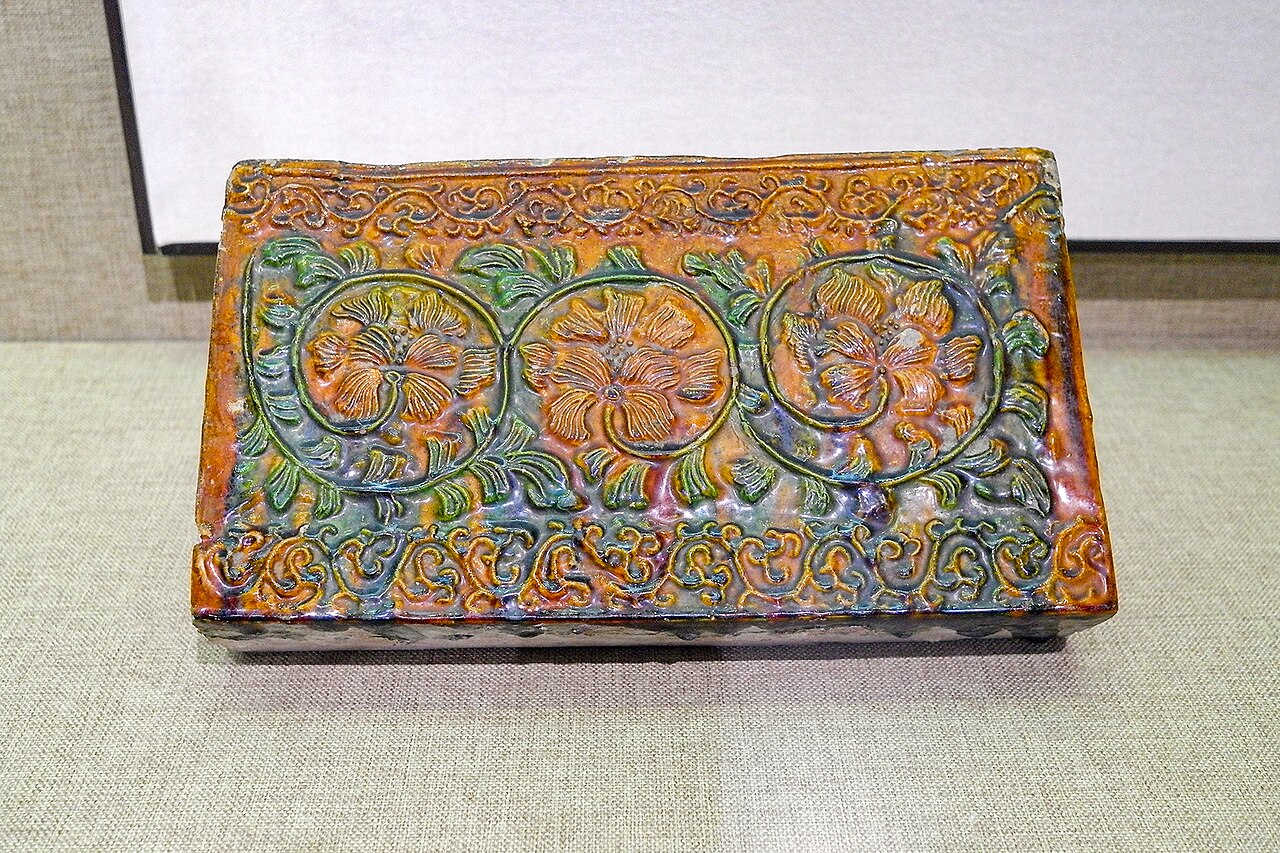
The surface is the reason to come. The bricks carry more than fifty moulded designs, among them standing and seated Buddhas, bodhisattvas, flying apsaras, qilin, musicians, lions and flowers. Glazes run in red, brown, blue and green, with brown dominating. Walk all eight sides slowly and look up storey by storey. The lower levels are where you can make out individual figures without a zoom lens.
What it has survived
Chinese accounts count thirty-eight earthquakes of magnitude six or more and nine Yellow River floods during the pagoda's life. English Wikipedia notes that the foundation rests in Yellow River silt. During the war with Japan, Japanese gunners took it for an observation post and shelled it, damaging the walls. It was repaired and opened to visitors in 1956, and in 1961 it entered the first batch of nationally protected sites. In 1994 it appeared on a two-yuan Chinese postage stamp.
Visiting the park
The pagoda stands inside Iron Pagoda Park, a landscaped ground with a lake, walkways and later halls, close to the old campus of Henan University. Entry is ticketed. Recent visitor reports and travel listings say climbing the inner stair has been closed to protect the structure. Treat the pagoda as a sight you walk around, and check at the gate in case access rules change. The park also closes temporarily in bad weather, as it did for snow in December 2025, so check the day's notice.
Allow about an hour. Morning light falls on the eastern faces, and the Kaifeng guide's tip to come back at dusk for the floodlights is worth following. Bring binoculars or a long lens if you want detail from the upper storeys.
Pairing with the rest of Kaifeng
The pagoda sits near the northeast stretch of the city wall, so a natural half-day runs from the park to the wall and the Daliang Gate area described in the Kaifeng guide. Millennium City Park on the west side of Longting Lake shows a reconstruction of the Song city that built this tower, and it is worth seeing the real Song building first. Evening food is easy at the Gulou or Xisi night markets.
Things to confirm before you go
- Park opening hours and any weather closure.
- Whether climbing the inner stair is allowed.
- Ticket price on the official board.
- Lighting times if you plan to stay into the evening.
Frequently asked questions
Is the Iron Pagoda made of iron?
No. It is brick faced with glazed tiles whose brown colour looks like iron from a distance.
Can you climb it?
Recent reports say the inner stair is closed. Check at the park gate.
How old is it?
The present brick pagoda was completed in 1049, replacing a wooden tower that burned in 1044.
How tall is it?
Chinese sources give 55.88 metres. Some English sources give 56.88 metres.
Sources
Facts in this article were checked against the following sources, retrieved 10 October 2026.
- 开宝寺琉璃塔, Chinese Wikipedia
- Iron Pagoda, English Wikipedia
- Henan Daily on the Iron Pagoda, September 2025
- Kaifeng Bendibao notice on the December 2025 park closure
Photos are from Wikimedia Commons under the licences shown in each caption.