Kaifeng Travel Guide: The Song Dynasty Capital in Three Days
Kaifeng, on the south bank of the Yellow River in Henan, was the capital of the Northern Song, and its best sights all come from that age or try to recreate it: the 1049 Iron Pagoda, Daxiangguo Temple, the Dragon Pavilion on the old palace site, the 14.4 km city wall and Millennium City Park, a theme park built from a famous Song scroll. Two days cover the main sights; three let you add the Zhou Bridge excavation, the evening show and more of the night markets. It's twenty minutes from Zhengzhou by high-speed train.
Some background helps. The city has been known as Daliang, Bianjing, Bianliang and Dongjing over some 4,100 years. The Xia kept a capital here for 217 years, then came the Warring States state of Wei, four of the Five Dynasties and the Northern Song, whose 168 years under nine emperors made it a city of over a million people. Yellow River floods buried each version, so six cities now lie stacked beneath the streets, which locals call chengluocheng, cities piled on cities.
Along the Song axis
Kaifeng's central axis has stayed in the same place since Song times. Three of the sights sit on or beside it.
Millennium City Park
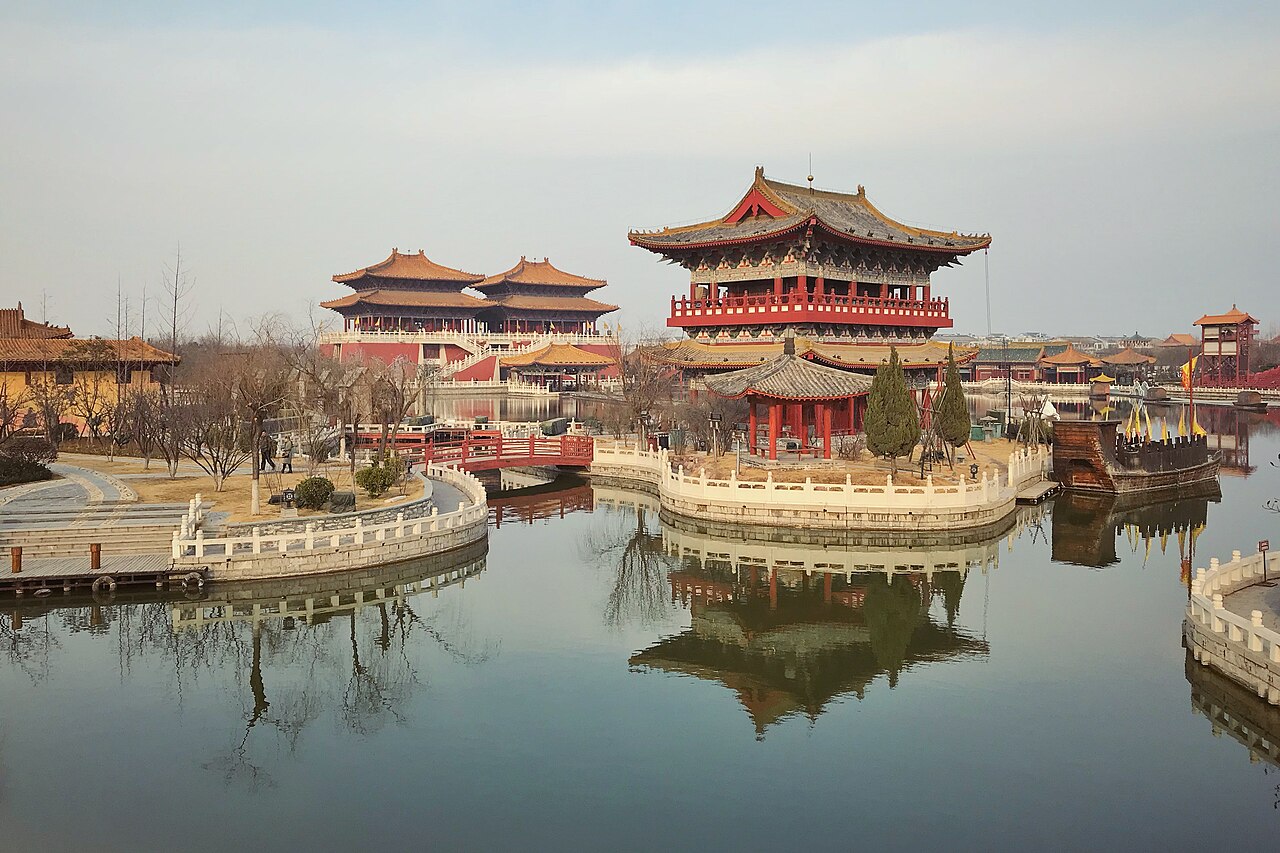
Opened in 1998 on the west bank of Longting Lake, the park is Zhang Zeduan's handscroll "Along the River During the Qingming Festival" built at full size, following the Song building manual Yingzao Fashi. It covers about 40 hectares, 8 of them water. A double pavilion bridge splits it: the south half recreates street life around the Rainbow Bridge, with crafts and snack stalls, and the north half, based on the Qing court version of the scroll, is an imperial garden around Jinglong Lake. It was rated 5A in 2011.
The buildings are modern, and if theme parks aren't your thing, give the time to the wall and Zhou Bridge instead. If you do go, arrive by early afternoon, catch the street acts (times change daily and are posted at the gate), and stay for "The Grand Song Dynasty, Dongjing Menghua", the seventy-minute show on Jinglong Lake with more than 700 performers, which premiered in April 2008. Show tickets are sold separately in seat tiers. The park's usual ticket allows re-entry within three days; the Millennium City Park page has the details, including a single-entry exception during the 2026 National Day holiday.
Longting Park
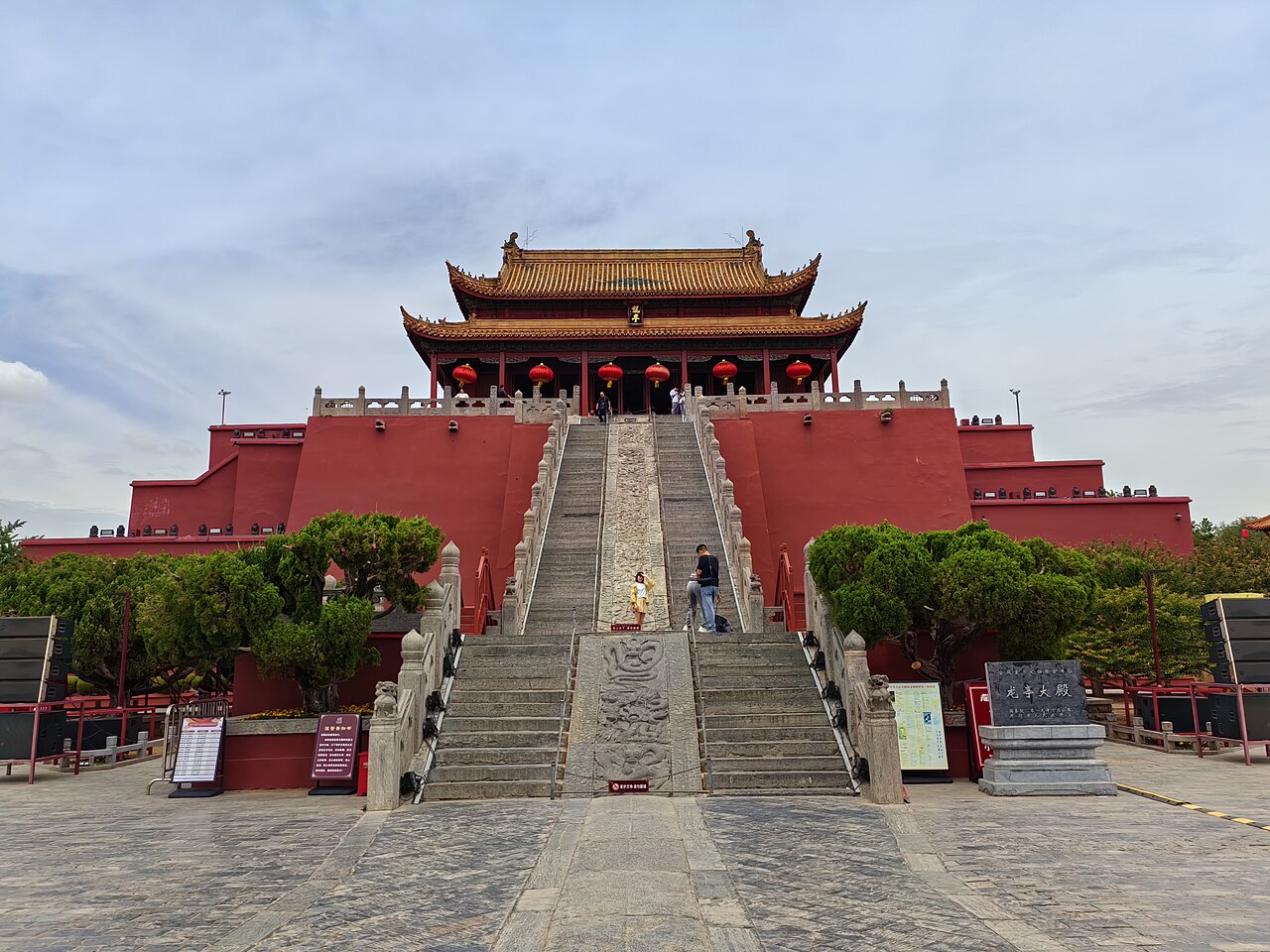
The Dragon Pavilion stands on the site of the Northern Song imperial palace. The Jin destroyed the palace, the Ming built Prince Zhou's mansion here in 1378, and the 1642 flood took that too. In 1692 officials put up a pavilion on the hill holding the emperor's name tablet, where they gathered for imperial birthdays, hence the name. It became the Wanshou Palace in 1743 and was rebuilt to the old design in 1856.
Today's hall is a double-eaved Qing building on a brick terrace reached by seventy-two steps. The avenue in front splits two lakes, named in folklore for the treacherous Pan family and the loyal Yang generals, and locals have joked about their different water colours for centuries. In July 1994 the terrace's rear wall collapsed and the hall tilted north; it was restored that winter with 90% of the original timber reused. It became a nationally protected site in 2019. Go in the morning.
The Zhou Bridge and Bian River site
Five metres under Zhongshan Road, on the axis, archaeologists found the Zhou Bridge, which carried the imperial avenue over the Bian River. Along the banks they uncovered carved stone panels of seahorses, auspicious beasts and clouds, 3.3 metres tall and up to 23.2 metres long, matching the Song memoir Dongjing Meng Hua Lu's description of carved walls "near the bridge on both banks". It was named one of China's top ten archaeological discoveries of 2022. The site now opens to visitors as a public archaeology base; listings give 9:00 to 17:00 with last entry at 16:30, and it closes for occasional maintenance days, as it did on 15 September 2026. Check the day's notice.
The old town
Kaifeng Fu
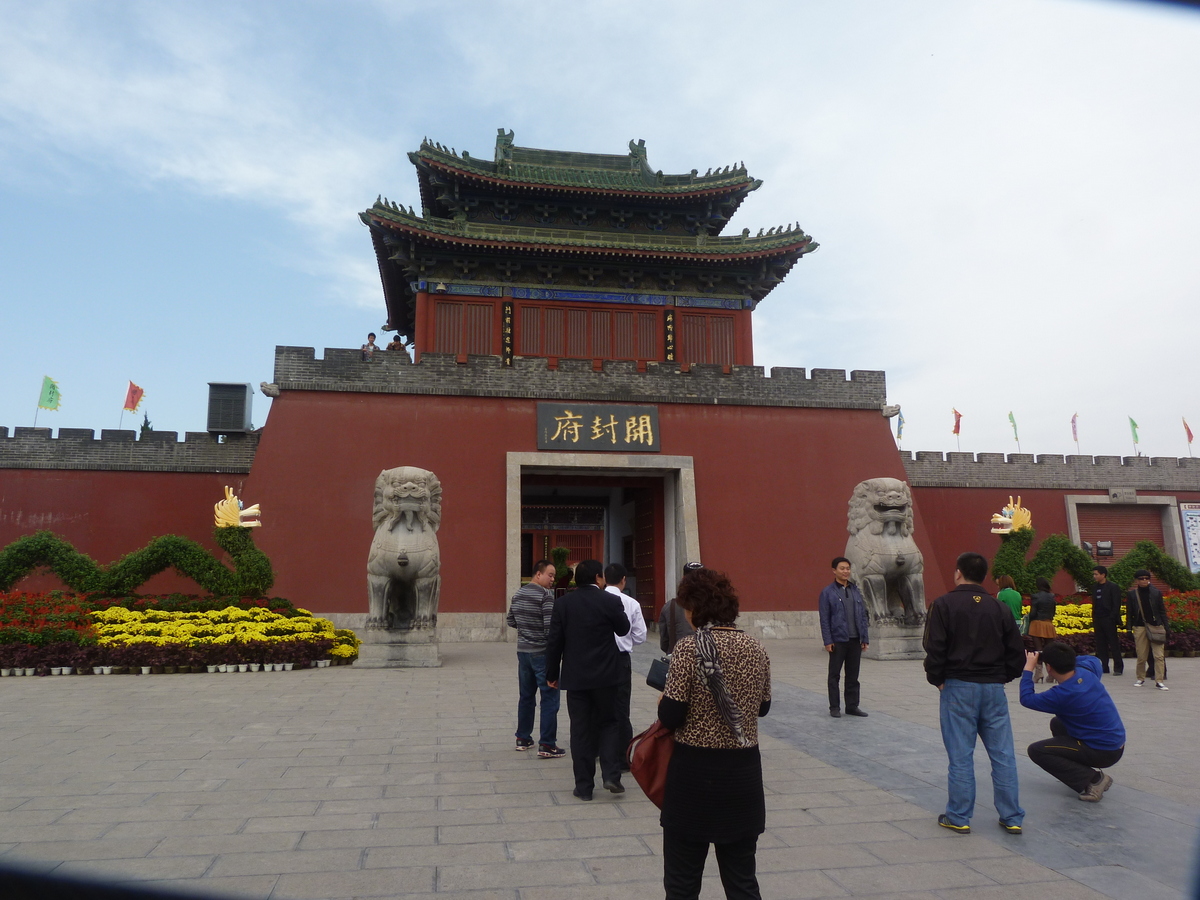
In the Northern Song, Kaifeng Fu was the only prefecture of the capital circuit, and its office stood inside the capital, so it was called the foremost office under heaven. Bao Zheng, the upright judge of opera and legend, served here as acting prefect. The present complex on the north bank of Baogong Lake is a rebuild following the Yingzao Fashi, about 4 hectares with 13,600 square metres of floor space. Gate-opening ceremonies and staged court sessions run through the day; check times at the entrance. The real Bao Zheng was known for blunt memorials to the throne. The black face and crescent brow of the stage came from storytellers centuries later.
Daxiangguo Temple
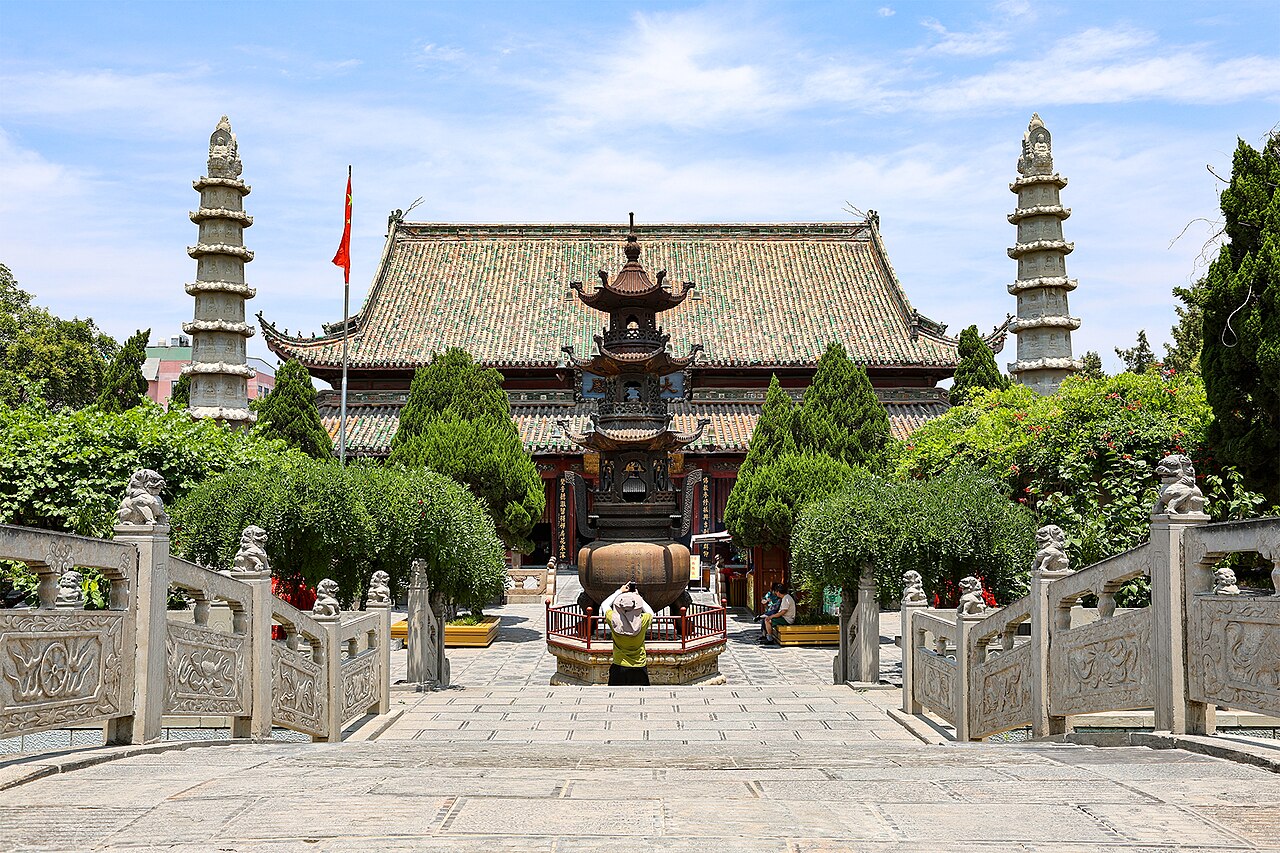
One of the ten great temples of Han Chinese Buddhism, in Gulou district. Tradition puts Lord Xinling's residence on the site. A temple stood here under the Northern Qi, the monk Huiyun rebuilt it in 706, and it took the name Daxiangguo in 712. In the Northern Song it had sixty-four affiliated monasteries, about 36 hectares and thousands of monks, and doubled as the capital's biggest market, which the Dongjing Meng Hua Lu says "opened for trade with the masses five times a month."
The 1642 flood destroyed every building, and most of what you see is Qing. The highlight is the thousand-armed, thousand-eyed Guanyin in the Octagonal Glazed Hall. A statue of Lu Zhishen uprooting a willow marks the Water Margin episode set here. The temple's Buddhist music became national intangible heritage in 2008; if chanting is on, stop and listen.
The northeast: pagoda and wall
The Iron Pagoda
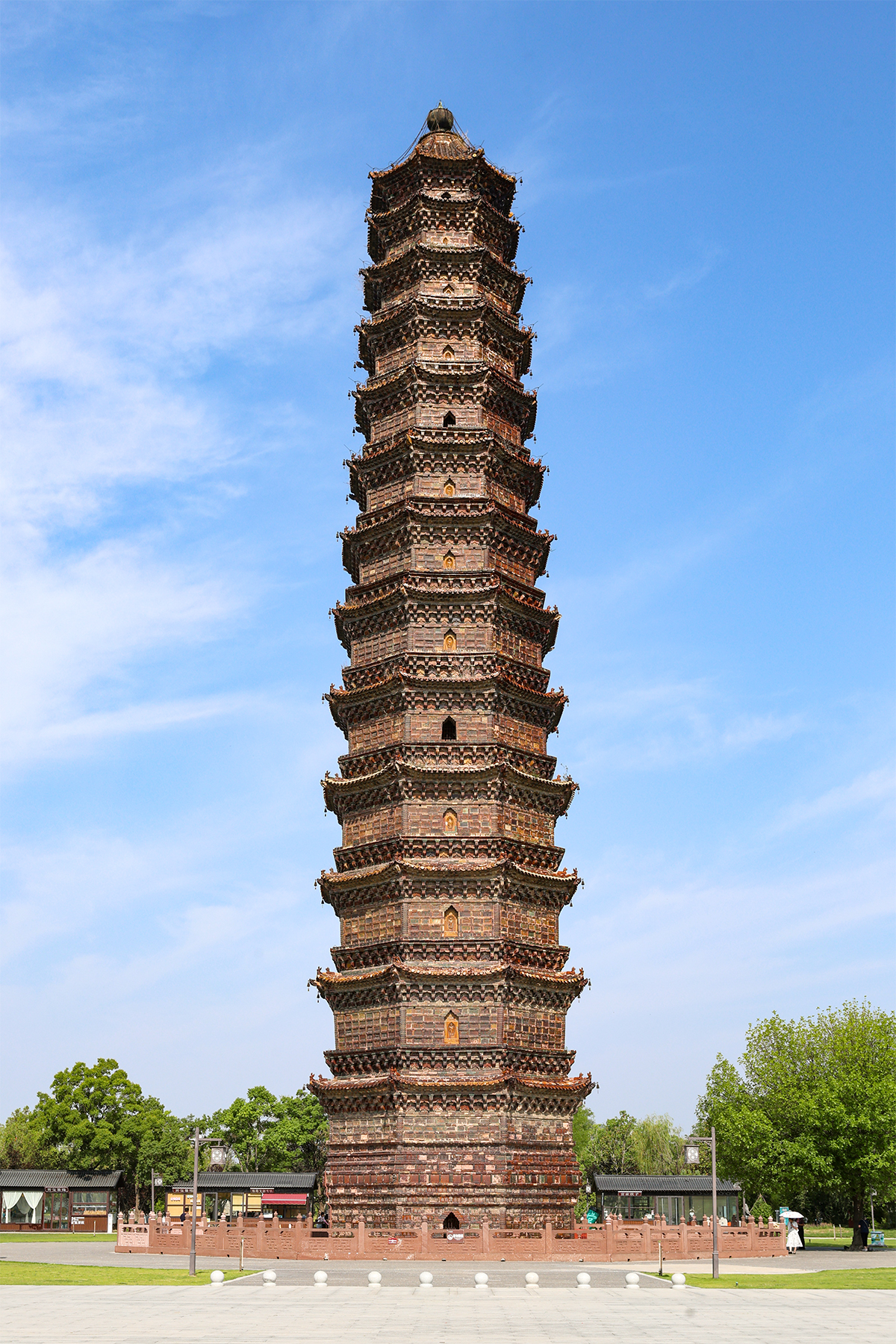
The best piece of real Song architecture in Kaifeng. It's brick, faced with reddish-brown glazed tiles that look like cast iron. It replaced a wooden pagoda by the master builder Yu Hao, finished in 982 at over 120 metres and deliberately leaning northwest; Yu Hao said the constant northwest wind would straighten it within a century. Lightning burned it in 1044, and Emperor Renzong rebuilt it in brick in 1049.
The pagoda is 55.88 metres and thirteen storeys, its bricks moulded with more than fifty designs: Buddhas, flying apsaras, qilin, musicians, lions and flowers. Chinese accounts say it has survived thirty-eight earthquakes of magnitude six or more and nine Yellow River floods, plus Japanese shelling during the war. Recent reports say the inner stair is closed, so plan to walk around it. Come at dusk, when it's floodlit. More on the Iron Pagoda page.
The city wall
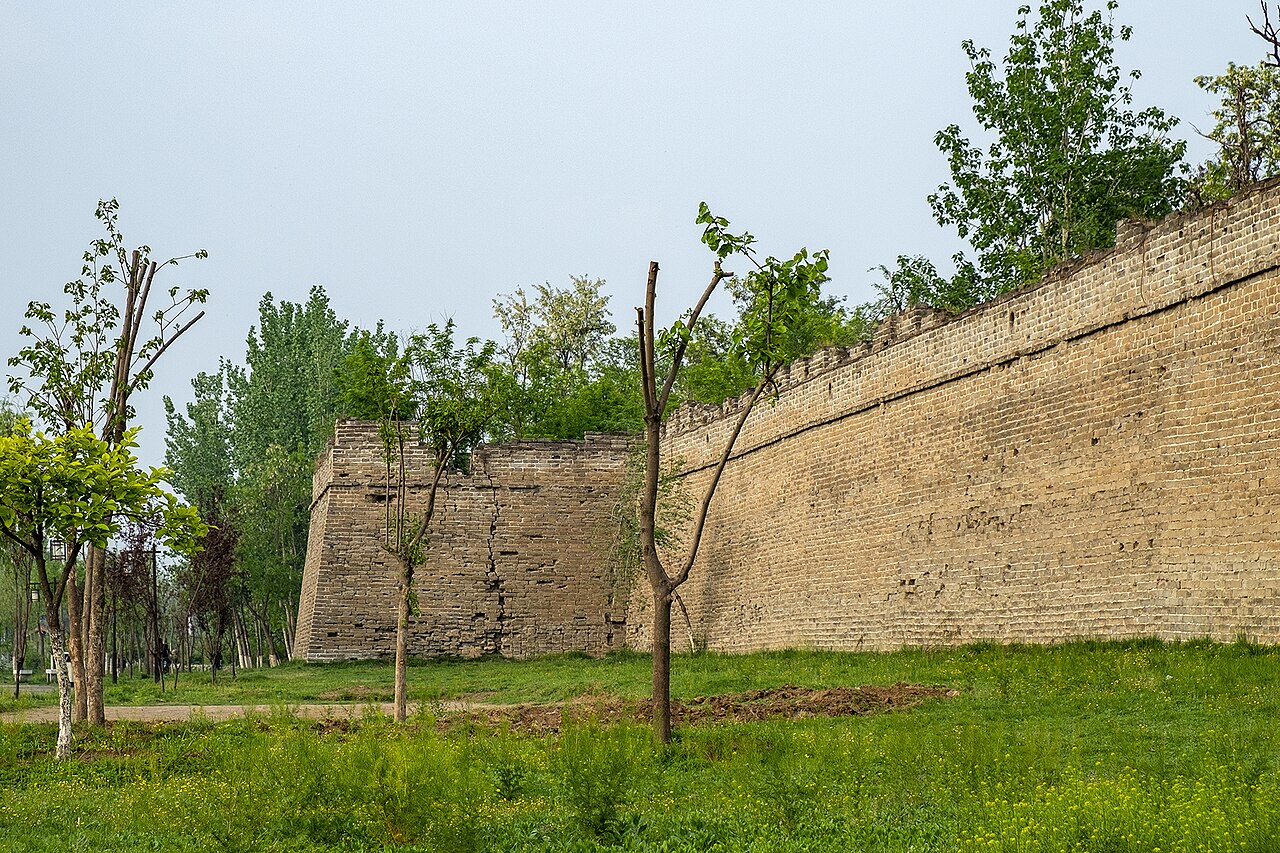
Kaifeng has been walled since 365 BC, when King Hui of Wei moved his capital to Daliang. The wall that survives is a Qing rebuilding, 14.4 km around, second only to Nanjing's among China's surviving city walls, and a national protected site since 1996. Daliang Gate, the west gate, was rebuilt in 1998. Next to it, the ancient horse-track site shows roads from several dynasties stacked on top of each other, the clearest view of the cities-on-cities layering. The city is flat, so cycling stretches of the wall is a good way to spend an afternoon.
When to come to Kaifeng
Spring and autumn. October is the peak, because the chrysanthemum is the city flower and the Chrysanthemum Cultural Festival fills the town with blooms and crowds. The climate is warm-temperate monsoon, averaging about 14 °C with around 640 mm of rain. Summers are muggy, with sudden rain, and winters are dry, cold and windy. Avoid the May Day and National Day weeks if you can, or book rooms and show tickets early.
Getting in and where to stay
- From Zhengzhou: High-speed trains from Zhengzhou East reach Kaifeng North in about twenty minutes. The Zhengzhou–Kaifeng intercity line stops at Songcheng Road, closer to the old town. Either works as a day trip.
- Air: Fly into Zhengzhou Xinzheng International Airport and take the train onward.
- In town: Buses and ride-hailing cover everything, and the old town is compact enough to walk or cycle.
Stay inside the walls near Gulou or Longting, so the night markets and morning sights are on foot.
Eating in Kaifeng
The signature is guantang bao, soup dumplings with thin skins and hot broth: bite a hole first, then sip. The old First Building restaurant has queues; neighbourhood shops are just as loyal. Liyu beimian is the banquet dish, sweet-and-sour carp under a nest of fine fried noodles. Tongzi chicken, salted and chewy, is best from old shops. The night markets are the heart of it: Gulou and Xisi come alive at dusk with almond tea, peanut cake, fried liangfen and braised fish soup, and a full crawl costs little. Have the big dishes at lunch and save the evening for the markets.
How to arrange the route
Day 1: Longting in the morning, then Millennium City Park from early afternoon through the evening show.
Day 2: Kaifeng Fu's gate-opening ceremony, soup dumplings near Gulou, Daxiangguo Temple in the afternoon, the Gulou night market at dusk.
Day 3: The Iron Pagoda in the morning, the wall at Daliang Gate and the horse-track site in the afternoon, and the Zhou Bridge site before it closes at 17:00.
From Zhengzhou, Luoyang is forty minutes further west, and many people do both old capitals on one trip; Xi'an is next. East on the plain, Shangqiu has an old walled prefecture town at a quieter scale.
What to cut if short on time
With one day, do the Iron Pagoda, Daxiangguo Temple and Longting, then the night market. Millennium City Park needs half a day at least, so it's the first cut if you don't care for recreated streets. Kaifeng Fu is also a rebuild and can go.
Things to confirm before you go
- Performance and show times at Millennium City Park, which change daily.
- The three-day entry rule, which can be suspended on holidays.
- Zhou Bridge site maintenance closures.
- Whether the Iron Pagoda stair is open.
- Crowds during the chrysanthemum festival and golden weeks.
Frequently asked questions
How many days for Kaifeng?
Two days cover the main sights; three fit the evening show, the night markets and the Zhou Bridge site comfortably.
Is Millennium City Park worth it?
If you like the idea of walking through a famous painting, with street acts by day and a big show at night, yes. It's modern, so history purists should prioritise the pagoda and wall.
Can I visit the Zhou Bridge site?
Yes. It opens as a public archaeology base, with listings giving 9:00 to 17:00, but it closes for occasional maintenance days, so check the notice first.
How do I get to Kaifeng from Zhengzhou?
High-speed rail from Zhengzhou East to Kaifeng North takes about twenty minutes; the intercity line to Songcheng Road is closer to the old town.
Sources
The facts in this article were checked against the following sources, retrieved September 1, 2026, and rechecked on October 18, 2026.
- Kaifeng (city) https://zh.wikipedia.org/wiki/开封市
- Millennium City Park https://zh.wikipedia.org/wiki/清明上河园
- Kaifeng Fu https://zh.wikipedia.org/wiki/开封府
- Daxiangguo Temple https://zh.wikipedia.org/wiki/大相国寺
- Kaibao Temple Pagoda https://zh.wikipedia.org/wiki/开宝寺琉璃塔
- Longting (Kaifeng) https://zh.wikipedia.org/wiki/龙亭公园
- Kaifeng city wall https://zh.wikipedia.org/wiki/开封城墙
- Zhou Bridge site maintenance closure notice, September 2026 https://finance.sina.com.cn/wm/2026-09-13/doc-inirrpaq5954489.shtml
- Zhou Bridge and Bian River site listing (opening hours) https://sight.qunar.com/1629482437
The Zhou Bridge and Bian River site has no Chinese Wikipedia entry yet; its excavation results were verified against Xinhua, People's Daily and Henan provincial cultural-relic reports, including the 2022 top-ten archaeological discoveries announcement.
All photos are from Wikimedia Commons, used under CC licenses; re-use requires attribution.
- kaifeng-city.jpg from File 20250622 Dragon Pavilion 01.jpg, by Windmemories, CC BY-SA 4.0
- kaifeng-qingmingyuan.jpg from File Millennium City Park 02.jpg, by Windmemories, CC BY-SA 4.0
- kaifeng-kaifengfu.jpg from File 河南开封府.JPG, by Gisling, CC BY-SA 3.0
- kaifeng-daxiangguo.jpg from File 20250622 Xiangguo Temple 07.jpg, by Windmemories, CC BY-SA 4.0
- kaifeng-tieta.jpg from File 20250622 Iron Pagoda Park 07.jpg, by Windmemories, CC BY-SA 4.0
- kaifeng-longting.jpg from File 20250531 Long Ting.jpg, by Yumeto, CC BY-SA 4.0
- kaifeng-chengqiang.jpg from File 20140419 Kaifeng City Wall.jpg, by Windmemories, CC BY-SA 4.0