Anyang Travel Guide: Yinxu, the Museum of Chinese Writing and the Red Flag Canal
Anyang, in the far north of Henan, is where Chinese writing enters history. Yinxu, the "Ruins of Yin" on the edge of the city, was the last capital of the Shang dynasty from about 1250 to 1046 BC, and the source of the inscribed oracle bones that hold the earliest known Chinese script. It has been a UNESCO World Heritage Site since 2006. Plan one full day for Yinxu: the new Yinxu Museum, opened in 2024, then the palace and temple area with Fu Hao's tomb, and the royal tombs if you have energy left. A second day covers the National Museum of Chinese Writing and the city's odd upside-down pagoda. Add a third for the Red Flag Canal in the Taihang Mountains.
How Yinxu was found
For three thousand years the Shang capital was a legend. Then in 1899 Wang Yirong, a scholar at the Imperial Academy in Beijing, noticed carved characters on "dragon bones" sold as medicine. The trade was traced to the village of Xiaotun outside Anyang, and in 1928 the first scientific excavations began. They found palace foundations, royal tombs and more than 100,000 oracle bones: ox shoulder blades and turtle shells used for divination, with the questions and answers carved into them. Inscriptions with the names of Shang kings matched the genealogy written down by Sima Qian a thousand years later. Digging continues today. The site covers about 30 square kilometres on both banks of the Huan River, the largest archaeological site in China.
When to come to Anyang
North Henan has hot summers and cold, dry winters. April to May and September to October are the most comfortable months for the outdoor parts of Yinxu. In summer, see the museum in the morning and the ruins late in the afternoon. In winter the galleries are fine, but the open sites are windy. The new museum is very busy during the National Day holiday in early October, so book ahead or avoid those dates.
Getting in and where to stay
Anyang is on the Beijing–Guangzhou rail corridor, with Anyang East on the high-speed line and Anyang station on the conventional line; check which one is on your ticket. Trains are quick from Zhengzhou, Shijiazhuang and Beijing. Taxis run from either station to Yinxu, and buses serve the main sites.
Stay in the city centre for restaurants and the pagoda, or near the station if you are moving on early.
Places worth visiting
Yinxu Museum
Start here. The new museum building, opened in 2024, shows nearly 4,000 objects: bronzes, jades, oracle bones and the tools that made them, with digital displays that let you read the inscriptions. Seeing the bones and bronzes first gives the outdoor ruins, which are mostly earth platforms and pits, the context they need. Tickets and timed entry are on the official booking channel, and holidays sell out. Real-name booking, the free shuttle to the royal tombs and a one-day plan are on the Yinxu page.
Palace and temple area and Fu Hao's tomb
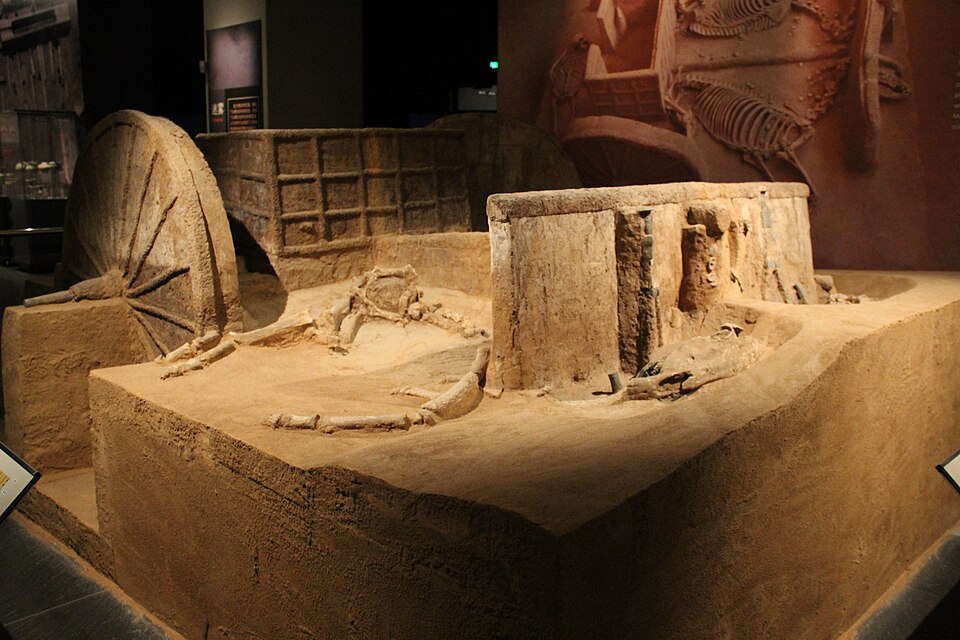
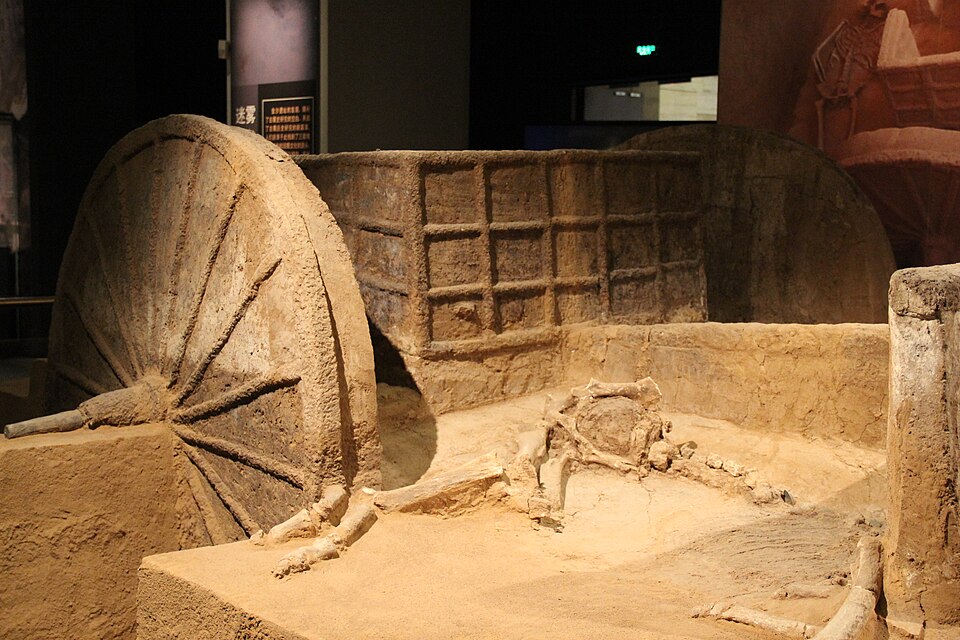
The palace and ancestral temple area around Xiaotun was the heart of the city. Excavations have found more than 80 rammed-earth foundations here. The highlight is the tomb of Fu Hao, a wife of King Wu Ding and a military commander in her own right, found in 1976. It is the only Shang royal tomb found intact, with 1,928 objects, including 468 bronzes and 755 jades, as well as 16 sacrificed people and six dogs. Nearby halls show chariot pits with horses, among the earliest wheeled vehicles found in China, and the storage pits where oracle bones were buried.
The royal tombs
North of the Huan River, near the villages of Houjiazhuang and Wuguan, is the royal cemetery: 13 great tombs and more than 2,000 sacrificial and chariot pits. The scale of human sacrifice is sobering. The largest tomb held over 160 victims. The Houmuwu ding, the heaviest ancient Chinese bronze ever found, came from this area. It is a separate stop from the palace area; go if you have a full day and the stamina.
National Museum of Chinese Writing
On Renmin Avenue in the city, this museum opened in 2009 and is devoted entirely to writing, from oracle bones to modern scripts and the minority writing systems of China. The building is shaped like an ancient character, and two golden "dark birds" at the entrance recall the legend of the bird that gave birth to the Shang. Allow two or three hours.
Wenfeng Pagoda
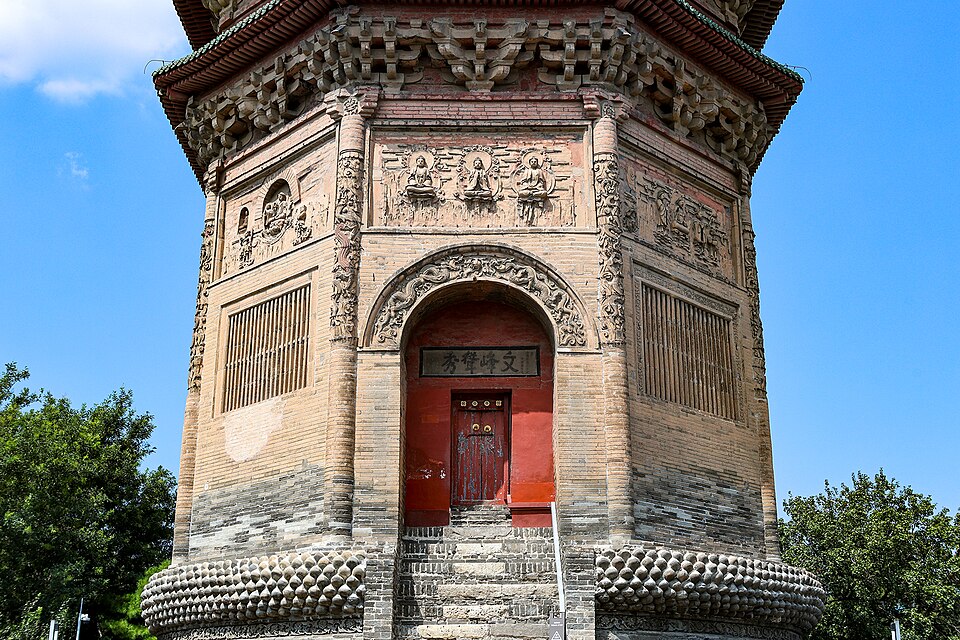
The brick pagoda of Tianning Temple, built in 952 and later renamed Wenfeng Pagoda, is 38.65 metres tall and gets wider as it rises, a shape rare in China, topped with a Tibetan-style stupa added in the Qing. Look for the brick reliefs of the Buddha's life around the base. A steep stair of 72 steps leads to a platform at the top. It is in the old centre and takes about an hour.
Red Flag Canal
About 80 kilometres northwest of the city, in Linzhou, the Red Flag Canal was dug by hand in the 1960s to bring water from the Zhang River along the cliffs of the Taihang Mountains. The main channel, finished in 1965, is 71 kilometres long with 42 tunnels. It became a national symbol of self-reliance, and the cliff-edge path and memorial hall are now a major sight. It is a full day by car or tour bus. The Youth Tunnel, Fenshuiyuan and Luositan are described on the Red Flag Canal page.
Eating in Anyang
North Henan food is wheat-based: noodles, steamed buns and dumplings. Look for local breakfast specialities in the old-town lanes around the pagoda and Beidajie, and for noodle shops and canteens full of locals at lunch. Skip the oracle-bone-themed snacks by the museum unless you want a souvenir.
How to arrange the route
- Day one: Yinxu Museum in the morning, the palace area and Fu Hao's tomb after lunch, the royal tombs if time allows.
- Day two: the Museum of Chinese Writing, then the Wenfeng Pagoda and an evening in the old centre.
- Day three: Red Flag Canal, or move on. Handan is to the north; Hebi and Xinxiang are to the south.
Yinxu complements Luoyang rather than competing with it: Anyang is Bronze Age, Luoyang is the Han to Tang capitals and the Longmen Grottoes.
What to cut if short on time
With one day, do the Yinxu Museum and the palace area and skip everything else. Next to drop are the royal tombs, then the Red Flag Canal. Keep the Museum of Chinese Writing if you have half a day more; it suits a rainy day.
Things to confirm before you go
- Yinxu Museum booking, opening hours and photography rules.
- Whether the palace area and royal tombs share a ticket and how you get between them.
- Which Anyang station your train uses.
- Transport and tickets for the Red Flag Canal.
Frequently asked questions
How long do I need at Yinxu?
A full day for the museum and the palace area, a little more if you add the royal tombs.
Should I see the museum or the ruins first?
The museum. The outdoor site is mostly foundations and pits, and the objects indoors give it meaning.
Is Anyang worth it if I have already been to Luoyang?
Yes, if you are interested in early China and the origins of writing. The two cities cover very different periods.
Sources
The facts in this article were checked against the following Wikipedia and encyclopedia entries, retrieved September 18, 2026, and rechecked on October 14, 2026.
- Anyang https://en.wikipedia.org/wiki/Anyang
- Yinxu https://en.wikipedia.org/wiki/Yinxu
- Yinxu (Chinese) https://zh.wikipedia.org/wiki/殷墟
- Oracle bone https://en.wikipedia.org/wiki/Oracle_bone
- National Museum of Chinese Writing (Chinese) https://zh.wikipedia.org/wiki/中国文字博物馆
- Wenfeng Pagoda https://en.wikipedia.org/wiki/Wenfeng_Pagoda
- Red Flag Canal https://en.wikipedia.org/wiki/Red_Flag_Canal
Museum tickets and open areas change; check the official notices before you go.
All photos are from Wikimedia Commons, used under CC or public-domain terms; re-use requires attribution.
- anyang-yinxu-chariot.jpg from File:Shang Chariot from Yinxu (Anyang) 03.jpg, by Gary Todd, CC0
- anyang-yinxu-2.jpg from File:Shang Chariot from Yinxu (Anyang) 01.jpg, by Gary Todd, CC0
- anyang-tianning.jpg from File:20250831 Tianning Temple Pagoda, Anyang 03.jpg, by Windmemories, CC BY-SA 4.0