Caishi Rock
Where the Yangtze narrows on the western edge of Ma'anshan, a wooded hill called Cuiluo Shan pushes a cliff out into the river. This is Caishi Ji, Caishi Rock, counted as the first of the three famous rocks of the Yangtze, alongside Yanziji in Nanjing and Chenglingji near Yueyang. For centuries it mattered for two reasons. Armies crossed the river here, and poets came to remember Li Bai, who according to legend drowned at this spot reaching for the moon. Today it is a national 5A scenic area of paths, pavilions and memorial halls on the hill.
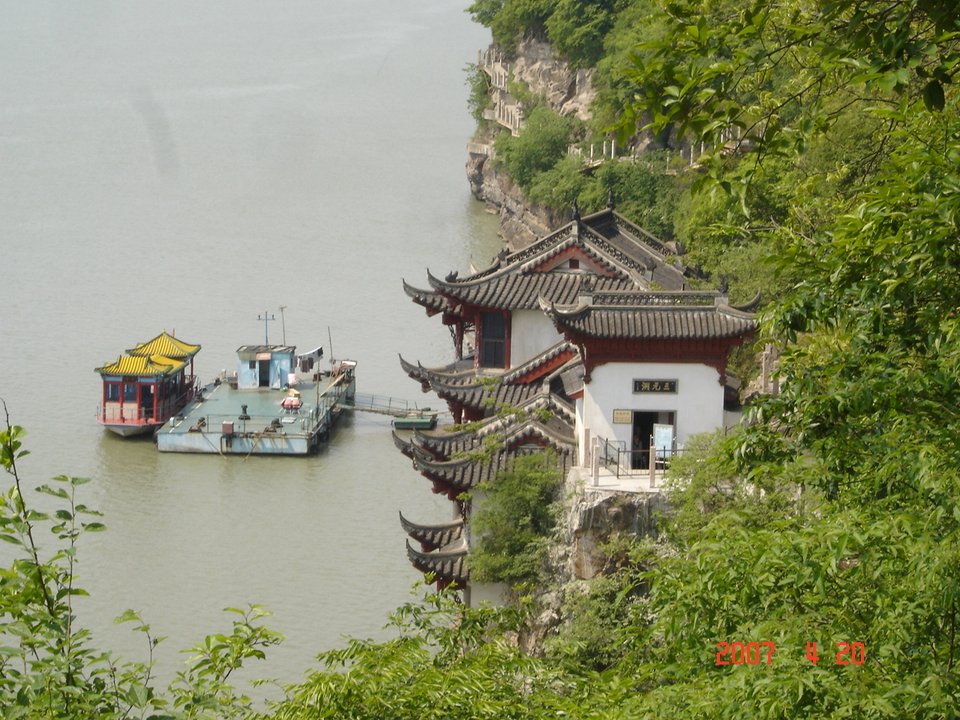
A crossing point
Chinese Wikipedia says the rock was first called Niuzhu Ji and took the name Caishi in the Three Kingdoms period. Because the river is narrow and the bank steep, it was a key point in the defence of the lower Yangtze. In 974 the Song army crossed here on its way to conquer the Southern Tang.
The most famous battle came in 1161. The Jin emperor Wanyan Liang marched south to finish off the Southern Song and chose Caishi for his crossing. English Wikipedia describes a naval battle on 26 and 27 November 1161 in which a Song force of about 18,000 under the civil official Yu Yunwen, who happened to be at Caishi to hand out rewards to the troops, beat back a much larger Jin army. The Song paddle wheel warships carried trebuchets that threw bombs of gunpowder and lime. Soon after the defeat Wanyan Liang was murdered by his own officers, and the Southern Song survived for more than another century.
Li Bai and the moon
Li Bai, the Tang poet, spent his last years in Dangtu, now part of Ma'anshan, staying with a relative who was the county magistrate. English Wikipedia says he died there in 762, with the date and cause lost. One story says he fell from a boat while drunk, trying to embrace the reflection of the moon in the Yangtze, and Caishi is the place where that story is set. Whether or not it happened, visitors have been coming ever since.
Not all of them were welcome. Chinese Wikipedia tells how so many admirers wrote their own poems on the cliff that the Ming writer Mei Zhihuan added a verse of his own mocking them, saying that to scrawl verses at Li Bai's grave was like showing off with an axe at the door of Lu Ban, the master carpenter. The line is still quoted as a proverb.
The scenic area keeps a cenotaph for Li Bai, a tomb holding his clothes and cap on the south side of the hill. His actual grave is elsewhere, at the Li Bai culture park in Dangtu County, which Wuhu Bendibao describes as the true tomb.
The Taibai Tower
The best known building is the Taibai Tower, named after Li Bai's courtesy name and counted among the famous towers on the Yangtze. Sources on its history say it began in the Yuanhe reign of the Tang, between 806 and 820, as the Zhexian Tower, the tower of the banished immortal, which was Li Bai's nickname. It was rebuilt in the Ming, burned in the early Qing, rebuilt again and renamed, and destroyed during the Taiping war. The building standing today dates from 1877, when the official Peng Yulin paid to rebuild it. Inside are statues and exhibits on Li Bai.
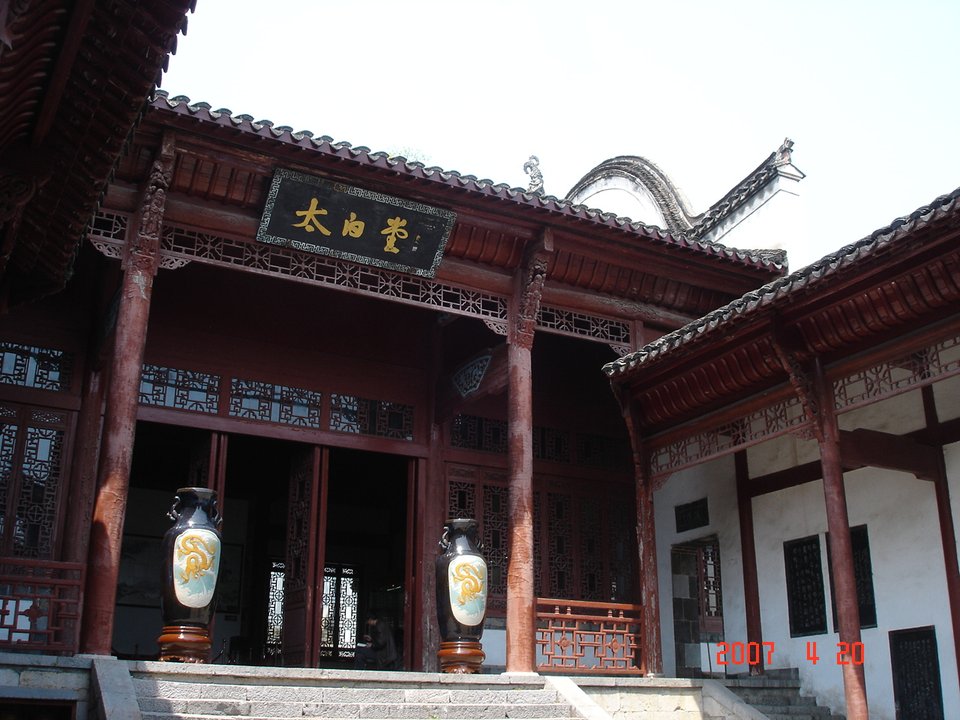
Walking the hill
Chinese Wikipedia lists the Taibai Tower, Sanyuan Cave and the Lianbi Terrace as the main old sites. Wuhu Bendibao, writing in March 2026, suggests a loop that covers them all. Enter by the east gate, pass the Wanzhuwu bamboo garden and the Lin Sanzhi art museum, then the Zhexian garden and the Taibai Tower. From there climb Cuiluo Shan or ride the ropeway to the Santai Pavilion at the top, follow the riverside boardwalk to Sanyuan Cave, a small temple built into the cliff over the water, continue to the Lianbi Terrace and the Li Bai cenotaph, and leave by the east gate. Bendibao says the climb takes about thirty minutes at a normal pace and recommends starting from the path beside the Taibai Tower.
The scenic area is large, so families with small children or anyone short of energy may want the sightseeing bus.
Tickets and hours
The official scenic area site lists the adult ticket at 68 yuan. A 34 yuan concession applies to children over 1.2 metres, people aged 60 to 64 and full time students. Children 6 and under or 1.2 metres and below, people aged 65 and over, local residents, serving soldiers, firefighters and people with disabilities go free with ID. The sightseeing bus costs 20 yuan one way or 30 return and runs 8:30 to 17:00. The ropeway costs 30 yuan one way and runs 8:30 to 16:30.
Bendibao gives closing times as 17:30 on ordinary weekdays, with the indoor sights such as the Taibai Tower and Sanyuan Cave closing at 17:15, and 18:00 on weekends and public holidays, with the indoor sights closing at 17:45. In early 2026 entry was free with advance booking until 31 March as part of a promotion, which has now ended. Check the day's notice. The tourist information number is 0555 3366666.
Getting there
The scenic area is on Jiuhua West Road in Yushan district, on the river west of the city centre. A taxi from Ma'anshan station is quick. Ma'anshan is close enough to Nanjing for a day trip, and English Wikipedia says Nanjing Metro line S2 now runs to Ma'anshan; check the current route before relying on it. Guangji Temple in Wuhu is less than an hour away by road.
Frequently asked questions
How long should I allow?
Half a day for the full loop, or two hours for the Taibai Tower and Sanyuan Cave.
Is Li Bai buried here?
No. Caishi has a cenotaph. His grave is at the Li Bai culture park in Dangtu County.
Should I take the ropeway?
It saves the climb to the Santai Pavilion, though the walk up takes only about half an hour.
Sources
Facts in this article were checked against the following sources, retrieved 23 October 2026.
- 采石矶, Chinese Wikipedia
- Battle of Caishi, English Wikipedia
- Li Bai, English Wikipedia
- Ma'anshan, English Wikipedia
- Caishi scenic area official site, tickets and services
- Wuhu Bendibao, Ma'anshan scenic areas in 2026
- Shici Daquan, history of the Zhexian Tower and Taibai Tower
- Ma'anshan travel guide on this site
Photos are from Wikimedia Commons under the licences shown in each caption.