Tianzhu Mountain
Tianzhu means pillar of heaven, and the main peak of this range in Qianshan, northwest of Anqing, earns the name. It is a column of pale granite, 1,489.8 metres high according to Chinese Wikipedia, rising above a sea of smaller domes and spires. The mountain is less famous abroad than Huangshan, a few hours' drive to the southeast, and much quieter on most days, yet it has a longer religious history and it gave Anhui its one character abbreviation, Wan.
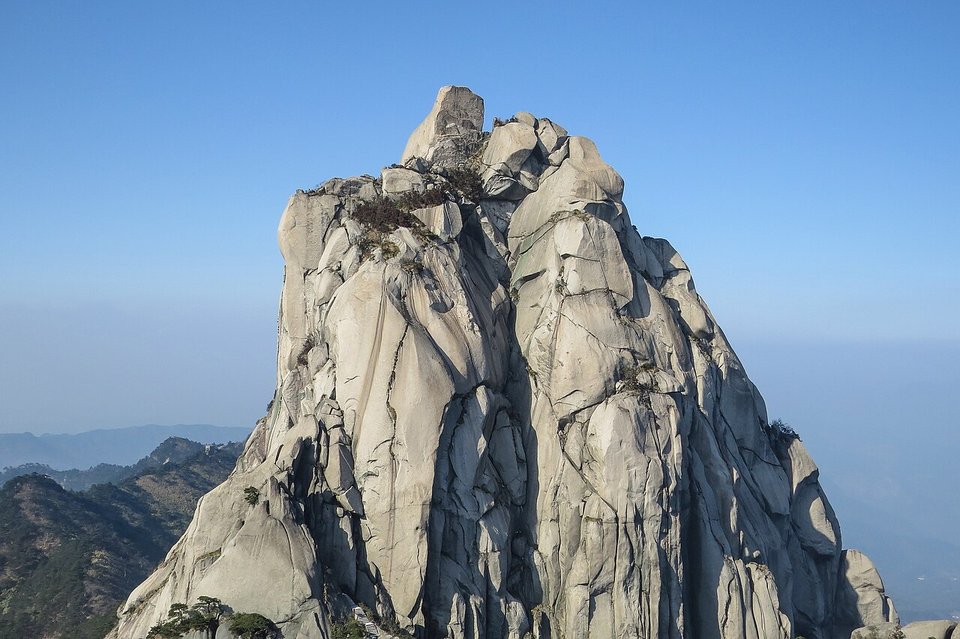
A sacred mountain for seven centuries
In the Spring and Autumn period the land around today's Qianshan was the small state of Wan. The mountain was called Wan Shan and the river Wan Shui, and Chinese Wikipedia explains that the abbreviation for Anhui comes from here. The mountain was also known in ancient times as Huo Shan.
In 106 BC, on a tour of the south, Emperor Wu of Han found the Southern Sacred Mountain, Hengshan in Hunan, too far away, and moved its sacrifices to this peak, which already ranked as Hengshan's deputy. Crowds at the rites shouted long life to the emperor, so the mountain was also called Wansui Shan. It kept the role until the Sui emperor Wen ended it, after which the title went back to Hengshan.
Poets kept coming. Chinese Wikipedia lists Li Bai, Bai Juyi, Su Shi, Wang Anshi and Huang Tingjian among the writers who praised it or left inscriptions. Bai Juyi wrote that the one peak of Tianzhu holds up the sun and moon. Taoists count the mountain as the fourteenth of their thirty six grotto heavens, and in Chan Buddhism it is linked to the second patriarch Huike and the third patriarch Sengcan, who both practised here.
The rock
Chinese Wikipedia says the range is an eastern spur of the Dabie Mountains, where they meet the Yangtze plain. Granite intruded deep underground about 128 million years ago, and around 60 million years ago movement on the Tanlu fault lifted the western side and brought it to the surface, together with what Chinese Wikipedia calls the largest ultra high pressure metamorphic belt in China. Erosion did the rest. The scenic area covers 333 square kilometres, with a core of 82.46. It was among the first national scenic areas, is a national forest park, and has been rated 5A since 2011. Chinese Wikipedia gives its forest cover as 97 percent.
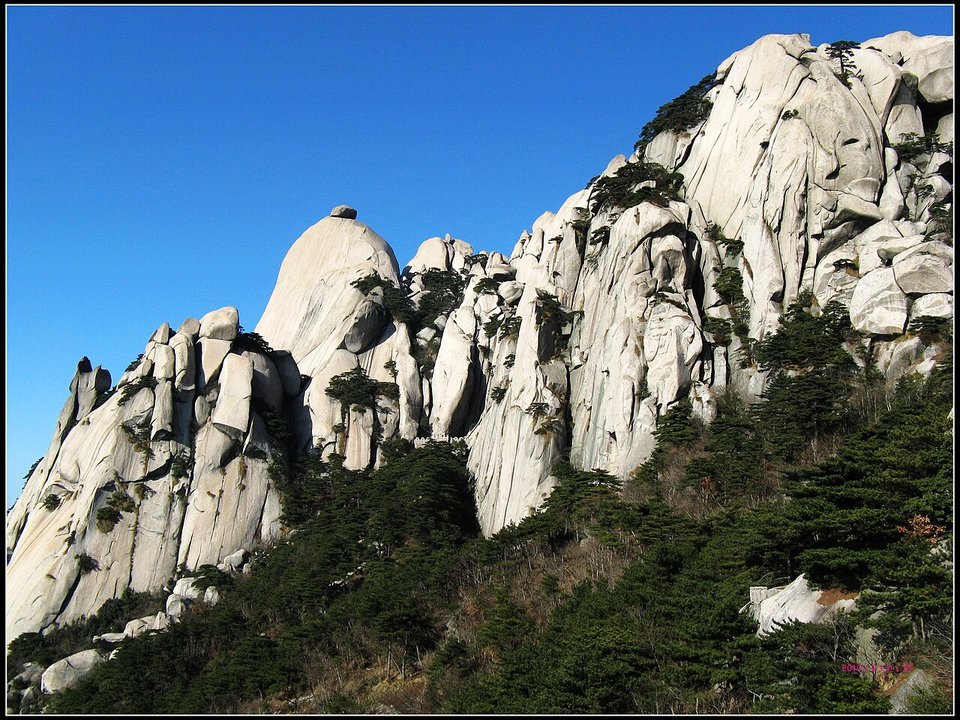
What to see on the mountain
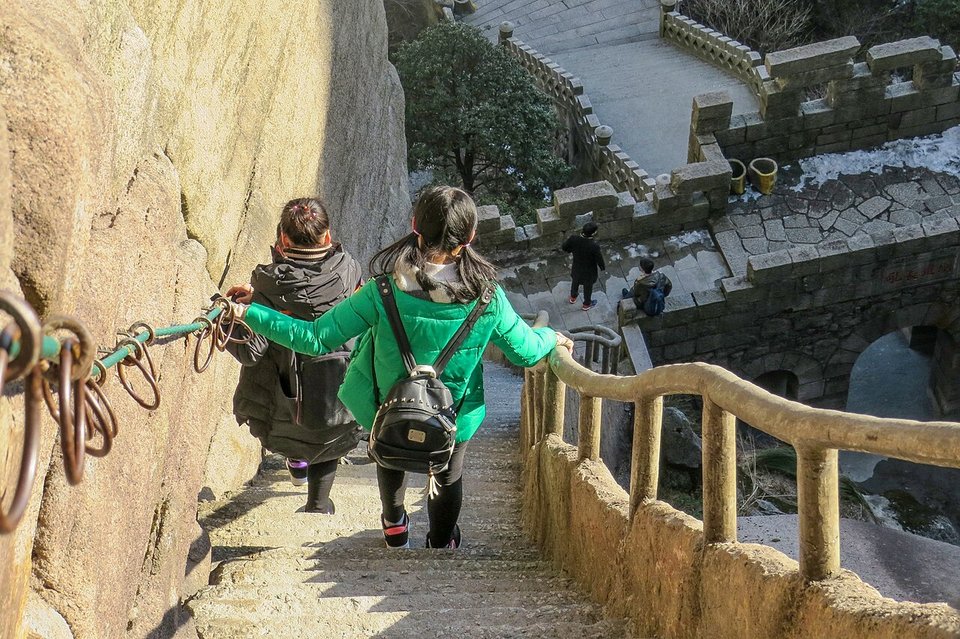
The named sights on the upper mountain include Tianzhu Peak itself, Feilai Peak, Tianchi Peak, Penglai Peak, the Hundred Step Ladder cut into the rock, the Mysterious Valley, the Qinglong Bei ridge, Liandan Lake and the Great Heavenly Gate. Paths link them with plenty of stone stairs, some steep and exposed. Some paths close for weather or maintenance, so ask at the visitor centre which routes are open.
Three ropeways lift visitors from the foot of the mountain, at Longtanhe, Dalongwo and Muyanghe, so you can ride up one and walk down another. A common plan is to ride up, walk the high circuit and descend by a different ropeway or on foot.
Inscriptions and Sanzu Temple at the foot
Save time for the foot of the mountain on the way down. Chinese Wikipedia says nearly 400 inscriptions survive on the rocks, from the Tang Zhenyuan reign in the late 8th century to the Republic, most of them at Shiniu Gudong, the stone ox gorge, inside what is now the Shangu Liuquan culture park.
Nearby is Sanzu Temple, the temple of the third patriarch. Chinese Wikipedia says it was founded under Emperor Wu of Liang, that Sengcan died here standing upright and passed the robe to the fourth patriarch Daoxin, and that in 758 Emperor Suzong of Tang named it Sanzu Shangu Qianyuan Chan Temple. Its Jueji Pagoda is the temple's best known building, and it remains a national key temple.
Tickets, booking and hours
Anhui's official government news account published the 2026 prices in March. The adult ticket is 130 yuan from 16 March to 15 November and 110 yuan from 16 November to 15 March, with half price tickets at 65 and 55 yuan. The return park bus is 30 yuan. The Longtanhe ropeway costs 85 yuan up and 75 down, Dalongwo 80 up and 60 down, and Muyanghe 40 each way. The Shangu Liuquan culture park and the geological museum are 20 yuan each. People aged 65 and over and children 6 and under or 1.2 metres and below enter free but must buy accident insurance of 5 yuan. People aged 60 to 64, minors over 6 and full time students pay half.
The scenic area's operating notice for 7 May to 30 September 2026 set the main area's hours at 7:00 to 18:00 on weekdays and 7:00 to 18:30 at weekends, with ticket sales and entry at the visitor centre stopping at 15:00 on weekdays and 15:30 at weekends. The ropeways ran 7:30 to 17:30 on weekdays and 7:00 to 18:00 at weekends. The geological museum opens 9:00 to 17:00 and closes on Mondays. Hours for late autumn and winter may differ, so check the day's notice.
All visitors must book tickets in their own name through the official platform, ideally at least a day ahead, and show the same ID at the gate. The scenic area caps daily visitors and stops sales when the cap is reached. The visitor hotline is 400 0556 900.
Getting there
Qianshan Station is on the high speed line. The notice lists a scenic area express bus from the station to the Chazhuang visitor centre from 7:50 to 17:00, and a bus from central Qianshan. From Anqing city, allow about an hour by road. Start early, because the afternoon entry cut-off comes sooner than you might expect.
In Anqing itself, Yingjiang Temple and its pagoda fill an easy half day.
Frequently asked questions
How long does it take?
A full day with the ropeway. Hikers walking both ways need an early start and good legs.
Tianzhu or Huangshan?
Huangshan is bigger and more famous. Tianzhu is less crowded and has the deeper history.
Do foreigners need to book?
The booking rule applies to everyone. Bring your passport.
Sources
Facts in this article were checked against the following sources, retrieved 23 October 2026.
- 天柱山, Chinese Wikipedia
- 三祖寺, Chinese Wikipedia
- Tianzhu Mountain scenic area, operating notice for May to September 2026
- Anhui Fabu on NetEase, Tianzhu Mountain 2026 tickets and free entry rules
- Anqing travel guide on this site
Photos are from Wikimedia Commons under the licences shown in each caption.