Yingjiang Temple
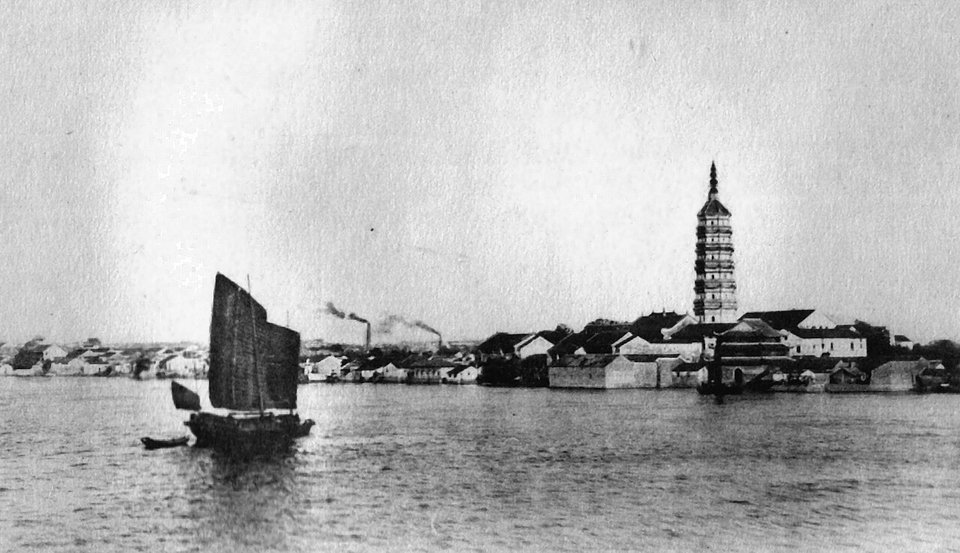
Anqing's skyline has been marked for more than four centuries by a single pagoda on the north bank of the Yangtze. It stands inside Yingjiang Temple, the temple that greets the river, on Yanjiang East Road at the eastern edge of the old city of Anqing. Locals like to say the city is a ship and the pagoda is its mast. The temple is a working Chan monastery of the Linji school, sometimes called the first temple of the middle Yangtze, and the climb up the Zhenfeng Pagoda gives the best view in town.
When was it founded?
The answer depends on whom you ask. Temple tradition, repeated by English Wikipedia and by Qunar's listing, dates the first temple to 974, early in the Song. Chinese Wikipedia says scholars have since concluded that the temple was in fact founded in 1619, in the Wanli reign of the Ming, by a local gentleman named Ruan Zihua, and English Wikipedia also gives 1619 for Ruan's work. The following year the new emperor, Guangzong, gave it the name Huguo Yongchang Chan Temple, the Chan temple that protects the nation and brings lasting prosperity.
The later history is also told two ways. Chinese Wikipedia says the temple was repaired in 1650 and renamed the imperially built Yingjiang Chan Temple. English Wikipedia says it was ruined in war in 1861, during the Taiping conflict, and restored and renamed Yingjiang Temple in 1862. In 1916 its abbot Yuexia was dismissed after speaking out against Yuan Shikai's attempt to restore the monarchy. In 1983 the State Council listed Yingjiang as a national key Buddhist temple.
The gate and the anchors
The name board over the river gate is in the hand of the Guangxu emperor. Chinese Wikipedia points out that the character for temple on it is missing a dot, and nobody quite knows why. On each side of the gate lies a heavy iron anchor; Qunar says each weighs about three tonnes. The story behind them is that Anqing's site is shaped like a boat and the pagoda is its mast, so the anchors stop the city from drifting off down the Yangtze.
The halls
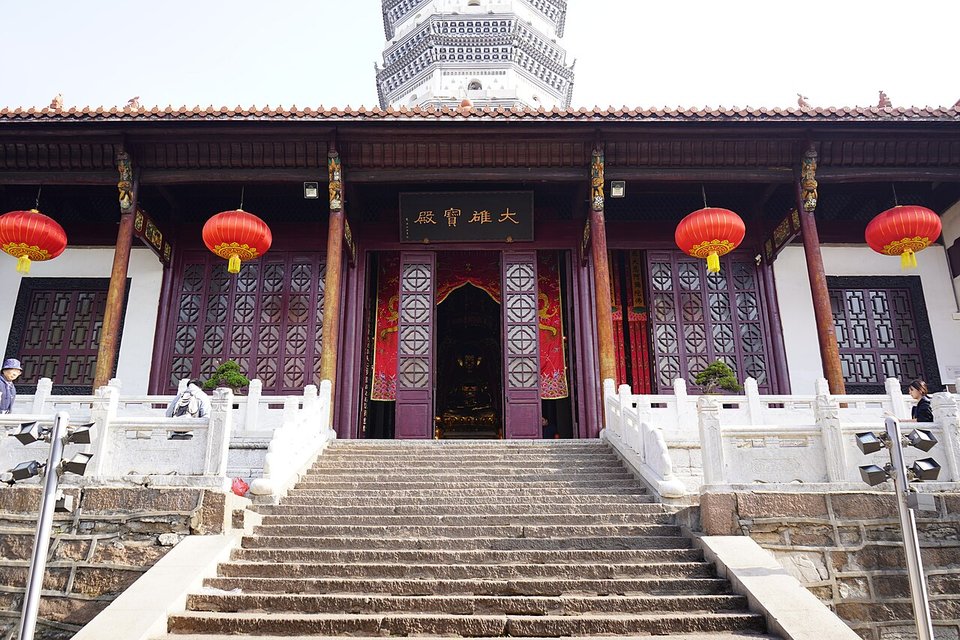
The temple covers more than 20,000 square metres and climbs back from the river in a line of halls. English Wikipedia describes the Heavenly Kings Hall, about 10.4 metres high, with Maitreya, Skanda and the four heavenly kings. Qunar counts 28 steps up from there to the Mahavira Hall, whose name board is by the Buddhist leader Zhao Puchu. The Mahavira Hall, 17.72 metres high, holds Shakyamuni, Amitabha and the Medicine Buddha, with Manjushri and Samantabhadra behind and the eighteen arhats along the walls. Gold lettered boards inside are attributed to the Qianlong emperor and to Empress Dowager Cixi.
Behind it, the Pilu Hall holds Vairocana with Brahma and Indra, and at the back a sculpted island scene of Guanyin. The three storey sutra library at the rear, about 16.2 metres tall, is said by Qunar to keep a gilded copy of the Lotus Sutra given by the Ming emperor Guangzong. In all, Qunar counts nearly 500 statues in the temple.
The Zhenfeng Pagoda
The pagoda stands in the middle of the temple. Its name means to stir up the wind, in the sense of reviving the spirit of learning, and it was first called the Ten Thousand Buddha Pagoda. Chinese Wikipedia's article on the pagoda says work began in 1568, while the temple article and English Wikipedia give 1570; either way it is late Ming and predates the 1619 founding date that historians give the temple. It was repaired in 1663, its top two storeys were damaged by gunfire in 1861, and it was restored in 1871 and again in 1893. In 2006 it was listed as a major national protected site.
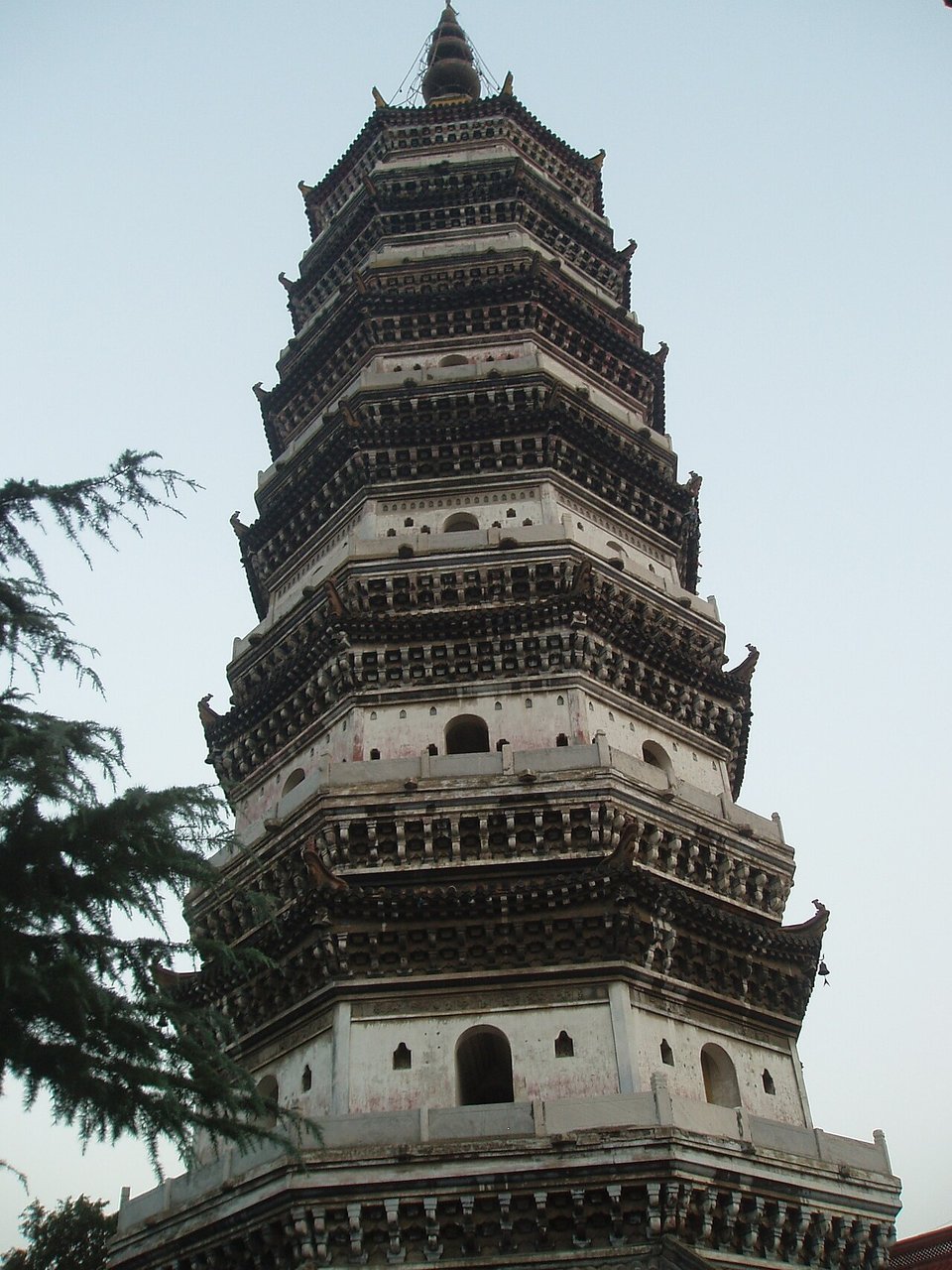
The pagoda is 64.8 metres high, octagonal, with seven storeys. Chinese Wikipedia says 168 steps lead to the top, past a large Amitabha on the ground floor, Maitreya on the second and the Buddhas of the five directions on the third. More than 600 small brick carved Buddhas are set into the walls of the third to fifth floors. Iron hooks under the eaves hang wind bells that ring in the breeze off the river. From the top you look straight down on the Yangtze and the Anqing bridge.
On moonlit nights the pagoda's shadow falls across the river, a scene called the pagoda shadow across the river that was one of Anqing's eight classic views. The early Qing official Zhang Ying of Tongcheng wrote that the pagoda seemed to share the sky with the shadow of Tianzhu Mountain.
Hours and tickets
Qunar lists the temple as open daily from 8:00 to 17:30, with last entry at 17:30. A Qunar travel article gives the ticket as 10 yuan, with a separate charge of about 10 yuan to climb the pagoda. Access to the pagoda can close for repairs or crowds, so check on arrival. The phone number listed is 0556 5529666. This is an active monastery, so dress modestly and keep your voice down in the halls.
Getting there and nearby
The temple is on Yanjiang East Road, a short taxi ride from Anqing railway station and within walking distance of the old streets in the city centre. Allow one to two hours. Afterwards, walk the riverside promenade outside the gate, best in late afternoon when the light falls on the water and the pagoda.
For a second day, Tianzhu Mountain in Qianshan is about an hour away and is the main natural sight of the prefecture.
Frequently asked questions
Can I climb the pagoda?
Visitors normally can, for a separate small fee. The stairs are steep and narrow.
How old is the temple?
The pagoda is late Ming. The temple claims a Song founding in 974, though historians date it to 1619.
Why are there anchors at the gate?
They belong to the legend that Anqing is a ship with the pagoda as its mast.
Sources
Facts in this article were checked against the following sources, retrieved 23 October 2026.
- 迎江寺, Chinese Wikipedia
- 振风塔, Chinese Wikipedia
- Yingjiang Temple, English Wikipedia
- Qunar, Yingjiang Temple hours and description
- Qunar travel article, Yingjiang Temple ticket and pagoda climb
- Anqing travel guide on this site
Photos are from Wikimedia Commons under the licences shown in each caption.