Puning Temple: The Wooden Guanyin of Chengde
Puning Temple stands on a slope by the Wulie River, northeast of the Mountain Resort in Chengde. Locals call it the Big Buddha Temple, after the statue inside its main pavilion, a gilded wooden figure of the thousand-armed Guanyin that Chinese Wikipedia gives as 27.21 metres tall and 110 tonnes, the largest surviving wooden statue in the world. The temple was built between 1755 and 1759, and its plan is two temples in one, a Chinese temple in front and a Tibetan mandala behind. It is also the one temple in Chengde with resident monks, and it is an active place of worship as well as a World Heritage monument.
Peace after a war
The name means Universal Peace. In 1755 Qing armies defeated the Dzungar leader Dawachi in the far northwest, and Qianlong held a ceremony at the Mountain Resort to grant titles to the nobles of the four Oirat Mongol tribes. To mark it he built this temple, following the example of his grandfather Kangxi, who had founded a temple at Dolon Nor after settling the Khalkha Mongols. Chinese Wikipedia says the name expresses the wish that the frontier peoples would live in peace and work in contentment for ever. The model was Samye, the oldest monastery in Tibet.
Puning became the centre of Tibetan Buddhism outside the Great Wall. When the Sixth Panchen Lama came to Chengde in 1780 he worshipped here before going to meet the emperor. The Changkya and Jebtsundamba lamas, the leading figures of Inner and Outer Mongolian Buddhism, preached here after their audiences at the Resort, and the temple held debates and cham dances. Religious activity resumed in 1985, with monks invited from Inner Mongolia and Qinghai, and the temple has held large ceremonies since.
The Chinese front
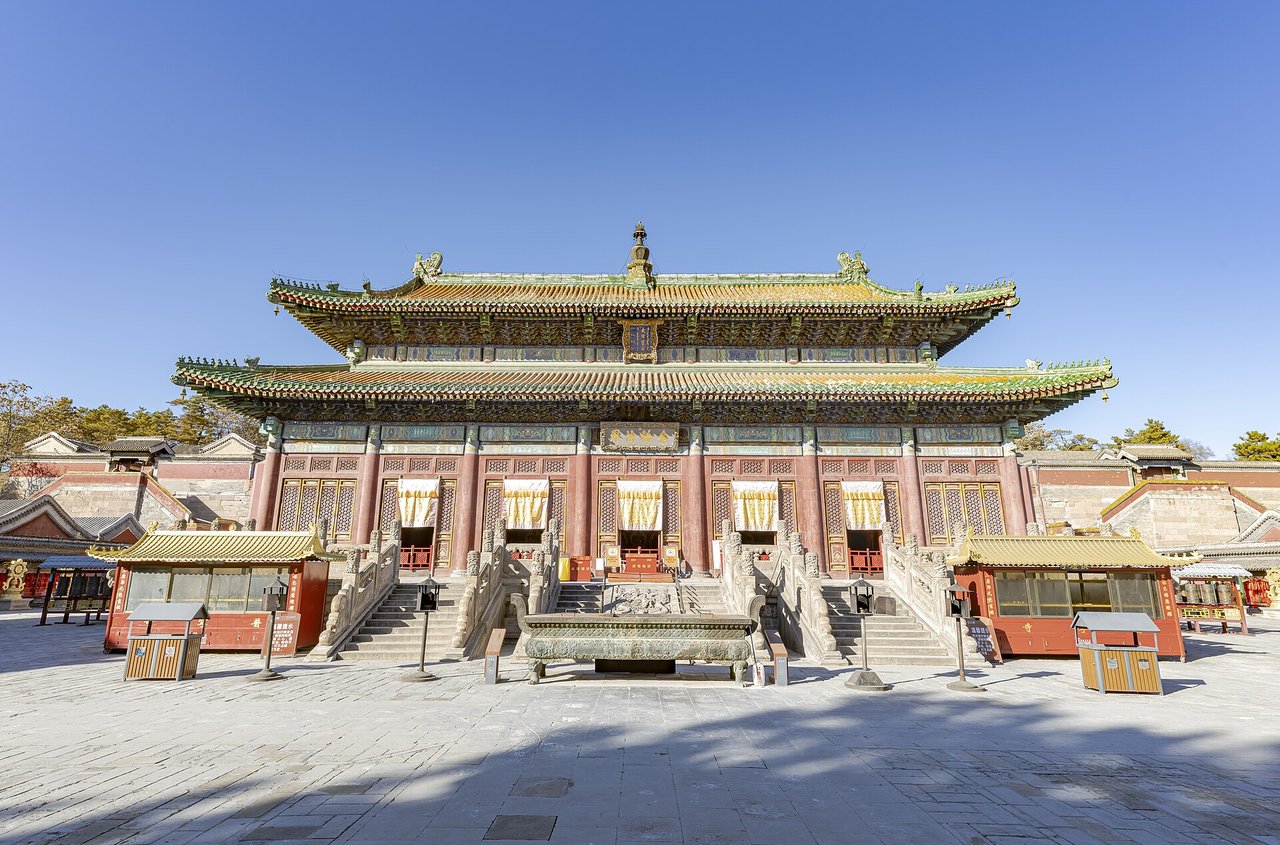
The front half follows the standard Chinese plan, with buildings in a line from the gate to the main hall and side halls to either side. Inside the gate a stele pavilion holds three steles in Manchu, Chinese, Mongol and Tibetan. One records the founding of the temple and two record the conquest of the Dzungars and the inscriptions set up at Ili. Next comes the Hall of the Heavenly Kings with the laughing Maitreya, Weituo and the four guardian kings, flanked by bell and drum towers. The Mahavira Hall is seven bays wide on a 1.4-metre stone platform, with a double-eaved roof of yellow tiles edged in green and a small gilded stupa on the ridge. It holds gilded wooden Buddhas of the past, present and future, with the eighteen arhats along the side walls.
The mandala behind
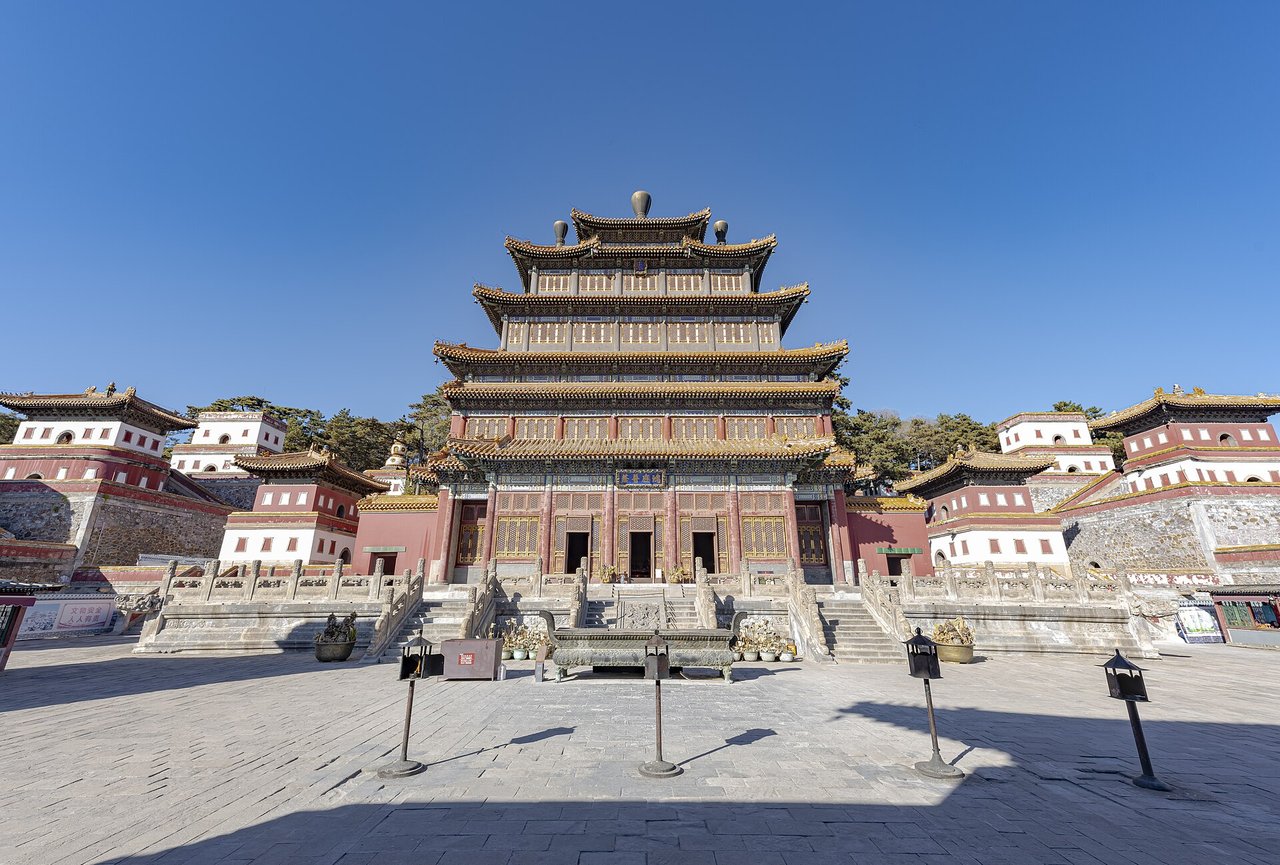
Behind the Mahavira Hall the ground rises and the architecture changes. Stairs climb to a terrace on which the Mahayana Pavilion stands as the centre of a mandala, the Buddhist diagram of the universe. Around it, following the plan of Samye, are towers for the four great continents of Buddhist cosmology, eight smaller platforms for the minor continents, terraces for the sun and moon, and four stupas in red, white, green and black that stand for the four kinds of wisdom. The buildings are white and red in Tibetan style with blind windows, and most can be seen from the paths around the pavilion.
The Mahayana Pavilion and the Guanyin
The pavilion shows six tiers of eaves on its south face and five on the sides, and its roof is crowned by five square pavilions with gilded tops, four small ones around a large one. Inside it is hollow through three storeys, with galleries running round and walls lined with more than ten thousand small Buddha niches.
The Guanyin fills the space. Chinese Wikipedia says it was made from five kinds of wood, pine, cypress, elm, linden and fir, and gives its height as 27.21 metres and its waist as 15 metres. Besides the two main hands joined in prayer, more than forty arms spread from its back, each with an eye and an emblem. A small seated Buddha, the teacher Amitabha, sits on the crown. Two attendants, Sudhana and the dragon girl, stand before it at 15.6 metres each. The figure entered Guinness World Records in 1999.
Tickets and hours
A 2026 Beijing tourism listing gives the ticket as 80 yuan from 1 April to 31 October and 60 yuan in winter, including Puyou Temple next door, which was the temple's college for sutra study. It lists hours of 08:00 to 17:30 in the main season and 08:30 to 17:00 from November to March. Check the day's notice. Incense and donations inside the halls are paid separately, and since Puning is a working temple, keep voices down near services.
Getting there
The temple is on the north side of town, northeast of the Resort, a short taxi or bus ride from the centre. Puning Street outside the gate is a Qing-style shopping street. Putuo Zongcheng and Xumi Fushou are a few kilometres west along the same hills.
How long and when
Allow about two hours, more if a ceremony is on. A morning visit leaves the afternoon for the Little Potala. Weekdays outside the summer peak are quietest.
Things to confirm before you go
- The season price and closing time.
- Whether the upper galleries of the Mahayana Pavilion are open.
- Ceremony days, when parts of the temple may be busy or closed.
- Photography rules inside the halls, which are set by the monastery.
Frequently asked questions
How tall is the Guanyin in Puning Temple?
27.21 metres by Chinese Wikipedia's figure, carved from five kinds of wood and weighing about 110 tonnes.
Why does Puning look Chinese in front and Tibetan behind?
It was built for Mongol nobles and modelled on Samye in Tibet, so the rear half is a Tibetan mandala set behind a standard Chinese temple.
Is Puning on the same ticket as the Little Potala?
No. Puning has its own ticket, which includes Puyou Temple. Putuo Zongcheng shares a ticket with Xumi Fushou.
Are there monks at Puning?
Yes. Since 1985 it has been the one temple in Chengde with resident monks.
Sources
Facts in this article were checked against the following sources, retrieved 8 October 2026.
Photos are from Wikimedia Commons under the licences shown in each caption.