Putuo Zongcheng Temple: The Little Potala of Chengde
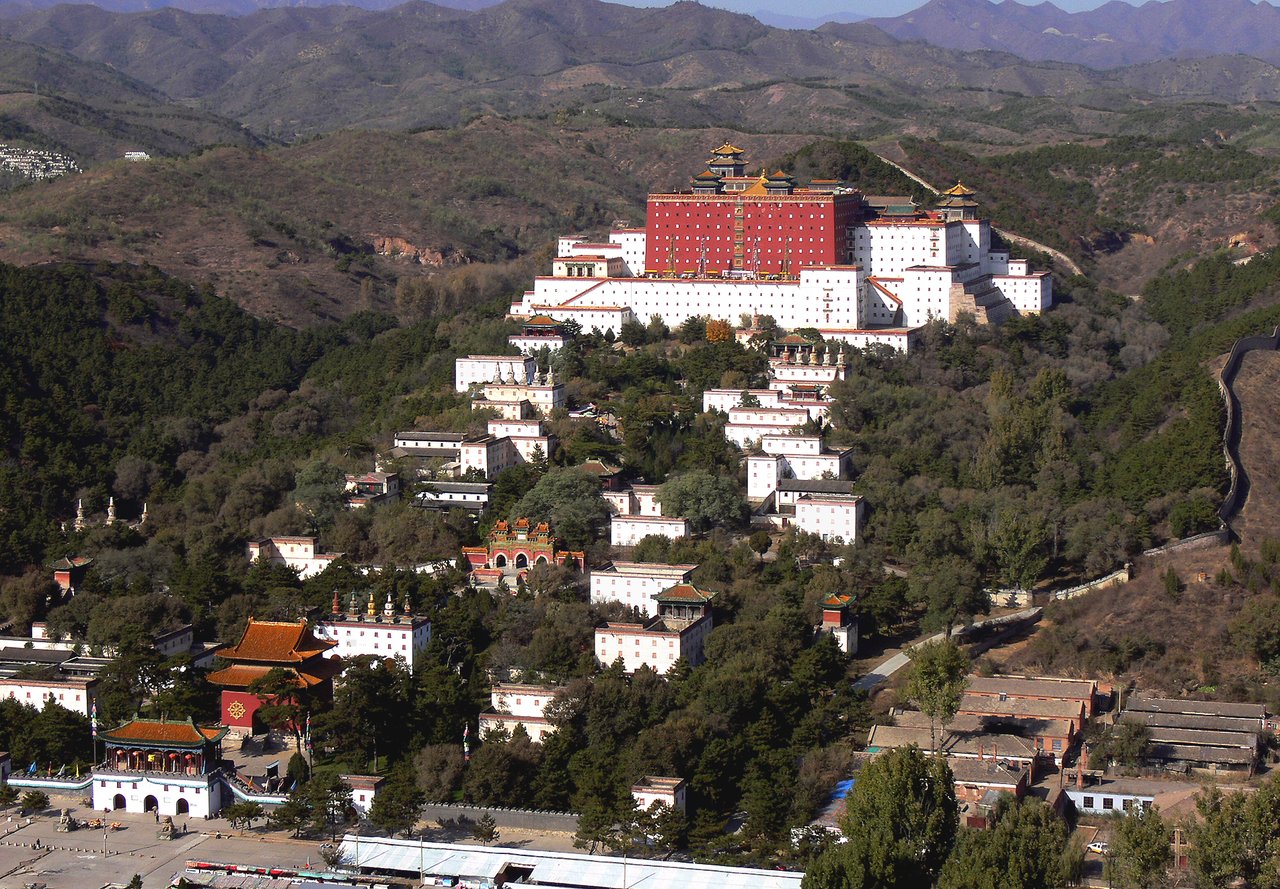
Putuo Zongcheng Temple climbs the southern slope of the hills north of the Mountain Resort in Chengde. The Qianlong emperor built it between 1767 and 1771 on the model of the Potala Palace in Lhasa, and everyone calls it the Little Potala. Putuo Zongcheng and Potala are two renderings of the same word, the name of the sacred mountain of Guanyin. It is the largest of the temples around the Resort, about 22 hectares inside its own winding wall, and it belongs to the Gelug school of Tibetan Buddhism. Its neighbour to the east, Xumi Fushou, shares its ticket.
A birthday temple with a political purpose
Qianlong's own stele inside the temple says he built it for the eightieth birthday of his mother, the Empress Dowager Chongqing, in 1771, which was also close to his own sixtieth. He also wanted a temple of Potala scale for the Mongol and Tibetan nobles who came to Chengde. The stele explains his choice of model. There were three seats of Guanyin, he wrote, in India, in Tibet and at Putuo Island in Zhejiang. The Indian one could not be studied, while the Potala's plan was well known, so he copied the Potala.
The year the temple was finished brought an unexpected guest. In 1771 the Torghut Mongols under Ubashi arrived after a long and costly migration from the lower Volga back to Qing territory, and Qianlong received their leader here in the main hall with sutra readings and birthday celebrations. Two of the three steles in the stele pavilion record the Torghut return and the relief given to them, carved in Manchu, Chinese, Mongol and Tibetan, with the Chinese text in Qianlong's own hand.
Up the hill
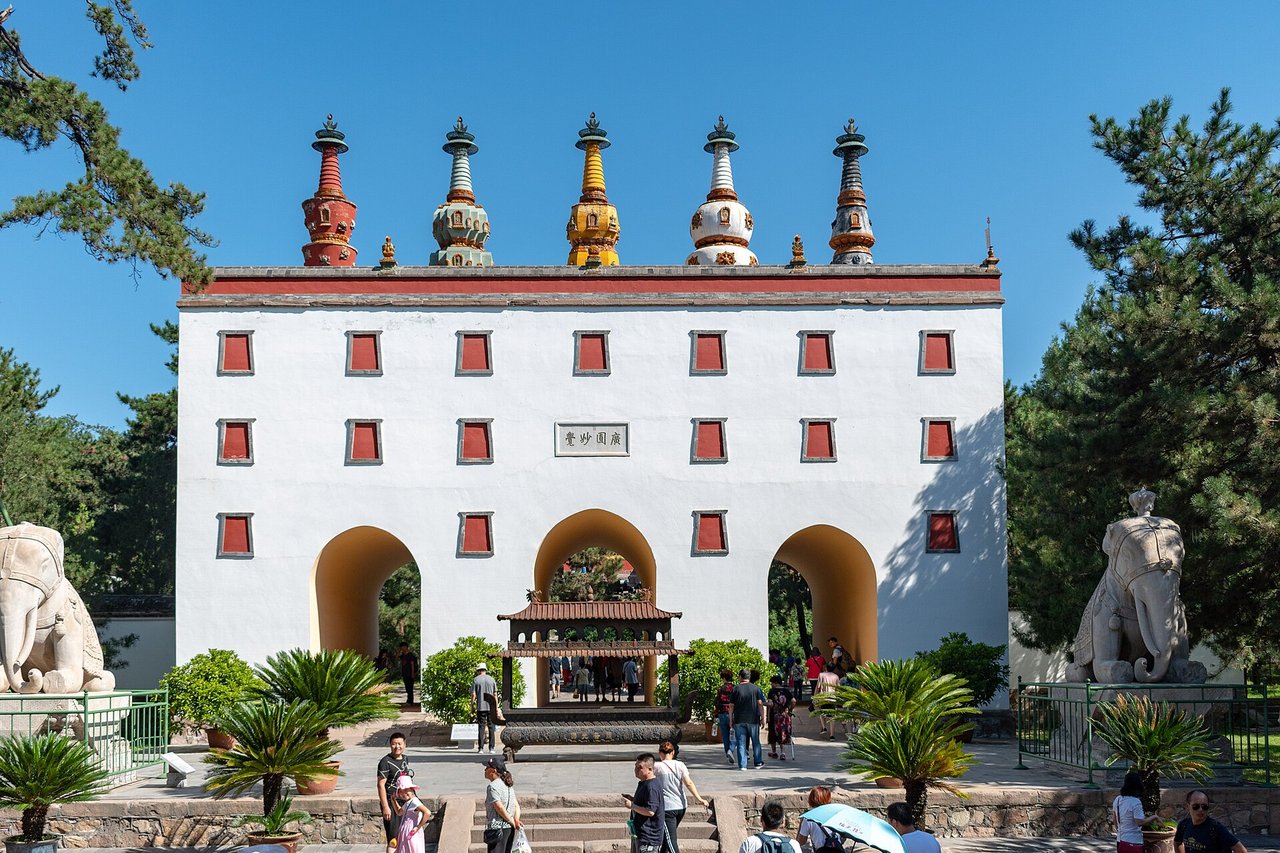
A five-arched stone bridge crosses the gully in front, and the route climbs from south to north. The mountain gate is a Chinese gate tower set on a white Tibetan-style base. The stele pavilion follows. Then comes the Five Pagoda Gate, a white platform more than ten metres high with three arched passages and seventeen false windows, crowned by five stupas in red, green, yellow, white and black glazed brick, with a pair of stone elephants in front. Beyond it a glazed archway with seven small roofs leads to the hillside proper.
From here the path winds up past about thirty white terraces, flat-roofed Tibetan-style blocks of one to four storeys. Most have rows of blind windows, and Chinese Wikipedia notes that some are solid and purely decorative. Others were monks' quarters or small halls, and some carry stupas on their roofs.
The Great Red Terrace
The climb ends at the Great White Terrace, a solid platform about 18 metres high, and the Great Red Terrace above it. The red block is about 25 metres high and 59 metres wide at the base, with seven storeys of windows on its south face. The lower rows are false. Six glazed niches run up the centre, and the parapet on top holds eighty more, one glazed Amitayus Buddha for each year of the empress dowager's life.
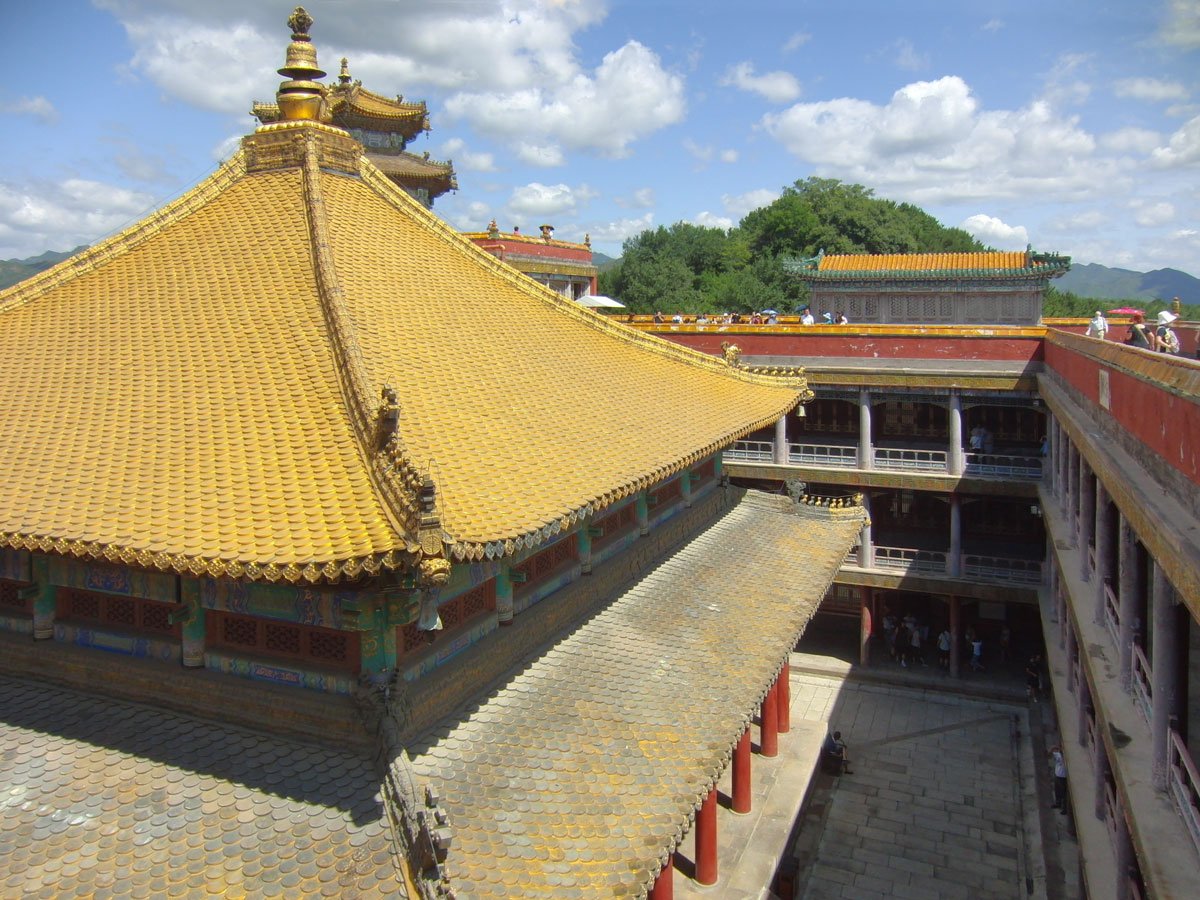
Inside, three storeys of galleries with 44 rooms on each level wrap around an open well, and in the middle stands the main hall, the Hall of All Dharmas Returning to One. It is square, with a double-eaved pyramid roof of gilded copper tiles shaped like fish scales. Chinese Wikipedia says more than 14,000 taels of gold leaf went into the roof. The hall still holds original altar pieces, while many of its present bronze statues were moved in from the galleries. A large silk hanging of the Buddha that once hung here was taken by warlords in the Republican years. The ground floor of the galleries holds six stone mandalas. Two small pavilions with gilded roofs stand at the northern corners of the terrace top.
The temple that went to Chicago
In 1930 the Swedish explorer Sven Hedin and his team came here looking for a lama temple to show at the Chicago World's Fair of 1933. A full-size copy of the main hall was made in Beijing, shipped to Chicago with Buddhist objects and displayed as the "Golden Temple of Jehol", Jehol being the old name of Chengde. A smaller model went to the Museum of Ethnography in Stockholm. Chinese Wikipedia adds that the Chicago parts were later bought by a Swedish foundation with plans to rebuild them.
Tickets and hours
The Chengde Cultural Relics Bureau sells Putuo Zongcheng and Xumi Fushou on one ticket, the Potala and Palace ticket, at 80 yuan from 1 April to 31 October and 60 yuan from November to March, half price for concessions, valid for one entry within two days. For 1 May to 9 October 2026 it opened at 08:00, with last entry at 17:10 and closing at 18:00. Hours shorten after 10 October. Booking is by real name online. Check the day's notice.
Getting there
The temple is in Shizigou, directly north of the Resort, a short taxi or bus ride from the town centre. Xumi Fushou is next door to the east, and Puning Temple is a short ride further east.
How long and when
Allow two to three hours for the climb and the Great Red Terrace, and add an hour for Xumi Fushou. Clear autumn days show the red walls and gold roofs at their best against the hills. The stairs to the top of the terraces are steep, so take them slowly.
Things to confirm before you go
- The season price and closing time for the joint ticket.
- Which galleries inside the Great Red Terrace are open.
- Your booking, by real name, before you arrive.
- Your energy for the climb after a day in the Resort.
Frequently asked questions
Why is it called the Little Potala?
Qianlong modelled it on the Potala Palace in Lhasa, and its Chinese name is a rendering of the same Sanskrit word.
Is the ticket shared with Xumi Fushou?
Yes. One ticket covers both temples, 80 yuan in the main season and 60 yuan in winter.
How long does the visit take?
Two to three hours, or half a day with Xumi Fushou.
Is it hard to climb?
It is a steady uphill walk with steep steps at the Great Red Terrace. Take it slowly and carry water in summer.
Sources
Facts in this article were checked against the following sources, retrieved 8 October 2026.
- 普陀宗乘之庙, Chinese Wikipedia
- Putuo Zongcheng Temple, English Wikipedia
- 避暑山庄及周围寺庙景区旅游景点价格公示, Chengde Cultural Relics Bureau
- 5月1日起,承德避暑山庄调整景区开园时间, Beijing Daily, April 2026
Photos are from Wikimedia Commons under the licences shown in each caption.