Xumi Fushou Temple: A Palace for the Panchen Lama
Xumi Fushou Temple stands on a slope north of the Mountain Resort in Chengde, just east of the Putuo Zongcheng Temple. Qianlong built it in 1780 as a residence for the Sixth Panchen Lama, who was travelling from Tibet to attend the emperor's seventieth birthday. It copies Tashilhunpo, the Panchen Lama's monastery at Shigatse, and its name is a Chinese translation of that Tibetan name, the Temple of Happiness and Longevity of Mount Sumeru. Locals call it the Panchen's Palace. It covers about 3.8 hectares, much smaller than its neighbour, and the two share a ticket.
A visit from Tibet
The Sixth Panchen Lama set out from Tibet to congratulate Qianlong on his seventieth birthday in 1780. Chinese Wikipedia says the emperor worried that the summer heat of Beijing and Rehe would be hard on a visitor from the high plateau, and gave him three residences. One was this new temple at Chengde, a second was a temple at Xiangshan in Beijing, and the third was the Western Yellow Temple in Beijing for the winter.
At Chengde the emperor held a welcome at the Resort and came in person to visit the Panchen Lama here. The Panchen Lama presented forty gifts and the diary of his journey, which recorded that at every stage of the road he had prayed for the emperor's long life. Qianlong gave him a portrait of himself in monk's robes. In the main hall the Panchen Lama preached, with the state preceptor Changkya Khutukhtu translating. Chinese Wikipedia notes one difference from the Beijing temple. Here the red terrace stands in front and the white buildings behind, closer to the layout at Tashilhunpo.
Through the gate and the glazed archway
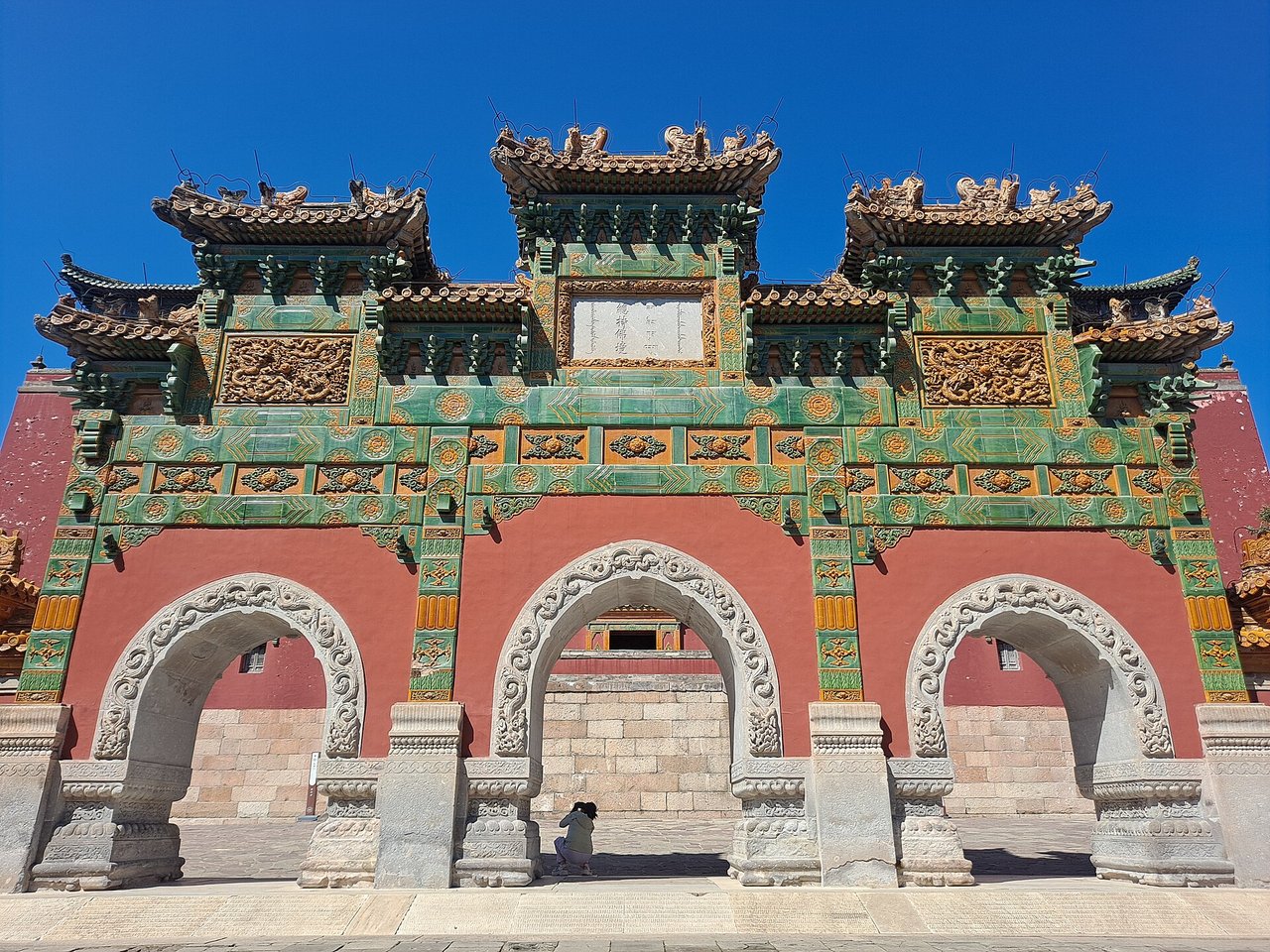
The temple faces south and climbs on a straight axis. The mountain gate has three arches under a gate tower with Qianlong's plaque. Behind it the stele pavilion holds the 1780 stele that records the temple's founding in Manchu, Chinese, Mongol and Tibetan. Steps then lead up to a terrace with a glazed archway in green and yellow tile.
Look down as well as up here. English Wikipedia says that in renovations from 1979 into the 1980s the temples and the Resort were repaved with local stone slabs, and that from 1992 fossil dinosaur footprints were found in the slabs. More than forty tracks have been reported at Xumi Fushou, in front of the gate and behind the glazed archway.
The Great Red Terrace
The Great Red Terrace is the main building, a broad red block with Tibetan windows. On each corner of its flat roof sits a small hall with a hip roof of glazed tiles, decorated with deer on the northern two and peacocks on the southern two. Inside, three storeys of wooden galleries surround a courtyard. Chinese Wikipedia says they are divided into more than four hundred rooms, holding statues of the four heavenly kings, the arhats and Tibetan masters, an octagonal three-storey prayer pagoda, and seven gilded mandalas.
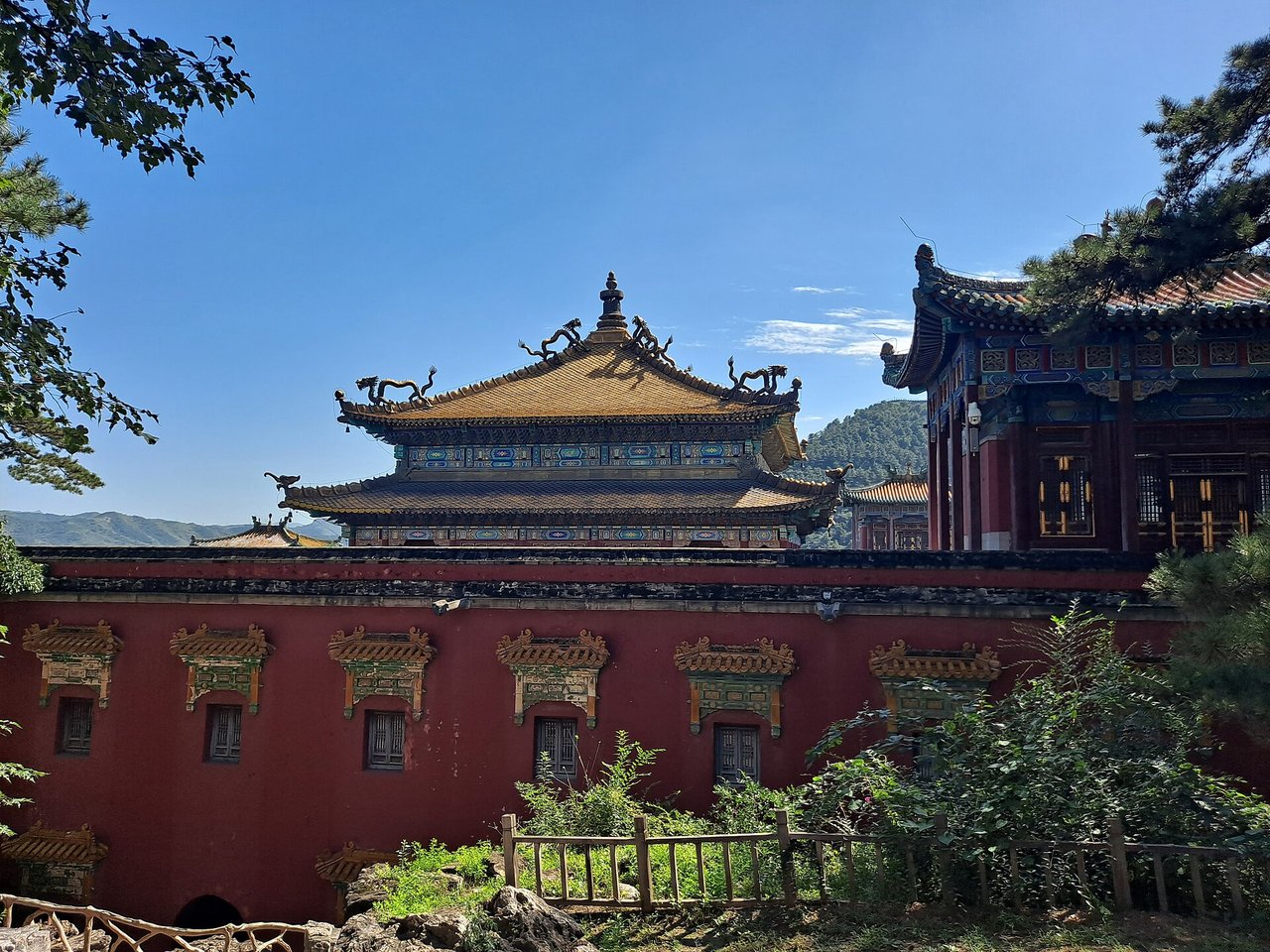
In the middle of the courtyard rises the Miaogao Zhuangyan Hall, the Hall of Sublimity and Majesty, where the Panchen Lama preached. It is three storeys high under a double-eaved pyramid roof of gilded copper tiles. Each of the four ridges carries two gilded copper dragons, one climbing and one descending, eight in all, and Chinese Wikipedia puts each at about a tonne. It says more than 11,500 taels of gold went into the roof. Inside, the ground floor holds a statue of Tsongkhapa, founder of the Gelug school, a Shakyamuni behind it, and the throne used by the Panchen Lama. The upper floors hold more Buddhas and a prayer pagoda Qianlong used for his long-life prayers.
The residence and the pagoda
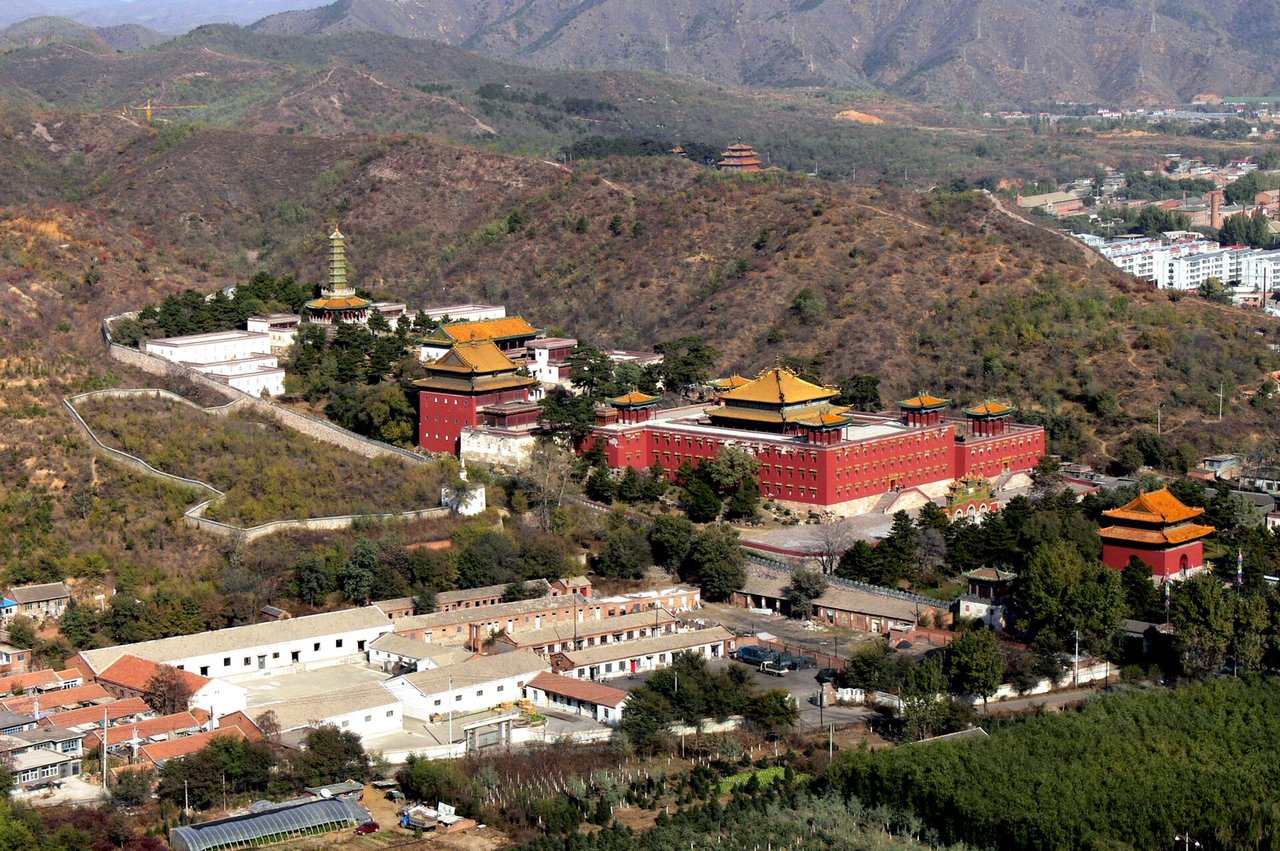
Northwest of the red terrace, the Jixiang Faxi Hall was the Panchen Lama's living quarters, and English Wikipedia notes that it too has a roof of gilded copper tiles. Behind the main hall a Tibetan-style courtyard with white outer walls holds two more halls. At the very top of the axis, and the highest point of the temple, stands the Glazed Pagoda of Longevity. It is octagonal and seven storeys high, with a wooden gallery round its base and a niche on every face of every storey for an image of Amitayus, the Buddha of long life.
Tickets and hours
The Chengde Cultural Relics Bureau sells Xumi Fushou and Putuo Zongcheng on one Potala and Palace ticket at 80 yuan from 1 April to 31 October and 60 yuan from November to March, valid for one entry within two days. For 1 May to 9 October 2026 the temples opened at 08:00, with last entry at 17:10 and closing at 18:00. Hours shorten from 10 October. Book by real name online, and check the day's notice.
Getting there
The temple is directly north of the Resort in Shizigou, next to Putuo Zongcheng. Taxis and city buses run there from the town centre, and a travel guide reports a free shuttle between the two temples. Puning Temple is a short ride to the east.
How long and when
An hour to an hour and a half is enough on its own. Most people pair it with Putuo Zongcheng for a half day, and doing Xumi Fushou second suits tired legs, as the climb is shorter.
Things to confirm before you go
- The season price and hours of the joint ticket.
- Whether the galleries inside the Great Red Terrace are open.
- Shuttle times between the two temples.
- Your booking before arrival.
Frequently asked questions
Who was Xumi Fushou built for?
The Sixth Panchen Lama, who came from Tibet in 1780 for Qianlong's seventieth birthday.
What was the model?
Tashilhunpo Monastery in Shigatse, the seat of the Panchen Lamas. The Chinese name translates the Tibetan one.
Is it worth visiting after the Little Potala?
Yes. It is smaller and quicker, and the eight gilded dragons on the main hall roof are worth the extra hour.
Where are the dinosaur footprints?
In the stone paving in front of the gate and behind the glazed archway, according to English Wikipedia.
Sources
Facts in this article were checked against the following sources, retrieved 8 October 2026.
- 须弥福寿之庙, Chinese Wikipedia
- Xumi Fushou Temple, English Wikipedia
- 避暑山庄及周围寺庙景区旅游景点价格公示, Chengde Cultural Relics Bureau
- 5月1日起,承德避暑山庄调整景区开园时间, Beijing Daily, April 2026
- 普陀宗乘之庙旅游攻略, Seeinchina
Photos are from Wikimedia Commons under the licences shown in each caption.