Foshan Ancestral Temple, the Northern Emperor's Shrine That Ran a Town
The Ancestral Temple, Zumiao, stands at 21 Zumiao Road in Chancheng, the old centre of Foshan. It is a Taoist temple to Xuantian Shangdi, the Northern Emperor or Beidi, a god of water. Around the Ming and Qing temple buildings the city has grouped a Confucian temple and memorial halls for the martial artists Huang Feihong and Ip Man, all run as the Foshan Zumiao Museum. The temple has been a national key heritage site since 1996 and was named a national first-grade museum in 2024. It is the place in Foshan to see Lingnan roof decoration, an old Cantonese opera stage and a daily lion dance in one visit.
A water god in a river town
Chinese Wikipedia dates the temple to the Yuanfeng years of the Northern Song, 1078 to 1085, when it was called Longzhu Shrine. It burned at the end of the Yuan, was rebuilt in 1372 and had a full restoration in 1899. In all it has been rebuilt or extended more than twenty times. Worship of Beidi came south with northerners who moved to Guangdong in the Song and Yuan. He was believed to control water, which mattered in Foshan, a town in a web of channels fed by the West and North rivers and often flooded.
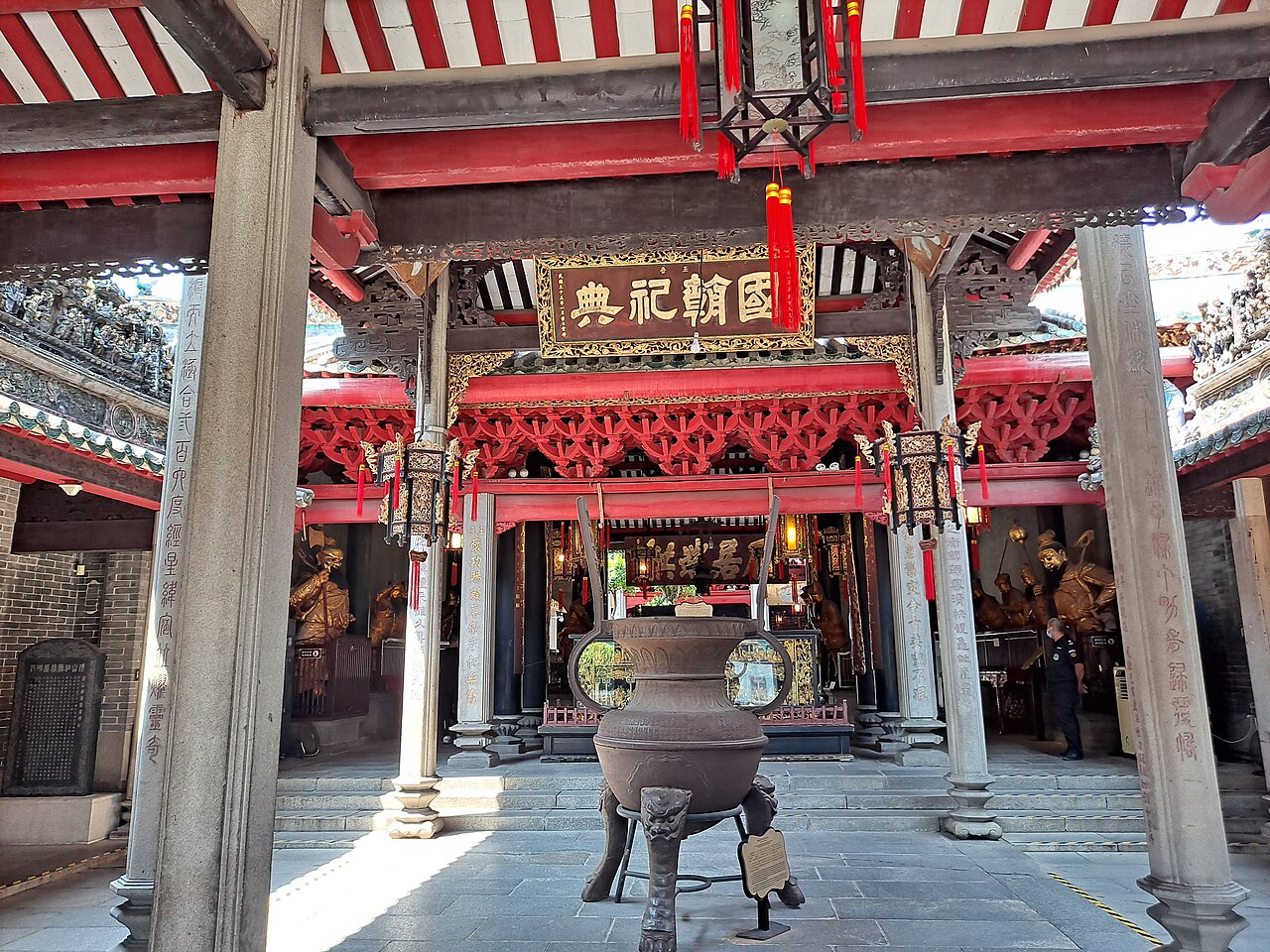
The turning point came in 1449, when the Huang Xiaoyang uprising swept the Pearl River Delta. Foshan held out, and the temple served as headquarters for the defence. Stories spread that the god had joined the fight, seen as a rider in a blue robe on a white horse, with clouds of mosquitoes attacking the rebels. The Ming court added the temple to the official sacrifices and the emperor granted it the name Lingying Ci. A gilt lacquered board with that name still hangs over the door of the main hall.
The temple that governed Foshan
Foshan was a market town without a county office until the twentieth century. Chinese Wikipedia, drawing on a 2021 article in The Paper, explains that the temple filled the gap. After 1449 the local gentry met here to settle disputes and decide matters for the whole town, in sessions called temple councils, and that is when the everyday name Zumiao, ancestral temple, replaced the official one. In the Qing, merchants who had moved to the town were brought into the council. Once Foshan became a city with its own government, the temple's role became cultural. The subdistrict and the road outside are both named after it.
Walking the axis
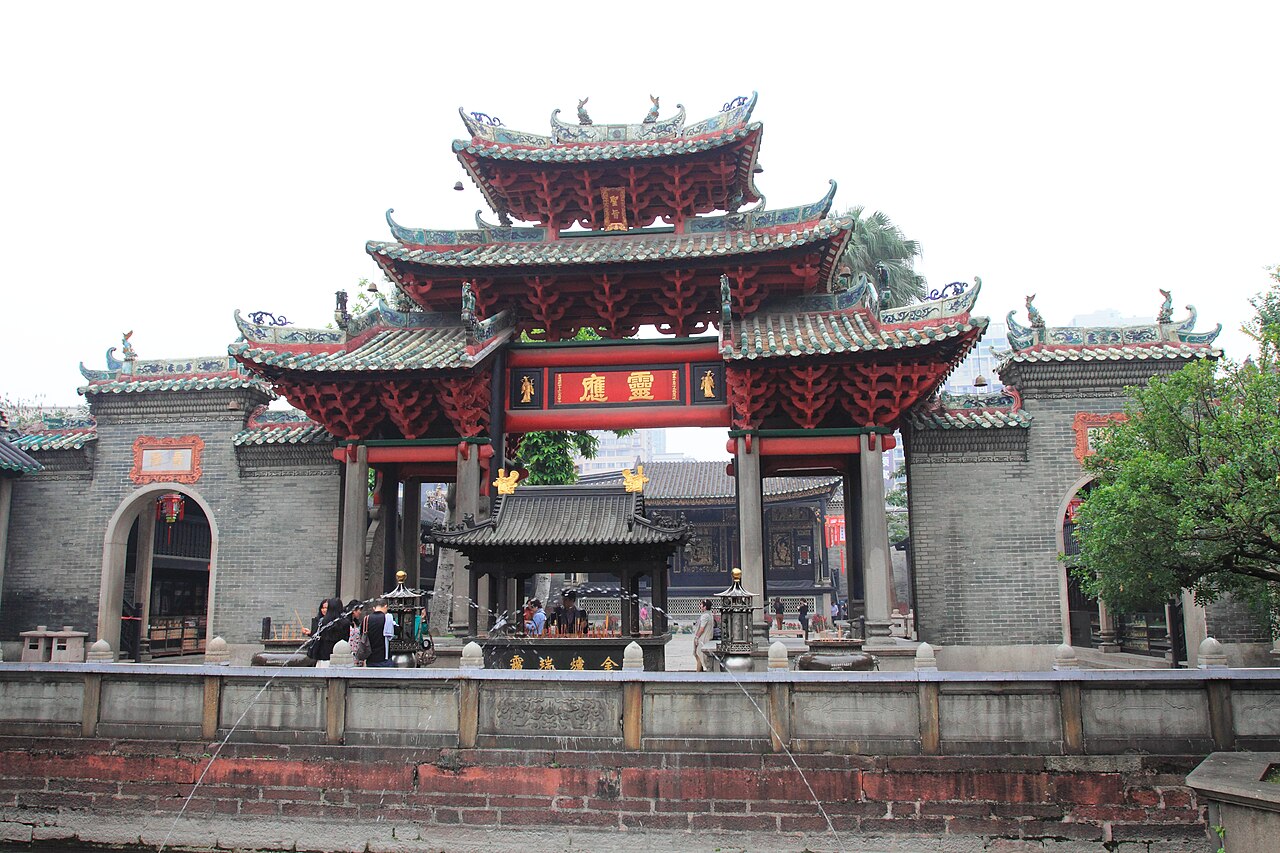
The main buildings face south along a single axis. From south to north you pass the Wanfu Stage, the Lingying memorial archway, Jinxiang Pond, the bell and drum towers, the triple gate, the front hall, the main hall and Qingzhen Tower at the back. The roofs carry the decoration Foshan is known for, ridges lined with Shiwan ceramic figures, lime plaster relief and gilded wood carving under the eaves. Inside the main hall Chinese Wikipedia lists a ceremonial set of seventy weapons, a bronze mirror 1.31 metres across, and a large iron incense burner cast in Foshan, a reminder that the town was a centre of iron working in the Qing.
The Confucian temple on the southwest side was built in 1911 and still holds ceremonies for children starting school. A history gallery opened in 2016 shows outdoor pieces taken down during the restoration that began in 2007.
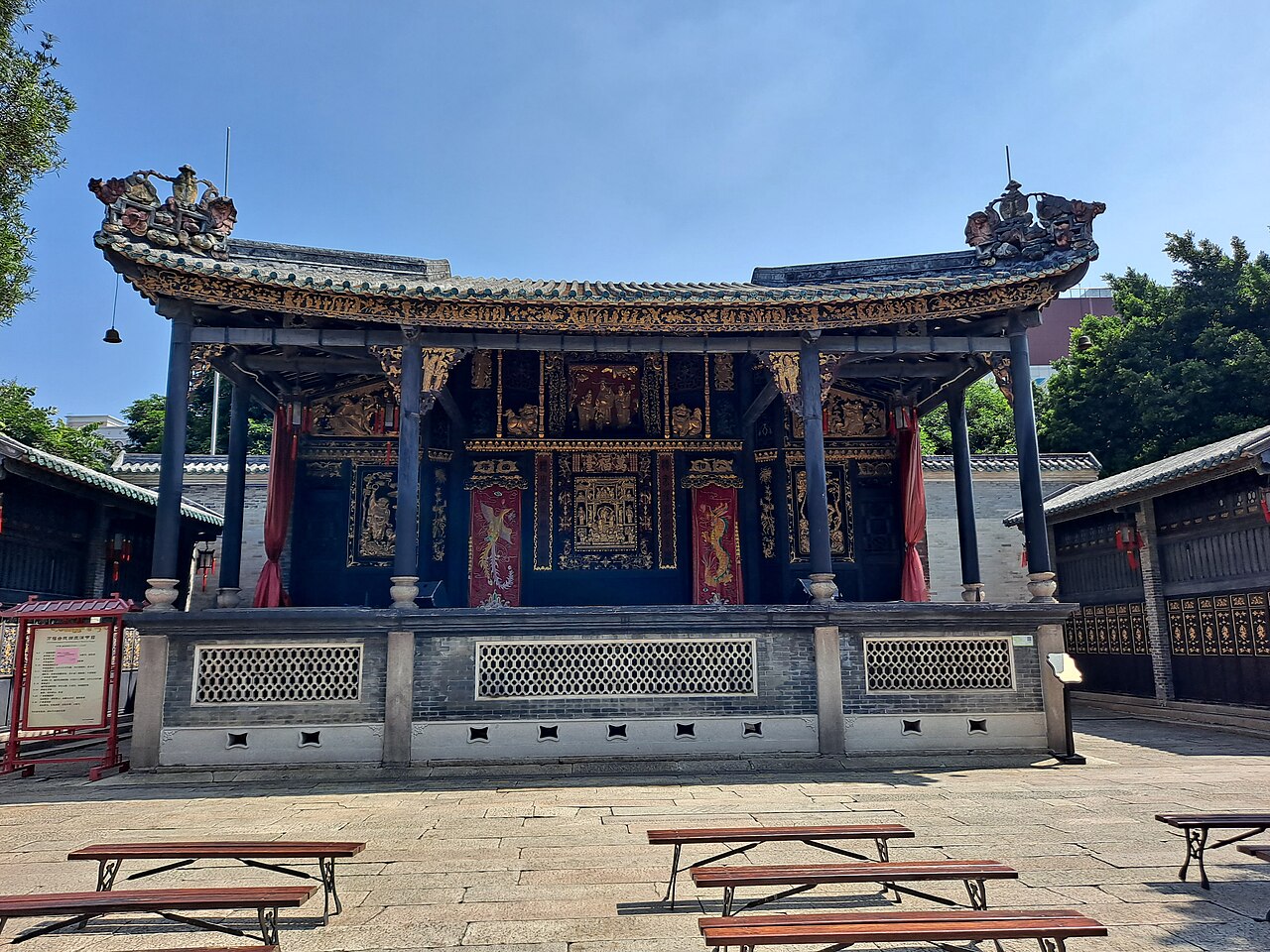
The Wanfu Stage
The stage was built in 1658 as the Huafeng Stage and renamed Wanfu in the Kangxi reign. It faces north, back toward the main hall, because operas were performed for the god. Chinese Wikipedia calls it the most richly decorated old stage surviving in Guangdong and the largest in Lingnan. The front is framed in gilt lacquered carving, with side doors for actors marked for generals coming out and ministers going in. Famous Cantonese opera performers, among them Xue Juexian, Hong Xiannü and Ma Shizeng, played here. After 1949 the stage was protected and closed to performance, and it reopened late in the twentieth century to help revive Cantonese opera.
Kung fu halls and shows
The Huang Feihong Memorial Hall and the Ip Man Hall opened in the early 2000s, honouring two Foshan martial artists made famous by films. Foshan Bendibao lists kung fu and lion dance shows every day at 10:00, 14:15 and 15:30, each about forty minutes and cancelled in rain. Cantonese opera is performed on the Wanfu Stage from 13:30 to 15:30 on weekends and on the first and fifteenth days of the lunar month. A 2026 travel listing reported the Huang Feihong hall closed from late May for air-conditioning work, so check whether it has reopened.
The temple is busiest at Lunar New Year, on Beidi's birthday on the third day of the third lunar month, when the Zumiao temple fair is held, and in autumn for the Qiuse parade, which traditionally sets off from here. The temple fair has been on the national intangible heritage list since 2008.
Tickets, hours and getting there
Foshan Bendibao and the museum's listing give daily hours of 8:30 to 18:00, with tickets stopping at 17:30. Travel listings put the full ticket at around 20 yuan with half-price concessions, so check the day's notice for current prices. The Guangfo Metro stops at Zumiao station, a short walk away, and many city buses stop on Zumiao Road.
Planning your visit
Arrive before 10:00 to see the main halls first and catch the morning lion dance. The Foshan guide gives the temple a full morning and puts Lingnan Tiandi, the restored blocks next door, in the evening. If the roof figures catch your eye, the kilns that made them are at Nanfeng Ancient Kiln in Shiwan, a short ride south.
Before you go
- Check the show times on the day, since rain cancels outdoor lion dances.
- Come on a weekend afternoon if you want Cantonese opera on the stage.
- Expect crowds at Lunar New Year and on Beidi's birthday.
- Wear a hat in summer, as courtyards have little shade.
Frequently asked questions
What god is worshipped at Foshan Zumiao?
Xuantian Shangdi, the Northern Emperor, a Taoist god of water.
What time is the lion dance at Zumiao?
Bendibao lists daily shows at 10:00, 14:15 and 15:30, cancelled in rain.
Is Ip Man Hall inside the Ancestral Temple?
Yes. The Ip Man Hall and the Huang Feihong Memorial Hall are part of the museum complex.
How do I get there?
Take the Guangfo Metro to Zumiao station.
Sources
Facts in this article were checked against the following sources, retrieved 12 October 2026.
- 佛山祖庙, Chinese Wikipedia
- 佛山市祖庙博物馆, PRD Culture
- 佛山祖庙开放时间和表演时间, Foshan Bendibao
- 佛山祖廟參觀攻略2026, Wing On Travel
- Foshan Ancestral Temple, English Wikipedia
Photos are from Wikimedia Commons under the licences shown in each caption.