Jiaxiu Tower, Guiyang's Landmark on a Rock in the River
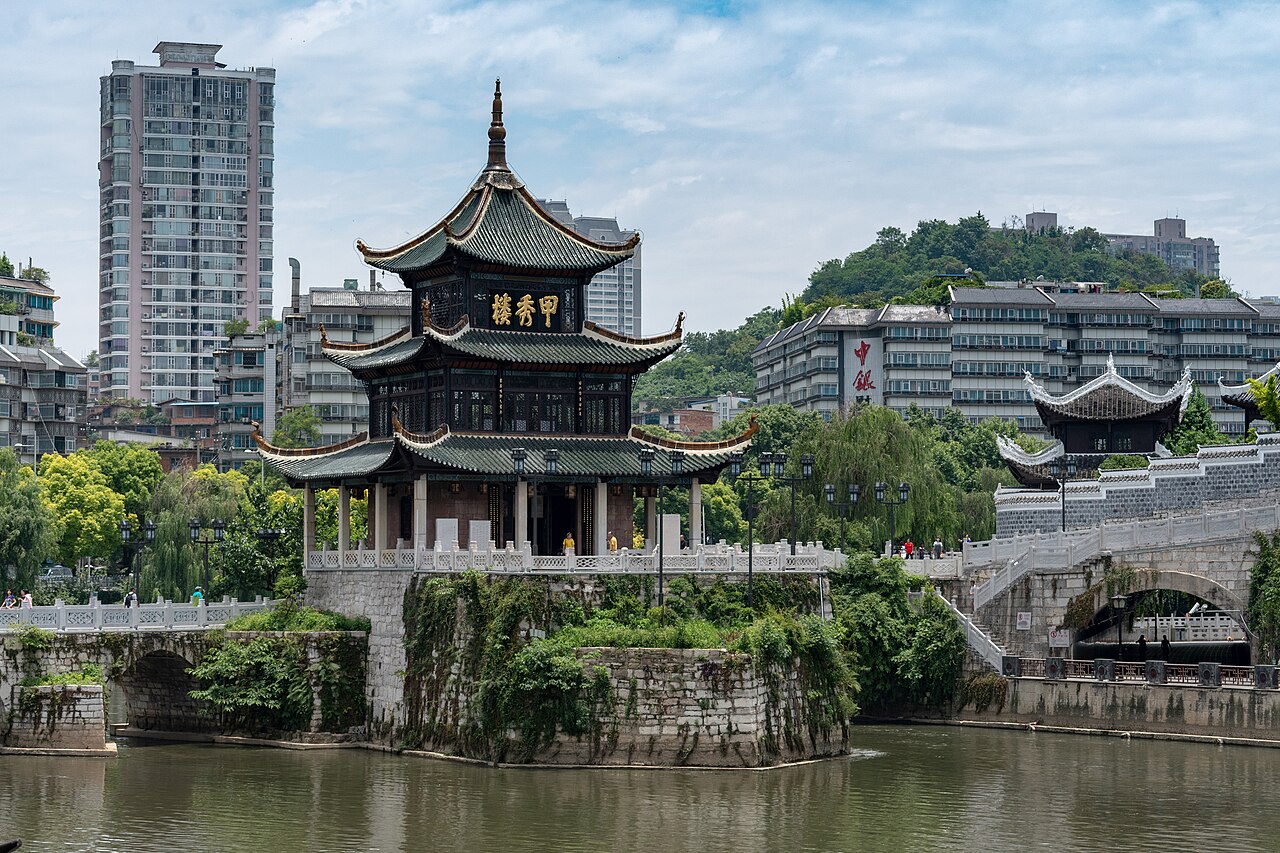
Jiaxiu Tower stands on a large boulder called Aoji Rock in the Nanming River, in Nanming District of central Guiyang. It is a three-storey pavilion of timber and stone about 20 metres high, joined to the banks by a long stone bridge, and it has been the city's emblem for four centuries. It is small, central and free to enter, which makes it the easiest heritage stop in Guiyang. Come by day for the timber and the inscriptions, or after dark when the eaves are lit and reflected in the water.
Why it was built
In 1598, the twenty-sixth year of the Ming Wanli reign, the Guizhou governor Jiang Dongzhi and the regional inspector Ying Chaoqing built a causeway to the south bank and put up a tower on the rock. They named it Jiaxiu, a wish that Guizhou's candidates would rise to the top of the imperial examinations. Baidu Baike records that the tower was meant as a place where young scholars could study, in a province that produced few successful candidates.
The building has burned and been rebuilt several times. It burned in 1621, and governor-general Zhu Xieyuan rebuilt it under the name Laifeng Pavilion. Governor Tian Wen rebuilt it again in 1689 and restored the old name. In 1776 governor Pei Zongxi repaired it, wrote the name plaque, and added the Hanbi Pavilion on the bridge. The present tower dates from a rebuilding in 1909, the first year of the Xuantong reign. The Guiyang government repaired it in 1982 and added a terrace on the east side. In May 2006 the State Council listed it in the sixth batch of nationally protected sites.
The tower and the bridge
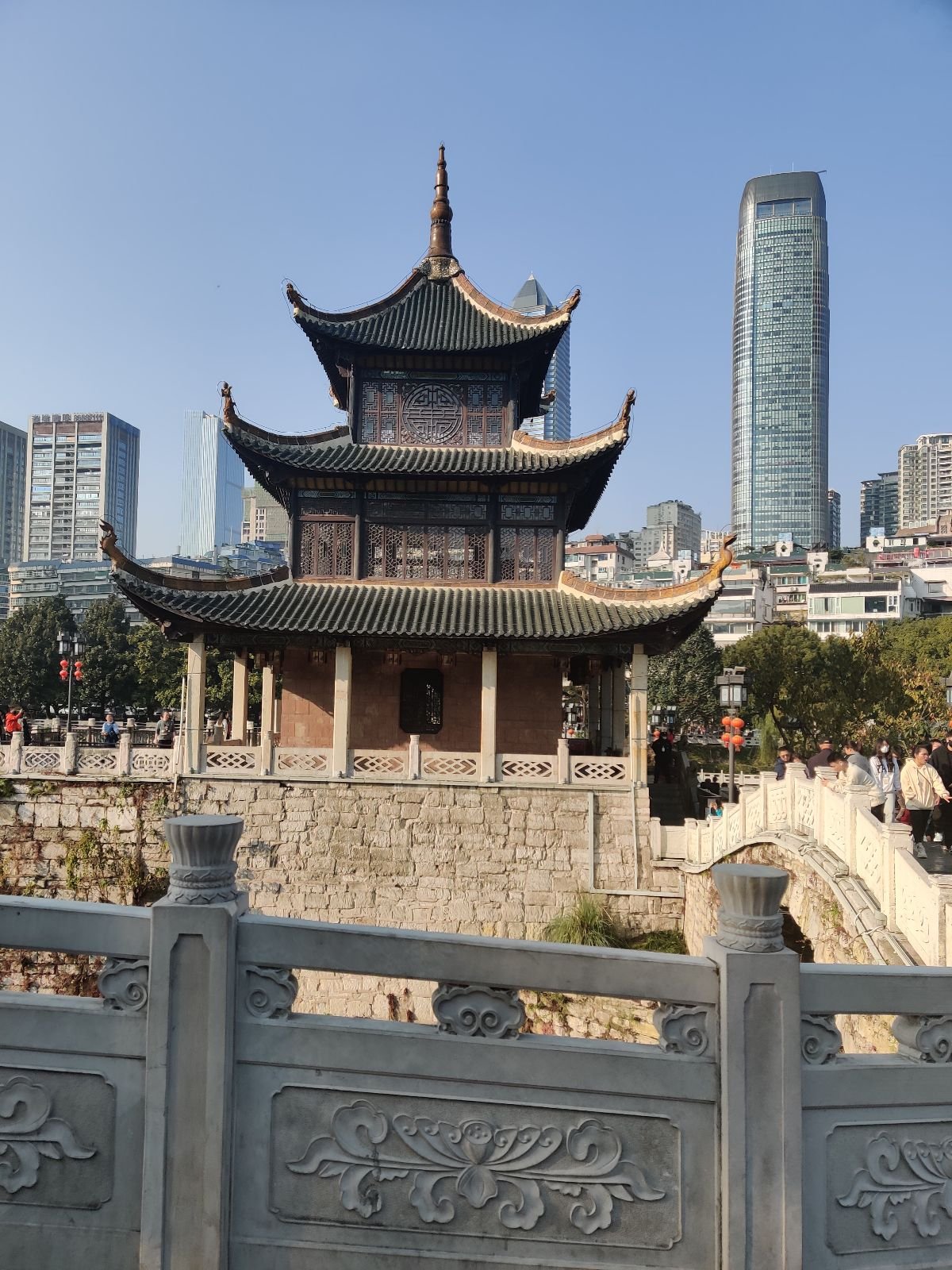
The tower has three storeys and three tiers of eaves under a four-sided pyramid roof. Twelve stone columns carry the eaves, and white carved stone balustrades ring each level as the storeys step in. It covers only 365 square metres. In the Qing the view of the tower on its rock, "Aoji Fuyu", was counted among the eight sights of Guiyang.
The Fuyu Bridge links the tower to both banks. It was built with nine arches and runs more than 90 metres. Two arches were buried when a riverside road was laid after 1949, so seven are visible today. The Hanbi Pavilion sits on the bridge, the pool below is called Hanbi Pool, and an archway inscribed "Chengnan Yiji" (relics of the south city) marks the bridge head.
The long couplet
Inside, the tower displays stone and wood inscriptions and calligraphy. The most famous piece is the long couplet by Liu Yunliang, a Guiyang scholar of the late Qing. The version recorded on Chinese Wikipedia runs to 87 characters on each side. Chinese writers set it alongside the long couplets of Daguan Tower in Kunming and Wangjiang Tower in Chengdu. The first half surveys Guizhou's place between Hunan, Yunnan, Guangdong and Sichuan. The second half runs through the region's history from the Qin roads to the Song. Even without reading Chinese, it is worth seeing how much text the two boards hold.
Cuiwei Garden
Just south of the tower, at the southern end of the bridge, Cuiwei Garden is a group of buildings that also dates back to the Ming. The provincial government joined it to the Jiaxiu Tower site in 1999. It includes Gongnan Pavilion, Cuiwei Pavilion and the Longmen Academy, and part of it now serves as a calligraphy hall. The garden is a quieter half hour after the busy bridge.
Hours and access
Entry to Jiaxiu Tower and Cuiwei Garden is free. The Guiyang Cultural Relics Protection Center announced that from 2 September 2026 the site would return to Monday closures, except on national holidays and other key dates, and open from 9:00 to 18:00 Tuesday to Sunday. Wenchang Pavilion, Yangming Shrine and the former Dade School site follow the same notice. Hours have changed several times in recent years, so check the day's notice. The bridge and riverbank remain public space outside those hours, which is why the night view is open to everyone.
Several city bus routes stop at Jiaxiu Lou, and the tower is a walk from many central hotels.
Pairing it
The usual plan puts the tower at the end of a city day, after Qianlingshan Park and the provincial museum, then a walk along the Nanming riverbank for supper. Qingyan Ancient Town, the Ming garrison town south of the city, makes the full-day counterpart, and the Guiyang guide has the three-day order.
Things to confirm before you go
- Opening hours and whether the day is a Monday closure.
- Whether the interior or Cuiwei Garden halls have exhibitions on.
- Evening lighting times if you want the night view.
Frequently asked questions
Is Jiaxiu Tower free?
Yes. Entry to the tower and Cuiwei Garden is free, although some activities inside may charge.
When is it closed?
From 2 September 2026 it closes on Mondays except national holidays, and opens 9:00 to 18:00 on other days. Check for later changes.
How old is the building?
The tower was founded in 1598. The present structure dates from a 1909 rebuilding, with repairs in 1982.
How long do I need?
Thirty minutes for the tower and bridge, an hour with Cuiwei Garden and the riverbank.
Sources
Facts in this article were checked against the following sources, retrieved 10 October 2026.
- 甲秀楼, Chinese Wikipedia
- 甲秀楼, Baidu Baike
- Guiyang Cultural Relics Protection Center opening notice, via Qianxun, 2 September 2026
- People's Daily Guizhou feature on Jiaxiu Tower, December 2025
Photos are from Wikimedia Commons under the licences shown in each caption.