Dazhao Temple and the Beginning of Hohhot
Dazhao Temple stands on Dazhao Front Street in Yuquan District, the old southern town of Hohhot. Its Mongolian name, Ikh Zuu, means the great temple, and zuu or zhao is the local word for a monastery. It was founded in 1579 and finished in 1580 by Altan Khan, ruler of the Tümed Mongols, and it is older than the city around it. It belongs to the Gelug school of Tibetan Buddhism and was the first of the seven great monasteries of Ming and Qing Hohhot. It is still an active temple, and monks hold services alongside the tourist traffic.
A promise made at Qinghai Lake
The temple grew out of one meeting. In 1578 Altan Khan met Sönam Gyatso, a leading Gelug lama, at Yanghua Temple beside Qinghai Lake. The two exchanged titles, and Sönam Gyatso was given the title Dalai, which later made him known as the Third Dalai Lama. Chinese Wikipedia says Altan Khan burned shamanic images in front of him as a sign of conversion and promised to build temples and images when he went home.
Work started in 1579. Craftsmen from Nepal cast a seated Shakyamuni from 3,000 jin of silver, and the temple was completed in 1580. The Third Dalai Lama came in person in 1586 to consecrate the image, and the Fourth Dalai Lama later visited as well. The Ming Wanli emperor named it Hongci Temple. Chinese Wikipedia notes one unusual detail. Among the large Tibetan Buddhist monasteries of Mongolia, Dazhao is the only one with no line of reincarnated lamas.
While the temple was going up, Altan Khan's consort, known in Chinese as Sanniangzi, built a town beside it called Köke Khota, the Blue City. The Ming named it Guihua in 1581. That town is the core of today's Yuquan District, and its Mongolian name lives on in Hohhot.
Wars, Qing patronage and the yellow roof
In 1627 the Chahar leader Ligdan Khan took Guihua and the temple. When Hong Taiji, the Later Jin ruler, pursued him there in 1632 his troops burned the town but spared the temple, and Hong Taiji posted an order forbidding anyone to damage it. In 1640 the temple was enlarged and renamed Wuliang Temple, and given a name plaque in Manchu, Mongolian and Chinese. The Fifth Dalai Lama stayed here in 1652 on his way to Beijing, and a bronze figure of him is still kept in the temple. In 1697 it was allowed to use yellow roof tiles, a mark of imperial favour.
By the twentieth century the temple had declined. A 1934 county gazetteer said it once had thousands of lamas and now had just over a hundred. Factories occupied it during the Cultural Revolution. It was returned to the monks and reopened to visitors in 1980, and the State Council listed it as a nationally protected site in 2006.
The halls and the three marvels
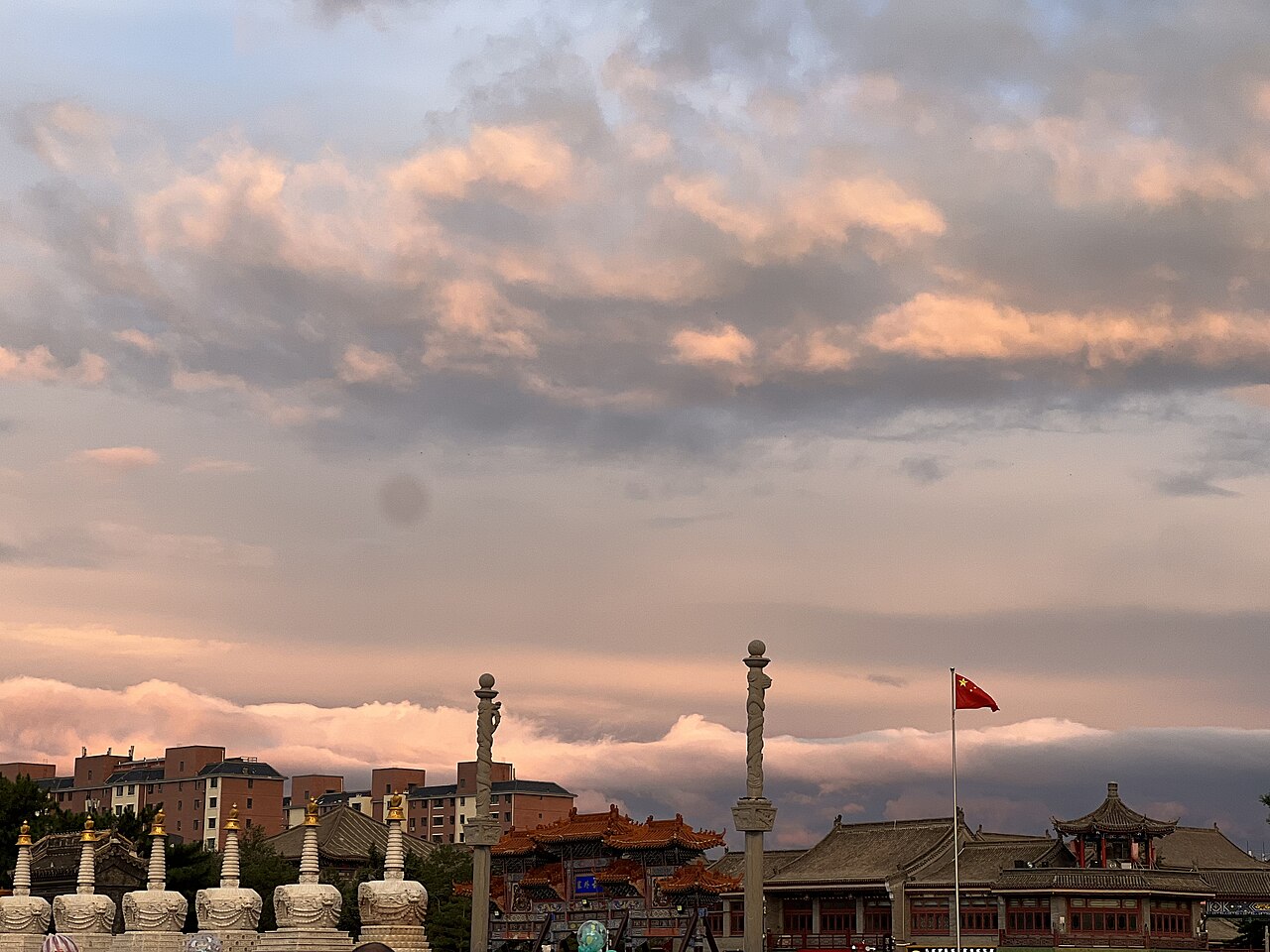
The temple faces south. Along the main axis stand a memorial archway, the gate, the Hall of Heavenly Kings, the Bodhi Hall, the main hall and a sutra library, with side halls on both flanks. Everything except the main hall follows Chinese temple design. The main hall mixes Chinese and Tibetan forms. It has a two-storey front porch, an assembly hall in the middle and the Buddha hall at the back.
Chinese Wikipedia lists three marvels from the Ming. The first is the silver Buddha, seated and nearly 3 metres tall, among the largest silver Buddhas surviving in China. The second is a pair of golden dragons coiled up the two pillars in front of it, made of paper pulp and clay and still without cracks. The third is the murals, painted with mineral pigments. Some of the older murals were removed for conservation from 1984 and are now in the Hohhot museum, but others remain in the assembly hall and the Buddha hall, including arhats and protector deities.
Two smaller objects show how mixed the early town was. In front of the main hall stand a pair of hollow iron lions. Their inscriptions say they were cast in 1623 by Chen Er, a craftsman from the Datong pastures, and one carries Mongolian text while the other carries Chinese. Outside the gate is the Jade Spring well. A plaque calls it the first spring of the nine frontier garrisons, and a legend says the Kangxi emperor's horse pawed it open. Yuquan District takes its name, Jade Spring, from this well.
Festivals
Dazhao holds a Buddha-sunning festival on the fifteenth and sixteenth days of the first lunar month and again on the fifteenth of the sixth month. Monks carry out a painted Maitreya about 7 metres by 5 and hang it in front of the hall while they chant and play ritual music. In the same months the temple stages a ceremony in which a dough effigy of misfortune, called the balin, is carried out with a masked cham dance and burned outside the gate. Dates follow the lunar calendar, so check them for the year you visit.
Tickets, hours and getting there
The temple charges a modest ticket. 2026 listings on travel sites quote 35 yuan, with longer hours in summer and shorter hours from early October, so check the day's notice at the gate. Dress modestly, walk clockwise around halls and stupas, and follow the signs on photography inside the halls.
Hohhot Bendibao lists buses 6 and 58 to a Dazhao stop about 200 metres away. From Hohhot East railway station or the airport, its suggested route takes Metro Line 1 to the Fushu Yiyuan station and then bus 59 to Dazhao. The temple sits in the old-town pedestrian area, so it pairs easily with a walk to the Five Pagoda Temple, a short taxi ride away in the same district.
Planning a Hohhot day
The Hohhot guide puts Dazhao in the morning, when the halls are quieter and services may be under way. The streets around it are full of shops selling shaomai, the steamed mutton dumplings Hohhot is known for, which makes a good late breakfast. Allow one to two hours inside.
Frequently asked questions
When was Dazhao Temple built?
It was built in 1579 and 1580 by Altan Khan, and the Third Dalai Lama consecrated its silver Buddha in 1586.
Why is it called the Silver Buddha Temple?
Its main image is a seated Shakyamuni cast from silver, nearly 3 metres tall.
Is Dazhao still an active monastery?
Yes. It has resident monks and holds regular services and festivals.
How do I get there by public transport?
Buses 6 and 58 stop at Dazhao, about 200 metres from the gate. From the metro, local guides suggest Line 1 to Fushu Yiyuan and then bus 59.
Sources
Facts in this article were checked against the following sources, retrieved 11 October 2026.
Photos are from Wikimedia Commons under the licences shown in each caption.