Five Pagoda Temple and Its Stone Map of the Sky
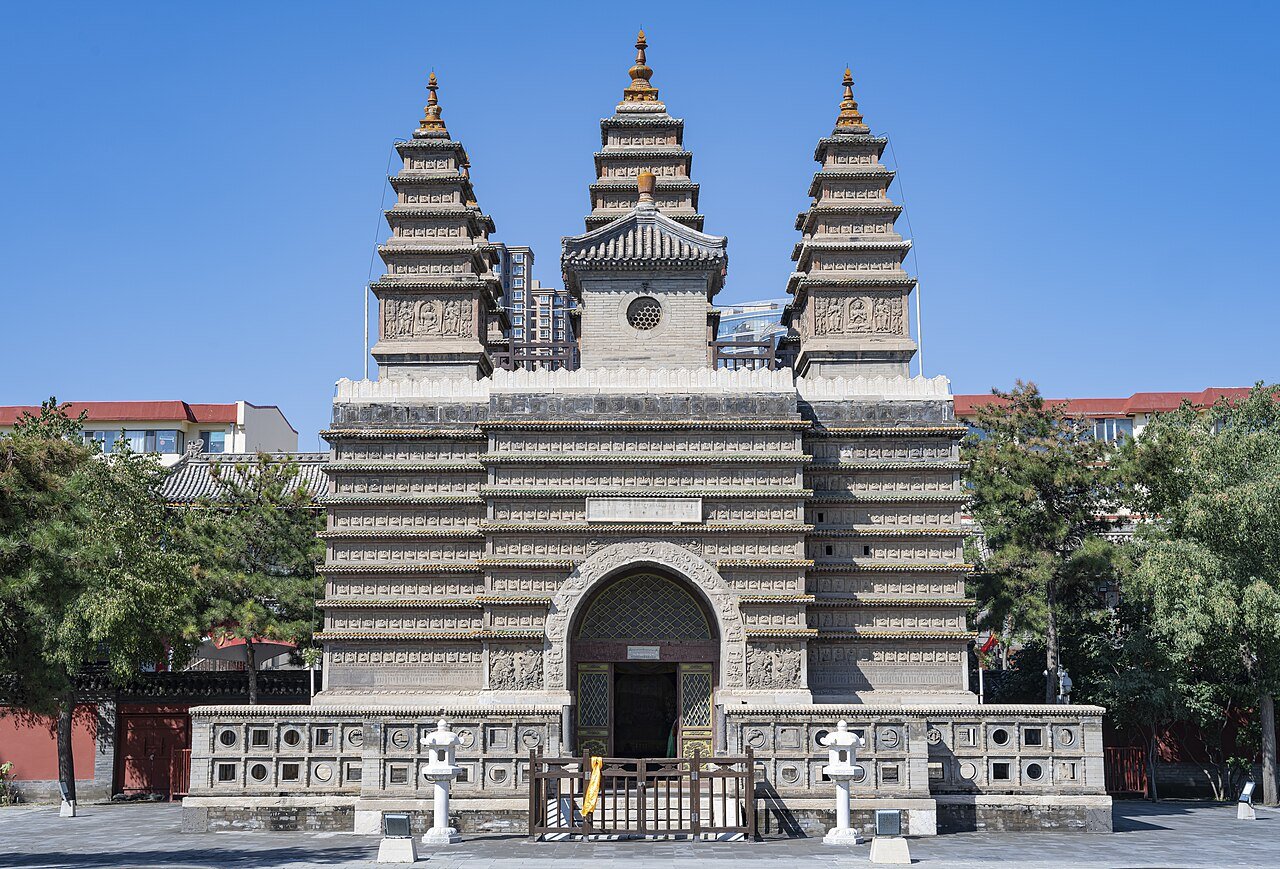
The Five Pagoda Temple stands at 48 Wutasi Back Street in Yuquan District, the old town of Hohhot. Its formal name is Cideng Temple, but everyone calls it Wuta Si after the five small towers that rise from a single brick platform at the back of the courtyard. The pagoda dates from 1727 to 1732 and is one of only a handful of diamond throne pagodas in China. The temple halls in front are a 2006 reconstruction, and the site now runs as a free museum of Hohhot's monastery culture.
A branch temple of Xiaozhao
Chinese Wikipedia gives the history in some detail. In 1727 Yangcarci, a lama of Xiaozhao, one of Hohhot's main monasteries, was serving as deputy administrative lama of Guihua. When he went to report to the Qing court, he asked permission to build a branch temple for Xiaozhao. It was finished in 1732, and the court named it Cideng Temple and gave it a name plaque in Mongolian, Tibetan and Chinese. The pagoda, known in Mongolian as Tabun Suburgan, the five stupas, was built over the same years.
The temple originally covered 1.35 hectares in three courtyards, each with a main hall and side halls. On New Year's Eve, lamas from the town's monasteries came to the square in front to perform the masked cham dance with drums, horns and cymbals. On the night of the Lantern Festival, iron lotus lamps were set along the pagoda and its low walls, so the whole tower glowed.
After the third Yangcarci died in 1886 the temple had no reincarnated lama, and the monks went back to Xiaozhao. A traveller of the time wrote that it was completely abandoned, with every building falling apart. By the end of the 1960s the halls were gone and only the pagoda remained.
Rescue and rebuilding
The architect Liang Sicheng and the writer Ye Shengtao came to Hohhot in September 1961 and spoke highly of the pagoda. A part-time guard was appointed in 1962. The state paid for repairs in 1977, a conservation office opened in 1982, and on 13 January 1988 the pagoda was listed as a nationally protected site.
In 2006 the city spent more than 8 million yuan rebuilding the temple on its old footprint. Designers worked from documents, photographs and excavation of the foundations. The walls, the halls of the second and third courtyards, six side halls and a well pavilion were finished on 12 July 2006, with thirteen Buddha figures placed inside. An official of the regional heritage bureau described it as the first old building complex in Inner Mongolia to be reconstructed on its original site.
Reading the pagoda
The pagoda is 16.5 metres high. A raised platform called the diamond throne stands on a lotus-carved base, and on top sit five square towers with green glazed eaves. The form goes back to the Mahabodhi temple at Bodh Gaya, and in China the closest relative is the Zhenjue Temple pagoda in Beijing. Chinese Wikipedia counts five such pagodas in the country, while English Wikipedia lists six. The central tower has seven storeys and stands 6.62 metres tall, with a pair of Buddha footprints carved around its base. The four corner towers have five storeys.
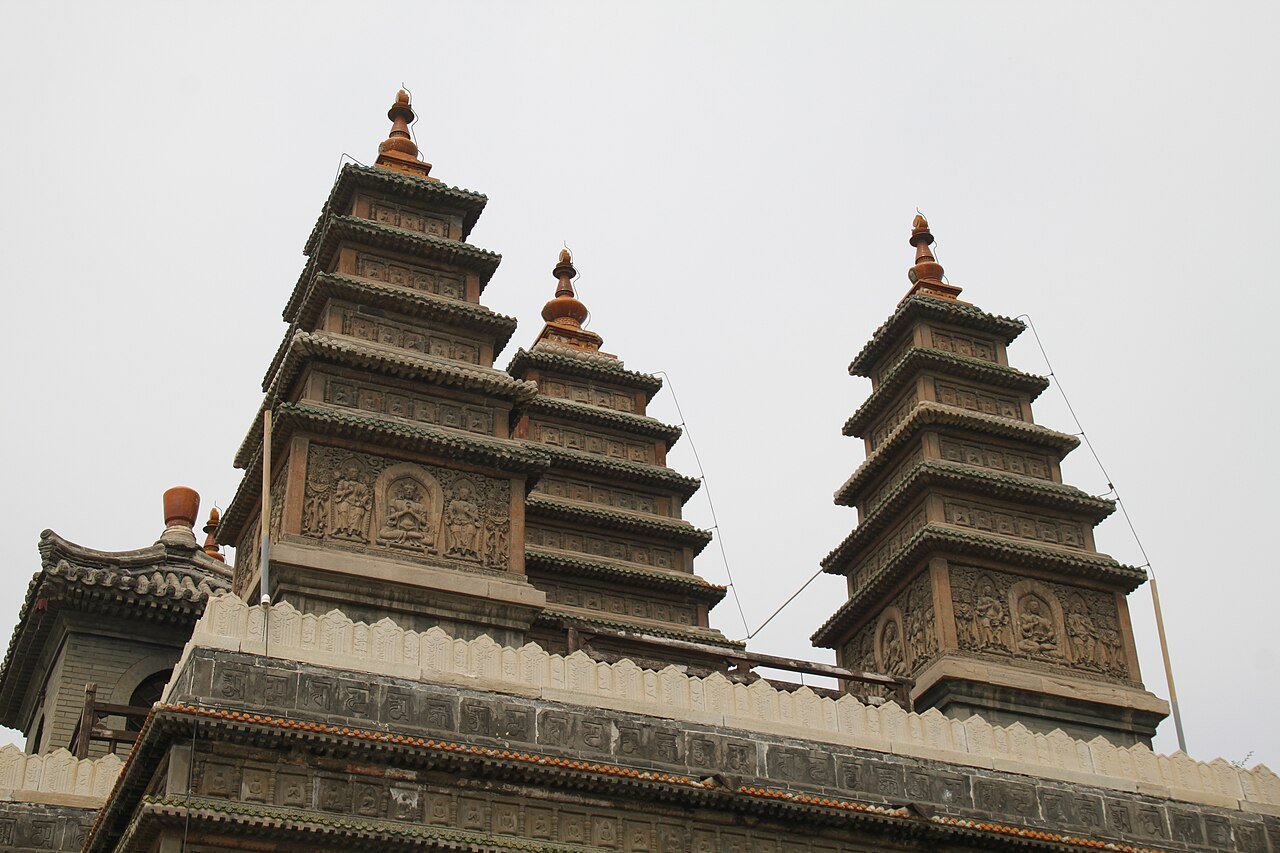
The carving is what holds people's attention. Four Heavenly Kings flank the arched south door, along with kalavinka birds, lions and horses, and above it is a white marble plaque naming the pagoda in Mongolian, Tibetan and Chinese. Around the waist of the base are brick carvings of the mounts of the five Buddhas, the lion, elephant, horse, peacock and garuda. The first tier of the throne carries the Diamond Sutra in Mongolian, Tibetan and Sanskrit. From the second tier up, rows of niches each hold a small gilded Buddha. Chinese Wikipedia counts 1,119 of them, and English Wikipedia gives 1,563 images in all. A spiral stair inside leads up to the top platform.
The star chart
On the back wall of the pagoda are three round stone carvings. One shows the wheel of life, one shows Mount Sumeru and the Buddhist universe, and the third is a star chart. The chart is made of eight pieces of white marble and measures 1.445 metres across. It is centred on the north celestial pole, with 28 radiating lines for the 28 lunar mansions and five circles for the polar, tropical and equatorial bands. It also marks the 24 solar terms and the twelve zodiac divisions. Its Mongolian inscription says it was cut in 1725 from a chart made by the Qing Imperial Astronomical Bureau. Chinese Wikipedia calls it the only surviving stone star chart in China labelled in a minority language, and the only surviving old star map labelled in Mongolian.
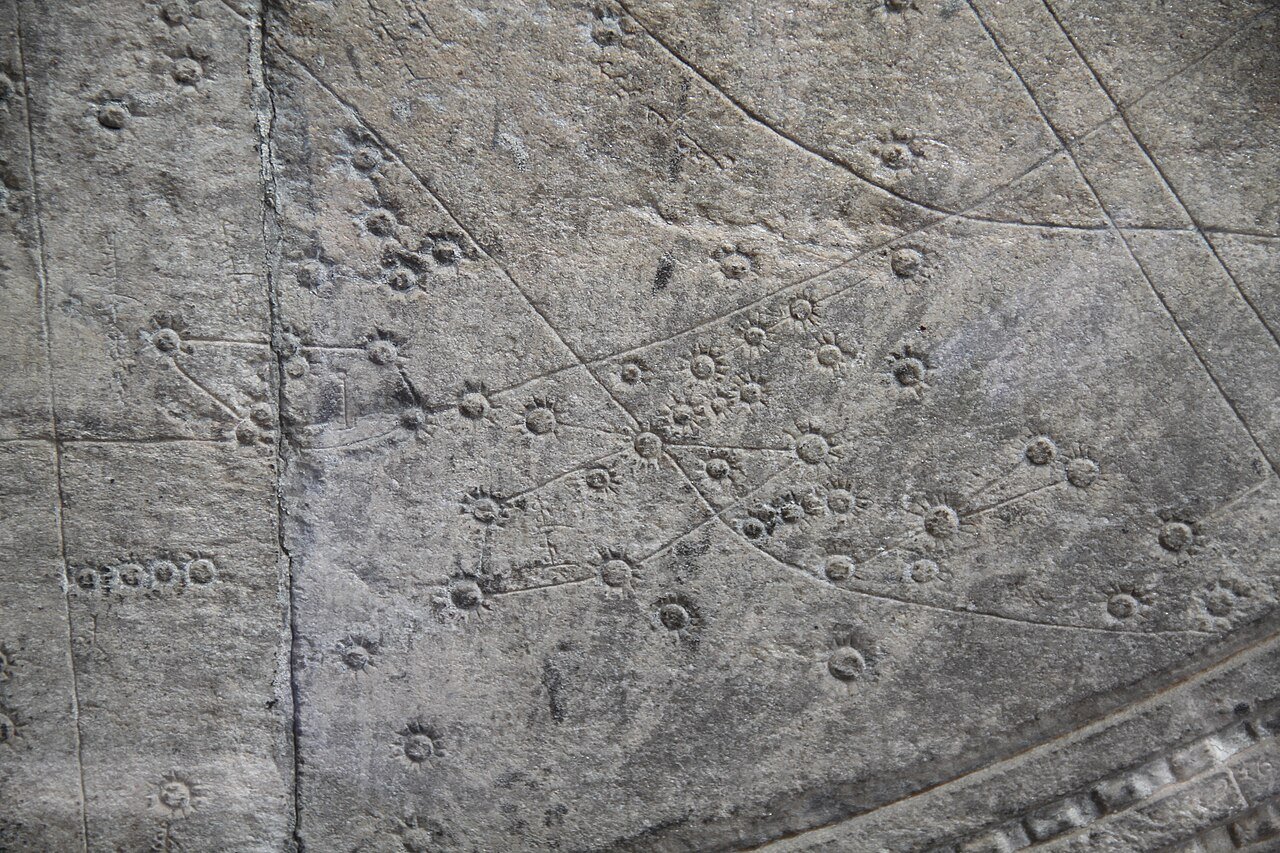
The museum uses the chart for evening astronomy events. At the 2026 Lantern Festival, for example, it ran a star-viewing session with telescopes alongside the lanterns.
Visiting
Hohhot Bendibao, citing the museum, lists opening hours of 9:00 to 17:00 from Wednesday to Monday. Last entry is at 16:30, and the museum closes on Tuesdays except for national public holidays. Entry is free once you register with a valid ID, and passports are accepted. Visitors under sixteen do not need a ticket. Free guided tours run at set times from the first courtyard, and the guided tours are also the way to walk close around the pagoda. The museum may close at short notice for events or maintenance, so check the day's notice.
The temple is in the old town, a short taxi ride from Dazhao Temple. Seeing both makes an easy half-day. The Hohhot guide suggests adding the Zhaojun Tomb on another afternoon.
Before you go
- Avoid Tuesday, the weekly closing day.
- Bring your passport or ID to register for free entry.
- Ask at the entrance for the guided tour times if you want to circle the pagoda closely.
- Bring binoculars or a zoom lens for the upper niches.
Frequently asked questions
Is the Five Pagoda Temple free?
Yes. Entry is free after registering with a valid ID.
When is it closed?
On Tuesdays, except for national public holidays, according to the museum's published hours.
How old is the pagoda?
It was built from 1727 to 1732. The halls in front were rebuilt in 2006.
What is special about the star chart?
It is a stone map of the sky cut in 1725 with labels in Mongolian, which Chinese sources describe as the only surviving example of its kind.
Sources
Facts in this article were checked against the following sources, retrieved 11 October 2026.
- 慈灯寺, Chinese Wikipedia
- Five Pagoda Temple (Hohhot), English Wikipedia
- 呼和浩特五塔寺开放时间, Hohhot Bendibao
- 五塔寺博物馆2026春节开放时间, Hohhot Bendibao
Photos are from Wikimedia Commons under the licences shown in each caption.