Zhengzhou Travel Guide: Six Stops in the Green City (with a Three-Day Itinerary)
Zhengzhou is the capital of Henan, abbreviated Zheng and nicknamed the Green City, a provincial capital on the lower Yellow River, once called the Shang capital, now a rail hub where the Beijing–Guangzhou and Longhai lines cross. The municipality covers about 7,567 square kilometers and held 13.01 million people in 2023. In 2004 it joined the list of China's eight great ancient capitals, on the strength of the Shang city under today's streets. Six places below (Shaolin Temple, the Pagoda Forest, Mount Song, the Henan Museum, the Shang city ruins, and the Erqi Memorial Tower) have all had their origins checked against public sources.
Planning a short Zhengzhou stay
Protect one signature half-day and one buffer for transport. Cut malls and duplicate viewpoints if the calendar is tight. A cut list beats a checklist when time runs short.
When to come to Zhengzhou
The city infobox calls the climate temperate monsoon; the same page's body puts Zhengzhou on the northern edge of the subtropical zone, with an annual mean around 15°C and about 640 millimeters of rain. Four seasons are clear either way: spring is dry and dusty, summer hot and wet, autumn long and bright, winter dry-cold. Autumn is the comfortable window. Shaolin and Mount Song photograph well then, and the museum is a relief in July. Sights split between the city and Dengfeng, more than an hour southwest; metro and taxis cover town, and Shaolin wants its own full day.
How to get in and where to stay
Use the main airport or high-speed rail station that serves Zhengzhou, then ride metro, bus, or taxi per posted notices. Stay near the primary visitor cluster if walking matters; treat outlying scenic areas as day trips, not hotel districts.
Places worth visiting
Shaolin Temple
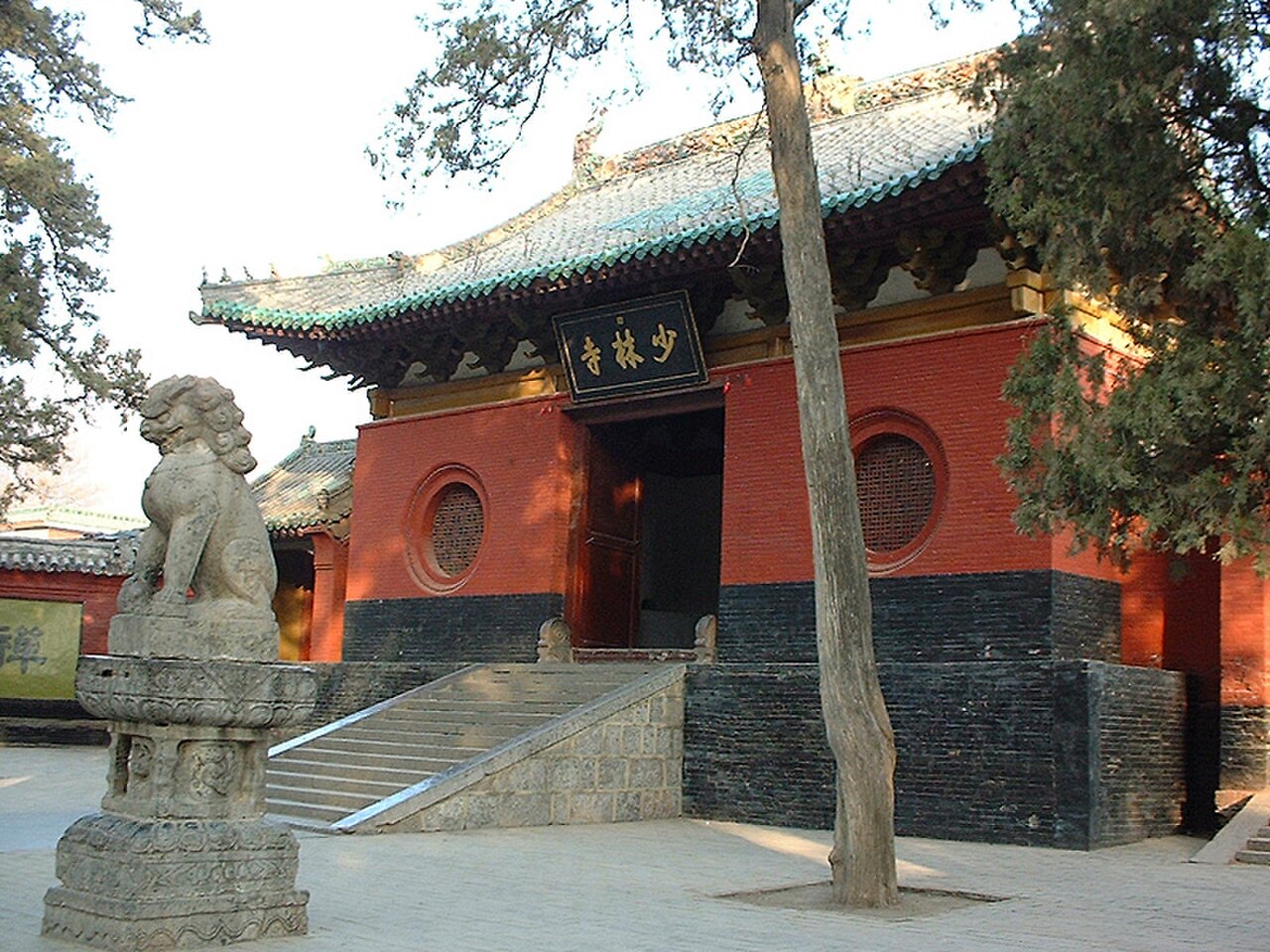
Shaolin Temple sits in Dengfeng, at the foot of Wuru Peak on Mount Song, in the forest of Shaoshi Mountain, hence the name. It was founded in the nineteenth year of Northern Wei Taihe (495) for the Indian monk Batuo, and later became the ancestral monastery of Chan Buddhism in China, of the Caodong lineage today. Bodhidharma is the figure everyone associates with the place: the tradition says he taught sitting meditation here and passed the Dharma to Huike. The kung fu is what fills the buses. The architectural cluster of the main compound, Chuzu Temple and the Pagoda Forest entered UNESCO's list in 2010 as part of the Historic Monuments of Dengfeng in "The Centre of Heaven and Earth," and the scenic area is a national 5A site.
Much of what you walk through is rebuilt. In March 1928 Shi Yousan's troops burned the Dharma hall and, the next day, the main halls, the bell and drum towers and the sutra collection, thousands of volumes gone. The Mahavira Hall and the Bodhidharma face-wall stone you see now are reconstructions; the Pagoda Forest and a number of steles are the older fabric. Ticket prices and performance times follow the site's notices; start early, the valley fills by mid-morning. Which halls are original, the Bodhidharma hermitages and day-trip logistics are on the Shaolin Temple page.
The Pagoda Forest
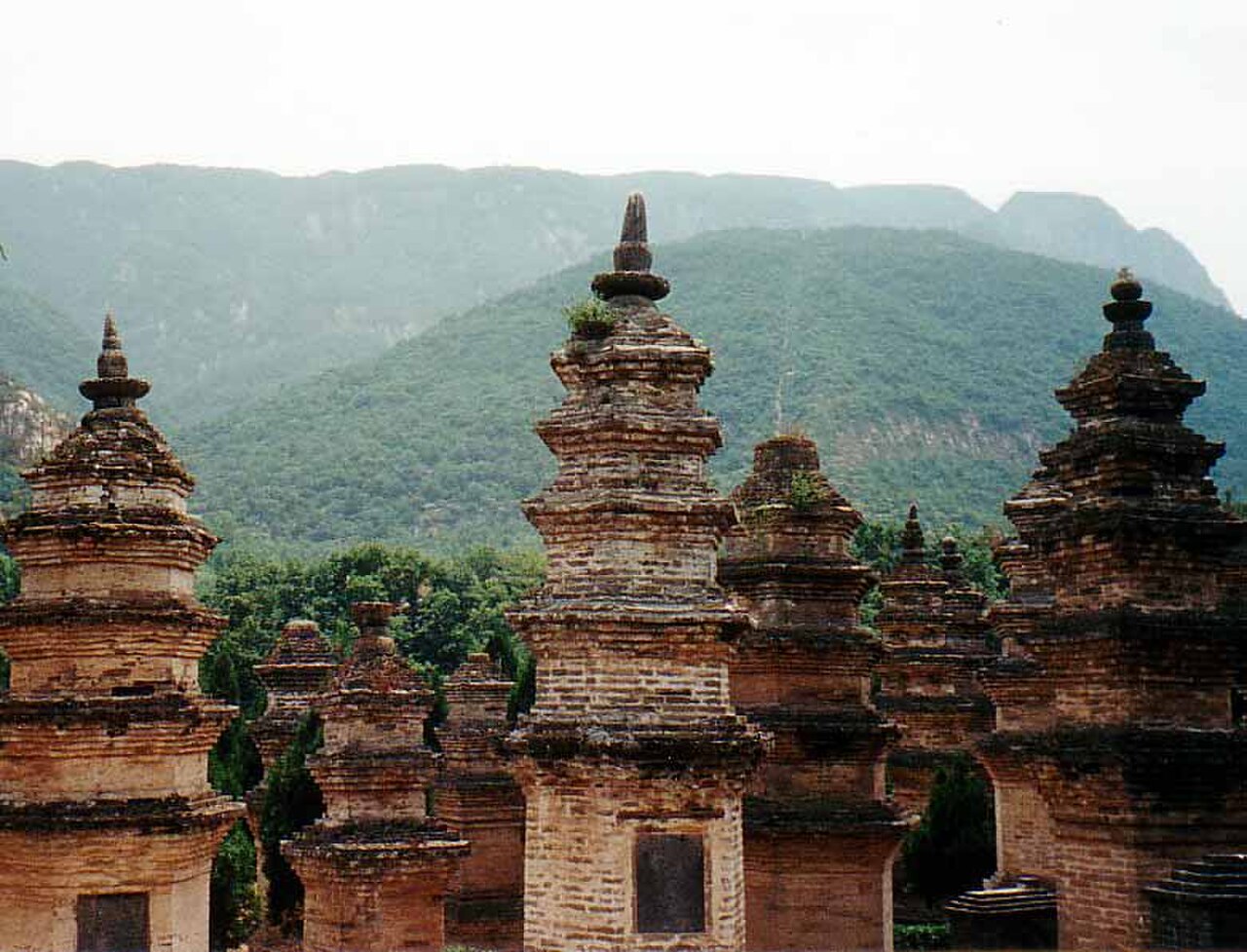
The Pagoda Forest lies a short walk from the main compound, brick and stone memorial pagodas from the Tang through the Qing, the burial ground of Shaolin abbots and monks. Chuzu Temple and the Pagoda Forest were listed together in the fourth batch of nationally protected sites in 1996; the temple itself followed in the seventh batch in 2013. The pagodas are not one size. Some are squat and dense, some rise in stacked eaves, and the inscriptions are worth slowing down for even if you cannot read every character.
This is the quietest stretch of the Shaolin visit. The main compound absorbs the tour groups and the martial-arts shows; among the pagodas the mountain air comes back. Give it time on the same ticket, rather than turning around at the mountain gate. The Shaolin Temple page places it in a full walking order.
Mount Song
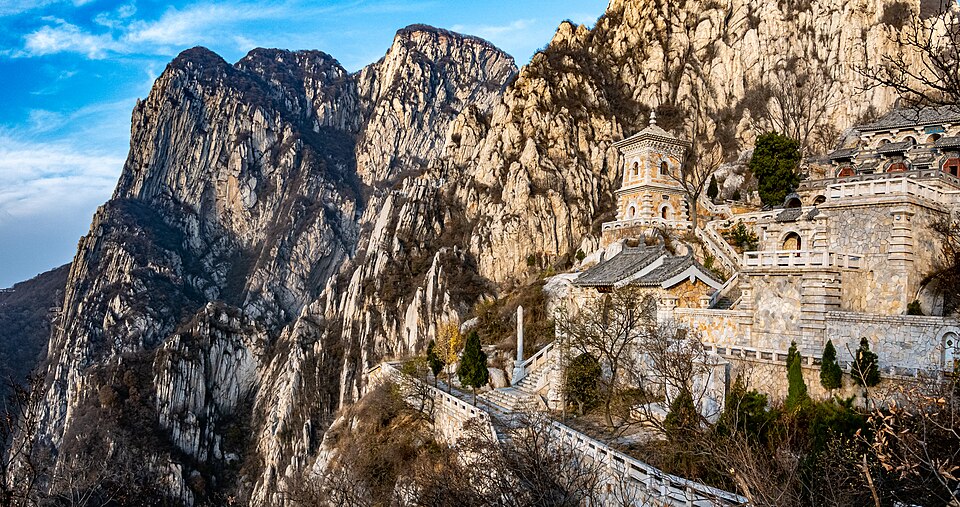
Mount Song is the central peak of China's Five Great Mountains, a range between Zhengzhou and Luoyang on the south bank of the Yellow River. The popular split is Taishi to the east of the Dengfeng valley and Shaoshi to the west; Shaolin sits on the Shaoshi side. The highest point is Lian Tian Feng at 1,512 meters. The photograph above shows the cliffs around Sanhuangzhai, on the upper Shaoshi slopes across the valley from the monastery, a steep walk, and a different mountain from the temple courtyards.
The 2010 UNESCO listing covers eight sites in Dengfeng under the old idea of Songshan as the centre of heaven and earth: Shaolin is one, Songyang Academy another. The academy, below Junji Peak, was among the four great academies of the Northern Song. Zhongyue Temple and the Gaocheng Observatory sit on the same mountain. You will not do all of them in a day; pick Shaolin plus one ridge, or Shaolin plus the academy, and leave the rest for a second Dengfeng trip. Cable cars run on the developed slopes; hours and fares follow official notices.
The Henan Museum
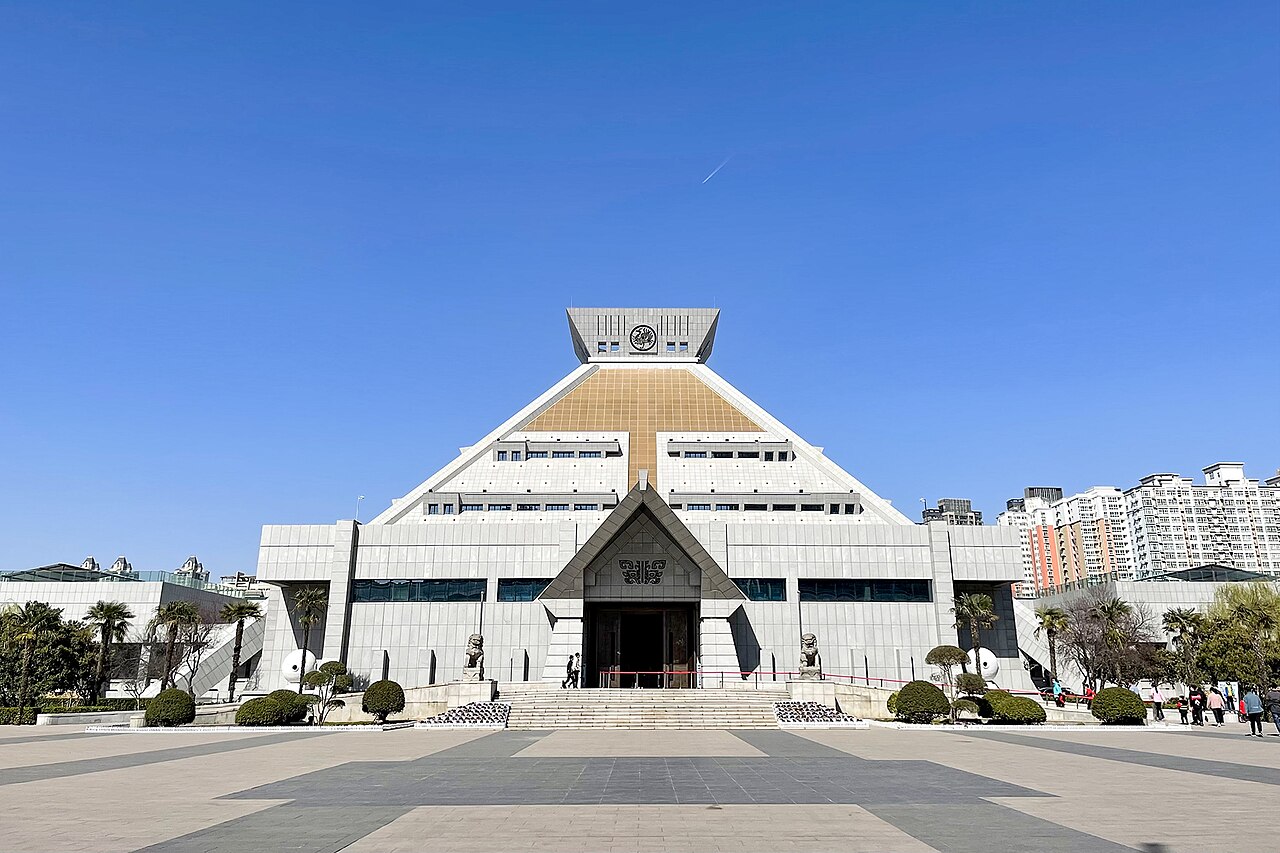
The Henan Museum stands on Nongye Road in Jinshui District. It opened in Kaifeng in 1927 under Feng Yuxiang, moved to Zhengzhou in 1961 after the provincial capital moved, and took its present building in 1997. It is a first-class national museum. The collection runs past 130,000 objects, strongest in prehistoric pieces, Shang and Zhou bronzes, ceramics and jades, the yield of a province that has been dug, almost without pause, for a century.
This is the fastest way to read Henan before you walk Shaolin or the Shang walls. The bronzes from Xinzheng, Luoyang and Sanmenxia make more sense of the ruins in town; the ceramics make more sense of the kilns you will not have time to reach. A batch of the original Kaifeng holdings went to Taiwan in 1949 and now sits in Taipei's National Museum of History; the Zhengzhou museum is what remained and what has been excavated since. Reservation and closing days follow official notices; Monday closures are the usual museum pattern. The nine headline treasures, gallery order and booking notes are on the Henan Museum page.
The Shang City Ruins
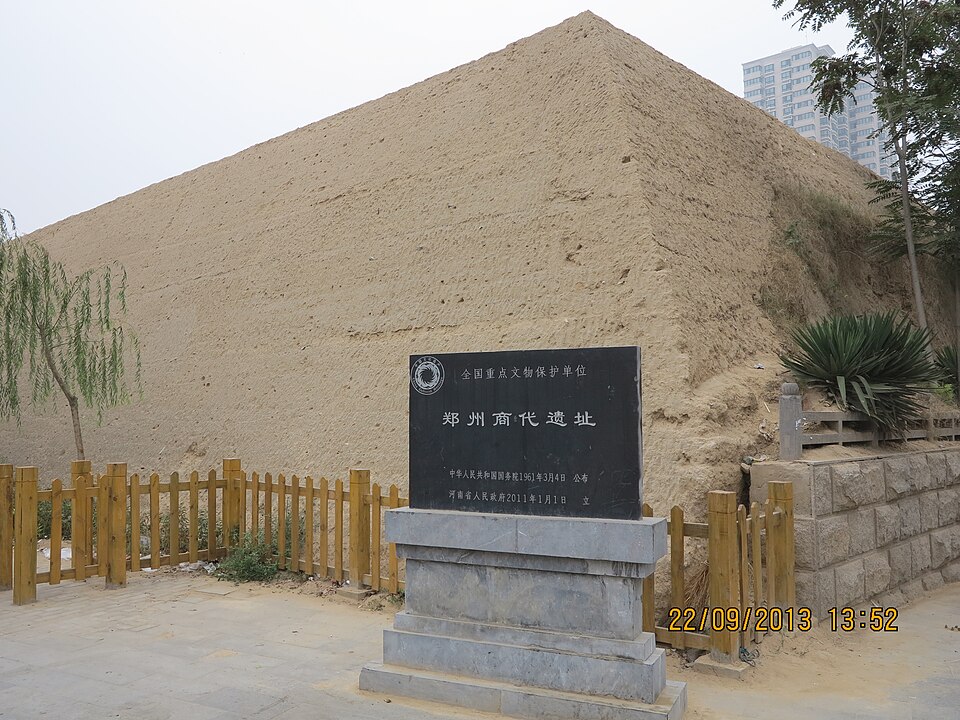
The Zhengzhou Shang city sits under the modern street grid, a Shang capital of about 3,500 years. The inner wall runs about 6,960 meters, roughly rectangular, with eleven gaps of which some were likely gates; a palace zone occupies the northeast, and workshops, cemeteries and houses spread outside. It was found in 1950, the inner wall in 1955, and listed in the first batch of nationally protected sites in 1961. Two bronze hoards produced the Duling square ding and related vessels, treated as royal ritual pieces.
Scholars split on the name. One camp reads it as Zhong Ding's Ao; the other as Tang of Shang's Bo. The 2004 "eighth ancient capital" listing followed the Bo camp, and other scholars still disagree, the city page records both. Either way the walls are Shang. The Shangdu Relics Museum on the site opened for trial in December 2021 and formally in July 2022; hours follow its notices. What you see at ground level is rammed earth, not a reconstructed palace, and that is the point.
The Erqi Memorial Tower
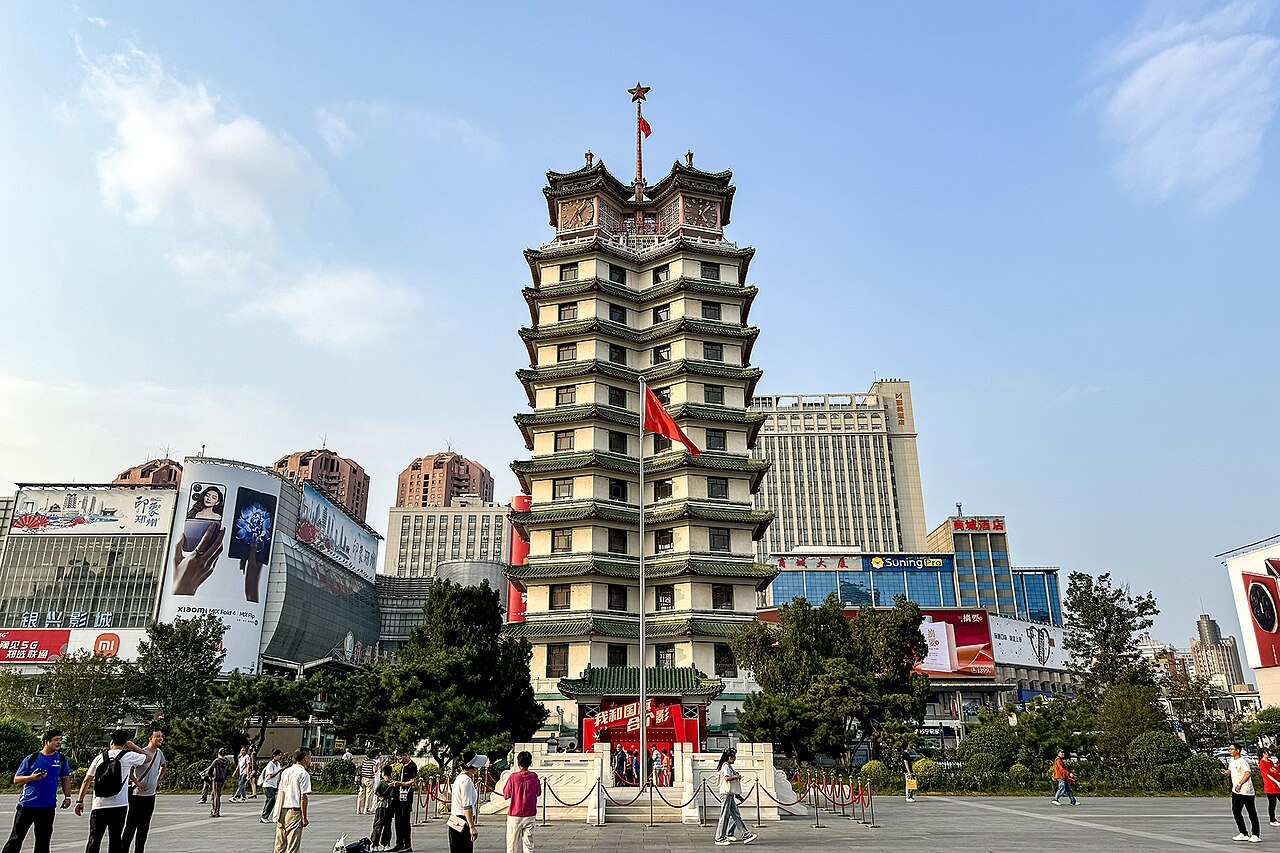
The Erqi Memorial Tower stands in Erqi Square, in the middle of the city. 63 meters, fourteen floors, finished on 29 September 1971. It commemorates the Beijing–Hankou railway strike of 7 February 1923, and it stands where the strike leaders were executed. The plan is two pentagonal towers joined together, a nod to the workers who walked off the railway. A wooden tower of 1951 stood here first and collapsed in 1971; the concrete tower replaced it the same year, and for a few years it was the tallest building in Zhengzhou.
At the top sit a red star and a 2.7-meter clock that plays The East Is Red on the hour. Inside are photographs and documents of the strike. The square is the city's ordinary meeting point, come in the evening when the outline lights are on, then walk the nearby streets for supper. The tower is a city landmark more than a half-day sight; twenty minutes on the square is enough if Dengfeng is waiting.
Eating in Zhengzhou
Henan is wheat country, and Zhengzhou eats accordingly. Hui mian is the city's claim, a braised-noodle soup in a long-simmered broth, so common that Zhengzhou calls itself a city of hui mian, with shops on almost every block. Hulatang, the peppery breakfast soup, is flour-thickened and eaten with youmo or a steamed bun; caijiao, the fried vegetable pie, is the other morning habit. Steamed dumplings sit next to the noodles on most local lists. Follow the queues rather than the neon; three days without a repeat is easy, and none of it is expensive.
How to arrange the route
Day one stays in town: the Shang city ruins and the Shangdu museum in the morning, the Henan Museum in the afternoon, the Erqi Tower at dusk and hui mian nearby.
Day two is Dengfeng: Shaolin Temple in the morning, the Pagoda Forest before the compound fills, then as much of Shaoshi as the legs allow. Stay the night in Dengfeng if you want the mountain at first light.
Day three is the rest of Songshan (Songyang Academy, a ridge walk, or Zhongyue Temple) then back to Zhengzhou for a last bowl of hui mian. With only two days, drop day three and let Shaolin take the whole of day two.
Kaifeng is about twenty minutes east by high-speed rail, the other Song-era capital on the same plain. Luoyang is the next old capital west, Longmen and the White Horse Temple a comfortable add-on, with Sanmenxia farther west for Yellow River swans and Guo Museum soft stops. North toward Anyang, soft Hebi Qi-culture stops and northeast Puyang park buffers sit on quieter Henan loops. South and east, Luohe snack-and-river overnights, Zhoukou Huaiyang temple days, and Shangqiu Guide Prefecture walls fit plain-corridor side trips. Xi'an is the western end of the same imperial line if the trip keeps going.
Things to confirm before you go
- Shaolin, the Pagoda Forest and Mount Song are in Dengfeng, a full day from the city; check same-day tickets and performance times on official notices.
- The Henan Museum is free with reservation; holiday slots go fast, and Monday closures are the usual pattern.
- The Shangdu Relics Museum hours follow its own notices; the rammed-earth walls are an open site, not a reconstructed palace.
- Zhengzhou summers are hot and wet, winters dry-cold; autumn is the easiest season for both the city and the mountain.
- The Erqi Tower sits in a busy square, fine at dusk, awkward as a first stop in the morning rush.
Frequently asked questions
How many days for Zhengzhou?
Three days fits the city, Shaolin and a slice of Mount Song. Two days covers the museum plus Shaolin if you start early. One day can only do the city or Dengfeng, not both.
Is Shaolin a day trip from Zhengzhou?
Yes, and it will take the whole day. The temple, the Pagoda Forest and a short walk on Shaoshi fill the hours; staying overnight in Dengfeng is better if you also want Songyang Academy or a longer ridge.
Kaifeng or Luoyang from Zhengzhou?
Both are short hops. Kaifeng is the closer Song capital, good for a night market and the Iron Pagoda; Luoyang is the heavier heritage day, with Longmen. Many travelers do Zhengzhou as the hub and add one of the two.
What must you eat in Zhengzhou?
Hui mian is the daily bowl, hulatang the breakfast, caijiao the fried side. Steamed dumplings sit on the same tables. None of it needs a banquet reservation.
Sources
The facts in this article were checked against the following Wikipedia entries, retrieved September 4, 2026.
- Zhengzhou (city) https://zh.wikipedia.org/wiki/郑州市
- Shaolin Temple https://zh.wikipedia.org/wiki/少林寺
- Zhengzhou Shang city https://zh.wikipedia.org/wiki/郑州商城遗址
- Henan Museum https://zh.wikipedia.org/wiki/河南博物院
- Erqi Memorial Tower https://en.wikipedia.org/wiki/Erqi_Memorial_Tower
- Mount Song https://en.wikipedia.org/wiki/Mount_Song
The Chinese Wikipedia pages for the Erqi Tower and Mount Song did not return usable body text in this round of retrieval, so those two entries were checked against the English Wikipedia. Shaolin's rebuilt halls after the 1928 fire, and the Bo-versus-Ao debate over the Shang city, are stated as the pages give them.
All photos are from Wikimedia Commons, used under CC licenses; re-use requires attribution.
- zhengzhou-city.jpg from File Zhengzhou_CBDcity.jpg, by 白诗棋, CC0
- zhengzhou-shaolin.jpg from File Shaolinsi.JPG, by Yaoleilei, CC BY-SA 3.0
- zhengzhou-talin.jpg from File Shaolin Pagoda Forest, Henan, China - June 2001.jpg, by Wintran, CC BY 2.5
- zhengzhou-songshan.jpg from File The Songshan Buddhist Academy Lied in Mount Song.jpg, by Iswzo, CC BY-SA 4.0
- zhengzhou-museum.jpg from File 20210220 Henan Museum - main hall 01.jpg, by Windmemories, CC BY-SA 4.0
- zhengzhou-shangcheng.jpg from File 郑州商城遗址1.JPG, by Robinlun, CC BY-SA 3.0
- zhengzhou-erqi.jpg from File 20240920 Erqi Memorial Tower 02.jpg, by Windmemories, CC BY-SA 4.0