Wuhou Temple at Wolong Gang
Wolong Gang, the "Crouching Dragon Ridge", is a low, winding rise in Wolong District on the west side of Nanyang. Tradition holds that Zhuge Liang farmed here for about ten years before Liu Bei called on him three times and persuaded him to serve, the scene every Chinese reader of the Three Kingdoms knows. His nickname, Wolong, comes from the same story. The Wuhou Temple on the ridge honours him as the Marquis of Wu. It is one of nine surviving Wuhou temples in China and has been a national key cultural relic since 1996.
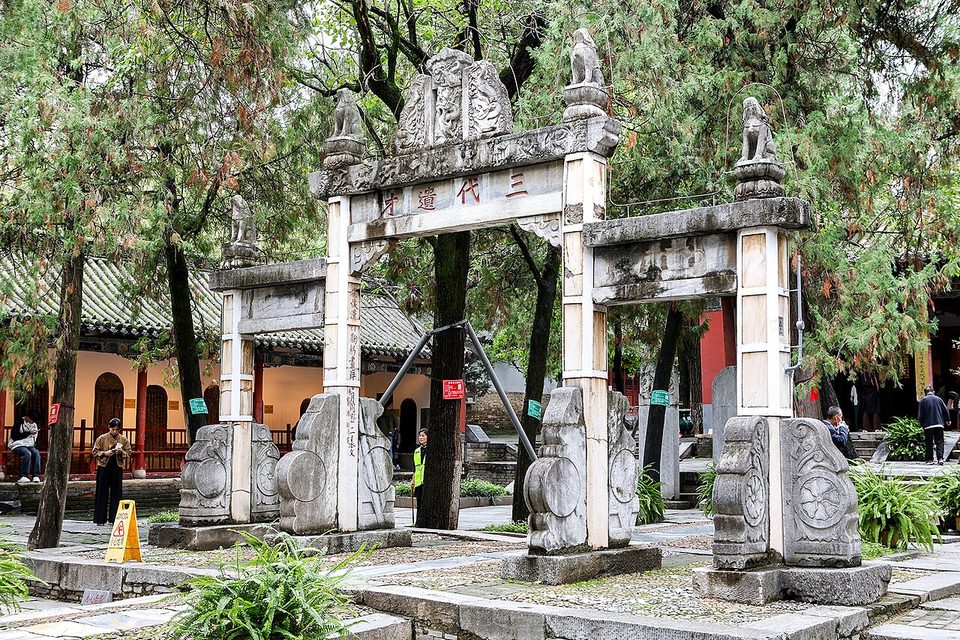
Is this really where he lived?
The claim is disputed. Xiangyang in Hubei has its own Longzhong site with the same story, and the argument between the two cities is old. Chinese Wikipedia describes the Nanyang claim as possible but contested. The temple itself is not in doubt. Worship of Zhuge Liang on this ridge goes back to the Jin dynasty and was well established by the Tang and Song.
Eighteen centuries of shrines
The first shrine, by tradition, was a small hall set up by Huang Quan, a Shu general who later went over to Wei. By the Tang the site appeared in poems as a known landmark. Wars in the Song and Jin burned it more than once. Under the Yuan it was repaired in 1298 and enlarged in 1309, and in 1317 Emperor Renzong of Yuan gave the buildings on the ridge the formal name Wuhou Ci. The Jiajing Emperor of the Ming fixed Zhuge Liang's sacrifice day as the 28th of the eighth lunar month, and Wuhou temples across China followed that date.
In 1711 the prefect Luo Jing rebuilt the temple and recreated the Ten Scenes of Wolong from an older engraved map of the ridge. The present plan follows the Yuan and Ming layout, and most timber halls are Ming and Qing rebuilds. The Cultural Revolution destroyed the three stone archways at the thatched hut, the figures inside and eighteen glazed Ming arhat statues, and burned the Qing woodblocks of the temple's gazetteers. Much of what you see was restored afterwards.
Steles and the Ten Scenes
The temple keeps more than 400 steles from the Han onwards, more than any other Wuhou temple according to Chinese and English Wikipedia. The most famous are stone copies of both versions of Zhuge Liang's memorial to the throne, the Chu Shi Biao, in the hand of the Song general Yue Fei. They stand in a stele corridor north of the main hall. The Wolong Taoist court has more than ten religious statues from the Sui onwards.
The Ten Scenes sit at the back of the compound and around the entrance.
- The thatched hut, an octagonal pavilion on the supposed site of his house. Its plaques were written by the prefect Fu Fengyang in 1894, the politician Yu Youren in 1940 and Guo Moruo in 1973.
- The small rainbow bridge of grey brick in front of the hut, said to be his daily path.
- The old cypress pavilion, built around a tree he is said to have planted.
- The moon companion terrace, where by legend he watched the stars at night, with the old dragon cave beneath it.
- The Zhuge well, a stone-rimmed well by the pond at the entrance.
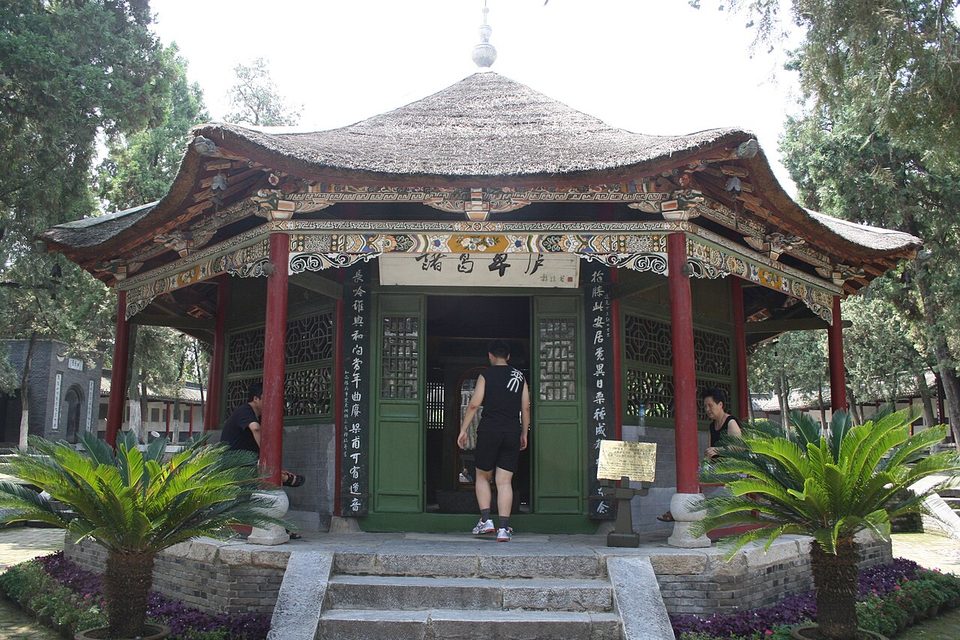
The Han Painting Museum next door
Also on Wolong Gang is the Nanyang Han Painting Museum, a national first-grade museum of carved Han dynasty stone reliefs. Chinese Wikipedia calls it the first museum of its kind in modern China. Nanyang was one of the great cities of the Eastern Han, and its tomb reliefs show performers, animals, myths and astronomical scenes. It makes a natural second half to the day. The museum's own notice lists free entry with ID and a Monday closure.
Tickets, hours and getting there
Local listings in 2026 give daytime opening hours and an adult ticket for the Wuhou Temple, sold through the Wolong Gang culture park's official account and travel platforms. This page does not quote prices. Check the official notice on the day.
The temple is in the city's Wolong District, a short taxi ride from Nanyang station. Allow two to three hours for the temple and another two for the Han Painting Museum.
Before you go
- Visit in the morning, when the courtyards are cooler.
- Look for the Yue Fei steles north of the main hall.
- Pair with the Han Painting Museum, closed on Mondays.
- Save a second day for the Neixiang County Office west of the city.
Frequently asked questions
Nanyang or Xiangyang for Zhuge Liang?
Both claim his early home. Nanyang has the larger collection of steles. Choose by route.
What does Wuhou mean?
It is short for Zhongwu Hou, the posthumous title the Shu Han court gave Zhuge Liang, usually rendered as Marquis of Wu.
How long do I need?
Two to three hours for the temple, a full day with the museum.
Are prices listed here?
No. Ticket prices follow the official notice.
Sources
Facts in this article were checked against the following sources, retrieved 20 October 2026.
- 武侯祠 (南阳), Chinese Wikipedia
- 卧龙岗, Chinese Wikipedia
- Wolong Gang, English Wikipedia
- Nanyang Han Painting Museum, visitor services
- Nanyang travel guide on this site
Photos are from Wikimedia Commons under the licences shown in each caption.