The Neixiang County Office
For two thousand years most Chinese met the state at the county yamen. The magistrate collected taxes, heard lawsuits, kept the jail and read out imperial edicts there. Very few of these compounds survive intact. The Neixiang County Office, in the county town of Neixiang west of Nanyang, is the one Chinese sources hold up as the most complete Qing county office in the country. A local saying pairs it with the Forbidden City, "the dragon's head in Beijing, the dragon's tail in Neixiang".
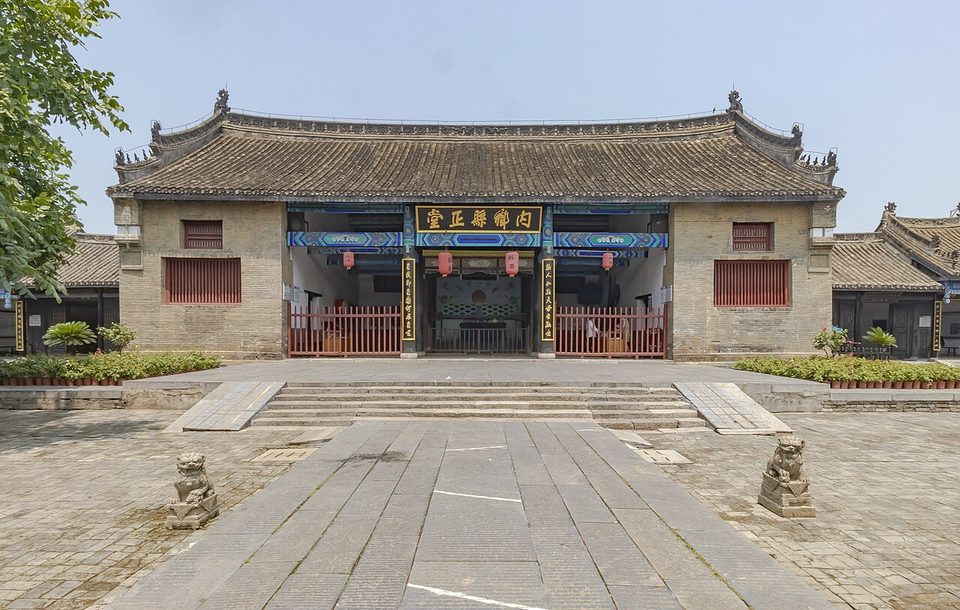
Six centuries of rebuilding
The county gazetteer dates the first office here to 1304, under the Yuan. The magistrate Shi Weiyi rebuilt it in 1369 at the start of the Ming, and it was repaired again in 1451. Li Zicheng's rebels destroyed it at the end of the Ming, the Kangxi era rebuilt it, and Nian rebels burned it in 1857.
The buildings standing today date from 1894, the twentieth year of the Guangxu reign. The magistrate Zhang Bingtao, a native of Shaoxing in Zhejiang, raised a large sum at a time of crisis at home and abroad and rebuilt the office. His background shows in the architecture, which mixes northern and southern styles. Most of the side wings have gone, leaving the central axis with 117 rooms on a site of about 6,700 square metres.
The office kept working long after the empire fell. It housed the county government through the Republic and the People's Republic until 1968. In November 1966 Red Guards from Xi'an pulled down the Xuanhua archway at the front, which was rebuilt in 1993. From 1968 the county's armed forces department occupied the compound, which helped protect it. In February 1984 the office became China's only county yamen museum approved by the Ministry of Culture. It was listed as a national key cultural relic in 1996 and is a 4A scenic area.
Reading the plan
The layout follows Qing rules for local offices. It faces south, with civil offices on the left and military ones on the right, public halls at the front and living quarters behind, and the prison in the southwest. Five gates on the axis, the Xuanhua archway, the main gate, the ceremonial gate, the screen gate and the gate to the inner residence, echo the five gates of an imperial palace on a small scale.
Three halls stand on the axis, each five bays wide under a simple gabled roof. The main hall held formal trials and major public business. The second hall handled preliminary hearings, and the third hall was the magistrate's office and reception room. Behind them lay the family quarters and the garden.
The prison is a separate walled yard in the southwest, with an inner jail for serious cases, an outer jail and a women's jail. A small shrine inside honours Gao Yao, the legendary judge worshipped as god of prisons. About twenty rooms survive.
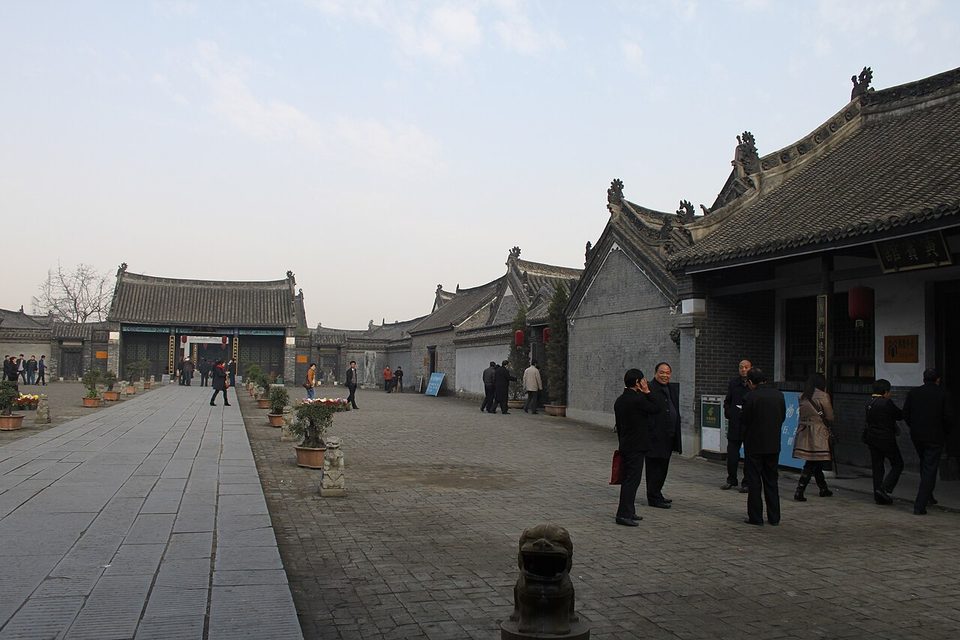
Couplets and objects
The couplets hung at the halls are the part Chinese visitors quote. Most are maxims on honest government. The best known reads, in translation, "You eat the people's rice and wear the people's clothes. Never say the people can be cheated." It was written in 1680 by the Neixiang magistrate Gao Yiyong, and it became famous nationally after Nanyang officials quoted it to Jiang Zemin on a train in 1999 and he asked for its origin to be traced.
The museum's 32 rooms are mostly furnished as they would have been in use, with about 3,600 square metres of displays. Objects include a judge's table said to be more than six centuries old, kneeling stones for plaintiff and defendant, an edict of the Xianfeng Emperor, shackles from the prison and coloured portraits of the Guangxu Emperor and the Empress Dowager Cixi. Staged performances of a magistrate trying a case are a regular feature, and travel listings in 2026 gave fixed morning and afternoon show times in the main hall.
Nanyang's prefectural office
In the city itself, the Nanyang Prefecture Office at 100 Minzhu Street served prefects under the Yuan, Ming and Qing. Chinese Wikipedia describes it as the only fully preserved prefecture office in China, with more than 150 rooms on a 240 by 150 metre site. It became a national key cultural relic in 2001. Together with Neixiang's county office and the Zhili Governor's Office in Baoding, it lets you walk through three levels of Qing local government.
Tickets, hours and getting there
Travel listings for October 2026 gave daytime opening hours with last entry in the early evening. This page quotes no prices. Check the official notice on the day, especially for show times.
Neixiang County is reached by road from Nanyang city. Long-distance buses and hired cars both work, and the office stands in the county town centre.
Before you go
- Allow two to three hours, more if you want a show.
- Arrive before a show time and find a place near the main hall.
- Visit the Nanyang Prefecture Office on the same trip if you have time.
- Pair with Wuhou Temple on your Nanyang day.
Frequently asked questions
How old are the buildings?
The main complex was rebuilt in 1894 on a site used since 1304.
Is it in Nanyang city?
No. It is in Neixiang County's town, west of the city. The prefectural office is in the city centre.
Are the trial shows in English?
They are in Mandarin. Check the official notice for show times.
Are prices listed here?
No. Prices and show times follow the official notice.
Sources
Facts in this article were checked against the following sources, retrieved 20 October 2026.
- 内乡县衙, Chinese Wikipedia
- 南阳知府衙门, Chinese Wikipedia
- China News Service Henan, Neixiang yamen performances, May 2026
- Nanyang, Henan, English Wikipedia
- Nanyang travel guide on this site
Photos are from Wikimedia Commons under the licences shown in each caption.