Shuozhou Travel Guide: The Yingxian Wooden Pagoda, Chongfu Temple and Guangwu
Shuozhou, in the far north of Shanxi, has one of the great buildings of China: the Wooden Pagoda of Ying County, built in 1056 under the Liao and, at 67.31 m, the oldest and tallest all-timber pagoda still standing. Visitors can enter only the ground floor; the upper storeys are closed to protect a structure that leans. Add Chongfu Temple's Jin-dynasty halls in Shuozhou city and the Ming Great Wall at Guangwu, and you have two good days, easily combined with Datong to the north.
Getting in
Since 31 December 2024 the Jining–Datong–Yuanping high-speed line has run through the prefecture, with new stations at Yingxian West, Shanyin South and Shuozhou East, plus Yanmenguan just to the south. Datong South to Yuanping West takes well under two hours, and Taiyuan to Datong South takes as little as 85 minutes. From Yingxian West, take a taxi or local bus into Ying County town; the pagoda is in the middle of it. The scenic area's WeChat account sells a direct shuttle.
Shuozhou city's old station is on the conventional Northern Tongpu line. Base yourself in Datong or Shuozhou city; Ying County town has simple hotels if you want the pagoda at opening time.
Places worth visiting
The Wooden Pagoda of Fogong Temple, Ying County
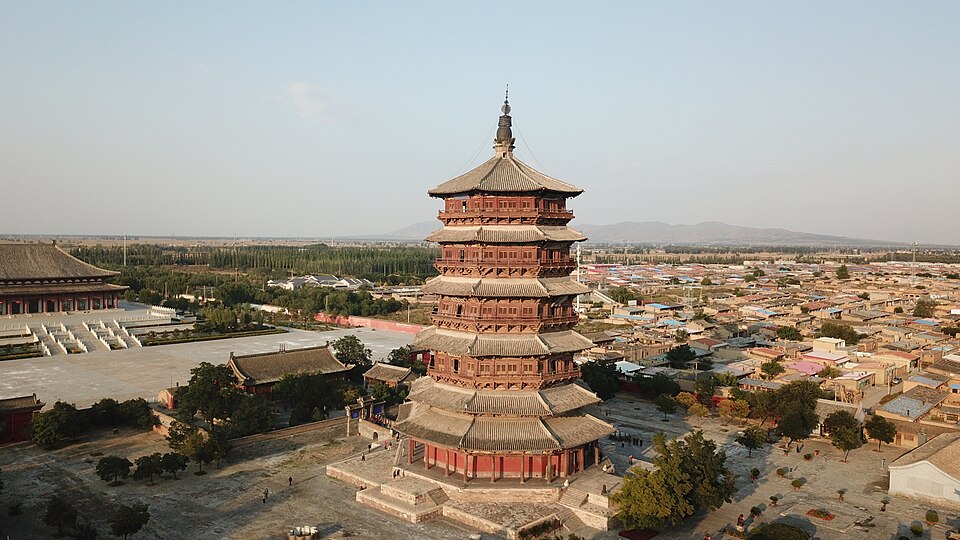
The Sakyamuni Pagoda of Fogong Temple was raised in 1056, apparently on the site of the family home of the Liao emperor Daozong's grandmother, about 85 km south of the Liao western capital at Datong. It stands on a 4 m stone platform, is topped by a 10 m spire and reaches 67.31 m.
The pagoda has had a hard history. Seven earthquakes struck between 1056 and 1103 and it stood. In the Second Sino-Japanese War, Japanese soldiers fired more than two hundred rounds into it. In 1974 restorers found Liao Buddhist scrolls inside, including twelve scrolls of the Liao Tripitaka printed in 1003 in Yanjing (Beijing), and a Buddha tooth relic in one of the fourth-floor statues.
How the pagoda is built
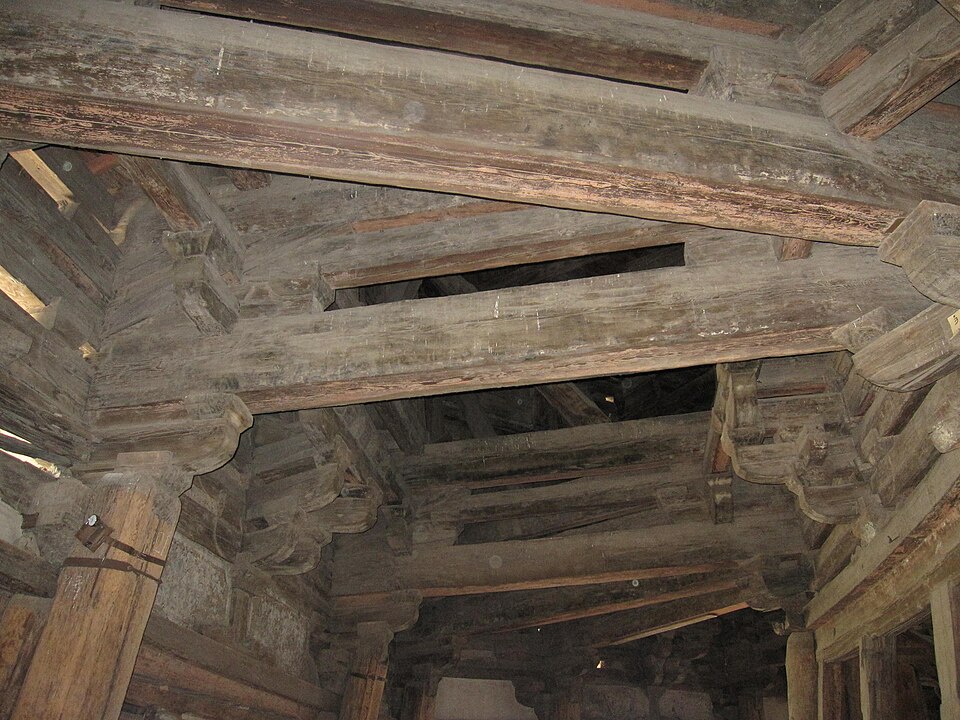
From outside you count five storeys; inside there are nine, because a hidden mezzanine sits between each pair of outer floors, marked on the outside by the balcony terraces. It was built without nails or iron bars. The frame locks together with fifty-four kinds of bracket arms, more than any other Liao building, which is why architects come here with binoculars.
Visiting the pagoda today
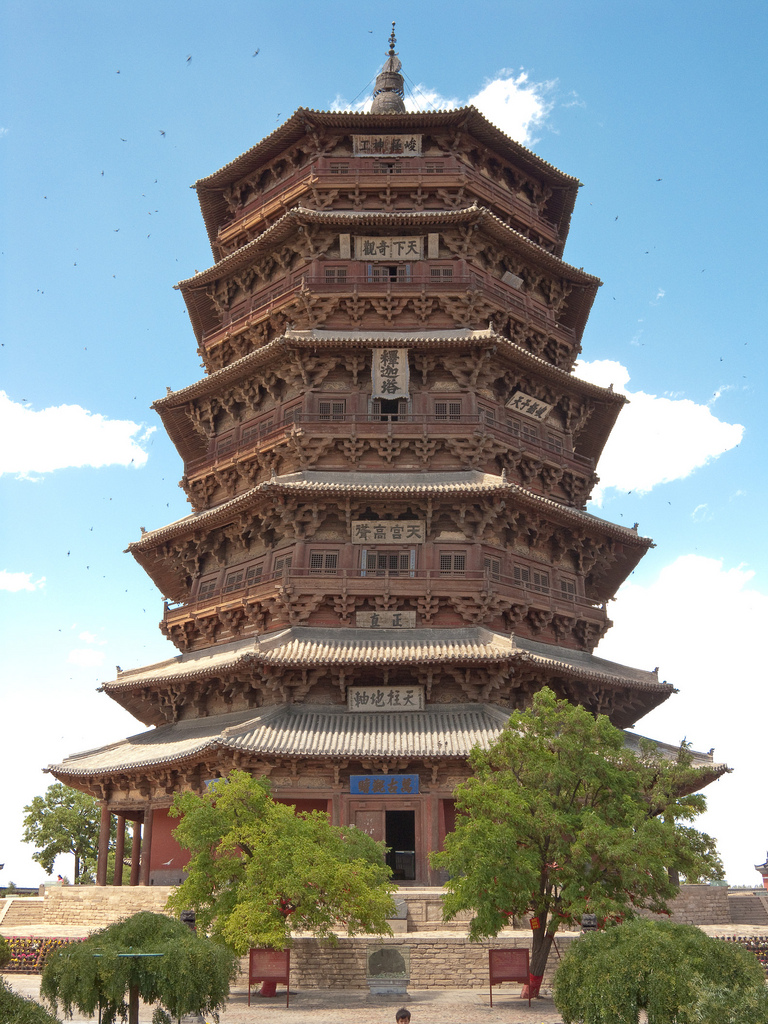
The pagoda now leans noticeably, and climbing is suspended, so the visit is the ground-floor hall, with its seated Sakyamuni under a carved caisson ceiling, followed by a slow walk around the outside. That is still worth the trip: stand on the platform and look up at the brackets.
Shuozhou's 2025 notice set hours of roughly 08:00–17:30, with ticket sales ending at 17:00; peak-season hours can run later. Visitor reports in 2026 give an adult ticket of about ¥50, with concessions for students and over-60s. Check the scenic area's WeChat account before you go.
Chongfu Temple, Shuozhou city
Chongfu Temple, on Dongda Street in old Shuozhou, is the better place to see Jin-dynasty architecture up close, because you can go inside the halls. A stele dates the founding to 665 under Tang Gaozong; the big Amitabha Hall was added in 1143, and the Amitabha and Guanyin halls are both Jin buildings. The temple served as a granary at the end of the Yuan, was rebuilt from 1383, and suffered badly under Japanese occupation. In 1939 the body of its Northern Wei nine-storey stone pagoda (made for one Cao Tiandu) was taken to Tokyo; after the war it went to the National Museum of History in Taipei, while its finial stayed in Shuozhou.
From 8 October 2026 the temple returned to normal hours, 09:00–17:00. Booking platforms list an adult ticket around ¥30. Allow an hour and a half.
Guangwu and the Great Wall
South of Shanyin County, the Ming wall at New Guangwu runs over bare hills as a largely unrestored ruin; this was the frontier zone where Han China met the steppe, and Shuozhou itself began as the frontier trading town of Mayi under the Han. Walking a section of wall above Xin Guangwu village is free; paths are dirt and slippery after rain. Yanmen Pass, a separate ticketed site, is just over the line in Xinzhou and now has its own high-speed station.
When to come
May to October. Winters are long and dry (January averages about -10 °C), and most of the year's rain falls from June to September. Spring winds are strong on the Great Wall. Autumn light is good for the pagoda.
Eating in Shuozhou
This is northern Shanxi noodle country: knife-cut noodles, youmian (oat noodles rolled into "cat's ears" or honeycomb shapes), and local lamb, which Shuozhou's high plateau is known for. In Ying County, eat in the streets around the pagoda; options are simple and cheap.
How to arrange the route
Day trip from Datong: high-speed train to Yingxian West, pagoda in the morning, on to Shuozhou East for Chongfu Temple in the afternoon, back to Datong.
Two days: day one the pagoda and Chongfu Temple; day two Guangwu and the wall, then south to Yanmenguan or Taiyuan.
What to cut if short on time
Keep the Wooden Pagoda. Chongfu Temple is the second priority, especially if you care about old timber halls. Cut Guangwu if the weather is bad or you have already walked the wall elsewhere.
Things to confirm before you go
- Pagoda ticket, hours and any changes to access (the upper floors have been closed for years).
- Chongfu Temple hours (seasonal).
- Which high-speed station suits you: Yingxian West for the pagoda, Shuozhou East for the city.
Frequently asked questions
Can you climb the Yingxian Wooden Pagoda?
No. To protect the leaning structure, only the ground floor is open.
Is the Wooden Pagoda in Shuozhou city?
No. It is in Ying County town, east of Shuozhou city, with its own high-speed station, Yingxian West.
Shuozhou or Datong as a base?
Datong has more hotels and more sights (Yungang, the Hanging Temple). Shuozhou city is quieter and closer to Chongfu Temple and Guangwu.
Sources
The facts in this article were checked against the following sources, retrieved September 23, 2026, and rechecked on October 21, 2026.
- Shuozhou https://en.wikipedia.org/wiki/Shuozhou
- Pagoda of Fogong Temple https://en.wikipedia.org/wiki/Pagoda_of_Fogong_Temple
- 朔州市 (Chinese Wikipedia) https://zh.wikipedia.org/wiki/朔州市
- 崇福寺 (朔州) (Chinese Wikipedia) https://zh.wikipedia.org/wiki/崇福寺_(朔州)
- Jining–Datong–Yuanping high-speed railway opens (CNR, 1 January 2025) https://www.cnr.cn/sx/yw/20250101/t20250101_527027706.shtml
- Notice on Yingxian Wooden Pagoda opening hours (Shuozhou government, November 2025) http://szxxgk.shuozhou.gov.cn/szfxxgk/fdzdgknr/zdxx/whty/202511/t20251121_752147.shtml
- Shanxi scenic areas' autumn hours from 8 October 2026, including Chongfu Temple (ifeng) https://feng.ifeng.com/c/8x245IRMlL1
Ticket prices above come from booking platforms and visitor reports, not official notices; check on the day.
All photos are from Wikimedia Commons, used under CC licenses or public domain; re-use requires attribution.
- shuozhou-pagoda.jpg from File:Pagoda of Fogong Temple at Dust.jpg, by Charlie fong, CC BY-SA 4.0
- shuozhou-pagoda-side.jpg from File:Muta 1.jpg, by Zeus1234, CC BY-SA 3.0
- shuozhou-pagoda-gate.jpg from File:Fogong Pagoda 1.jpg, by Patrick Streule, CC BY 2.0