Datong Travel Guide: Yungang Grottoes, the Hanging Temple and the Old City
Datong sits in northern Shanxi, on the Datong Basin at the edge of the Mongolian Plateau. It was a military town for centuries, and locals still quote the old line about three dynasties using it as a capital and two as a stronghold. The most important of those centuries began in 398, when the Northern Wei moved its capital to Pingcheng, in what is now Datong, and stayed nearly a hundred years until Emperor Xiaowen moved the court to Luoyang in 494. From that era come the Yungang Grottoes. The six places below (Yungang, the Hanging Temple, Huayan Temple, the Nine-Dragon Screen, the rebuilt city wall, and Mount Heng) have had their origins checked against public sources. This is a city that still talks in sandstone, glazed tile, and cliff timber.
When to come to Datong
Datong has a temperate continental climate, with four clear seasons and a dry wind that visitors feel as soon as they step off the train. Spring and autumn are the most comfortable months for walking the grottoes and the wall. Summer is cooler than most of North China; official notes put the city's average elevation around 1,000 meters, and July is still walkable. Winter is cold and dry. Sand and wind can pick up in spring, so a scarf and sunglasses are not only for the photographs.
How to get in and where to stay
Use the main airport or high-speed rail station that serves Datong, then ride metro, bus, or taxi per posted notices. Stay near the primary visitor cluster if walking matters; treat outlying scenic areas as day trips, not hotel districts. South toward timber-pagoda days sits in Shuozhou; Wutai and Yanmen continue in Xinzhou.
Places worth visiting in and around Datong
Yungang Grottoes
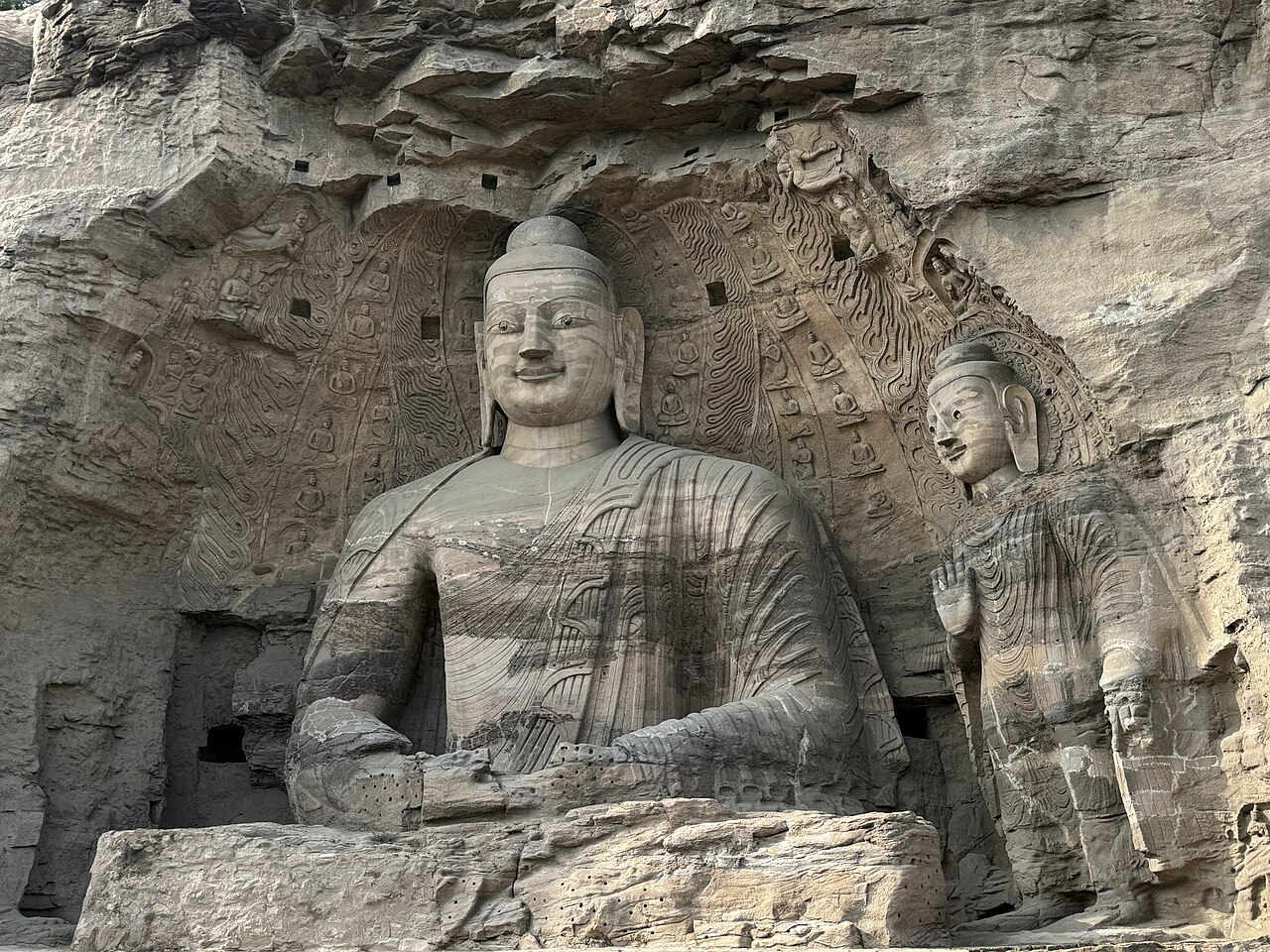
The Yungang Grottoes lie at the southern foot of Wuzhou Mountain in Yungang District, carved mainly between 453 and 495. They were the first large cave complex in China cut under imperial patronage. The cliff runs about a kilometer along the north bank of the Wuzhou River, with 51 principal caves, more than 1,100 niches, and more than 51,000 statues. The tallest figure is about 17 meters; the smallest is only a couple of centimeters.
The earliest and most imposing group is the Five Tanyao Caves, numbered 16 to 20, opened in 460 at the request of the monk Tanyao under Emperor Wencheng. Cave 20 is the emblem of Yungang. Its front wall later collapsed, leaving the seated Buddha in the open; the heavy robe and high ushnisha still carry a strong Gandhara look. Cave 5 holds the largest single statue in the complex, about 17 meters. Cave 6, cut in the reign of Xiaowen, is the largest cave, some 20 meters from floor to ceiling, with a central pagoda-pillar carved with the life of the Buddha. Yungang was listed among the first national protected relics in 1961 and inscribed as a World Heritage site in 2001. Tickets and timed entry are per official notice; a half day is the minimum, a full day is better. The cave-by-cave route, the 2026 prices and the direct buses are on the Yungang Grottoes page.
The Hanging Temple
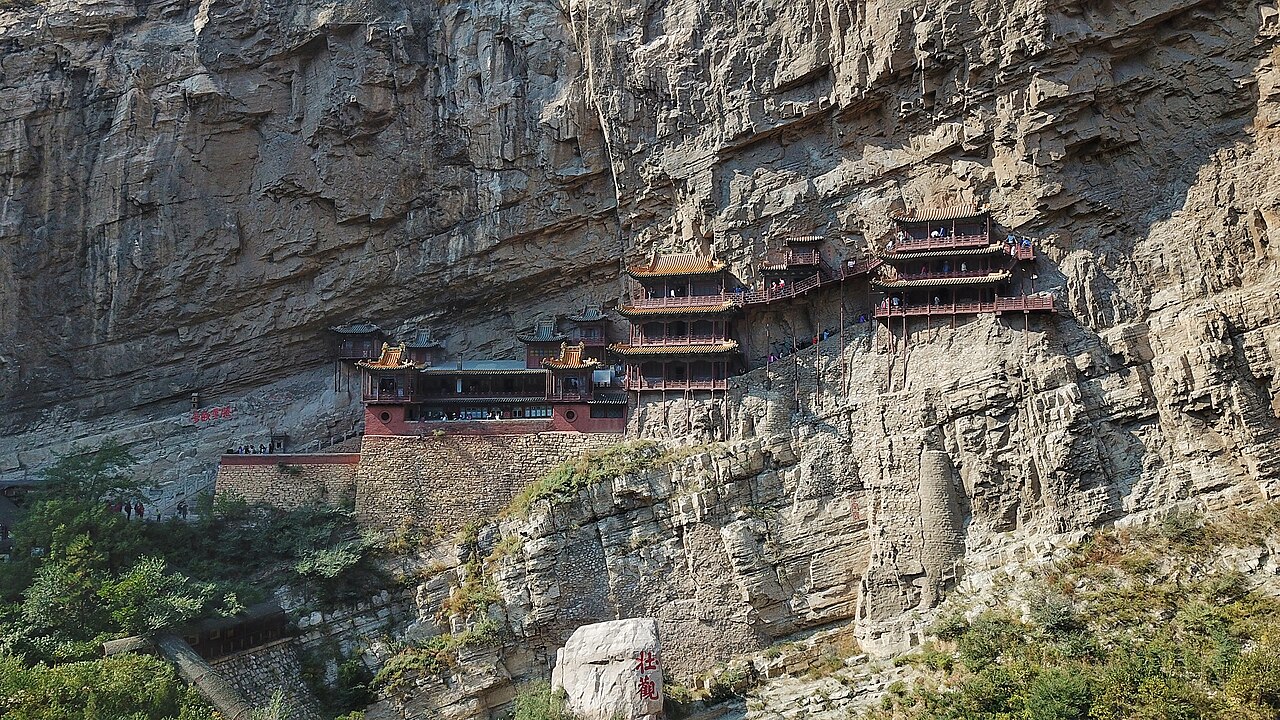
The Hanging Temple clings to a recess in Cuiping Mountain in Hunyuan County, about 90 meters above the valley floor. One tradition says it was founded in 491, in the fifteenth year of the Taihe era, under Emperor Xiaowen, first as a Daoist site connected with Kou Qianzhi, and later called Xuankong because the temple hangs in the air and because "xuan" and "xuan" (mystery) sound the same. Other foundation stories exist and are not settled. The buildings standing today are mostly Ming and Qing reconstructions.
The temple occupies only about 152.5 square meters and has 40 rooms, all in a timber frame. Twenty-seven wooden beams, about 50 centimeters across and soaked in tung oil, are socketed into the cliff; extra posts under the walkways are not the main load. Confucianism, Buddhism, and Daoism have been worshipped together here since at least the Jin dynasty, with Confucius, Laozi, and Sakyamuni sharing the highest hall. The temple became a Shanxi provincial relic in 1957 and a national protected relic in 1982. A major repair in 1978 replaced several of the hidden beams and confirmed the mortise-and-tenon work that actually holds the place up. Tickets are per official notice; Hunyuan is a day trip from the city. Entry and climbing tickets, the daily quota and the shuttle are on the Hanging Temple page.
Huayan Temple
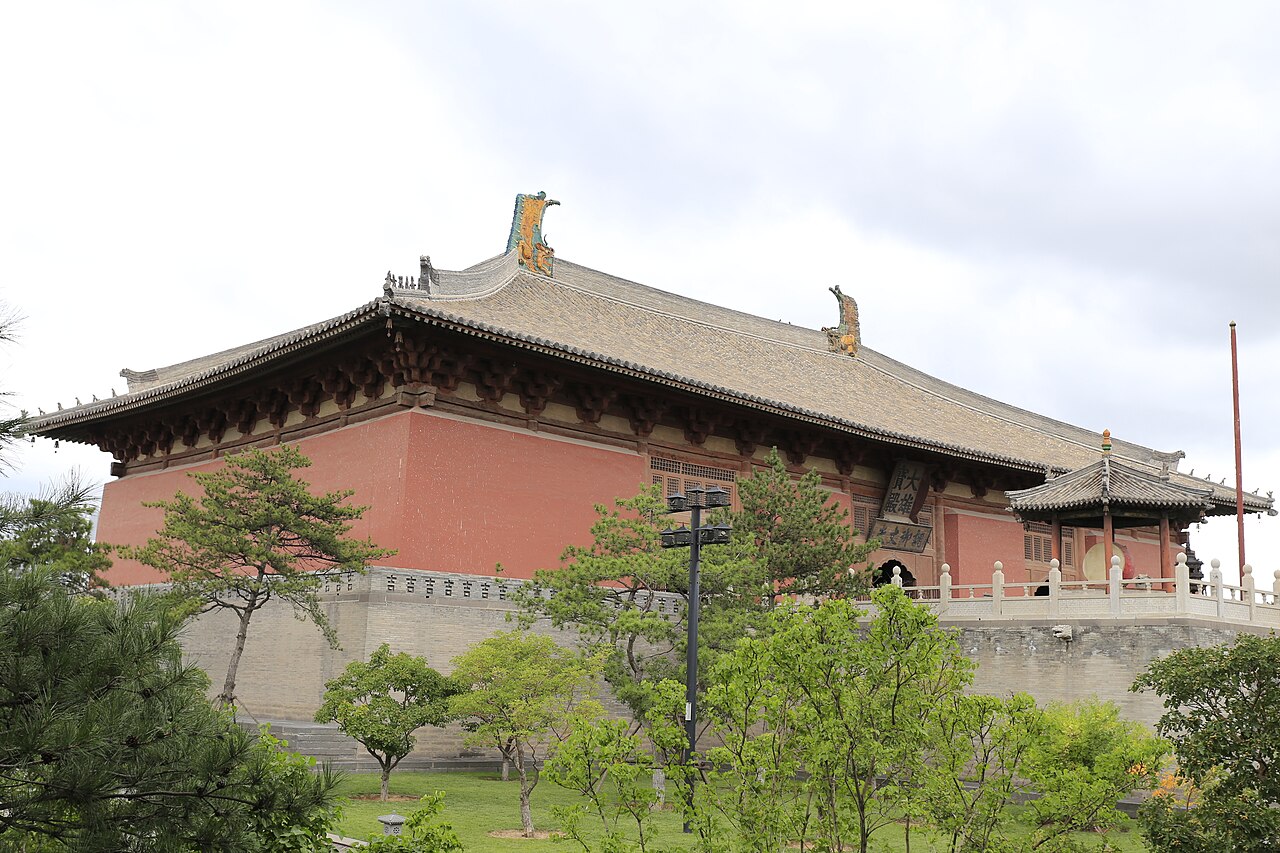
Huayan Temple was founded in the seventh year of the Liao Xingzong Chongxi era, 1038, as an imperial monastery of the Liao. In 1122 Jin troops took the western capital at Datong and the temple burned, leaving only a few halls. The Great Hero Hall was rebuilt in the third year of Jin Tianjuan, 1140, still in a Liao manner. The whole complex covers about 66,000 square meters, split into an upper and a lower temple, and faces east rather than south, a layout often tied to the Khitan custom of honoring the sun.
The Great Hero Hall sits on a four-meter platform, nine bays across, with a single-eave hip roof and about 1,559 square meters of floor, one of the largest surviving timber Buddha halls in China. The three front doorways are among the oldest remaining hu-doors of their type. The lower temple's Bhagavat Sutra Repository is another early hall. In 1963 the Datong Museum opened in the lower temple; in 2008 the site was repaired and rebuilt from Liao and Jin records. Tickets are per official notice; two to three hours is enough, and it sits inside the old city, easy to pair with the wall and the Nine-Dragon Screen. The two old halls, the smiling bodhisattva and seasonal prices are on the Huayan Temple page.
The Nine-Dragon Screen
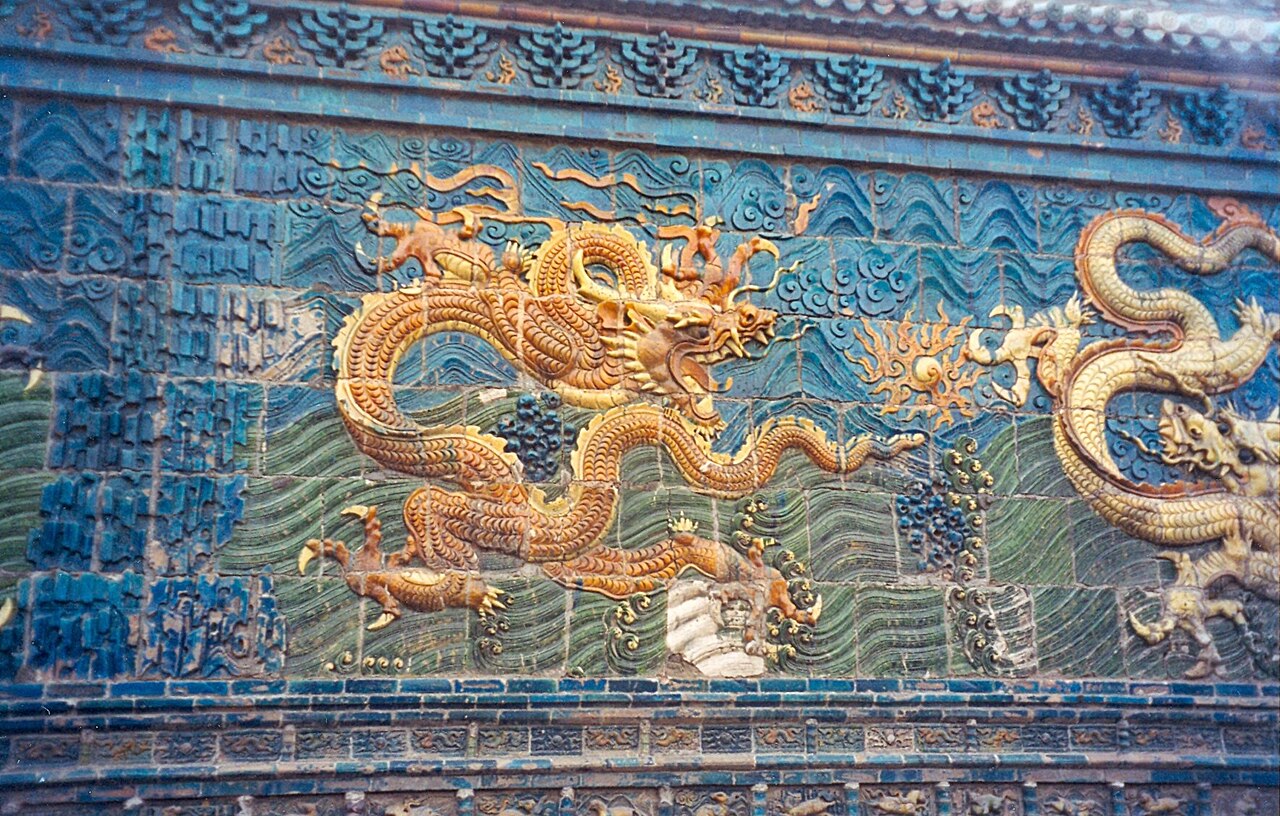
Datong's Nine-Dragon Screen was built between 1392 and 1396 for Zhu Gui, the thirteenth son of the Ming Hongwu emperor, after he was enfeoffed as Prince Dai and came to Datong to take up his fief. The wall is 45.5 meters long, 8 meters high, and 2.02 meters thick, with a roof, a body of nine glazed dragons against clouds and sea, and a carved base. As a prince's wall, the dragons have four claws, not the five of an emperor.
The prince's palace was destroyed in the wars at the Ming-Qing turn; the screen survived. In August 1954 it was taken apart and rebuilt 28 meters south of the original line to make way for a road. Some missing pieces were patched with grey brick, and some parts were put back in the wrong places. It joined the fifth batch of national protected relics in 2001. The wall is in the old city; half an hour is enough, and it is close to Huayan Temple. The legend, the 1954 move and the ticket are on the Nine-Dragon Screen page.
Datong City Wall
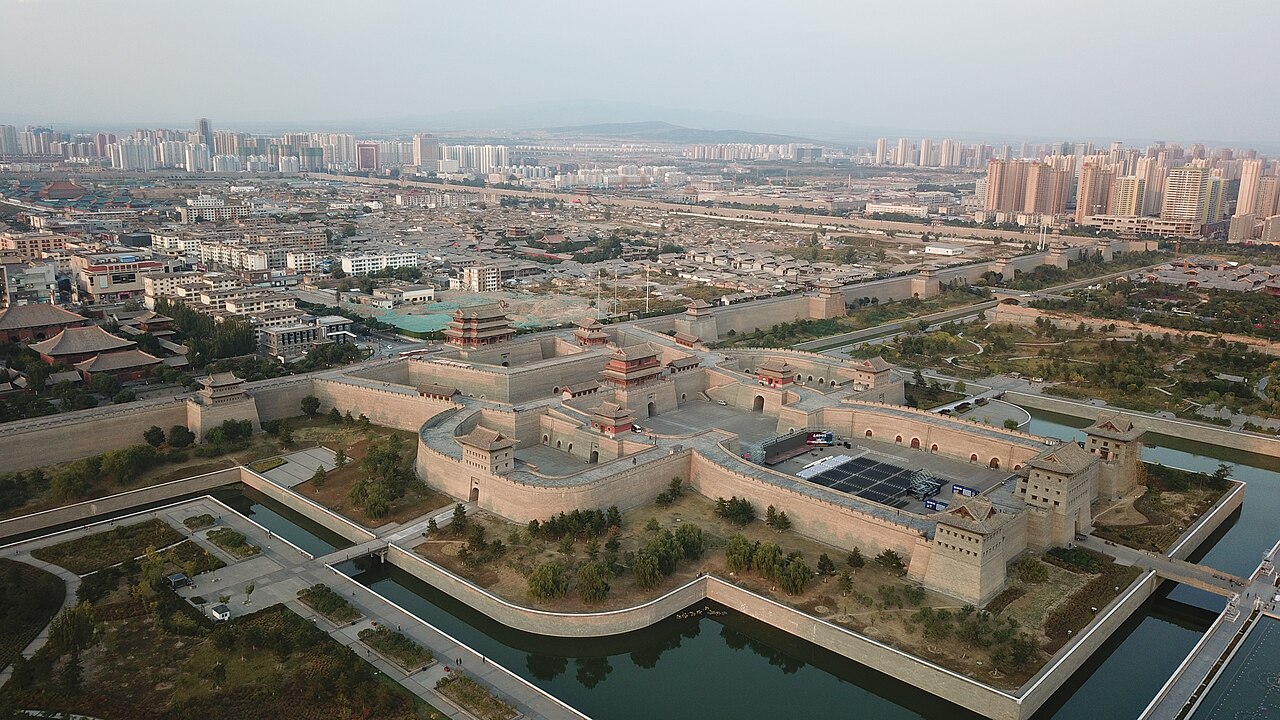
The Ming wall around Datong ran 7,270.7 meters, about 14 meters high, enclosing 2.63 square kilometers, with a moat some 40 meters outside. In 1649, after a long siege, Qing troops under Dorgon entered the city, massacred the inhabitants, and ordered the wall cut down by five feet. In the 1950s the remaining gates were pulled down, the bricks stripped, and the wall left as earth. The last south gate tunnel went in 1981.
From 2008 the city ran a restoration project. On 18 November 2016 the circuit closed again and the moat was reconnected. What you walk today is that rebuilt wall, not a Ming original left untouched. Evening is the easy time, when the brick is lit and the old city below is still busy. The free daytime hours and the evening lantern zone are on the Datong City Wall page.
Mount Heng
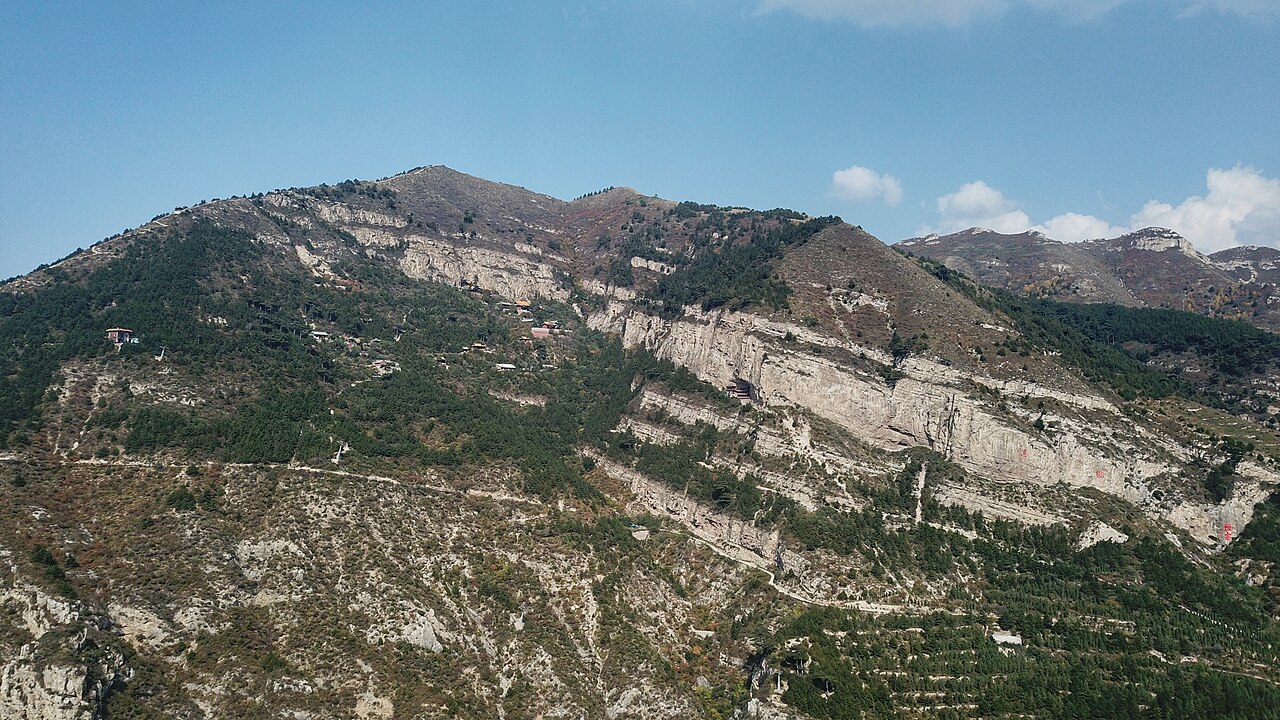
Mount Heng is the northern peak of the Five Sacred Mountains. Before the Qing, the name pointed to Mount Damao in Hebei. In the Shunzhi reign the official northern sacrifice moved to Xuanyue Mountain in Hunyuan, which then took the name Hengshan. The range runs northeast to southwest for about 150 kilometers. The main peak, Tianfeng Ridge, is listed at about 2,017 meters on the same Wikipedia page that also gives 2,016.1 meters.
The Beiyue Temple on the mountain houses the god of Hengshan. The Hanging Temple sits between Hunyuan town and the mountain gate, a few kilometers away, so the two are usually done on the same day. Wear shoes with grip; the paths are stone and steep. Tickets are per official notice.
Eating in Datong
Datong knife-cut noodles
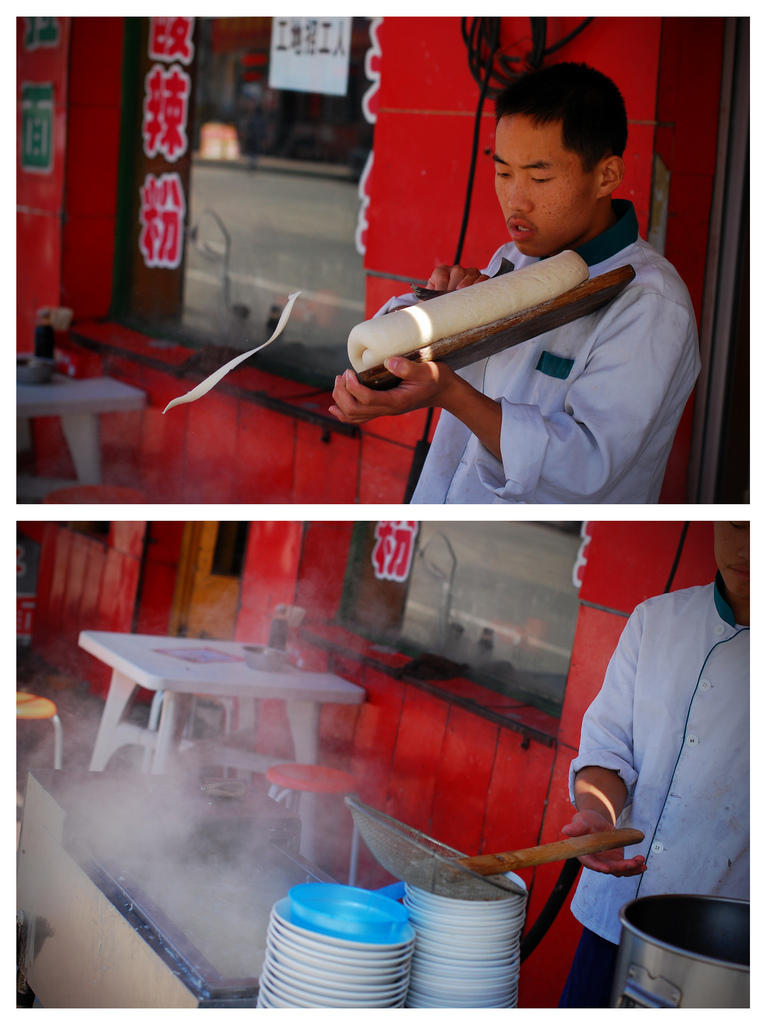
Knife-cut noodles are the bowl this city is known for. The dough is held in one hand and shaved into the pot with the other, each piece thick in the middle and thin at the edges, then eaten in a meat sauce or broth. Shaomai, Hunyuan cold jelly, and youmian oat noodles sit on the same tables. Follow a queue on a side street rather than a dining room aimed at tour groups. Portions are large; one bowl is a meal.
How to arrange the route
Three days covers the city and the Hunyuan side trip.
Day one stays inside the old city. Morning at Huayan Temple, then the Nine-Dragon Screen, then a stretch of the wall, and knife-cut noodles whenever you are hungry.
Day two is Yungang. Leave in the morning, give the Five Tanyao Caves and Caves 5 and 6 most of the time, and be back in the city by evening.
Day three is Hunyuan. The Hanging Temple first, while the light is still on the cliff, then Mount Heng. It is a full day; start early.
If you have only two days, drop Mount Heng and keep the Hanging Temple, or drop Hunyuan entirely and spend both days in the city plus Yungang.
Beijing is the capital to the east, the usual start before a Datong wall-and-cave day. Taiyuan is two hours south, the usual next stop in Shanxi. Luoyang holds the later Northern Wei caves at Longmen, if grottoes are the thread you are following.
What to cut if short on time
Keep Yungang as the non-negotiable day. Keep either the old-city cluster (Huayan, Nine-Dragon Screen, wall) or the Hunyuan day (Hanging Temple, optionally Mount Heng). With two days, drop Mount Heng first, then drop the wall walk if needed.
Things to confirm before you go
- Yungang is west of the city. Confirm bus and ticket rules on the official channels; peak days use timed entry.
- The Hanging Temple and Mount Heng are in Hunyuan County, a separate trip from the urban sights. The temple stairs are narrow and the drop is real.
- The city wall you walk is a 2008 to 2016 reconstruction. Treat it as a rebuilt circuit, not an untouched Ming ruin.
- Spring wind and winter cold are both sharp. A jacket is useful even in May and September.
- Ticket prices and opening hours at every site are per official notice.
Frequently asked questions
How many days for Datong?
Three is comfortable. Two covers Yungang plus the old city. Hunyuan needs its own day.
Is Yungang worth a full day?
Yes if you care about the caves. The Five Tanyao Caves and Caves 5 and 6 already take a morning. The western small caves can fill an afternoon.
How far is the Hanging Temple?
It is in Hunyuan County, not in the urban area. Plan a day trip. Confirm current road time before you go.
When is Datong best?
Spring and autumn. Summer is cooler than the North China plain. Winter is harsh and better for people who like empty courtyards.
What should I eat?
Knife-cut noodles first. Then shaomai and whatever the next stall is selling to locals.
Sources
The facts in this article were checked against the following Chinese Wikipedia entries, retrieved August 28, 2026, and rechecked on October 15, 2026. Food notes were additionally checked against public web sources.
- Datong (city) https://zh.wikipedia.org/wiki/大同市
- Yungang Grottoes https://zh.wikipedia.org/wiki/云冈石窟
- Hanging Temple https://zh.wikipedia.org/wiki/悬空寺
- Huayan Temple (Datong) https://zh.wikipedia.org/wiki/华严寺_(大同)
- Datong Nine-Dragon Screen https://zh.wikipedia.org/wiki/大同九龙壁
- Datong city wall https://zh.wikipedia.org/wiki/大同城墙
- Mount Heng https://zh.wikipedia.org/wiki/恒山
All photos are from Wikimedia Commons, used under CC licenses; re-use requires attribution.
- datong-yungang.jpg from File 云冈石窟第20窟正面.jpg, by Patrick20242023, taken May 25, 2024, CC BY-SA 4.0
- datong-xuankongsi.jpg from File Hangingtemple20190929.jpg, by Charlie fong, taken September 29, 2019, CC BY-SA 4.0
- datong-huayan.jpg from File Datong Huayan Si 2013.08.29 08-54-08.jpg, by Zhangzhugang, taken August 29, 2013, CC BY-SA 3.0
- datong-jiulongbi.jpg from File DatongJiulongBi.jpg, by Doron, taken July 2000, CC BY-SA 3.0
- datong-citywall.jpg from File Datongsouthgate2019.jpg, by Charlie fong, taken September 27, 2019, CC BY-SA 4.0
- datong-hengshan.jpg from File Mountheng-Shanxi2019.jpg, by Charlie fong, taken September 29, 2019, CC BY-SA 4.0
- datong-daoxiaomian.jpg from File Datong Daoxiaomian.jpg, by Qi Jian, taken August 24, 2010, CC BY 2.0