Suizhou Travel Guide: The Tomb of Marquis Yi, the Zeng Bronzes and the Yandi Shennong Site
Suizhou, in northern Hubei, is where the tomb of Marquis Yi of Zeng was found in 1977, with its set of 64 bronze bells from 433 BC. The original bells are in the Hubei Provincial Museum in Wuhan, but Suizhou has the tomb pit itself, a free city museum full of Zeng-state bronzes from later digs, and a weekend bell-music performance. Add the Yandi Shennong scenic area, the claimed birthplace of the Flame Emperor 18 km outside town, and Suizhou fills one full day.
Zeng and Sui: why this city has so many bronzes
In the Zhou period this was the state the texts call Sui and the bronzes call Zeng; inscriptions have since shown they were the same Ji-surnamed state, related to the Zhou royal house, living inside the cultural orbit of Chu until Chu absorbed it around 328 BC. Since the 1970s, digs around the city have uncovered a run of Zeng cemeteries: Yejiashan (early Western Zhou, more than 6,000 objects), the Yidigang group of Spring and Autumn tombs (over 200 graves, more than 10,000 objects) and, most famous, Marquis Yi's tomb at Leigudun.
Places worth visiting
Tomb of Marquis Yi at Leigudun
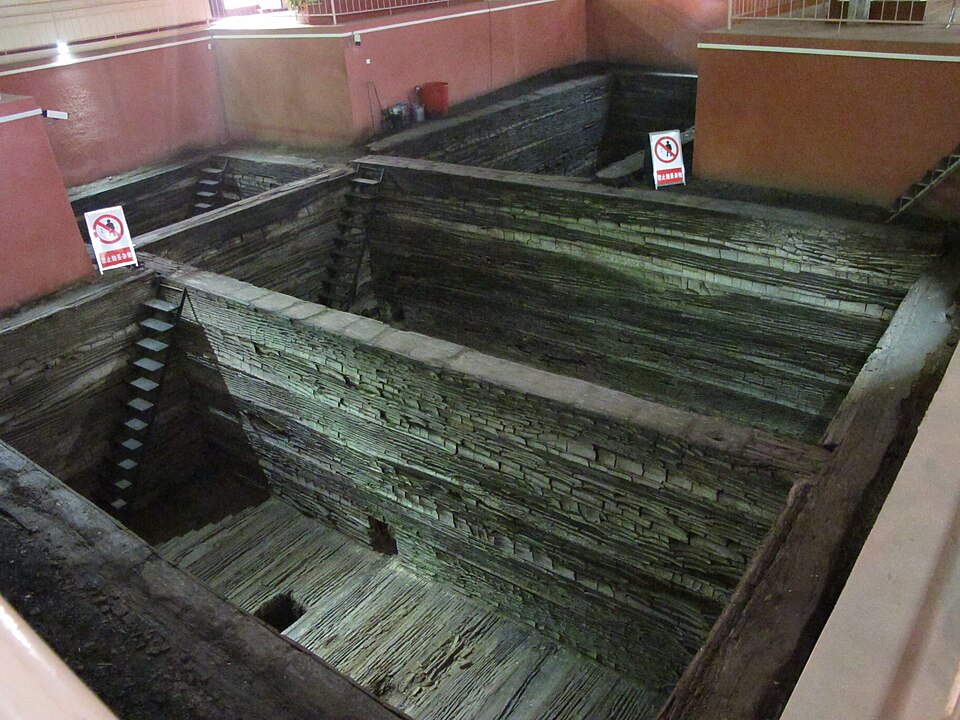
Soldiers levelling a hill for a factory at Leigudun, 2.5 km northwest of the city, found the tomb by accident in 1977; it was excavated in 1978. It is one of the few royal tombs of the period found intact and dug with modern methods. The timber chamber covers 220 m² in four rooms laid out like a palace: weapons in the north, the marquis's nested lacquer coffins with eight women in the east, thirteen more women in the west, and the great ritual orchestra in the central chamber. A lacquer chest bears a star chart with a date that points to 433 BC.
The open pit, with its massive timbers, is the reason to come; the objects themselves are elsewhere. The tomb site museum charges for entry, unlike the city museum; check the price on the day.
Suizhou Museum
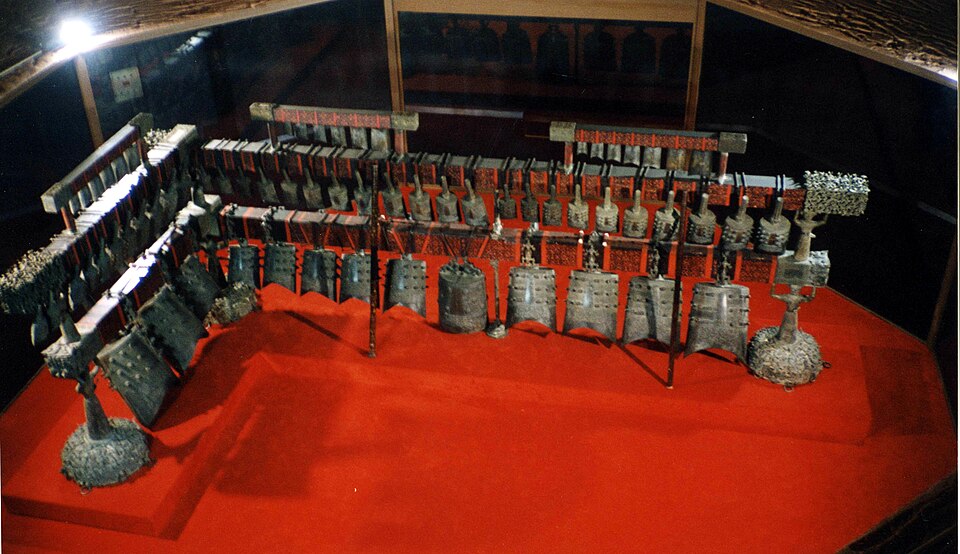
The Suizhou Museum, at 98 Leigudun Avenue near the tomb, holds the finds from Yejiashan, Yidigang and other Zeng cemeteries, with a full-size replica of the Marquis Yi bells. The real set is 64 bells on two L-shaped racks, the largest bell 153.4 cm tall and 203.6 kg; each bell sounds two notes, a third apart, depending on where you strike it, and the set covers about five octaves, playing a full chromatic scale in its middle range. A bell sent by King Hui of Chu for the marquis's funeral dates the burial.
Entry is free with booking through the museum's WeChat account. The city's museum directory lists it as open Tuesday to Sunday from 09:00, last entry around 16:00, closed Mondays except holidays. The museum's bell-music show runs at 11:00 and 15:00 on Saturdays and Sundays, about 25 minutes each, with extra shows at holidays; book a seat in advance.
Zeng bronzes beyond the bells
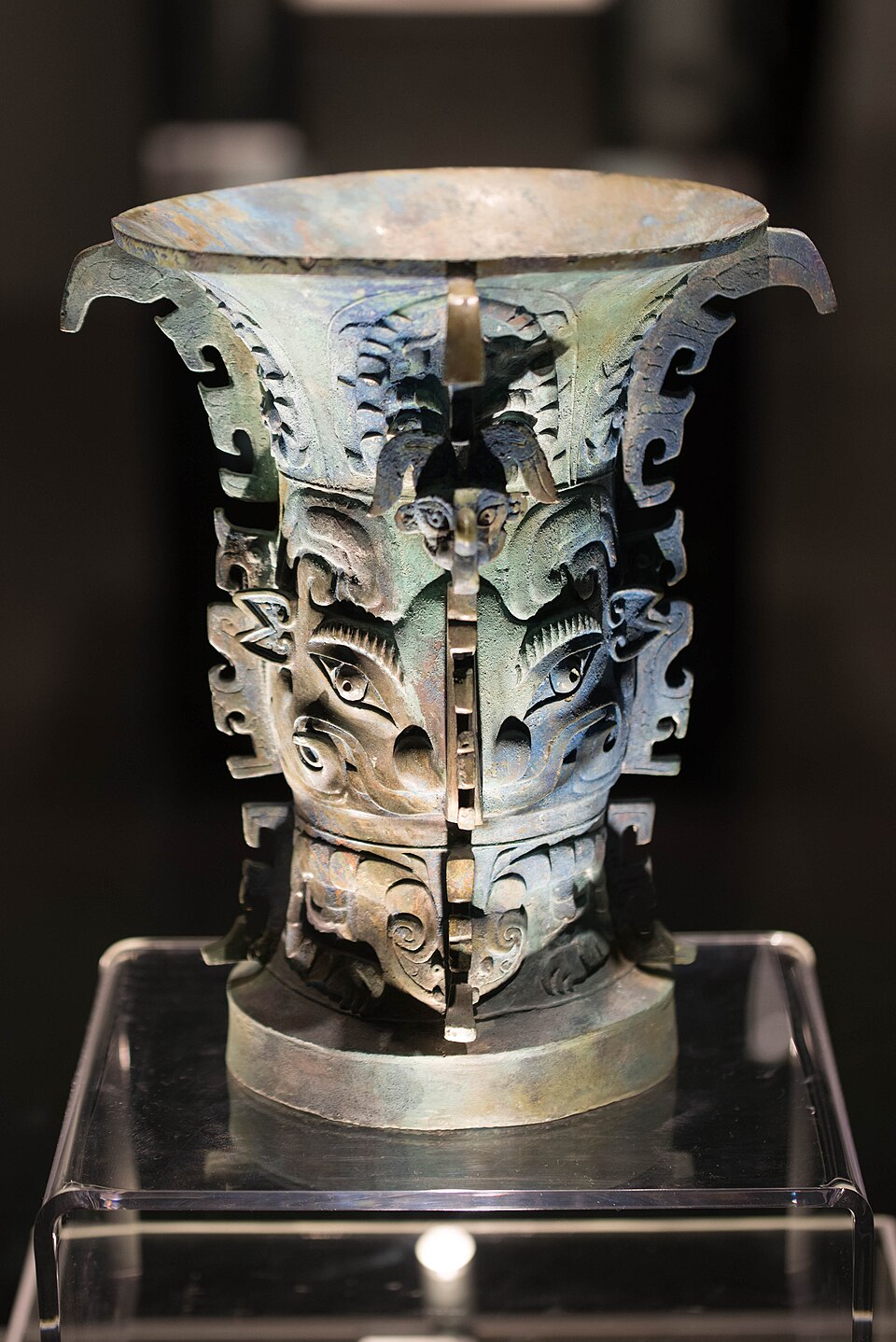
Do not stop at the bells. The museum's earlier Zeng bronzes, many from the early Western Zhou cemetery at Yejiashan, show how long the state flourished before Marquis Yi. Ritual vessels such as this zun, with tall flanges and animal masks, are typical of that early period.
Yandi Shennong scenic area
Lishan town, 18 km from the city, is traditionally the birthplace of Yandi Shennong, the Flame Emperor and Divine Farmer of Chinese myth. A large 5A scenic area of 171 hectares was built here, and the provincial government held an annual "root-seeking" ceremony for Chinese worldwide from 2009 to 2020. Expect monumental halls and statues and a new immersive show (launched for National Day 2026) about Shennong teaching farming. It is a modern ritual site; go if Chinese ancestor culture interests you.
Dahongshan
The Dahong Mountains in the south of the prefecture are a national scenic area with forest, temples and the site of the Lülin uprising at the end of the Western Han. It needs a car and a separate day.
Getting in and where to stay
Suizhou is on the Wuhan–Shiyan high-speed line and the older Hankou–Danjiangkou railway, between Wuhan and Xiangyang, so a day trip from Wuhan is easy. The museum and tomb are northwest of the centre; the Yandi area is a taxi ride beyond. Stay in Zengdu District. Wudang Mountain, in Shiyan, is further up the same line.
When to come
Spring and autumn. Summers in northern Hubei are hot and wet; winters are short and damp. Plan around a weekend if you want the bell show.
Eating in Suizhou
Northern Hubei cooking is salty and spicy, built on noodles, stewed meats and river fish. Suizhou is one of China's big shiitake-growing areas, so mushrooms appear in many dishes and in every souvenir shop. In autumn, locals drive out to the Thousand-Year Ginkgo Valley, a 4A scenic area in the hills, when the leaves turn gold.
How to arrange the route
Day from Wuhan (weekend): early train; Suizhou Museum at opening and the 11:00 bell show; lunch; the tomb site; Yandi Shennong scenic area in the afternoon if time allows; evening train back.
On a weekday: same order without the show, or see the bells' originals in Wuhan first and use Suizhou for the context.
What to cut if short on time
Keep the museum and the tomb pit. Yandi Shennong is the first to cut; Dahongshan needs its own day.
Things to confirm before you go
- Museum booking and bell-show seats (WeChat account).
- Tomb site museum ticket price and hours.
- Mondays: the city museum is closed.
Frequently asked questions
Are the original Marquis Yi bells in Suizhou?
No. The originals are on permanent display at the Hubei Provincial Museum in Wuhan. Suizhou has the tomb, a replica set and many other Zeng bronzes.
Can I hear the bells played?
The Suizhou Museum's weekend show at 11:00 and 15:00 uses its replica set. Times change at holidays.
Is Suizhou worth it after the Hubei Museum?
Yes, if the bells caught you: the tomb and the Zeng finds from later digs complete the story the Wuhan museum begins.
Sources
The facts in this article were checked against the following sources, retrieved September 26, 2026, and rechecked on October 21, 2026.
- Suizhou https://en.wikipedia.org/wiki/Suizhou
- Tomb of Marquis Yi of Zeng https://en.wikipedia.org/wiki/Tomb_of_Marquis_Yi_of_Zeng
- Bianzhong of Marquis Yi of Zeng https://en.wikipedia.org/wiki/Bianzhong_of_Marquis_Yi_of_Zeng
- 随州市 (Chinese Wikipedia) https://zh.wikipedia.org/wiki/随州市
- Suizhou museum directory (Suizhou Culture and Tourism Bureau, December 2025) http://www.suizhou.gov.cn/lyj/fbjd_43/zfxxgkgz/fdzdgknr/shsyjs/ggwhfw/202512/t20251216_1391844.shtml
- Bell show times at Suizhou Museum (Sina, 2026) https://www.sina.cn/news/detail/5257195650548137.html
- Suizhou's National Day 2026 digital exhibits (Hubei Department of Culture and Tourism, 7 October 2026) https://wlt.hubei.gov.cn/bmdt/mtjj/202610/t20261007_6027176.shtml
Ticket prices for the tomb site and Yandi scenic area are not quoted; check on the day.
All photos are from Wikimedia Commons, used under CC licenses; re-use requires attribution.
- suizhou-bianzhong.jpg from File:Bianzhong.jpg, by The original uploader was Zzjgbc at Chinese Wikipedia., CC BY-SA 3.0
- suizhou-zenghouyi.jpg from File:Zenghouyi - IMG 5811.JPG, by Shallowell, CC BY-SA 3.0
- suizhou-yandi.jpg from File:兽面扉棱尊, 2017-05-01.jpg, by Siyuwj, CC BY-SA 4.0