Luoma Lake
Luoma Lake spreads across the northwestern edge of Suqian, on the line where Suqian meets Xuzhou. At its usual controlled level it covers about 375 square kilometres, and Jiangsu counts it among the province's four great freshwater lakes. It is also a working reservoir. Engineers hold back floods from the Yi, Shu and Si rivers here, and that double life explains most of what a visitor sees, from the long embankments to the sluice gates and the managed beaches on the southern shore.
How the lake was made
The basin started as a sunken block of crust. The Tanlu fault, one of the great fault lines of eastern China, runs north to south along the eastern side of the lake, and a second set of faults lies to the west. Rivers did the rest. In 1128 the Yellow River broke south and took over the lower Si and Huai channels, and for more than seven centuries its floods and silt reshaped this part of northern Jiangsu.
The lake turns up in the official history of the Song dynasty. An entry for 1131 records that the Jin general Talan crossed the Huai and camped at Malehu in Suqian county, an early form of the name. Older texts also write it Lemahu and Luomahu. By the late Ming, local records describe summer and autumn floods spreading the water for more than twenty li. When the Yellow River swung back north in 1855, the Si and Yi lost their old outlet to the Huai, and the Yi waters gathered here for good.
From flood basin to reservoir
The modern lake is a product of the 1950s. After the great Huai floods of 1949, a scheme to guide the Yi and straighten the Shu turned Luoma into a temporary flood store. The southern dike was raised, a barrage was thrown across the Zaohe outlet, and a cutting at Zhangshan let flood water run straight to the sea through the New Yi River. In 1952 the Zaohe barrage was rebuilt as a control sluice and shipping lock, and farmers grew wheat on the drained lake bed between floods.
The 1957 flood ended that arrangement. Water at the Yanghetan gauge rose above the design level, and the planners made Luoma a year-round reservoir while the neighbouring Huangdun Lake became an emergency overflow. The Suqian sluice and lock went up in 1957 and 1958, and the Zhangshan sluice was finished in April 1961. Chinese Wikipedia gives a lake bed of 18 to 21 metres above datum, a maximum depth of about 5.5 metres and more than sixty islands large and small. Average depth at normal storage is a little over three metres, which is why the water warms quickly in summer and can look grey and choppy in a north wind.
The name that officials disliked
Spoken aloud, Luoma sounds exactly like luoma, the common phrase for an official who falls from office. The old texts even wrote the lake with those very characters. In 2010 the press reported that Xinyi, the Xuzhou county that shares the lake, had started calling its part Longma Lake, the "dragon horse" lake. Many local people objected, and both names still appear on signs and maps around the shore.
The lakeside today
Most visitors come to the southern shore in Suyu District, where Suqian has built its lakeside resort area. The centrepiece is the Luoma Lake Beach Park at No. 178 Huanhu Avenue, an artificial white-sand beach about 1,500 metres long laid out in leisure, sports and shallow paddling zones. The paddling water is kept under about 0.6 metres deep. A sand sculpture show has run here since 2019, and the eighth edition opened on 30 April 2026 with about fifty sculptures across a 12,000 square metre display area, according to a report in China Tourism News.
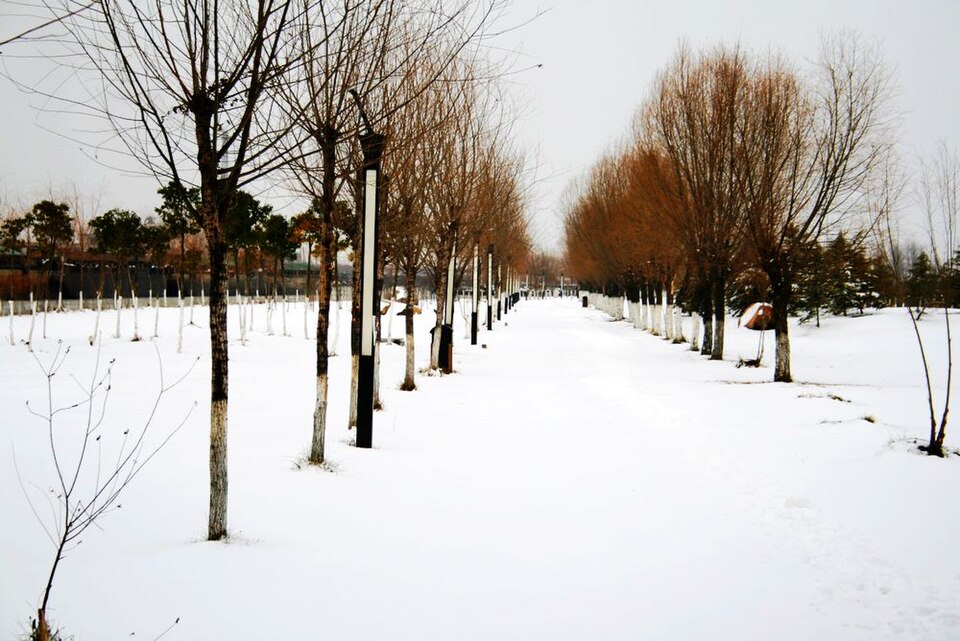
A short ride inland, Santai Mountain National Forest Park offers woods, small lakes and flower fields. The park runs a 3,500 metre walking route past Qingcui Lake, a 1,000 metre mist boardwalk and Jinghu Square. In spring its terraced flower fields draw big crowds. The lake itself also feeds the city's fish markets, and the reed beds and lotus along the edges support silver carp, white shrimp and crabs that turn up on Suqian menus.
Swimming in open water is a safety issue. Local authorities have installed an anti-drowning warning system along the shore that uses cameras and infrared sensors, and water sports at the beach park require life jackets. Stay inside the marked areas.
When to go
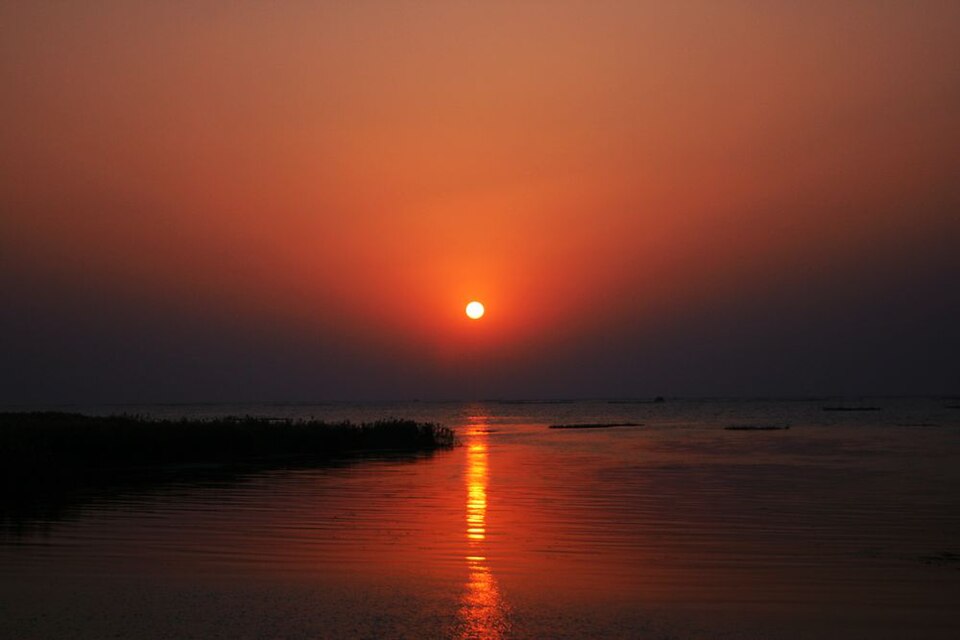
Late spring and early autumn are the comfortable months for a shore walk. Summer brings heat, humidity and the longest beach hours. Winter wind off the open water is cold, and the beach turns quiet. Sunsets over the western water are the classic photo, so plan an afternoon visit that ends at the lake.
Tickets, hours and getting there
Opening hours at the beach park change with the season. Listings on Baidu Baike and Suqian Bendibao give 9:30 to 21:30 from 30 April to 31 October and 9:00 to 17:00 from 1 November to 29 April, with a single ticket listed at 30 yuan. Santai Mountain's own price page lists daily hours of 9:00 to 17:00 with last entry at 16:30, and the park has run free-entry months in summer. Prices and promotions change, so check the day's notice at the gate or on the official accounts before you go.
Suqian station sits on the Xuzhou to Yancheng high-speed line on the south side of the city. City buses 102, 103 and 106 are listed for the beach park, and taxis or ride-hailing cover the run from the old town and the canal belt. If you want the sunset, arrange the ride back first, since cars thin out along the lake road after dark in the cooler months.
Pairing it with the rest of Suqian
The lake and Xiangwang Guli, the traditional birthplace of Xiang Yu, make a natural two-day pairing. Spend the morning in the city at the hometown park, then head north for the afternoon and the evening light on the water. Suqian also works on a northern Jiangsu loop with Xuzhou and Huai'an.
Frequently asked questions
Can you swim in Luoma Lake?
Only in the managed zones. The beach park has a shallow paddling area with lifeguards, and life jackets are compulsory for water sports. Open shores are unsupervised.
Is the beach real sand?
It is an artificial beach. The sand sculpture show has used sea sand shipped in from Fujian, according to Baidu Baike.
How long should I give the lake?
Half a day covers the beach park and a shore walk. Add Santai Mountain and it becomes a full day.
Sources
Facts in this article were checked against the following sources, retrieved 21 October 2026.
- 骆马湖, Chinese Wikipedia
- Luoma Lake, English Wikipedia
- Luoma Lake Beach Park, Baidu Baike
- Suqian Bendibao, beach park hours and tickets
- China Tourism News, May Day 2026 at the Luoma Lake resort area
- Santai Mountain National Forest Park, ticket page
- Suqian travel guide on this site
Photos are from Wikimedia Commons under the licences shown in each caption.