Xiangwang Guli
Xiangwang Guli, "the old home of King Xiang", is the park in southeastern Suqian built around the traditional birthplace of Xiang Yu, the Chu general who brought down the Qin dynasty and then lost the empire to Liu Bang. The address is No. 288 Huanghe South Road in Sucheng District. Locals also know the spot as Wutong Lane. The site has a small genuine core and a large modern park wrapped around it, and it helps to know which is which before you walk in.
Who Xiang Yu was
Xiang Yu was born Xiang Ji around 232 BC into a noble family of the old state of Chu. Sima Qian's Records of the Grand Historian calls him a man of Xiaxiang, a county seat that lay in what is now Suqian, and descendants of the Xiang family in the city keep their own genealogy of his father's line. His father died early and his uncle Xiang Liang raised him. He was about eleven when Qin finished conquering the other states in 221 BC.
When rebellion broke out against Qin, uncle and nephew raised an army in the lower Yangtze. In 207 BC Xiang Yu led an outnumbered Chu force to victory over the Qin armies at Julu, the battle that broke Qin's military power. After Qin fell he divided the country into eighteen kingdoms and took the title Hegemon-King of Western Chu, ruling from Pengcheng, today's Xuzhou. Four years of war with Liu Bang followed. In 202 BC he was trapped at Gaixia in present-day Anhui. Han troops sang Chu songs around his camp, his consort Yu took her own life, and Xiang Yu fought his way to the Wu River. There he refused the ferryman's boat home, saying he could not face the families of the eight thousand men who had followed him, sent his horse Zhui across, and died on the bank.
The story gave Chinese several sayings still in daily use, among them "Chu songs on four sides" for a hopeless position. It also gave Peking opera one of its best known pieces, The Hegemon-King Bids His Lady Farewell. Mei Lanfang, whose family came from Taizhou in Jiangsu, made the role of Consort Yu famous, and the Mei Lanfang Memorial Hall in Taizhou covers that side of the legend.
What is old and what is new
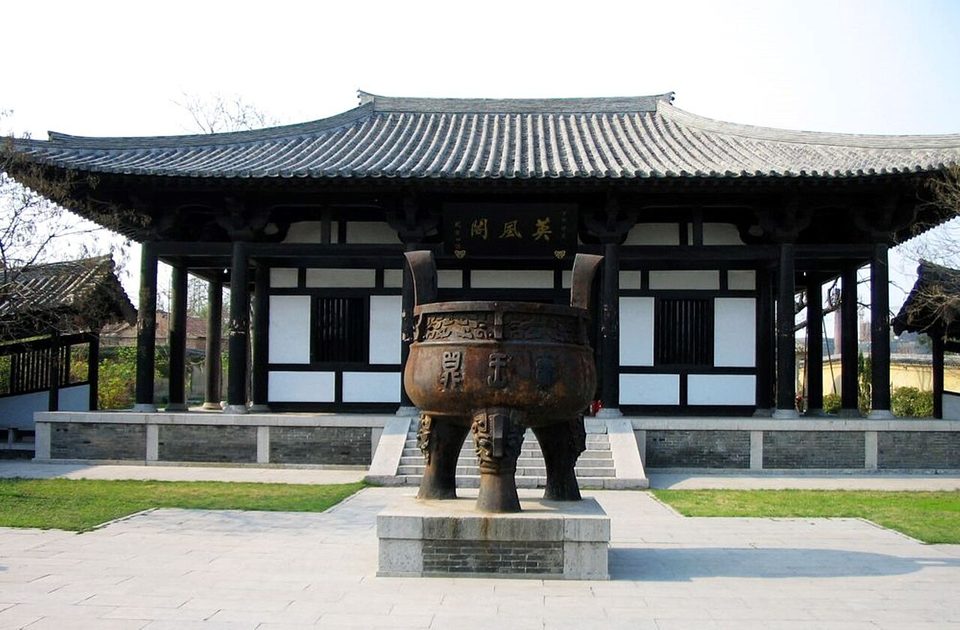
The historic core is small. The scenic area's own description says a memorial arch once stood here and fell into ruin in the early Qing. In 1703, the forty-second year of the Kangxi reign, the Suqian magistrate Hu Sanjun set up a stone tablet that fixed the name Xiangwang Guli. That tablet, a set of courtyards and some very old trees are the heart of the place.
The Former Residence area holds three courtyards in a row with couplets and poem tablets. In the yard stands a locust tree that tradition says Xiang Yu planted with his own hands, along with an old wutong tree, a well called the Xiang family well, a statue of the horse Zhui and a white marble statue of Xiang Yu. Nobody can date the tree to the third century BC, and the park does not claim archaeological proof. Treat it as a local tradition that has been honoured on this spot for at least three hundred years.
Everything else is modern, built to turn the site into a full day out. Bendibao lists the scenic area at about 65 hectares, and it holds the status of a national 4A scenic area. In front of the Western Chu Old City gate stands a 9.9 metre statue of Xiang Yu, and the gate tower rises to 24.5 metres with a view over the Chu-style rooftops. Inside, dioramas restage the division of the kingdoms, Julu, the Battle of Pengcheng and the Hongmen banquet. The Xiang Mansion has ten display areas on Chu life with bronzes, lacquer and wedding customs, and a Six Arts garden presents the rites, music, archery, charioteering, writing and arithmetic of a Zhou gentleman's education. The park has also added a costume hall.
How to walk it
Start at the Former Residence while it is quiet, since it is the reason to come. Read the 1703 tablet, find the locust tree, then work outward to the Xiang Mansion displays and the gate tower. Climb the tower last for the view. Families tend to spend longer in the reenactment halls and costume rentals. History readers can cover the core in about an hour and the whole park in half a day.
Tickets and hours
The scenic area's visitor notice, dated 28 March 2024, lists a full ticket at 80 yuan and a half-price ticket at 40 yuan. Half price applies to young people aged 6 to 18, full-time students up to undergraduate level and visitors aged 60 to 69. Children up to 6 or 1.4 metres, visitors aged 70 and over and people with disabilities enter free. One rule is unusual. Visitors surnamed Xiang or Yu enter free, so bring an ID that shows your name if that applies to you. Suqian residents get a discount on Tuesdays outside public holidays.
Hours follow two seasons, according to the official notice and Ctrip's listing. From 1 July to 30 September the park opens 9:00 to 18:00 with last entry at 17:30. From 1 October to 30 June it opens 9:00 to 17:30 with last entry at 17:00, so the shorter winter hours apply now. Hours and prices can change, especially around holidays, so check the day's notice at the gate.
Getting there
The park is inside the city. Taxis and ride-hailing cover the trip from Suqian station on the Xuzhou to Yancheng high-speed line, and the old canal belt is a short ride away. The scenic area lists a car park about 50 metres south of the west gate. Pair the park with an afternoon at Luoma Lake on the city's northwestern edge, or with the Grand Canal walk described in the city guide.
Frequently asked questions
Is this really where Xiang Yu was born?
It is the site that Suqian has honoured as his birthplace since at least 1703. The ancient sources place him in Xiaxiang, which lay in today's Suqian. The exact house and tree rest on local tradition.
Is it worth it without much Chinese history?
The theme park side works for families. Readers who know the Farewell My Concubine story get far more from the courtyards.
How long should I allow?
One to two hours for the residence and the gate tower, half a day for every hall.
Sources
Facts in this article were checked against the following sources, retrieved 21 October 2026.
- Xiang Yu, English Wikipedia
- Jiangsu Xiangwang Guli scenic area, visitor notice
- Ctrip listing for Xiangwang Guli, hours and site description
- Suqian Bendibao, Xiangwang Guli
- Suqian, English Wikipedia
- Suqian travel guide on this site
Photos are from Wikimedia Commons under the licences shown in each caption.