National Museum of Chinese Writing
Anyang is where Chinese writing first appears in quantity. The inscribed oracle bones dug up at Yinxu, the last Shang capital, are the earliest large body of Chinese script. It made sense to put a national museum of writing here, and since 2009 the city has had one. The National Museum of Chinese Writing on Renmin Avenue covers the whole story, from oracle bones and bronze inscriptions through bamboo slips, calligraphy and printing to the scripts of China's minority peoples. Its main exhibitions are free with a booking.
How the museum came about
The idea came from a scholar. In 2001 Wang Yunzhi, a paleographer at Zhengzhou University, wrote to the provincial governor proposing a museum of writing, and the province agreed. Planning began in Anyang the next year. The State Council approved the name "Henan Chinese Writing Museum" in 2005, then in 2007 agreed to drop "Henan", making it a national museum. It opened on 16 November 2009. Chinese Wikipedia describes it as the first national museum in the world devoted to writing as its main collection.
The building
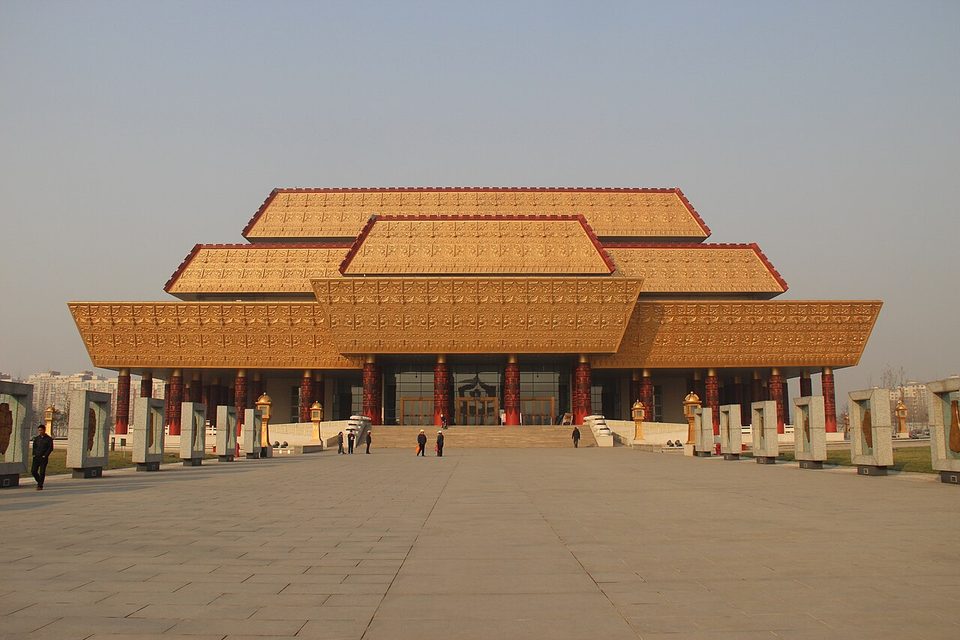
The main hall is shaped after the ancient character yong, meaning a city wall, and stands 32.5 metres high. Its walls and columns carry red and black taotie and coiled-dragon relief patterns meant to recall the double-eaved halls of a Shang palace. Two golden "dark birds" stand at the entrance. They recall the legend that a woman named Jiandi swallowed an egg dropped by a black bird and gave birth to Xie, ancestor of the Shang.
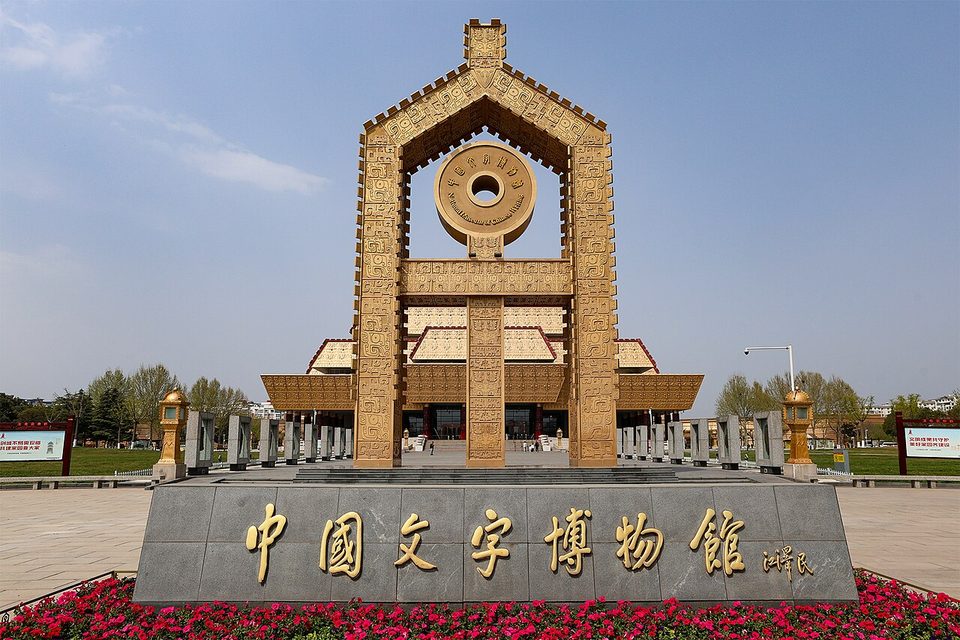
Past the birds is the Zifang, an archway shaped like the bronze-script form of the character zi, meaning "character". Beyond it, bronze rows of oracle-bone inscriptions, 28 in all, line both sides of the plaza.
Three halls
A second phase opened on 16 November 2022, together with a Chinese Character Park on both sides of the museum. The museum director, the paleographer Huang Dekuan, named the three buildings.
The Xuanwen Hall, the original building, holds the core displays. The permanent exhibition on the history of Chinese writing follows characters from their origins through their changes of form. A themed exhibition on oracle bones tells how they were found, excavated and studied. Special exhibitions fill the rest.
The Huiwen Hall, to the east, covers writing in daily life, with exhibitions on characters in folk custom, dictionaries and calligraphy.
The Bowen Hall, to the west, is the paid hall, with a digital experience exhibition on characters and a display on family instructions.
The Character Park outside has six themed gardens on the origins, change, play, beauty, rhythm and strength of characters.
What to look for
Chinese Wikipedia gives the collection as 4,123 objects, 305 of them first-grade relics. The museum's prize pieces are eight Western Zhou bronzes with inscriptions. One is the gui food vessel of Grand Preceptor Cuo, its lid and body cast with a matching 70-character text recording a gift of a tiger-skin robe from the king in his twelfth year. Another is the Jia Bo hu, a wine vessel bought from a Hong Kong collector in 2012 after national experts examined it. Chinese Wikipedia also lists Qin standard weights and edict plaques, Han wooden slips from Juyan and Qin bamboo slips from Shuihudi among the major holdings.
Allow two to three hours. Visitors who read some Chinese will get more from the labels.
Tickets, hours and getting there
The museum's website lists opening from 9:00 to 17:00 with last entry at 16:30, and closure every Monday except public holidays. The Xuanwen and Huiwen halls are free, but individuals must book with real names one to three days ahead, the same day included, through the official WeChat account or website. The Xuanwen Hall has also run an evening session on its first two floors. Some groups, including visitors aged 60 and over, may enter with ID without booking. The Bowen Hall sells its own tickets. Rules change for holidays, so check the museum's announcement before you go.
The museum is at 656 Renmin Avenue East in the city. Taxis from Anyang East high-speed station or the old Anyang station reach it easily.
Before you go
- Book a slot, and carry the ID used for the booking.
- Do Yinxu first, then come here to see the scripts in context.
- Avoid Mondays.
- Keep a separate day for the Red Flag Canal in the Taihang Mountains.
Frequently asked questions
Is the museum free?
The Xuanwen and Huiwen halls are free with a booking. The Bowen Hall charges.
Should I visit Yinxu or this museum first?
Yinxu first. The writing museum makes more sense once you have seen where the oracle bones came from.
Is there English labelling?
This page could not confirm how much of the labelling is in English. Ask at the service desk or check the museum's website.
When is it closed?
Mondays, except public holidays, according to the museum's own notice.
Sources
Facts in this article were checked against the following sources, retrieved 20 October 2026.
- 中国文字博物馆, Chinese Wikipedia
- National Museum of Chinese Writing, visitor guide
- National Museum of Chinese Writing, booking notice
- National Museum of Chinese Writing, second-phase opening, November 2022
- Anyang travel guide on this site
Photos are from Wikimedia Commons under the licences shown in each caption.