Yinxu, the Ruins of the Last Shang Capital
Yinxu, the Ruins of Yin, on the northwestern edge of Anyang, is the site of the last capital of the Shang dynasty. The Shang kings ruled from here for roughly the last two and a half centuries of the dynasty, until its fall around 1046 BC, and the inscribed oracle bones found here hold the earliest known Chinese writing. It became a UNESCO World Heritage Site in 2006. A visit now has three parts, the new Yinxu Museum, the palace and temple area at Xiaotun and the royal cemetery north of the Huan River, and together they fill a full day.
From dragon bones to a buried city
For about three thousand years the Shang capital survived only in texts. Sima Qian wrote of the Shang kings, and the sixth-century geographer Li Daoyuan described the ruins beside the Huan River, but the city itself was forgotten. In 1899 the scholar Wang Yirong noticed ancient characters on so-called dragon bones sold as medicine in Beijing. Dealers kept their source secret, until the scholar Luo Zhenyu traced the bones to Xiaotun village outside Anyang and identified it with the Shang capital. In 1917 Wang Guowei read the names of Shang kings in the inscriptions and showed that they matched Sima Qian's list.
Scientific digging began in 1928, when Dong Zuobin led an eighteen-day trial excavation for the Academia Sinica. From 1929 Li Ji directed fifteen seasons of work up to 1937, which uncovered palace foundations, royal tombs and tens of thousands of inscribed bones. Because these were the first excavations organised entirely by a Chinese research body, Yinxu is often called the cradle of Chinese archaeology. Work by the Chinese Academy of Social Sciences has continued since 1950.
The Yinxu Museum
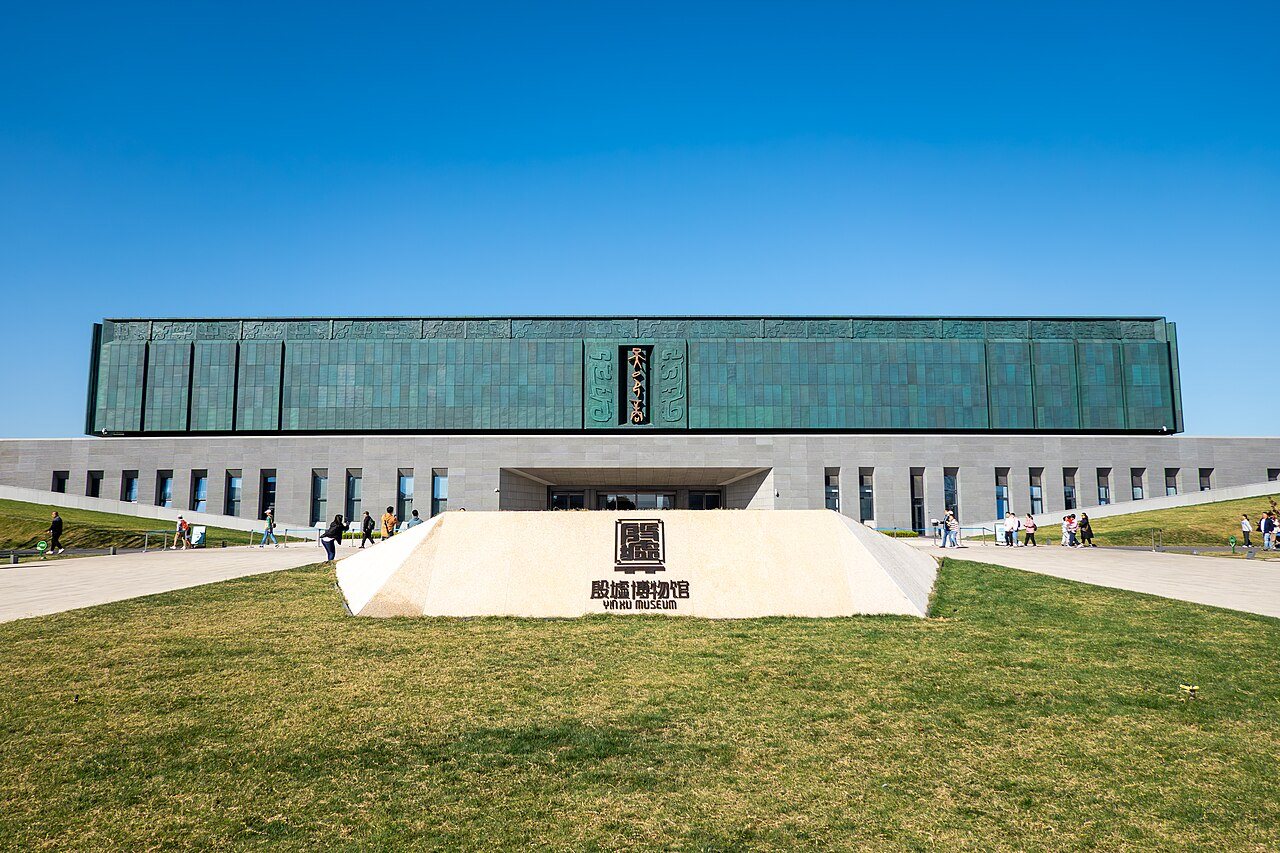
The new museum opened on 26 February 2024. It stands on the bank of the Huan River facing the palace area, in a building shaped like a bronze ding designed by the architect He Jingtang, with three oracle-bone characters for Great Settlement Shang on its facade. The galleries cover about 22,000 square metres and show nearly 4,000 objects, more than three quarters of them on display for the first time. Most come from excavations by the Academy's Anyang team since 1950.
The permanent displays follow the story of the Shang from discovery to daily life and its place in the ancient world. Highlights include the Simuxin ding, the finds from the tomb of the military leader Ya Chang, a special exhibition of oracle bones from Huayuanzhuang East, and a hall of 23 chariot burials, among the earliest real chariots found in China. Some chariots are still being conserved in view of visitors. Seeing the bronzes and bones first gives the outdoor ruins, which are mostly earth foundations and pits, the context they need.
The palace and temple area
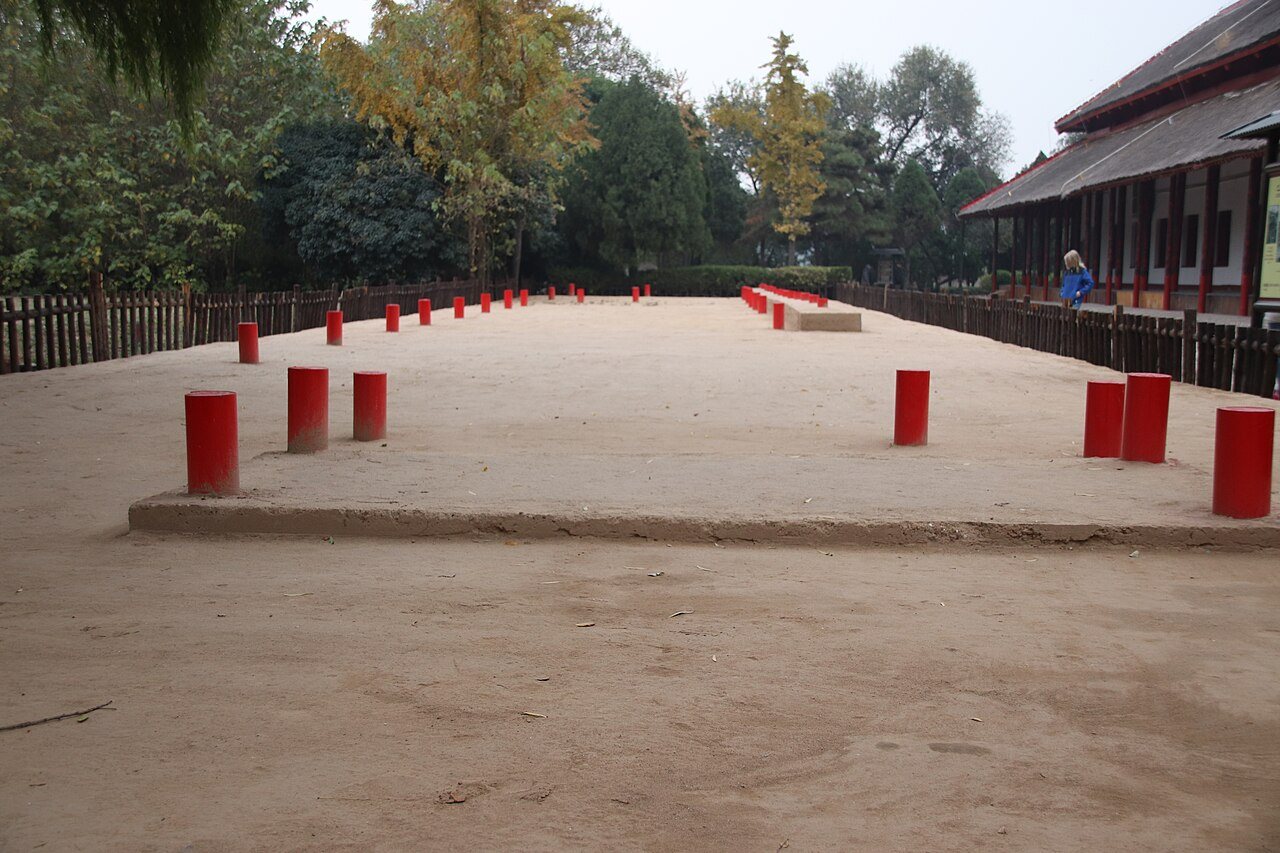
The palace and ancestral temple area lies on the south bank of the river around Xiaotun and Huayuanzhuang, covering about 71.5 hectares. Archaeologists have found more than 80 rammed-earth building foundations here, and the site park marks their outlines and post positions on the ground. Nearby are the storage pits where oracle bones were buried, sacrificial pits and chariot displays.
The best-known single find is the tomb of Fu Hao, a consort of King Wu Ding who also led armies, found in 1976. It is the only Shang royal tomb discovered intact, with 1,928 objects, and the Anyang travel guide summarises its contents. The tomb site is part of the standard walk.
The royal tombs
North of the Huan River lies the royal cemetery, the source of the Houmuwu ding, the heaviest bronze vessel of ancient China. Large shaft tombs and rows of sacrificial pits show the scale of Shang ritual, including human sacrifice, which many visitors find sobering. New excavations around the cemetery were named among China's top ten archaeological discoveries for 2022. The tombs are about six kilometres from the palace area.
Booking, tickets and getting around
Since June 2024 Yinxu and the Yinxu Museum have used real-name ticketing. You can book through the official Yinxu scenic area or Yinxu Museum accounts or through major travel platforms, and buy at the window with your own ID. The scenic area ticket covers both the palace and temple area and the royal tombs, and a free shuttle runs between them from the square in front of the palace area gate. The tombs are open by day only. The museum is ticketed and booked separately, and holiday slots sell out. Prices and hours change, so check the day's notice when you book.
From Anyang East or Anyang railway station, a taxi to Yinxu takes around half an hour depending on traffic, and city buses also serve the site.
A one-day plan
Start at the museum when it opens and give it three hours. Cross to the palace and temple area after lunch, see Fu Hao's tomb and the oracle-bone pits, then take the shuttle to the royal tombs if you still have energy. On a second day, the National Museum of Chinese Writing and the Wenfeng Pagoda in the city fill a morning, and the Red Flag Canal in the Taihang Mountains makes a full-day trip.
Before you go
- Bring the ID you booked with, as originals are checked at entry.
- Book holiday and weekend museum slots several days ahead.
- Wear comfortable shoes, since the outdoor sites are spread out.
- Follow up with the National Museum of Chinese Writing in the city.
- Read the Anyang travel guide for food and transport.
Frequently asked questions
Should I see the museum or the ruins first?
The museum first. The ruins are mostly earthworks and make far more sense after seeing the objects.
How long do I need at Yinxu?
A full day for the museum, palace area and royal tombs, or half a day if you skip the tombs.
Is the museum ticket separate from the ruins?
Yes. The scenic area ticket covers the palace area and royal tombs, and the museum is booked on its own.
Can I see real oracle bones?
Yes. The museum displays more than a hundred selected inscribed pieces in its oracle-bone exhibition.
Sources
Facts in this article were checked against the following sources, retrieved 18 October 2026.
- Yinxu, English Wikipedia
- Yinxu, Chinese Wikipedia
- Henan Department of Culture and Tourism, Yinxu Museum opening, February 2024
- Chinese government portal, Yinxu Museum feature, February 2024
- Henan Tourism Network, real-name ticketing notice, May 2024
- Anyang travel guide on this site
Photos are from Wikimedia Commons under the licences shown in each caption.