Potala Palace, Lhasa: How to Book and Visit in 2026
To visit the Potala Palace (布达拉宫) you must book a real-name, timed ticket in advance through the palace's official WeChat booking system. From 1 May to 31 October 2026, Route 1, the full circuit through the White and Red Palaces, costs 200 yuan and Route 2 costs 100 yuan, with bookings opening ten days ahead; the palace opens at 9:00 and stops admitting visitors at 15:40. From 1 November to 30 April prices halve to 100 and 50 yuan and bookings open seven days ahead. Plan the visit for your second or third day in Lhasa, after the altitude has eased, and expect two to three hours of stairs. The full city plan is in the Lhasa travel guide.
Tickets and booking, step by step
These rules come from the Potala Palace Administration's notices for 2026:
| Season | Route 1 (full / concession) | Route 2 (full / concession) | Booking opens |
|---|---|---|---|
| 1 May to 31 October | 200 / 100 yuan | 100 / 50 yuan | 10 days ahead |
| 1 November to 30 April | 100 yuan full | 50 yuan full | 7 days ahead |
- Book only through official channels: the "布达拉宫票务预订系统" (Potala Palace ticket booking system) mini-program or the palace's official WeChat account. Each ticket is tied to one ID.
- Bring the same ID or passport you booked with. Ticket, document and person must match at the gate.
- Arrive early for your time slot. Missed slots are generally lost.
- Older visitors over 60, and others who struggle with smartphone booking, have been able to reserve in person at the palace's ticket reservation office the day before, from 9:00. Check that this still applies.
- Foreign visitors on a Tibet Travel Permit tour normally have their agency book with passport details.
Peak-season dates sell out, especially in July, August and the October holiday. Book the moment the window opens, then build the rest of your Lhasa days around the slot you get.
Route 1, Route 2 and the new Shol route
Route 1 takes you up through the White Palace and into the Red Palace, with its chapels and the gilded reliquary stupas of past Dalai Lamas. Route 2 is a shorter circuit with less climbing and fewer rooms. For a first visit, if your legs and lungs are up to it, Route 1 is the one to get. Route 2 is a reasonable choice if you are acclimatising slowly or travelling with older relatives.
From 20 September 2026 the palace also opened a separately ticketed Shol route, covering only the old Shol town at the foot of the palace and none of the main building. Visitors enter by the east or south gate and leave by the Shol west gate. The route includes the old Shol prison, the mint, a treasury exhibition and several aristocratic houses. It costs 25 yuan in peak season and 10 yuan in the low season, and it is free during the winter "Winter Tour" promotion. It is booked through the same official mini-program. It does not replace the main visit, but it is a good extra on the same morning.
What you are seeing
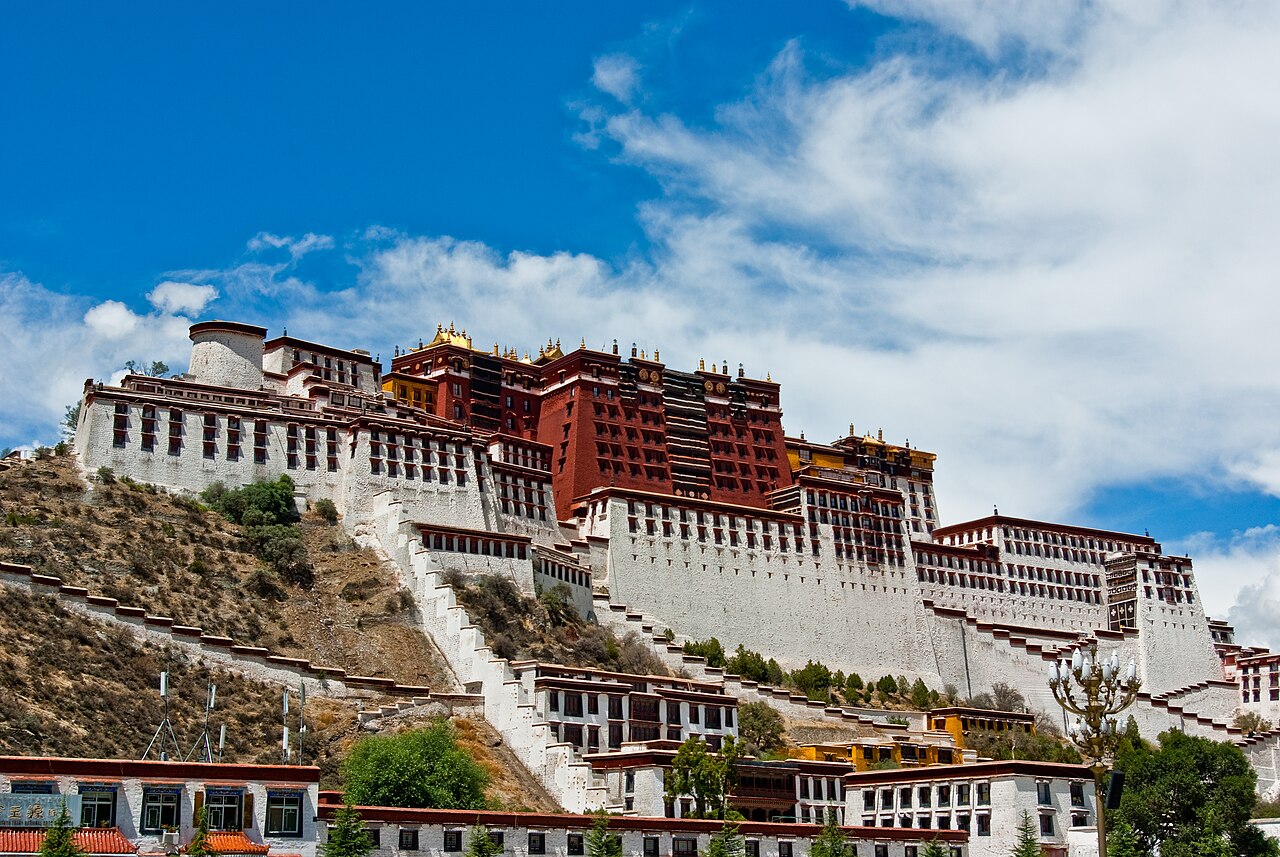
Songtsen Gampo built a palace on Red Hill in the seventh century, but almost nothing survived the fall of his dynasty except two chapels. The building you see is the work of the Fifth Dalai Lama, who began rebuilding in 1645. The White Palace was finished three years later. The Red Palace, added after his death to house his reliquary stupa, was essentially complete by 1693, 48 years after work began. From then on the Dalai Lamas used the Potala as their winter palace and seat of government.
The main building is 117.2 metres tall, 360 metres east to west and 140 metres north to south. It looks like thirteen storeys but has nine, with close to 10,000 rooms. The White Palace, on the east, held offices and living quarters, including the Sunlight Hall at the top. The Red Palace, in the centre, holds chapels and the reliquary stupas of the Fifth, Seventh, Eighth, Ninth and Thirteenth Dalai Lamas. The Fifth's is the largest at 14.85 metres, said to be covered with 110,000 taels of gold.
The Potala was on China's first list of protected cultural relics in 1961, became a World Heritage site in 1994, and has been a 5A scenic area since 2013.
The visit, in practice
There is a security check at the entrance, so carry as little as possible. From there you climb a long series of stone ramps and steps to the White Palace entrance before you even reach the interior. Inside, the route is one-way, dim and often narrow, and stewards keep groups moving. Photography is not allowed in the interior. Hats come off in the chapels, and you walk clockwise.
Most visitors spend two to three hours on Route 1, including the climb up and the walk down the back of the hill. Drink water before you start the climb and take the landings slowly.
Altitude: why not on day one
Lhasa sits at about 3,660 metres, and the climb up Red Hill adds more height and hundreds of steps. People who land in the morning and go straight to the Potala often finish the day with a pounding headache. Spend your arrival day resting and walking the flat Barkhor Street, then book the Potala for day two or three. Walk slowly, stop on the landings, and turn back if a headache or breathlessness gets worse. Anyone with heart or lung conditions should get medical advice before the trip.
The classic photograph
The famous full-front view is from the platform on Chakpori, also called Yaowang Hill, across the road southwest of the palace. It is free to look from. Morning light falls on the front of the palace. At night the Potala is floodlit and the square to the south fills with locals walking the Lingkor pilgrim circuit around the hill.
Behind the palace, the park around the Lukhang (Dragon King Pool) was once the Potala's garden and is a quiet place to sit afterwards.
Building the day around your slot
A morning slot fits the classic day: Potala in the morning, photos from Chakpori, lunch, then Norbulingka, the summer palace two kilometres west, for a flat afternoon in its gardens. Keep the Jokhang Temple for a separate day; it needs its own booking. Do not put the Potala and Namtso Lake on the same day or back to back while you are still adjusting. The monasteries of Sera and Drepung make another full day.
If you could not get a slot, walk the Lingkor around the hill, take the Chakpori view and visit the Shol route. That still shows you a lot of the palace.
Frequently asked questions
How much is the Potala Palace ticket in 2026?
From 1 May to 31 October: Route 1 is 200 yuan and Route 2 is 100 yuan. From 1 November to 30 April: 100 and 50 yuan. In peak season concession tickets are half price; check the low-season concession rate when you book.
How far ahead do I need to book the Potala?
Bookings open ten days ahead in peak season and seven days ahead in the low season, through the official WeChat booking system.
What time does the Potala Palace open?
In the 2026 peak season it opened at 9:00 and stopped admitting visitors at 15:40.
How long does a Potala visit take?
Two to three hours for Route 1, including the climb and the walk down.
Sources
- Potala Palace Administration, 2026 peak-season notice, via Tibet Department of Culture and Tourism, 24 April 2026: https://wlt.xizang.gov.cn/xwzx_69/tzgg/202604/t20260424_536658.html
- Potala Palace Administration, low-season price notice, 10 March 2026: https://wlt.xizang.gov.cn/xwzx_69/tzgg/202603/t20260310_528204.html
- Potala Palace Administration, notice opening the Shol route, 16 September 2026: http://wlt.xizang.gov.cn/xccx/lytg/202609/t20260916_559291.html
- Tibet Department of Culture and Tourism, price adjustments for Tibet sites, March 2024: https://wlt.xizang.gov.cn/xwzx_69/xydt/202403/t20240319_408004.html
- Potala Palace, Chinese Wikipedia: https://zh.wikipedia.org/wiki/布达拉宫