Jingdezhen Travel Guide: Kilns, Studios, Porcelain Markets and the Yaoli Hills
Jingdezhen has made porcelain for over a thousand years, and the reason to come is to see how it is still made. Start with the Ancient Kiln park for the old firing technology, spend an evening at the Taoxichuan market where young potters sell their work, and if you have a third day, drive out to the clay mines at Gaoling and Yaoli. In 2026 UNESCO inscribed the Jingdezhen Handicraft Porcelain Industry Sites on the World Heritage List, which covers the kilns in town and the mines in the hills. Two or three days is the right length.
How the porcelain town works
The town was called Changnan until 1004, when it took the era name of the Song emperor Zhenzong, Jingde, as its porcelain became famous. It sat close to two raw materials: porcelain stone and the white clay the locals called gaoling tu, which is where the word kaolin comes from. Pine forests fed the kilns, and the Chang River carried finished ware down to Poyang Lake and the Yangtze. Qingbai ware in the Song and Yuan, blue-and-white from the 1330s and the Qing famille rose colours all came from here. In 1855 Taiping forces destroyed all 9,000 kilns in town; they were rebuilt from 1866.
The World Heritage listing follows that whole chain. Its five parts are the town-centre production area around the Imperial Kiln Factory, the Song and Yuan kiln site at Hutian, the Gaoling clay mine and Changling porcelain-stone mine near Yaoli, and the Jiaotan firewood area. Knowing this helps you plan: the kilns are in the city, the mines are an hour or more into the hills.
Places worth visiting
The Ancient Kiln park
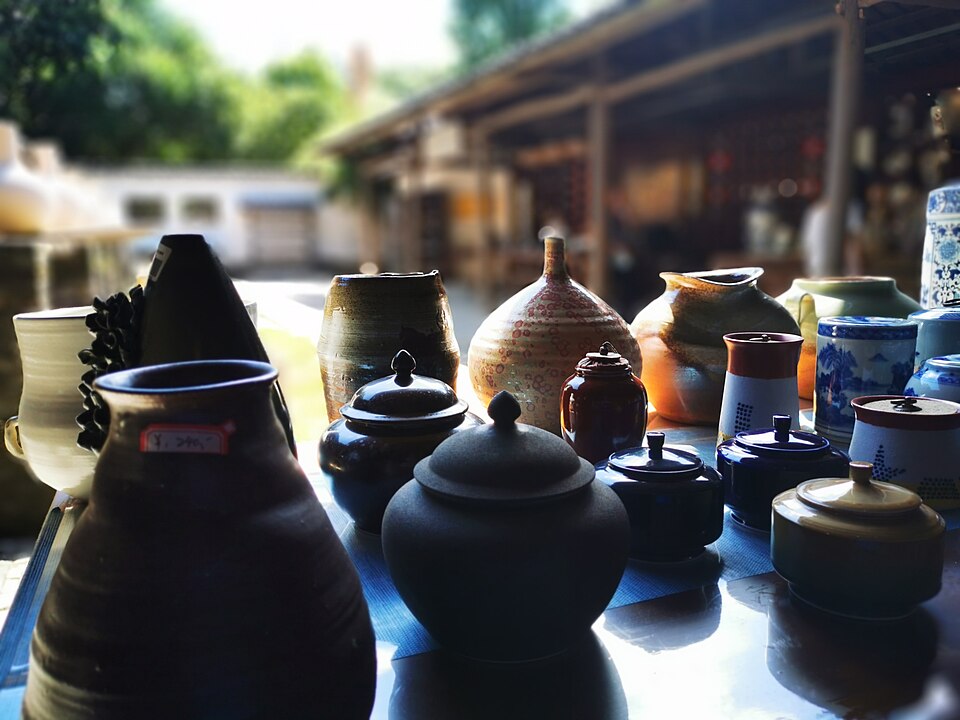
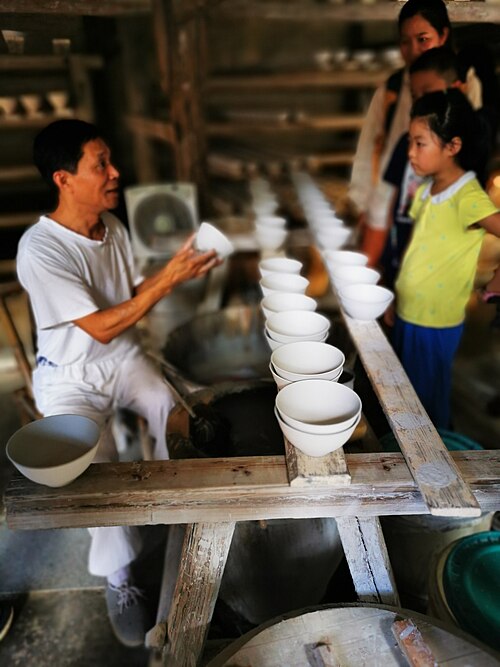
The Ancient Kiln Folk Customs Expo Area is the city's only 5A site and the best single explanation of firing. Its centrepiece is the Qing egg-shaped Zhen kiln, restored and refired in 2009, beside a sequence of rebuilt Song, Yuan and Ming kilns and a workshop line where veteran craftspeople throw, trim and paint by hand. Allow two to three hours and go in the morning, when the workshops are busiest. Details are on the Ancient Kiln page.
Taoxichuan
The former Yuzhou Porcelain Factory, a state works founded in 1958, reopened in 2016 as a district of studios, galleries and a ceramics industrial heritage museum. Its weekend creative market is the liveliest place in town: 2026 travel listings put it on Friday to Sunday from late afternoon into the evening, and Xinhua reported more than 1,200 stalls a weekend. See the factory buildings in daylight and come back when the stalls open. Market days and buying tips are on the Taoxichuan page.
The Imperial Kiln site and old town
The Imperial Kiln Factory site, in the heart of the World Heritage town area near the Chang River, made porcelain for the Ming and Qing courts. Archaeological remains and a museum are there, and the surrounding lanes hold old workshops and kiln houses. It is a good rainy-day choice, with more indoor space than the kiln park. Check its opening days, since museums here often close one day a week.
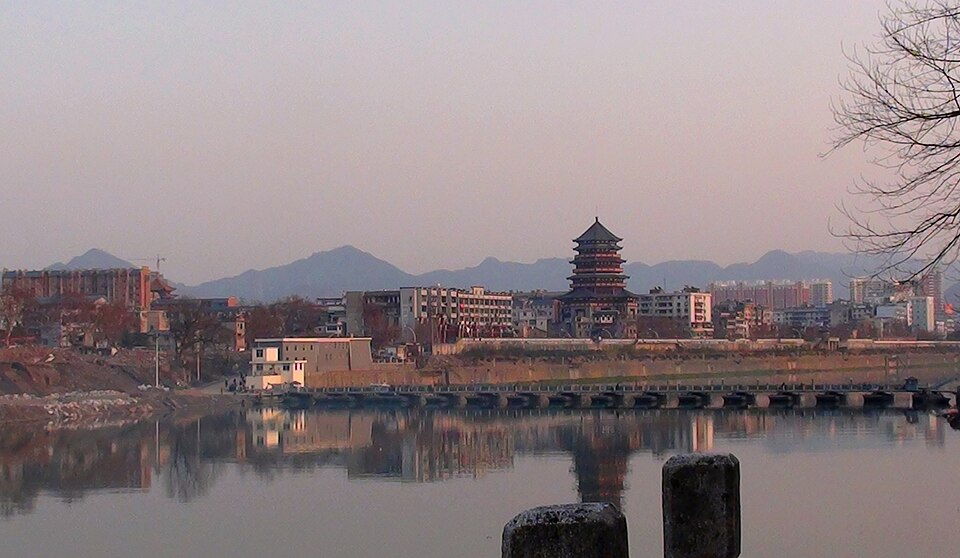
A short walk on the Chang River embankment afterwards shows the route the ware once took to Poyang Lake.
Yaoli and the Gaoling mine
Yaoli is an old kiln and trading village in the forested northeast of the prefecture, and the Gaoling clay mine and Changling stone mine are nearby. It is a full day with a car, and it makes most sense if you have already seen the kilns in town and want to understand where the raw materials came from. Skip it on a two-night trip.
When to come to Jingdezhen
April to May and October to November. Summers are long and very hot (July averages about 29 °C), and the year's rainfall is heavy at around 1,800 mm, so carry an umbrella in any season. Winters are cool, damp and quiet, which suits museums and studio visits. The Taoxichuan market runs most of the year, so the season matters less than getting a weekend.
How to get in and where to stay
- High-speed rail: Jingdezhen North is on the Hefei–Fuzhou high-speed line, which links it with Huangshan North and Wuyuan. Use it for a combined trip with Huangshan.
- Conventional rail: Jingdezhen station connects to Nanchang and Jiujiang.
- Air: Jingdezhen Luojia Airport is about 8 km northwest of downtown, with domestic flights only.
Taxis are plentiful and cheap. Stay in the centre, between the Ancient Kiln and the old town, or near Taoxichuan if the market is your priority.
Eating in Jingdezhen
Jiangxi food is spicy and savoury. Local favourites include rice noodles for breakfast, stir-fried dishes heavy with chilli, and cold rice-noodle snacks. Fuliang County, just outside the city, has been known for tea since the Tang poet Bai Juyi mentioned merchants going there to buy it. Taste before you buy, and leave the first tourist-street stall alone.
Buying porcelain without regret
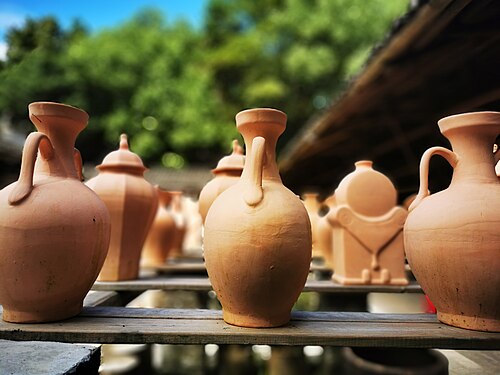
See how it is made first, then shop. At stalls, ask whether a piece is thrown by hand or moulded, feel the weight and the foot ring, and compare a few sellers. Many can pack and ship; agree the terms before paying. Bring bubble wrap or buy a padded box if you're carrying pieces on the train.
How to arrange the route
Day 1 (ideally a Friday or Saturday): Ancient Kiln park in the morning, lunch, the Imperial Kiln area and the river in the afternoon, Taoxichuan from late afternoon until the market winds down.
Day 2: A studio visit or a hands-on pottery class, museums, and a second look at the market if you want to buy.
Day 3: Yaoli and Gaoling by car, or a train to Huangshan North or Wuyuan.
What to cut if short on time
With one day, do the Ancient Kiln in the morning and Taoxichuan in the evening. Drop Yaoli first; it needs a full day. Skip retail-only porcelain malls entirely.
Things to confirm before you go
- Taoxichuan market days and times for your week.
- Museum closing days, especially at the Imperial Kiln site.
- Which station your train uses, Jingdezhen North or Jingdezhen.
- Shipping terms before you pay for fragile pieces.
Frequently asked questions
How many days do I need in Jingdezhen?
Two days covers the kilns, a museum and the market. Add a third for Yaoli and the clay mines.
When is the Taoxichuan market?
Listings in 2026 show Friday to Sunday from late afternoon into the evening. Check the notice for your dates.
Is Jingdezhen a World Heritage Site?
Yes. The Jingdezhen Handicraft Porcelain Industry Sites were inscribed in 2026, covering the town-centre kilns, Hutian, the Gaoling and Changling mines and the Jiaotan firewood area.
Sources
The facts in this article were checked against the following sources, retrieved September 17, 2026, and rechecked on October 18, 2026.
- Jingdezhen https://en.wikipedia.org/wiki/Jingdezhen
- Jingdezhen (Chinese) https://zh.wikipedia.org/wiki/景德镇市
- UNESCO World Heritage Centre, Jingdezhen Handicraft Porcelain Industry Sites https://whc.unesco.org/en/list/1765/
- Jingdezhen – Wikivoyage https://en.wikivoyage.org/wiki/Jingdezhen
Tickets change; this article does not quote yuan amounts.
All photos are from Wikimedia Commons, used under CC licenses; re-use requires attribution.
- jingdezhen-ancient-kiln.jpg from File:景德镇古窑民俗博览区 半成品瓷器 01.jpg, by Liuxingy, CC BY-SA 4.0
- jingdezhen-workshop.jpg from File:景德镇古窑民俗博览区 半成品瓷器 07.jpg, by Liuxingy, CC BY-SA 4.0
- jingdezhen-potter.jpg from File:景德镇古窑民俗博览区 一位师傅正在展示半成品的瓷器.jpg, by Liuxingy, CC BY-SA 4.0
- jingdezhen-changjiang.jpg from File:景德镇市昌江东岸.JPG, by JHH755, CC BY-SA 3.0