Jiayang Steam Train: The Bashi Narrow-Gauge Railway in Qianwei
The Jiayang steam train runs on a 19.84-kilometre narrow-gauge line in the hills of Qianwei County, south of central Leshan. It was built to carry coal from the Jiayang mines down to Shixi on the Min River, and it kept running for passengers after the coal stopped because the valley had no road. Chinese sources call it the Bashi railway, after its two end towns, and English sources often use the Shixi to Huangcunjing railway. It is one of the very few places in the world where coal-fired steam locomotives still pull scheduled trains, and it makes a slow, very different day from the Leshan Giant Buddha.
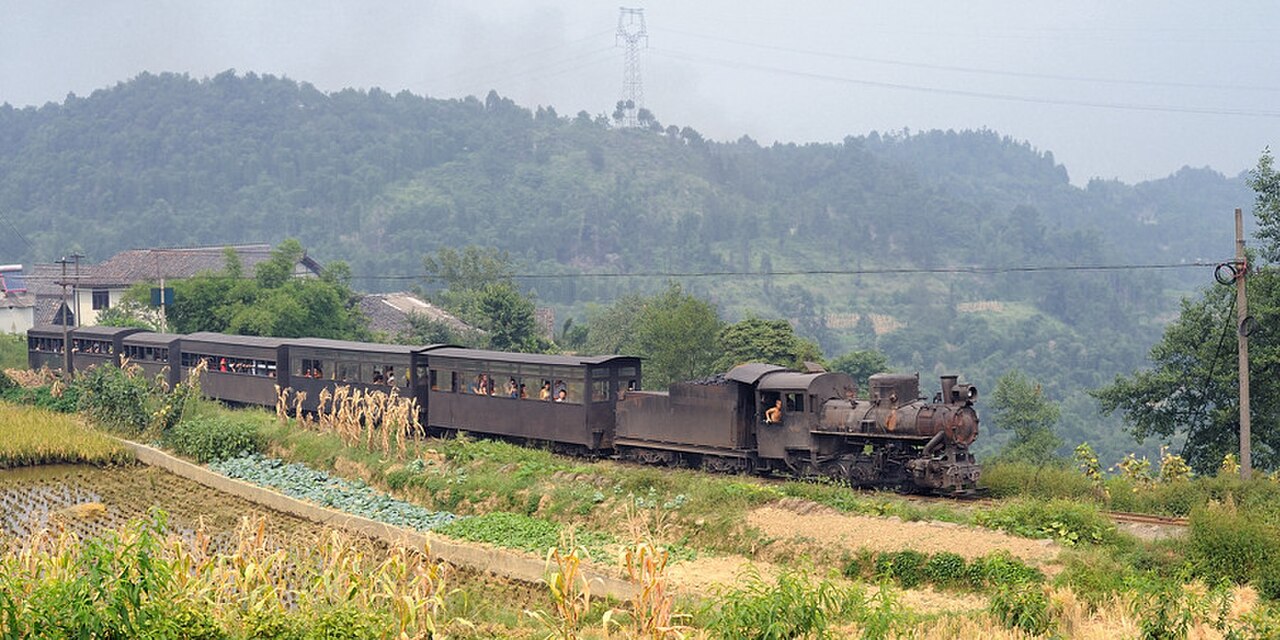
A coal line that outlived its coal
The Jiayang coal company moved to Qianwei from Jiaozuo in Henan in 1937, during the war with Japan, and a mine opened at Bajiaogou in 1938. At first coal went down to the Mabian River by hand-pushed trucks on a 600 mm track. Construction of the present line began in 1958, it opened on 12 July 1959, and in 1960 it was regauged to 762 mm. The railway carried coal and people together, with passenger carriages added in the 1960s; English Wikipedia says six pairs of passenger trains ran daily in 1975.
Mining wound down along the line, and coal traffic on the last section ended in 2003. The company planned to close the railway. In 2004 the county government asked for it to be kept for its tourist value, and protection followed in stages; it became a Leshan city heritage site in 2006, a Sichuan provincial protected site in June 2007, and in 2010 the core of the Jiayang National Mine Park. Chinese Wikipedia reports about 130,000 riders in 2015. A BBC crew filmed the line for a documentary on China's last steam train in January 2018.
Locals still pay a token fare. English Wikipedia gives half a yuan for residents against a tourist price many times higher, and before the road came, the railway even kept a small hearse car, numbered 0, to carry the dead of the valley down to burial.
The ride
The line climbs from the river through six tunnels totalling 905 metres. Chinese Wikipedia says curves make up 46 per cent of its length and that it rises 238 metres from the low end to the high point near Caiziba. Trains run at about 20 km/h. At Mifengyan, the midpoint, the valley is too narrow for a loop, so the line uses a zig-zag where the train reverses up a switchback; tourist trains stop here to show it. Liangshuituo is where the crew blow steam across the track for photographs, and Duanjiawan, a short walk from Mifengyan, is the photographers' spot for the train crossing rapeseed fields in spring.
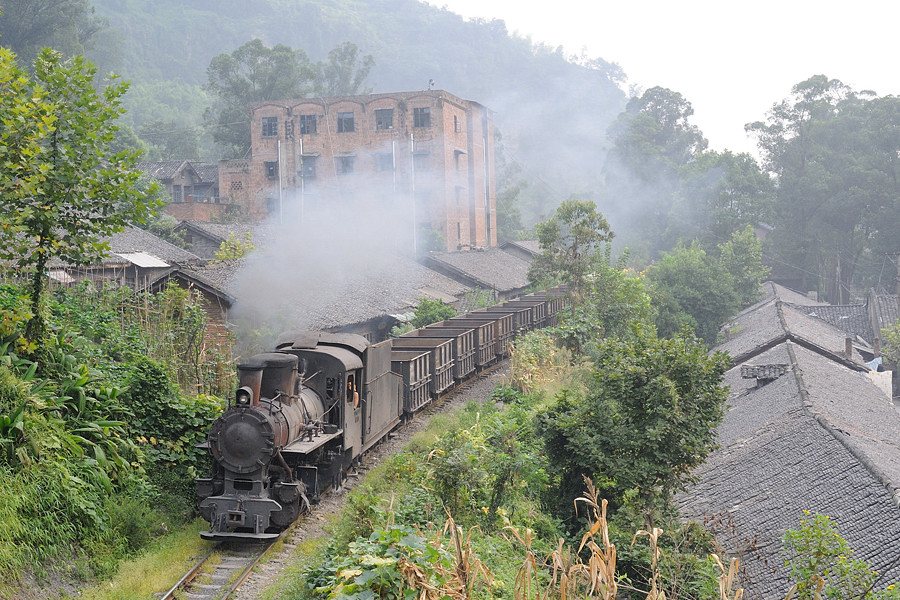
The locomotives are C2 class engines of the ZM16-4 type, coupled to small tenders. Chinese Wikipedia lists engines 08, 16, 17, 18 and 19 in service since 2018; numbers 17 and 18 were newly built in 2015 and 19 in 2017, with boilers from a company subsidiary, so the fleet is being renewed and is not simply preserved. The old passenger cars are open-window steel boxes with wooden benches. Tourist cars, with glass and some with air conditioning, are added for visitors.
Bajiaogou and Huangcunjing
The tourist specials end at Bajiaogou, a mining town of Soviet-style red-brick blocks, workers' housing and old squares. Walking around it is free. From Bajiaogou a short electric tram runs up to Huangcunjing, where a mine experience takes visitors underground on a separate ticket.
Fares and timetable
Fares and departures here are as published by local Chinese listings in 2026, and they shift with seasons and events. Tourist specials leave from Yuejin station, which replaced Shixi as the starting point for visitors in 2011. The listed single fare on the tourist special is 80 yuan in peak periods and 50 yuan in the off-season, with return fares and short return trips priced in between, and children under 1.3 metres riding free without a seat. Peak periods include public holidays and weekends in the March and April flower season. The Huangcunjing mine experience is listed at 80 yuan peak and 50 yuan off-peak.
On ordinary days local listings show tourist specials at 10:30 and in the early afternoon, with sources giving 14:00 or 14:30, and the full special takes about two and a half hours with stops. On holidays and flower-season weekends specials have left roughly hourly. Book through the railway's official WeChat account or a major travel platform, and check the day's timetable before you set out. Holiday and rapeseed weekends sell out.
Getting there
Yuejin station is in Qianwei County, a little over an hour by road from central Leshan. Public transport involves a bus to Qianwei or Shixi and a local connection, so most visitors hire a car or join a day tour from Leshan or Chengdu. If you ride one way, a rural bus can bring you back from Bajiaogou toward Yuejin; confirm the last departure.
How long and when
Give it most of a day including travel. March is the famous month, when rapeseed is yellow along the track and the crowds are heaviest. Weekdays outside March and April are calm. Smoke and soot are part of the deal, so wear clothes you do not mind getting dirty.
Things to confirm before you go
- The day's tourist special times from Yuejin.
- Whether your ticket is single, return or a short return.
- Your transport back from Bajiaogou if you ride one way.
- Huangcunjing mine opening if you want to go underground.
Frequently asked questions
Is the Jiayang train still really steam?
Yes. The trains are pulled by coal-fired C2 steam locomotives, some newly built in the 2010s.
How long is the ride?
The full tourist special takes about two and a half hours with photo stops. The line itself is just under 20 kilometres.
When is the best time to go?
March for rapeseed, with crowds. Weekdays in other months for space.
Can I do it as a day trip from Chengdu?
Yes, but it is a long day. Leshan is the easier base.
Sources
Facts in this article were checked against the following sources, retrieved 7 October 2026.
- Jiayang Coal Railway, English Wikipedia
- 嘉陽小火車及芭石窄軌鐵路, Chinese Wikipedia
- Jiayang steam train visitor information, Leshan Bendibao
- Jiayang steam train fares 2026, Miaodongshe
Photos are from Wikimedia Commons under the licences shown in each caption.