Leshan Giant Buddha: Plank Road, River Boat, Tickets and Booking
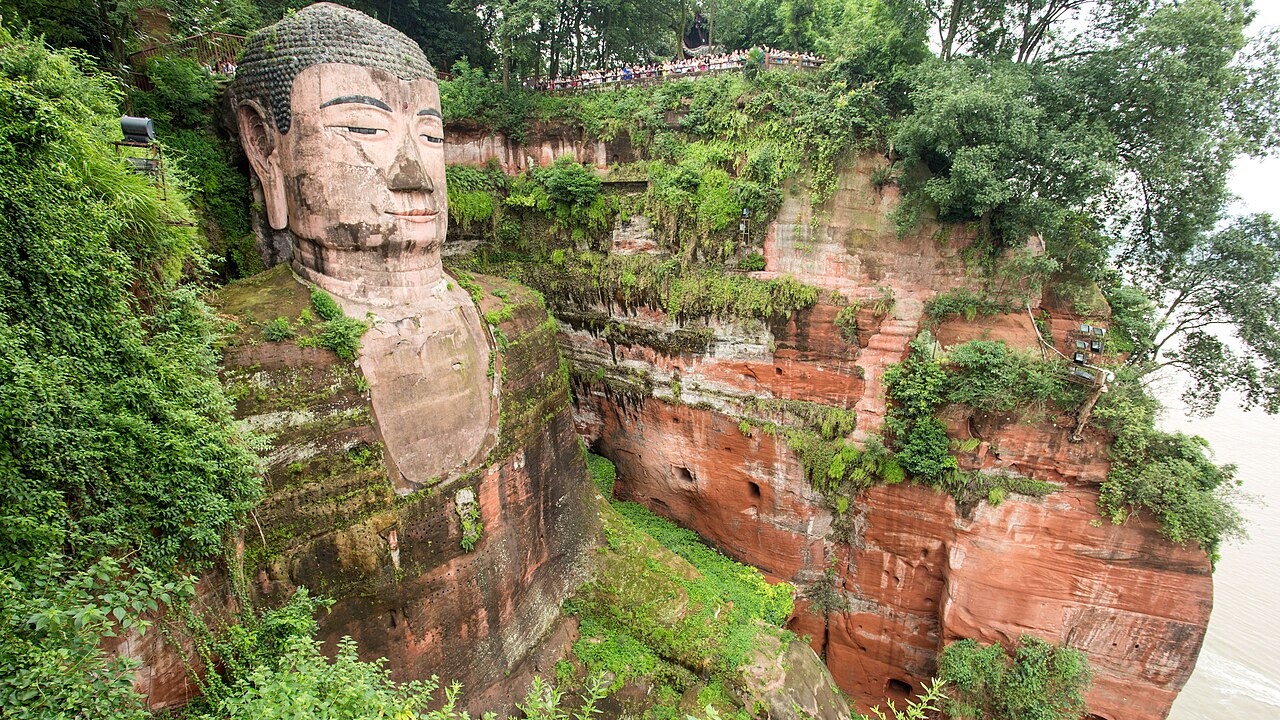
The Leshan Giant Buddha sits in the red sandstone of Lingyun Hill, on the east bank where the Min, Qingyi and Dadu rivers meet below central Leshan. Its formal name is the Great Maitreya Stone Image of Lingyun Temple in Jiazhou, and at 71 metres it is the tallest stone Buddha in the world. It was inscribed together with Mount Emei as a single mixed cultural and natural World Heritage site in 1996. Most visitors come on a day trip from Chengdu, and the Buddha is day one in the Leshan plan.
Why it was carved
The project began with a monk called Haitong, who came from Guizhou and settled at Lingyun Temple in the early Kaiyuan years of the Tang. The three rivers met hard at the foot of the hill and boats were lost there, so he proposed a seated Maitreya on the cliff to calm the water. Chinese Wikipedia gives the start as 713, which matches the Tang stele and the date the scenic area's managers repeated in March 2026, when they rejected an online rumour that the figure began as a statue of Yu the Great. English Wikipedia gives 722, so you will see both years in print.
The story people tell most is about money. When a local official demanded a bribe from the funds Haitong had raised, the monk is said to have answered that he could gouge out his own eye before he would give up the Buddha's money, and then did it. After his death the work stopped. The regional governor Zhangchou Jianqiong restarted it in 739 with his own salary, and it stopped again at the knees when he was recalled to the capital in 746. A later governor, Wei Gao, funded the last phase from 785 and the statue was finished in 803, about ninety years after it began. Wei Gao's account of the work is cut into the cliff to the right of the niche.
Tradition says the debris dropped into the river did change the current. English Wikipedia repeats that claim, and it is worth treating as plausible local history more than measured fact.
What you are looking at
The Buddha is seated with both hands on its knees, facing Mount Emei across the water. Chinese Wikipedia lists the head at 14.7 metres high and 10 metres wide, ears of 7 metres, a nose of 5.6 metres and an instep about 9 metres wide, broad enough for the often repeated claim that a hundred people can stand on one foot. There are 1,021 spiral curls on the head. The right ear and the nose were patched with wood and plaster in later repairs.
A drainage system was carved into the body when it was made. Channels run across the 4th, 9th and 18th rows of curls, and passages behind the ears and chest carry rainwater away from the stone. That is one reason a soft sandstone figure has lasted 1,200 years in one of the wettest parts of Sichuan.
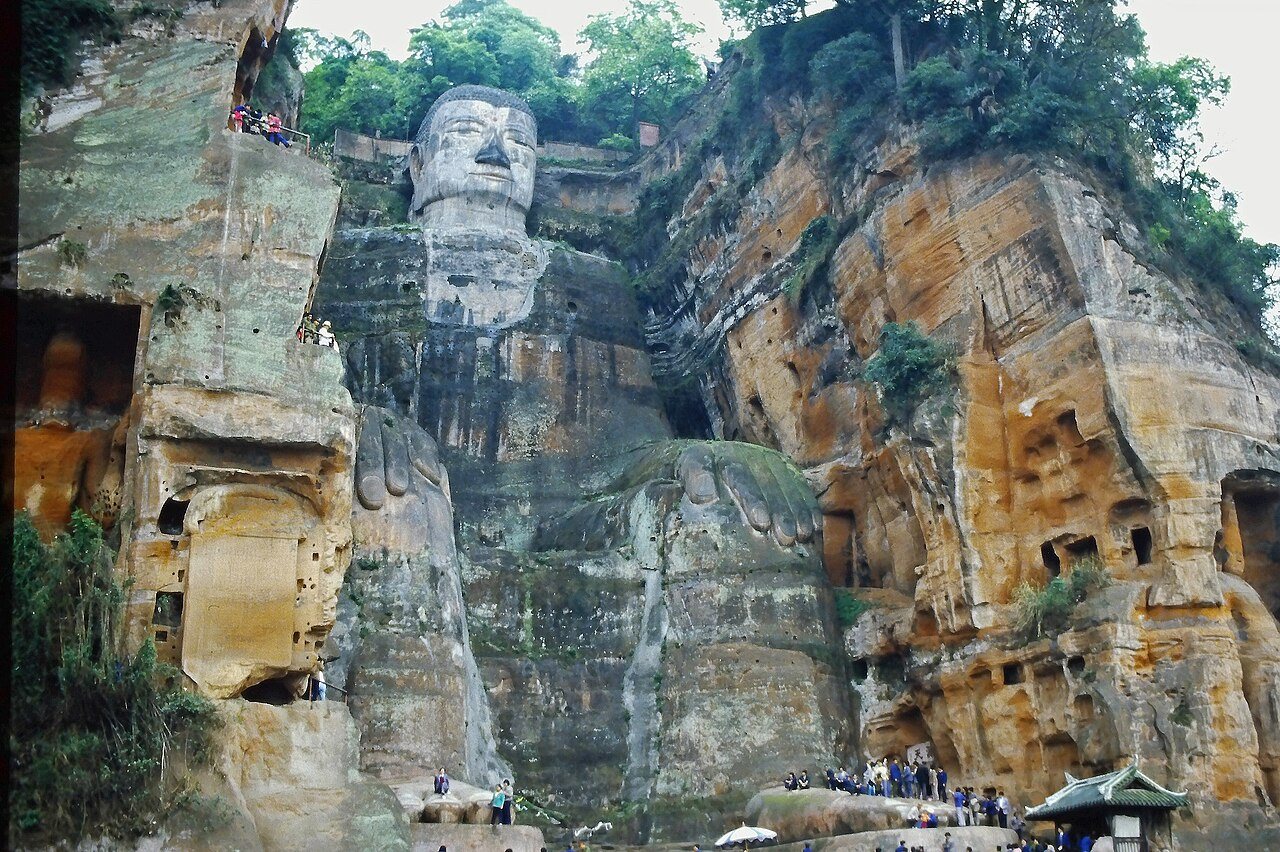
It once had a cover. A thirteen-storey timber pavilion sheltered the statue after it was finished, and records say it was rebuilt in the Northern Song before it was destroyed at the end of the Yuan. The figure has been exposed ever since. Repairs in the 1920s went badly; a mask of red sandstone blocks was fixed over the face, and soldiers under the warlord Yang Sen later used the Buddha for target practice. The mask came off in a repair of 1930 to 1933. Modern conservation, including two World Bank funded phases in 2002, reinforced the head, chest and the rock at the feet, and a further round of emergency work on cracking in the chest and belly ran from late 2018 to April 2019.
Two ways to see it
The walking ticket takes you onto Lingyun Hill. You reach the Buddha's head first, then queue for the Nine-Turn Plank Road, a narrow stair cut down the cliff on the Buddha's right side to the platform at its feet. Chinese guides describe it as roughly 500 metres long with 217 steps. The queue is the main time cost of the whole visit, and on holidays it can run for hours. Two of the better preserved Tang niches are on the stair wall, along with a relief of the Western Paradise at the first turn.
The boat ticket is separate and does not enter the hill. Boats run out to the middle of the river, pause in front of the statue for photos and return, a trip local guides put at 30 to 40 minutes. It is the only way to see the whole figure at once, along with the two guardian kings, each about 16 metres tall, carved into the cliff on either side. In 2026 the scenic area's spring notice listed the Wuyou Temple pier for daytime boats, and it warns that departures change with water level and weather.
If you have time, do both. If you have to choose, the plank road gives scale and the boat gives the picture.
Wuyou Temple and the rest of the hill
The walking ticket also covers Wuyou Temple, on the next hill to the south, and the Mahao cliff tombs, Eastern Han burial chambers cut into the rock. Wuyou is the oldest temple in the area, founded in the Tang as Zhengjue Temple and renamed in the Song. Its Arhat Hall holds five hundred figures remade between 1986 and 1989 after the originals were destroyed in the Cultural Revolution, and the Erya Terrace looks out over the three rivers. It is much quieter than Lingyun Hill.
Tickets, booking and hours
The scenic area's ticket notice, republished on the Leshan city government site, lists the daytime walking ticket at 80 yuan and the daytime boat at 70 yuan, with children under 1.2 metres riding the boat free. A few travel sites quote a lower winter walking price; the official notice does not, so budget for 80. Half-price tickets cover children and students. Entry is by timed, real-name booking through the "Da Fo Lv You" mini-program on WeChat or Alipay or the scenic area's Douyin page, and tickets for a time slot are not valid outside it. Foreign visitors book and enter with a passport.
Hours follow two seasons. From 1 April to 7 October the hill is open 07:30 to 18:30 and boats run 07:30 to 18:00. From 8 October to 31 March the hill opens 08:00 to 17:30 and boats run 08:00 to 17:00. Night tours of Lingyun Hill and the three rivers have been offered on separate tickets, but the feet of the Buddha are not open at night, and a spring 2026 notice said the night hill tour was paused. Check the day's notice before planning around one.
Getting there
Leshan's high-speed station is about an hour from Chengdu. City bus 3 has run from the station to the Dafo Temple stop by the scenic area, and bus 13 also passes the site, but several central routes were adjusted in June 2026, so confirm the stop on a map app before you rely on it. A taxi is the simple fallback. Bus 601 links the Buddha with Baoguo Temple at the foot of Mount Emei, which makes a Buddha morning and an Emei evening workable.
How long and when
Allow three to four hours for the walking route including the plank road, or about an hour for the boat alone. Arrive at opening to reach the head of the queue early. Weekdays are much easier than weekends, and the May and October holidays are the worst days of the year; a 2026 Sina travel report noted that daytime walking tickets for 4 May sold out. The stair is wet and slippery after rain, which in Leshan is often.
Things to confirm before you go
- Your booked time slot and that it matches the ticket type you want, walking or boat.
- Boat departures, which change with river level.
- Whether any night tour is running and what it includes.
- Your bus route from the high-speed station after the 2026 changes.
Frequently asked questions
How much is the Leshan Giant Buddha ticket?
The official notice lists 80 yuan for the walking ticket, which includes Wuyou Temple and the Mahao cliff tombs, and 70 yuan for the daytime boat. They are sold separately.
Should I take the boat or walk the plank road?
The boat shows the whole statue at once and takes under an hour. The plank road brings you down to the feet and takes most of a morning. Do both if you can.
Do I need to book in advance?
Yes. Entry is timed and real-name, and peak days sell out. Book on the official mini-program or a major platform with your passport.
Can I combine it with Mount Emei?
Yes, but give Emei its own day or overnight. The Buddha takes a morning, and bus 601 or a taxi gets you to Baoguo Temple for the evening.
Sources
Facts in this article were checked against the following sources, retrieved 7 October 2026.
- 乐山大佛, Chinese Wikipedia
- Leshan Giant Buddha, English Wikipedia
- Leshan Giant Buddha ticket notice, Leshan city government
- Summer operating hours from 1 April 2026, Chengdu Bendibao
- Wuyou Temple, English Wikipedia
- UNESCO World Heritage Centre, Mount Emei Scenic Area, including Leshan Giant Buddha Scenic Area
Photos are from Wikimedia Commons under the licences shown in each caption.