Guangyue Tower, the Ming Timber Landmark of Old Liaocheng
Guangyue Tower stands at the exact centre of the walled old city of Liaocheng, the square island ringed by Dongchang Lake. It is a four-storey timber tower raised on a brick platform in the early Ming dynasty, and most of its main timbers are reported to be original. That makes it rarer than the famous rebuilt towers of southern China. The Liaocheng guide treats the tower and the lake as the two things that justify a stop, and this page covers the tower half.
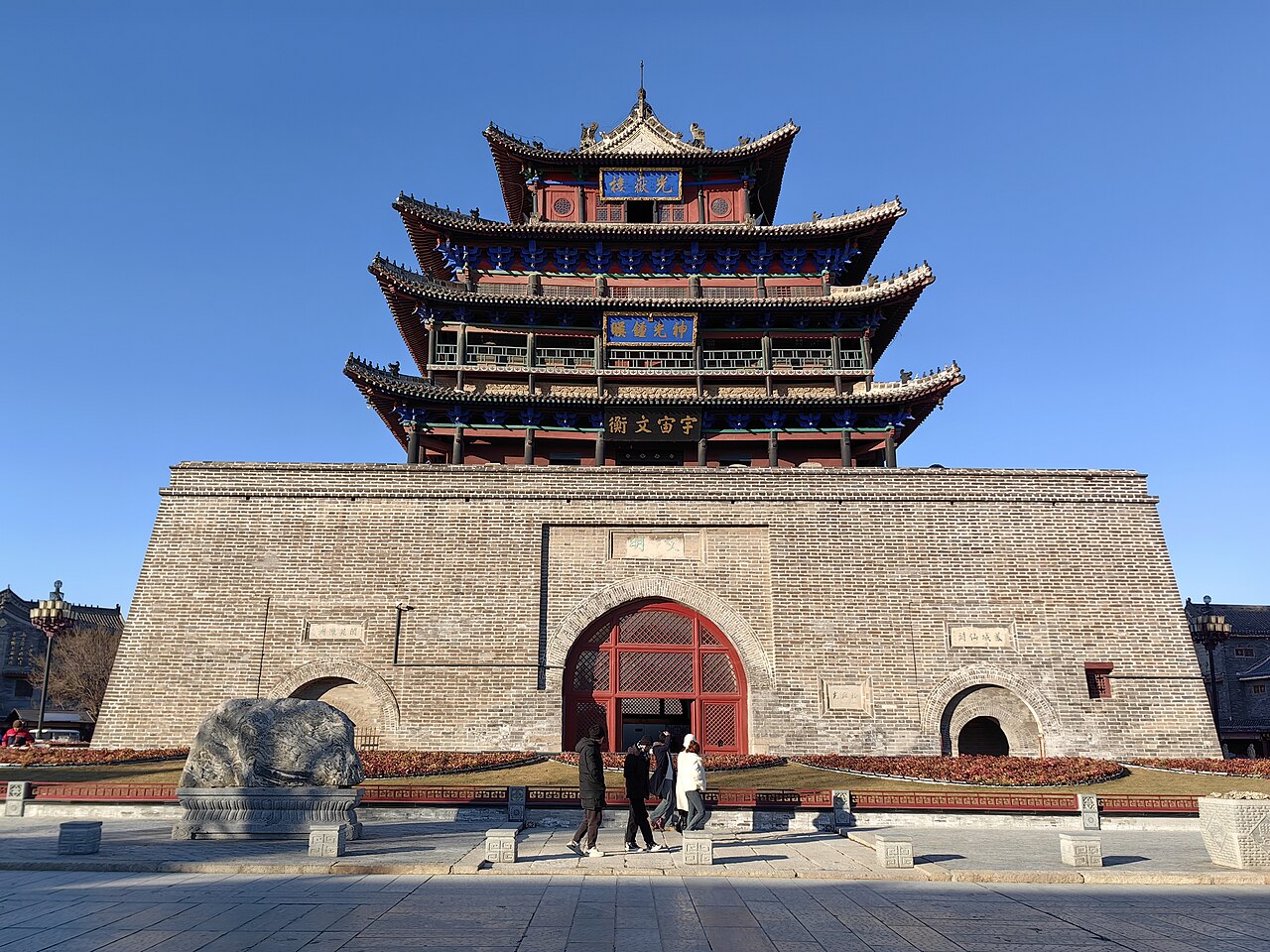
How the tower came to be
In 1372, early in the Hongwu reign, the official Chen Yong began replacing the earthen walls of Dongchang prefecture with brick. Local tradition says the tower was built with timber left over from that job, which is why its first name was Yumu Lou, the Leftover Wood Tower. Early records admit nobody wrote down the founding date. The prefectural gazetteer of 1777 is the first source to give 1374, and it says the tower was meant for watching the approaches and spotting enemies.
The present name dates from 1496. The prefect Jin Tianxi and the official Li Zan chose Guangyue, a phrase that links the tower's light to Mount Tai, the great peak of the old state of Lu. Repairs followed in the Chenghua, Jiajing and Wanli reigns and again under the Qing. The Kangxi Emperor climbed it and left a plaque, and the Qianlong Emperor is recorded as visiting several times on his southern tours and writing poems here. In the 1930s the county magistrates Sun Tongfeng and Fan Zhuxian both repaired the building, and Fan used it as a command post during street fighting against Japanese forces in 1938. The tower became a national key protected site in 1988.
What you actually see
The numbers explain the silhouette. The whole structure is about 33 metres tall. The brick platform alone is a little over 9 metres high and around 34 metres along each side at the base, with an arched passage on all four faces. The four gates carry the names Taiping, Wenming, Xingli and Wuding. Only the east gate leads to the stairs, and the west gate is a blind arch.
On top sits the timber tower itself, about 24 metres high, with four levels, cross-ridged roofs and layered eaves. Chinese sources count 122 steps, 192 columns and more than 200 bracket sets. The style looks back to Song and Yuan towers while showing Ming detail, and architectural historians often cite it as one of the oldest surviving timber towers of its kind in China.
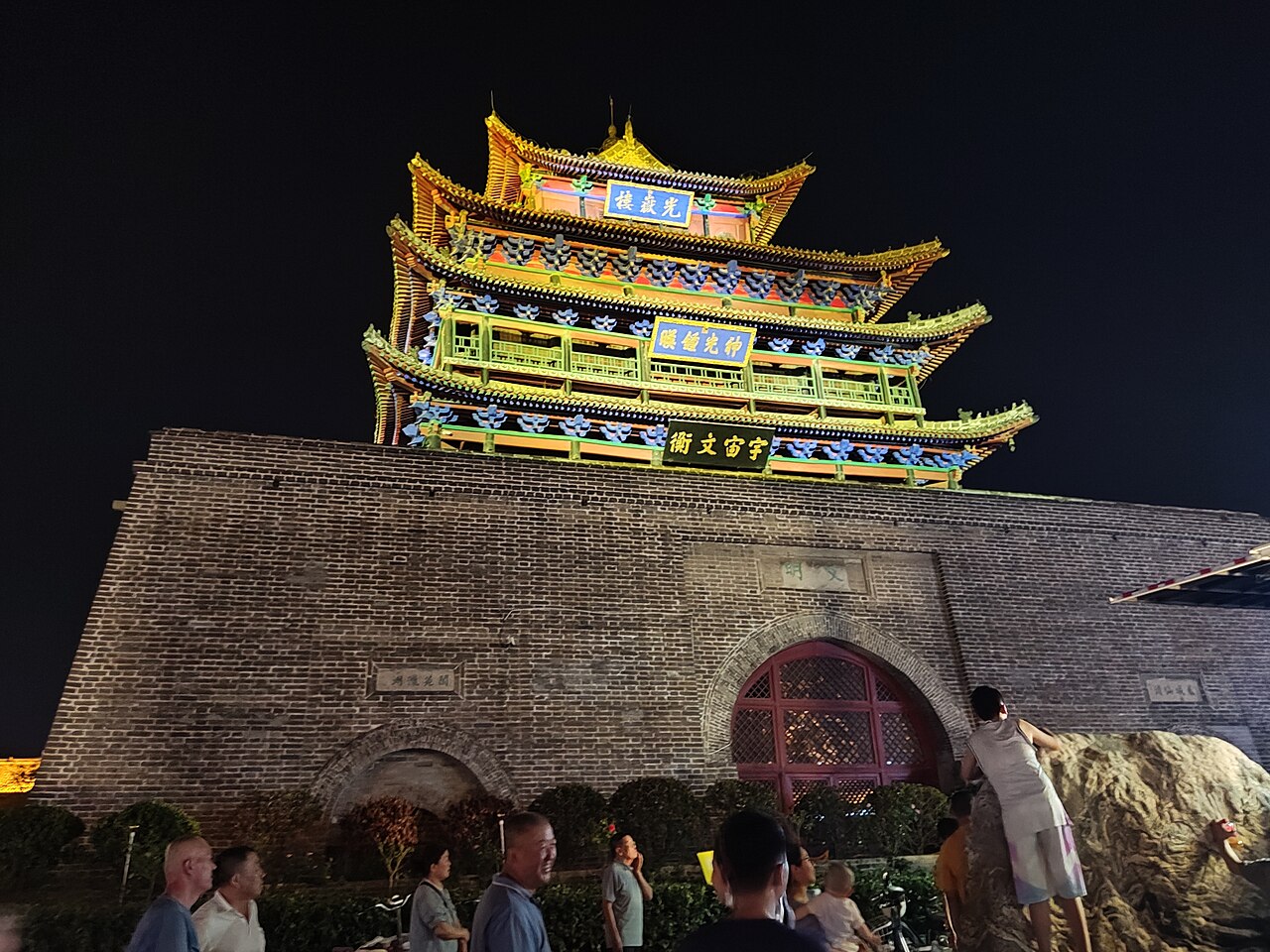
Inside, the first floor holds a shrine to Lu Ban, patron of carpenters, which suits a building famous for its woodwork. The second floor has a painted statue of the Qianlong Emperor about two metres tall. The third is mostly structure. The top floor is small and may be a Qing addition. Steles, wall inscriptions and plaques are spread through the building, including calligraphy by Guo Moruo and Shu Tong. The stairs are steep and narrow, so people with bad knees may prefer to stay on the platform level and enjoy the views of the cross streets.
Visit order around the old city
The old city is a square of roughly one kilometre per side, cut into quarters by two pedestrian shopping streets that cross under the tower. That layout makes the tower an easy anchor. Arrive close to opening, climb while the stairs are quiet, then walk east along Dongguan Street toward the canal and the Shanshaan Guild Hall, a Qing merchants' temple with an opera stage. A slow loop through the side lanes fills the late morning.
Save the afternoon or evening for the water. The lake walk along the old city edge is free, and the tower is lit after dark, so the outside view from the cross streets or the lake shore works as a second look. Visitors with only one day usually do tower and guild hall in the morning and a lake segment before dinner.
Tickets and hours
Liaocheng media reported opening hours of 8:30 to 17:30, with ticket sales stopping at 17:00, for both early 2025 and the autumn 2024 winter timetable. Local listings have long given an adult ticket of around 30 yuan with half price for full-time students, and a paid guide option. Treat those as reported figures and check the day's notice on site.
Work on the building happens. In June 2025 the floors above the second level closed for a week while the stair protection layer was renewed, and tickets were discounted during that period. If climbing to the top matters to you, check recent notices before you go.
Getting there and how long to stay
The tower sits on Loubei Street in the middle of the old city in Dongchangfu District. From Liaocheng railway station a taxi or ride-hailing car is the simplest way in, and city buses run toward the lake ring. Inside the old city everything is walkable. Plan one to one and a half hours for the tower itself, or half a day if you add the guild hall and lanes.
Spring and autumn are the comfortable months. Summer afternoons on the platform are hot and shadeless, and winter wind cuts across the lake.
Before you go
- Carry ID in case concessions or ticket checks need it.
- Wear shoes with grip for the steep timber stairs.
- Pair the tower with the Shanshaan Guild Hall on the same walk.
- Keep the Dongchang Lake loop for softer light later in the day.
- Read the Liaocheng travel guide for a full three-day plan.
Frequently asked questions
Is Guangyue Tower original or rebuilt?
It has been repaired many times, at least seventeen by one count, yet Chinese sources describe most of the main structural members as dating from the Ming construction. Expect an old building that has been kept up.
Can you climb to the top?
Usually yes, by the stairs through the east gate. Upper floors can close for maintenance, as they did for a week in June 2025.
How long should I spend at the tower?
About an hour covers the climb and the platform. Add another hour for the lanes around it.
What else is close by?
The guild hall is a short walk east, and the lake surrounds the whole old city.
Sources
Facts in this article were checked against the following sources, retrieved 17 October 2026.
- Guangyue Tower, Chinese Wikipedia
- Dazhong news, New Year opening notice, January 2025
- Liaocheng News, stair maintenance notice, June 2025
- Liaocheng News, winter timetable for city venues, October 2024
- Liaocheng Bendibao, Guangyue Tower visitor notes
- Liaocheng travel guide on this site
Photos are from Wikimedia Commons under the licences shown in each caption.