Jianglang Mountain
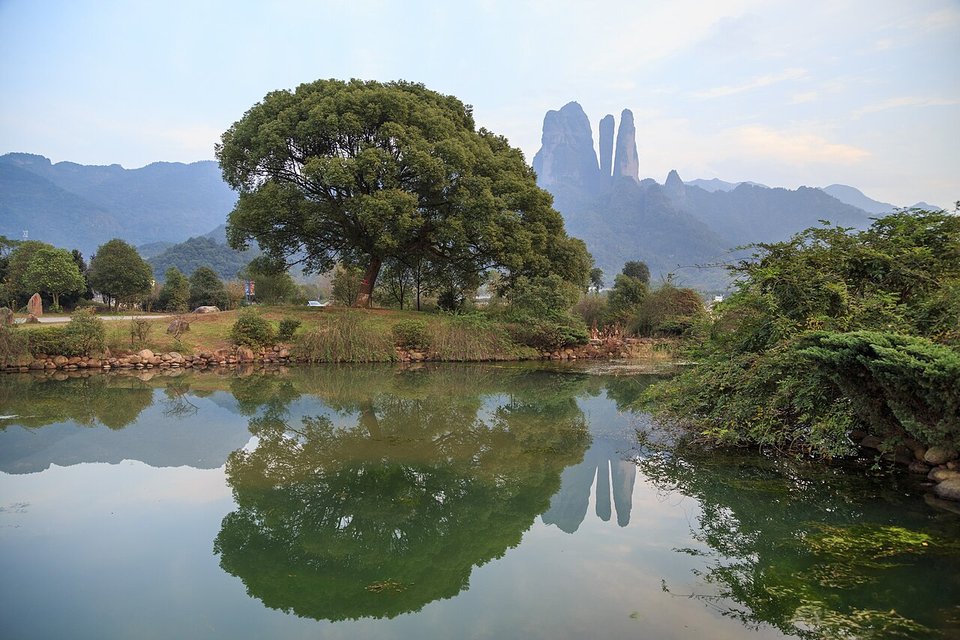
Three giant blocks of red sandstone stand side by side in the hills south of Jiangshan, in the far southwest of Quzhou prefecture. Seen from the road they line up like the three strokes of the Chinese character for river, and locals simply call them the three slabs of stone. Jianglang Mountain was one of the six sites inscribed together as China Danxia on the World Heritage List in 2010, and it is the main reason most travellers make the trip down to Jiangshan.
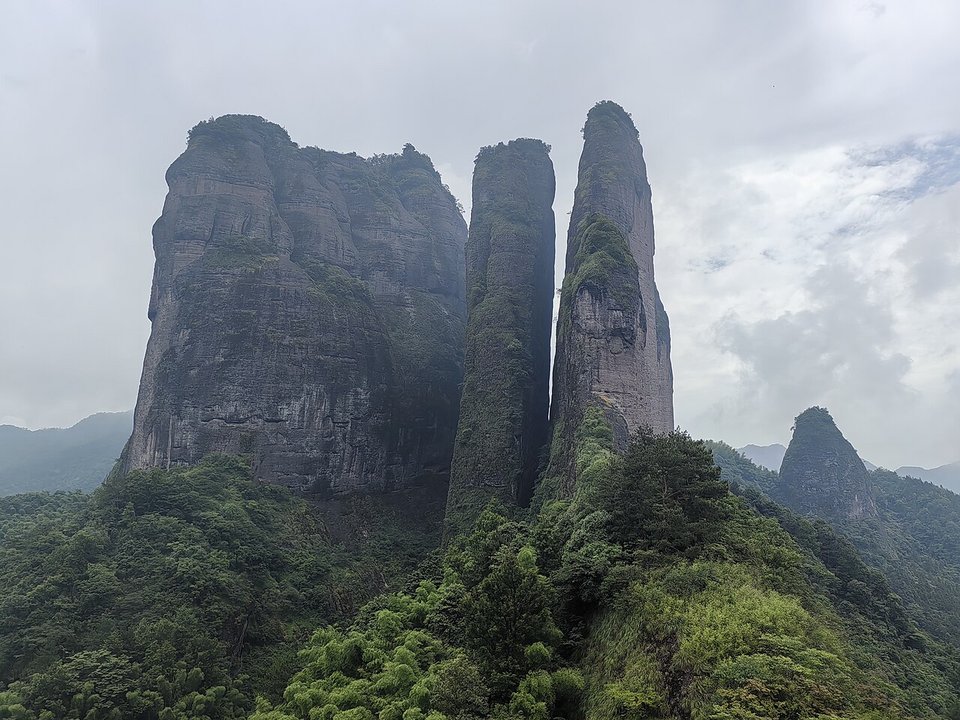
The three peaks
From north to south the peaks are Lang Peak, Ya Peak and Ling Peak. Chinese and English Wikipedia give the height of Lang Peak, the highest, as 816.8 metres above sea level; some travel sites use 819.1 metres. What matters on the ground is that each pillar rises a couple of hundred metres straight out of the forest on almost vertical walls. Chinese Wikipedia describes the landform as a late stage, high standing isolated peak type of Danxia, the red bed sandstone that has been worn down until only these towers remain.
There is an old local saying that the mountain is the most striking under heaven and the most beautiful in the southeast. The Ming travel writer Xu Xiake came here, and his visits are a point of local pride. A more recent visitor was the American wingsuit pilot Jeb Corliss, who in September 2013 jumped from a helicopter and flew through the gap between two of the peaks.
Yixiantian, the slot between the walls
The best known walk at Jianglang is through Yixiantian, the line of sky, a narrow cleft between Ya Peak and Ling Peak. Steps climb along the bottom of the slot with rock rising on both sides, and when you look up you see only a thin strip of light. Scenic area material says the gap is only a few metres wide and around a hundred metres long. Walkers on Ctrip recommend going through it on the way up, since it is cool and shaded even in summer.
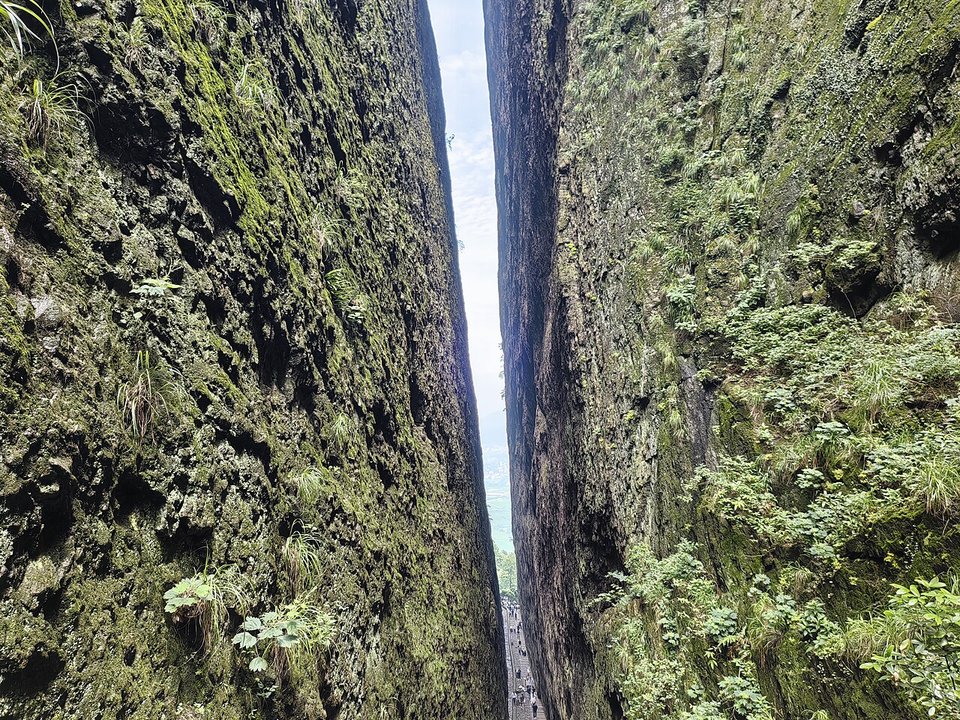
Routes and how long they take
There is no cable car. The park shuttle bus carries visitors from the visitor centre up to the foot of the climb near Kaiming Chan Temple, and from there you walk. Ctrip's description of a typical route runs from the temple past Huixian Rock and the Baizhang Gorge to Xiake Pavilion, then through Yixiantian to Dengtian Ping, a platform below Lang Peak. Xiake Pavilion is the classic viewpoint for a photo of all three peaks in a row, and it is a dead end, so you walk back the way you came.
From Dengtian Ping you can either head down or carry on up Lang Peak. The summit path is cut into the cliff and is one person wide in places, with steep steps and railings. In busy periods visitors report long queues on it, and you cannot easily turn back once you are on it. Ctrip's listing gives Lang Peak opening hours of 9:00 to 15:30, so plan to be at the start well before mid afternoon. Some travel sites say Lang Peak does not open on every weekday, so phone ahead if the summit is your goal. Without the summit, two to three hours is enough. With it, allow four to six.
Skip the summit in rain. The steps get slippery, and low cloud can hide the view and the pillars themselves.
Tickets and hours
Jiangshan Tourism Development, which runs the scenic area, lists the Jianglang ticket at 90 yuan in the high season from 1 March to 30 November and 60 yuan from 1 December to the end of February, with the shuttle bus at 15 yuan. Concessions are half price for people aged over 6 and up to 18, children between 1.2 and 1.5 metres, people aged 60 to 69 and full time students. Children 6 and under or below 1.2 metres, people aged 70 and over and several other groups go free with ID. Ctrip gives opening hours of 8:00 to 17:00, with last entry at 16:00.
Quzhou city runs a free travel scheme for its core scenic areas. A city document lists Jianglang among 14 sites whose entry fee is waived from January to March, except the Spring Festival holiday, and in November and December, with online booking through the Quzhou culture and tourism WeChat account. That document notes that Lang Peak itself is excluded, and the shuttle still costs extra. If you are visiting in the colder months, check whether the scheme is running and book before you go.
Getting there
Jiangshan Station is on the high speed line from Hangzhou, one stop beyond Quzhou. The scenic area is about 25 kilometres south of Jiangshan city. Local bus numbers differ between guides; the Quzhou guide on this site gives bus 202 from the station, and a 2026 travel site gives 302, so ask at the station. A taxi takes around half an hour. In April 2026 the scenic area announced trial tourist express buses and a loop bus between its sites, so ask about those too.
Nianbadu, an old mountain town near the Fujian border, is also run by the same operator and is about an hour further by road. With a car, the two make a full day. Back in Quzhou city, the Southern Confucius Family Temple and the Longyou Grottoes fill another day.
Frequently asked questions
Can I see the peaks without climbing?
Yes. The view from the road and from Xiake Pavilion shows all three, and the shuttle saves most of the uphill walk.
Is the summit climb dangerous?
It is steep and narrow with railings. People with a fear of heights or bad knees should skip it, and nobody should try it in rain.
When is the best season?
Spring and autumn, ideally on a clear weekday. Mornings after rain can bring cloud around the peaks.
Sources
Facts in this article were checked against the following sources, retrieved 23 October 2026.
- 江郎山, Chinese Wikipedia
- Mount Jianglang, English Wikipedia
- Jiangshan Tourism Development, ticket information
- Ctrip, Jianglang Mountain listing
- Jianglang and Nianbadu scenic area official site
- Quzhou culture and tourism bureau, free travel scheme rules (PDF)
- Quzhou travel guide on this site
Photos are from Wikimedia Commons under the licences shown in each caption.