Dai Temple: Where the Climb to Mount Tai Began
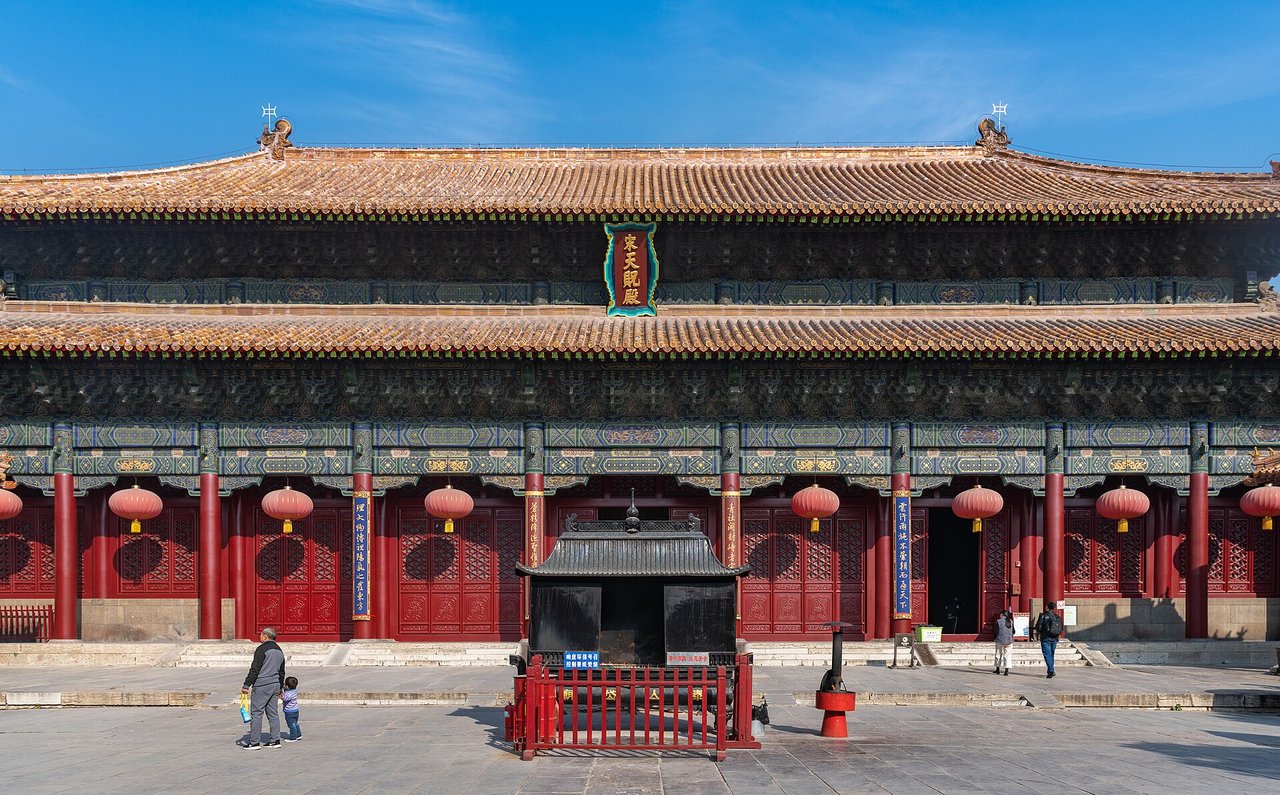
The Dai Temple, or Dai Miao, stands in the centre of Tai'an at the southern foot of Mount Tai. It is the temple of the god of the mountain, the Dongyue Emperor, and it is also called the Dongyue Temple. Emperors who came to perform the Fengshan rites stopped here first to make offerings before climbing. The complex covers close to ten hectares inside high walls and is laid out like a palace. Its main hall, the Tiankuang Hall, is often grouped with the Hall of Supreme Harmony in the Forbidden City and the Dacheng Hall of the Confucius Temple in Qufu as one of the three great halls of old China. It has been a national protected site since 1988.
A temple for an emperor's mountain
Chinese Wikipedia dates the temple to the Han and says it was enlarged several times in the Tang and Song. The decisive moment came in 1008, when the Song emperor Zhenzong brought his court to Mount Tai for the Fengshan ceremony. The following year he ordered the temple expanded and built the Tiankuang Hall, the Hall of Heavenly Gifts, on the site of the old shrine to the mountain god. Parts burned under the Jin, more was added under the Yuan, and much of the temple was destroyed by fire in the Jiajing reign of the Ming and repaired in the Qing. A town grew up around the temple to serve pilgrims, and that town is the ancestor of modern Tai'an.
The twentieth century was hard on it. Chinese Wikipedia records that on 25 August 1966 students pulled down the statue of the mountain god, tore up rubbings of the Tang cliff inscription, scrawled slogans on the mural and gouged its crowded western wall with shovels. One hall was demolished and the main gate replaced with concrete. Restoration came in stages, and the old appearance of the front gates was rebuilt in 1998. The Tai'an Museum has used the temple since 1986 and holds more than 10,000 objects.
Through the gates
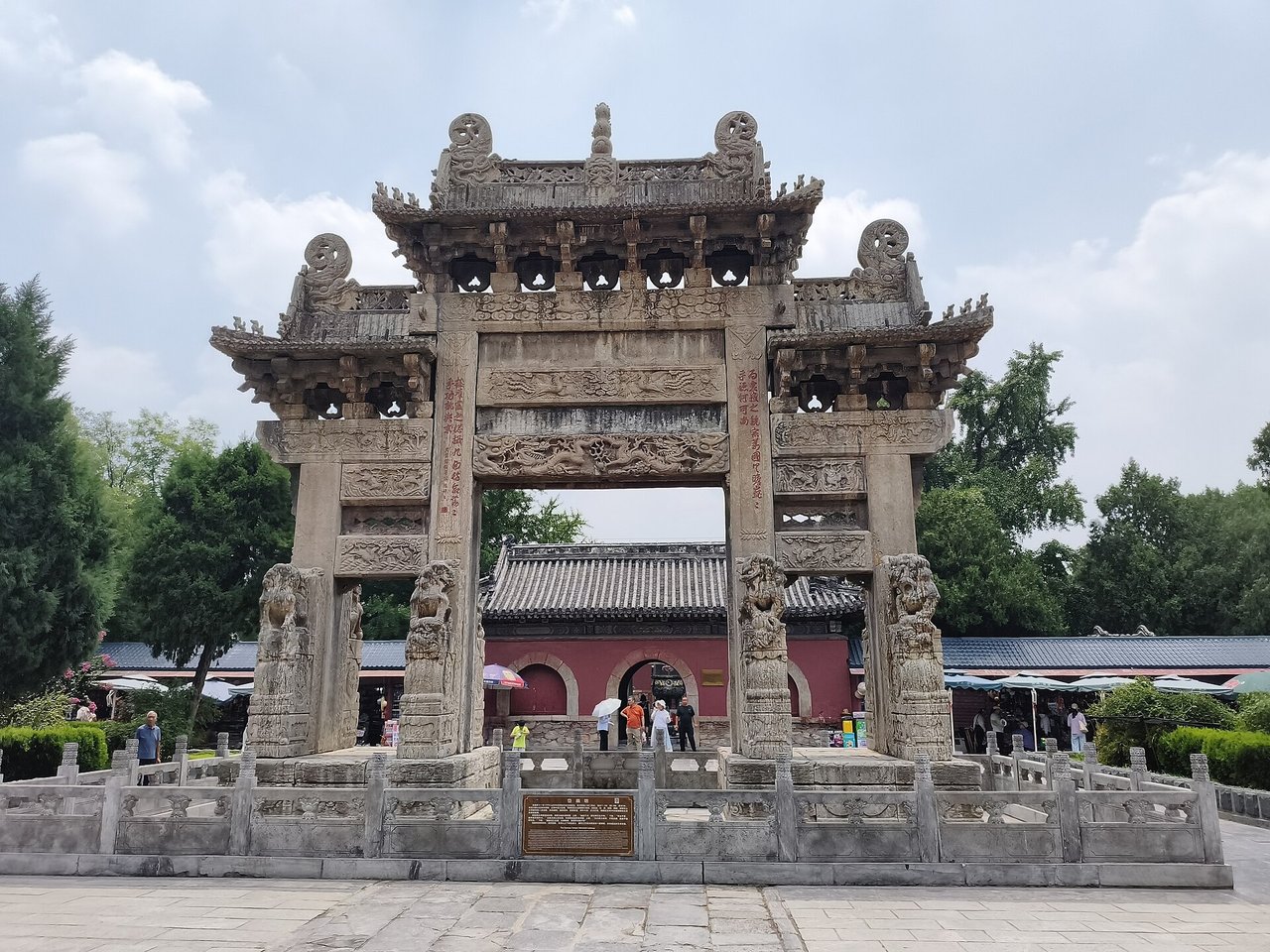
The approach starts south of the walls at the Yaocan Pavilion, where pilgrims paid their first respects, and passes a carved stone archway before the main gate, the Zhengyang Gate. From there the axis runs north through a series of gates and courtyards to the Tiankuang Hall. Chinese Wikipedia counts 211 steles and inscriptions from the Qin and Han onward. Many stand on the backs of stone tortoises, among them Song steles from the Huizong reign and a much later one from the Qianlong era. The most precious fragment is the Qin inscription of Mount Tai, set up by the First Emperor in 219 BC with text in the small seal script attributed to his minister Li Si. Only two broken pieces with ten characters remain, and they are kept here.
Near the east side is the Dongyuzuo, the lodging used by emperors and officials on their visits, and in the northeast corner stands a bronze pavilion. Two memorial steles, one inside the walls and one by the Yaocan Pavilion dated 3 May 1929, remember the Jinan Incident of 1928, when Japanese troops killed more than six thousand Chinese soldiers and civilians in the provincial capital, by Chinese Wikipedia's count.
The Tiankuang Hall and its mural
The hall is nine bays wide and five deep, 22.3 metres high, roofed in yellow glazed tiles with double eaves. Inside, a painted mural runs around the east, west and north walls. Its usual title is "The God of Mount Tai Setting Out and Returning", and it shows the god's grand procession. Chinese Wikipedia gives its length as 62 metres and its height as 3.3 metres. English Wikipedia dates it to 1009, the year the hall was built, and the western wall still carries scars from 1966. The Tai'an Museum calls it one of the finest surviving Daoist murals in China.
The old trees
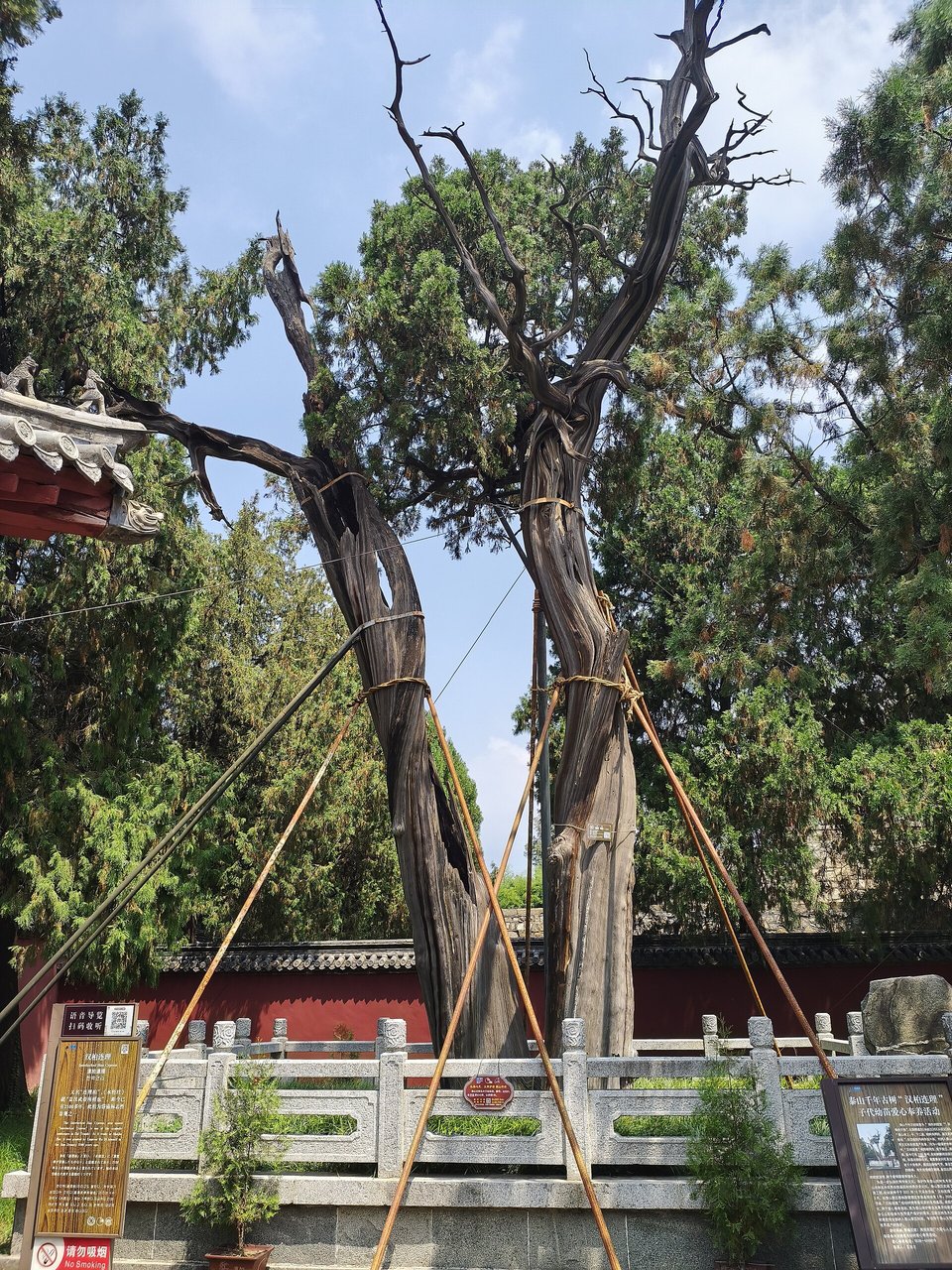
Chinese Wikipedia counts more than 200 old trees in the courtyards. The best known are the Han cypresses, which tradition says were planted by Emperor Wu of Han, and a Tang scholar tree, both in courtyards of their own. Some lean on metal props now, and their shade covers much of the inner courtyards.
Tickets and hours
Since 1 June 2024, Tai'an Bendibao reports, the Dai Temple has charged its own ticket and is no longer included in the Mount Tai ticket. The scenic area's own fee list gives 20 yuan for adults and 10 yuan for students. Some 2026 travel articles still say the mountain ticket covers the temple, so check at the gate. Published hours are 08:00 to 18:00 from May to August, 08:00 to 17:30 in spring and early autumn, and 08:00 to 17:00 from November to February, with entry stopping about half an hour before closing. Check the day's notice.
Getting there
The temple is in the middle of Tai'an, a short taxi ride from Tai'an railway station. The Red Gate, the start of the classic climb, is straight north of the temple along the old pilgrim road. Many visitors walk from the temple to the mountain, which follows the route the emperors took.
How long and when
Allow one and a half to three hours. Go the evening before your climb or the morning after, so that the mountain day stays clear. The old trees keep the courtyards shaded in summer.
Things to confirm before you go
- Whether your Mount Tai ticket covers the temple, or you need the separate one.
- Closing time for the season.
- Which halls are open, and whether the mural is lit.
- Holiday events, which can fill the courtyards.
Frequently asked questions
Is the Dai Temple included in the Mount Tai ticket?
Local reports say it has been ticketed separately since June 2024, at 20 yuan for adults. Some 2026 articles disagree, so ask at the gate.
What is the Tiankuang Hall?
The main hall, built in 1009 under Song Zhenzong for the god of Mount Tai and ranked with the Forbidden City and Qufu as one of China's three great halls.
How long should I spend?
One and a half to three hours. It is small enough for a morning or evening.
Should I see it before or after the climb?
Either works. Before follows the old pilgrim order. After makes sense if the climb is your only fixed day.
Sources
Facts in this article were checked against the following sources, retrieved 8 October 2026.
- 岱庙, Chinese Wikipedia
- Dai Temple, English Wikipedia
- Mount Tai, English Wikipedia
- 泰山石刻, Chinese Wikipedia
- 泰山门票 and 岱庙 fees, Mount Tai Scenic Area Administration
- 泰山门票能去岱庙吗, Tai'an Bendibao
Photos are from Wikimedia Commons under the licences shown in each caption.