Mount Tai: The Stairway of Emperors Above Tai'an
Mount Tai rises straight out of the central Shandong plain on the northern edge of Tai'an. It is the eastern and foremost of China's Five Sacred Mountains, and for more than two thousand years emperors came here to report to Heaven. The summit, Jade Emperor Peak, is usually given as 1,545 metres, while a more recent survey quoted by both Chinese and English Wikipedia gives 1,532.7. The climb starts at about 150 metres in the town, so you gain almost 1,400 metres on stone stairs. Mount Tai was inscribed by UNESCO in 1987 as a mixed cultural and natural site. Most people walk up from the Dai Temple in town or take a bus and cable car, and many climb through the night to see the sunrise.
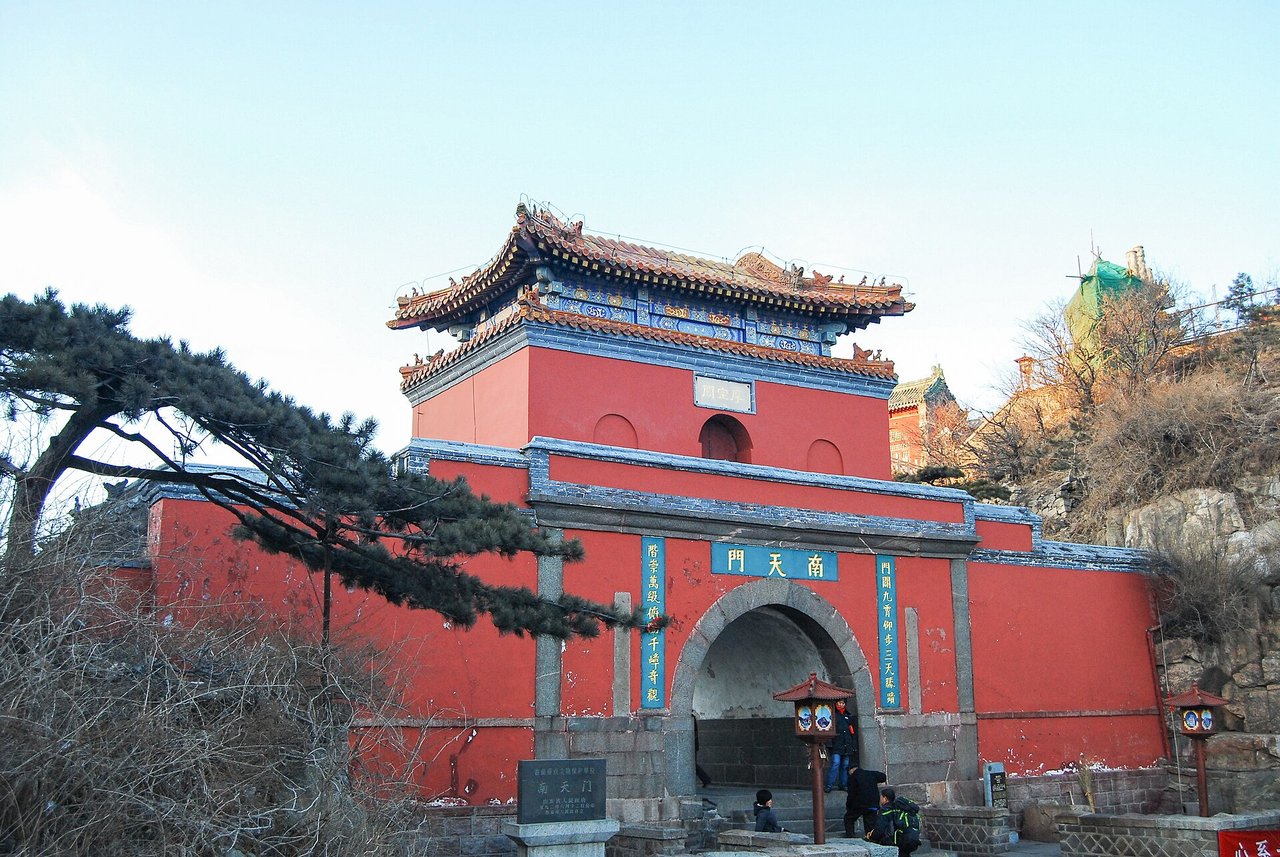
Why emperors climbed it
In the old view of the world the east was where the sun rose and life began, and Mount Tai was the highest point in the east. The Fengshan sacrifices joined these ideas to kingship. In the feng rite the emperor raised an altar on the summit to report to Heaven, and in the shan rite he made an offering to Earth on a small hill below. A ruler who performed them was claiming that his reign had brought peace to the world. The First Emperor of Qin held a ceremony on the summit in 219 BC. Emperor Gaozong of Tang came in 666, and English Wikipedia notes that envoys from Japan, India, the Korean kingdoms, the Turks and the Umayyad caliphate attended. Chinese Wikipedia counts twelve emperors who performed the rites from the Qin onward. Song Zhenzong's ceremony of 1008 was the last full one.
Ordinary pilgrims mattered as much. The goddess Bixia Yuanjun, the Lady of Mount Tai, has her temple just below the summit, and her attendant goddesses include one who grants children and one who cures eyesight. Writers came too. Mencius records Confucius climbing the mountain and finding the world small from the top, and Du Fu's short poem "Gazing at the Mountain" ends with the wish to stand on the summit and see all other peaks shrink below.
Stone and inscriptions
Chinese Wikipedia counts more than 1,800 inscriptions on and around the mountain, about 800 steles and more than 1,000 carved into the rock. Two are worth a detour. In Sutra Rock Valley, just off the main route northeast of Doumu Palace, the Diamond Sutra was carved into a sloping slab of rock in the Northern Qi, covering 2,064 square metres. Of its 2,799 characters, each about half a metre across, 1,069 survive. Near the top, on the cliff of Daguan Peak, Emperor Xuanzong of Tang had his own account of his Fengshan ceremony carved in 726. The panel is 12.3 metres high and 5.3 metres wide, and about a thousand of its characters survive. Close by on Sun-Viewing Peak is the inscription "Most Revered of the Five Sacred Mountains", carved in 1907, which appears on the back of the five-yuan note.
The Red Gate route and the Eighteen Bends
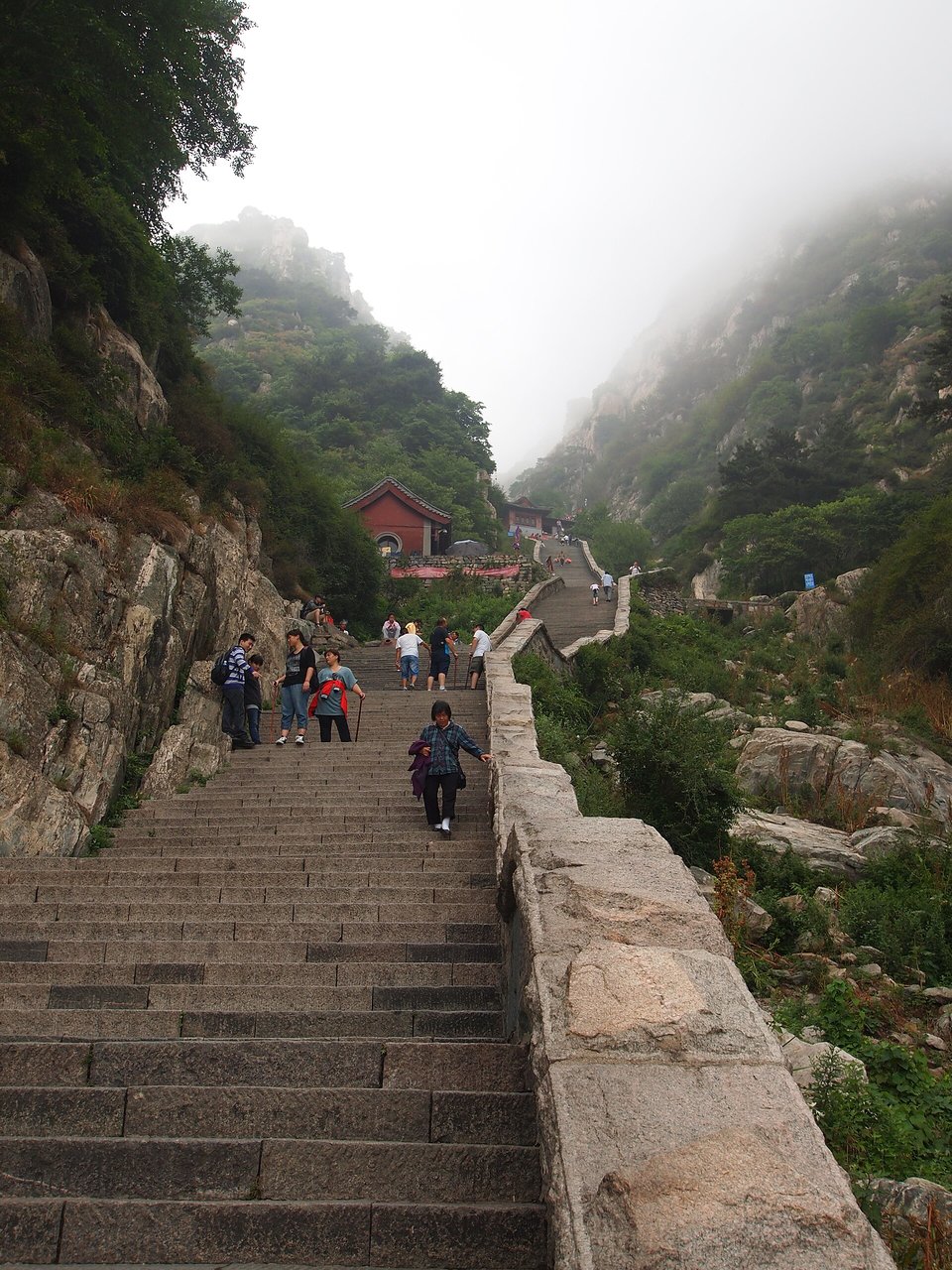
The classic way up is the eastern route from the Red Gate, the Hongmen, just north of the old town. It follows the old imperial road past the First Gate of Heaven, Doumu Palace and the Sutra Rock Valley to the Midway Gate of Heaven at about 847 metres, where the bus road from Tianwaicun arrives. A spring 2026 Tai'an guide gives the full route from the Dai Temple as 9.5 kilometres with 7,863 steps. Other counts are lower. English Wikipedia gives about 6,660 steps from the Red Gate to the South Gate. Everyone agrees on the hard part. Above the Midway Gate the path climbs the Eighteen Bends, 1,827 steps by English Wikipedia's count, up a narrow ravine to the South Gate of Heaven at about 1,460 metres. English Wikipedia puts the whole climb at two and a half hours for a fast walker and six at a leisurely pace.
Above the South Gate, Heavenly Street runs along the ridge with shops and inns to the Bixia Temple, the Tang cliff inscription and the Jade Emperor Temple on the summit, with the Wordless Stele in front of it. The Sun-Viewing Peak to the east is where sunrise crowds gather. China's first permanent mountain weather station was set up there in 1935.
Buses and cable cars
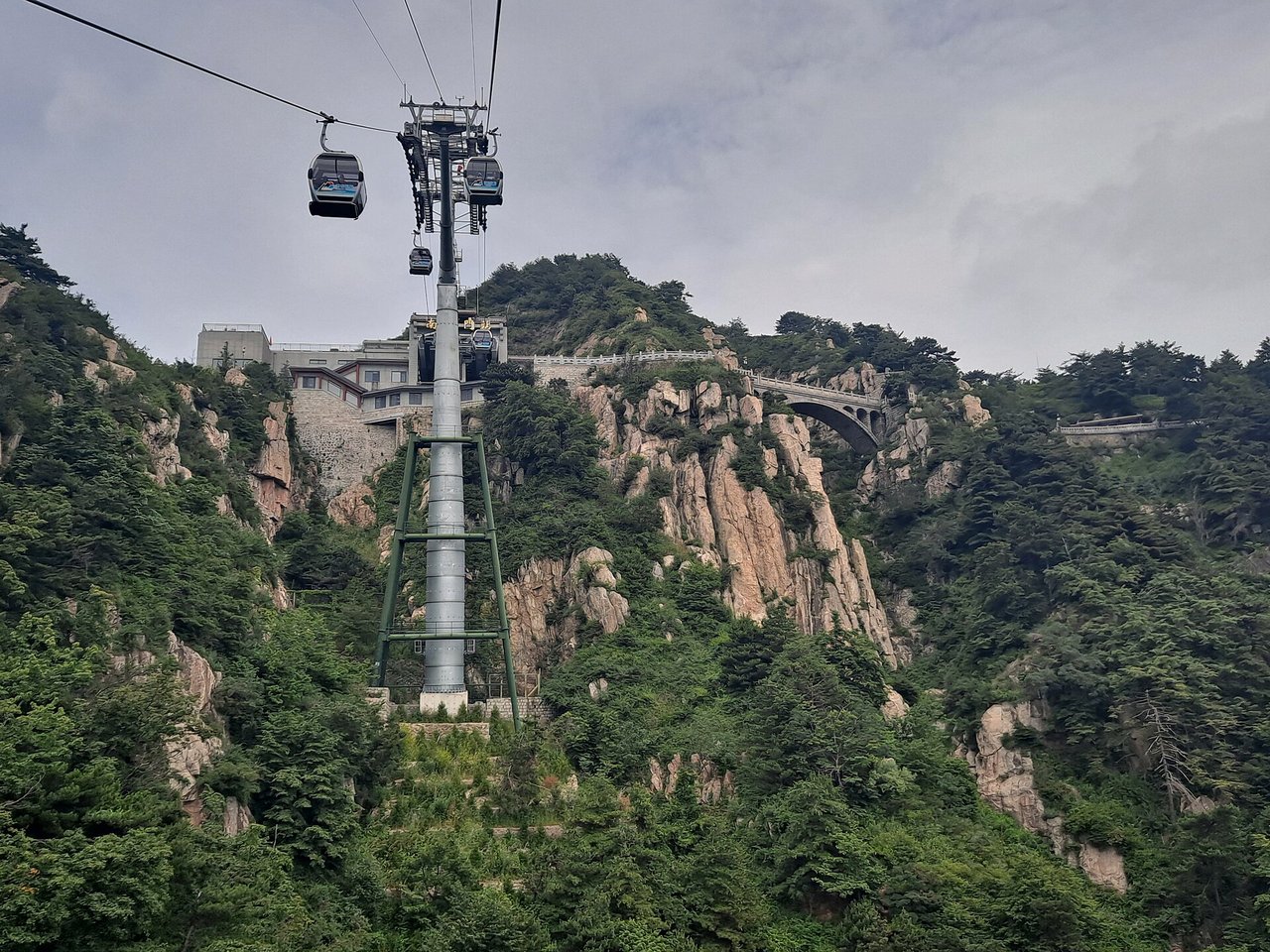
If you do not want to climb all the way, take the scenic-area bus from Tianwaicun, on the west side of town, to the Midway Gate, then the cable car to the summit area or walk the Eighteen Bends. A third route on the west side starts at Taohuayu, with a bus to Taohuayuan and a second cable car to the top. A short cable car on the north side links the summit with the Rear Rock Basin. Cable cars stop in high wind, thunderstorms and snow, and close for maintenance.
Tickets and hours
The 2026 entry ticket is 115 yuan from 1 April to 30 November and 100 yuan from December to March, by Tai'an press reports. Children aged 6 to 18 and full-time students pay half, and the scenic area grants free entry to people aged 60 and over. Tickets are valid for three days from first entry, but each re-entry needs a fresh booking. Booking is by real name, up to seven days ahead, through the official "泰山景区" WeChat account or the big travel platforms, and foreign visitors use their passports. A spring 2026 guide listed the Midway Gate and Taohuayuan cable cars at 100 yuan one way and the scenic buses at about 40 yuan each way. The Red Gate and Tianwaicun entrances are open 24 hours. Taohuayu has kept shorter daytime hours. Check the day's notice for cable car hours and closures.
Getting there
Tai'an has a high-speed station on the Beijing to Shanghai line, Tai'an station, with fast trains to Jinan and to Qufu for the Confucius Temple. From the station, taxis and city buses reach the Red Gate, the Dai Temple and Tianwaicun. Stay near the Dai Temple if you plan to walk.
How long and when
A full day for the climb, or a night climb timed to reach the top before dawn, plus time to recover. Spring and autumn are best. Summer brings heat on the lower stairs and storms at the top, and Chinese Wikipedia gives the summit an average of 27 days of snow a year from late October to late April. The summit is much colder than the town at any season, and wind makes dawn bitter, so carry a warm layer for sunrise. Holidays bring enormous crowds, and the scenic area runs special traffic plans during the October Golden Week.
Things to confirm before you go
- Your booking, the entrance on it, and the re-entry rules.
- Cable car and bus hours, and the weather forecast for the summit.
- Sunrise time if you plan a night climb.
- Water, snacks and shoes with grip. Summit prices are high.
Frequently asked questions
How long does it take to climb Mount Tai?
Two and a half to six hours from the Red Gate, depending on pace. From the Midway Gate to the summit it is about two hours on foot.
How much is the Mount Tai ticket in 2026?
115 yuan from April to November and 100 yuan from December to March, with buses and cable cars extra.
Can I climb at night?
Yes. The Red Gate and Tianwaicun entrances stay open around the clock, and many people climb overnight for sunrise at Sun-Viewing Peak.
Should I visit the Dai Temple too?
Yes. It is where the imperial climb began, and it makes a good half day before or after the mountain.
Sources
Facts in this article were checked against the following sources, retrieved 8 October 2026.
- 泰山, Chinese Wikipedia
- Mount Tai, English Wikipedia
- 泰山石刻, Chinese Wikipedia
- 泰山门票, Mount Tai Scenic Area Administration
- 泰山"双节"登山线路, Qilu Net, September 2026
- 五一泰山预约, ticket, bus and cable car prices, Tencent News, April 2026
- 2026泰山门票, Sina, 2026
Photos are from Wikimedia Commons under the licences shown in each caption.