Guoqing Temple
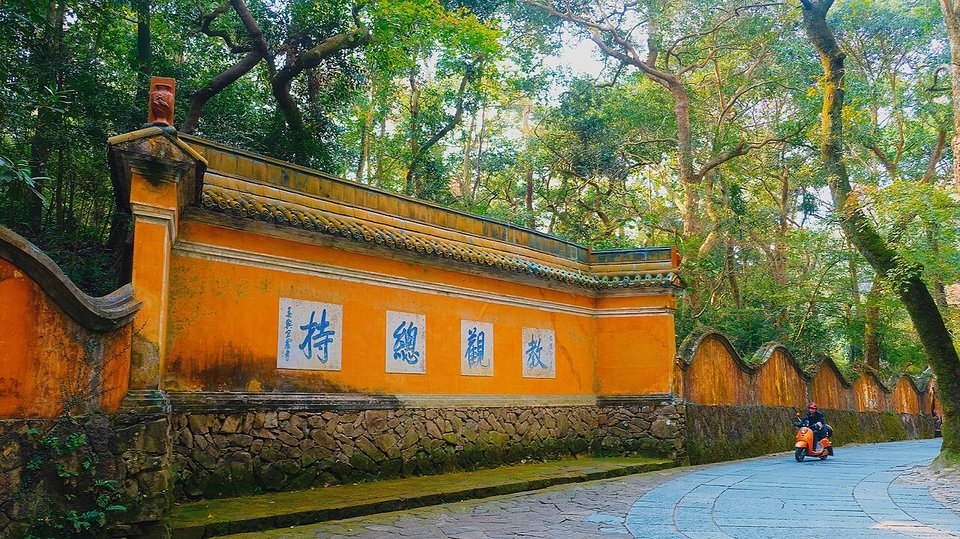
Guoqing Temple sits in a wooded valley at the foot of Mount Tiantai, in Tiantai County in the north of Taizhou prefecture. It is the founding temple of the Tiantai school of Buddhism, one of the first schools to take shape in China, and through Japanese monks who studied here it is also the ancestral temple of Japan's Tendai school. For a temple of that weight it is a calm place. The approach runs past rice fields, streams and an old brick pagoda, and the temple itself is a maze of courtyards, halls and stone paths under big trees.
Zhiyi and the founding
The monk Zhiyi (538 to 597) spent much of his life on Mount Tiantai and built the teaching that took the mountain's name. He died in 597. In 598, following his last wish, the Sui court built a temple at the foot of the mountain, the start of Guoqing Temple. The present buildings mostly date from a rebuilding in the reign of the Yongzheng Emperor in the early eighteenth century.
The temple's international role began in the Tang. In 804 the Japanese monk Saicho arrived with a diplomatic mission and studied the Tiantai teachings here. When he went home the next year he founded the Tendai school on Mount Hiei, which became one of the great schools of Japanese Buddhism. Korean monks also carried the teaching home. Japanese and Korean pilgrims still come to Guoqing for that reason.
The poet monks Hanshan and Shide belong to the same mountain in Chinese tradition, and the temple keeps their memory alongside that of its founder.
The Sui Pagoda
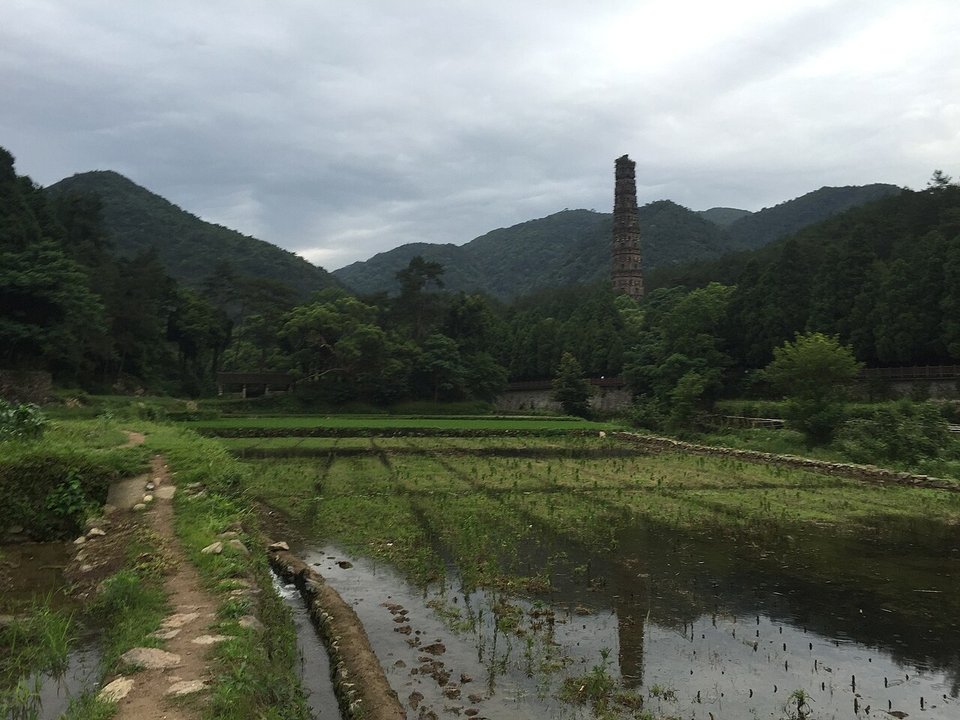
Outside the temple walls, on a rise above the fields, stands the Sui Pagoda, a tall brick tower worn rough by fourteen centuries. English Wikipedia counts it among the oldest surviving brick pagodas in China, with only the Songyue Pagoda of 523 clearly older. Sources date it to the very end of the sixth century, close to the temple's founding. It is the first thing you see on the approach and the best photograph of the visit.
The temple grounds also hold the Seven Buddha Pagodas, a row of small towers, and a memorial pagoda to the Tang monk Yixing (683 to 727), the astronomer who worked on the calendar and is said to have come to Guoqing to study mathematics.
The 1970s restoration
Guoqing owes its present condition partly to Japanese politics. English Wikipedia tells how, during the 1972 visit that restored relations between China and Japan, the Japanese prime minister Kakuei Tanaka asked Zhou Enlai whether he could worship at Guoqing Temple on behalf of his mother, a Tendai believer. The temple had been damaged during the Cultural Revolution and had not been repaired for years. Zhou ordered it restored by 1975.
The county formed a restoration committee and searched for lost objects. Of the temple's five hundred arhat statues, 323 turned up in a farm tool factory. Replacements came from collections in Beijing, including the Palace Museum and the Yonghe Lamasery, and arrived by train in two special carriages. Among them were a Ming bronze Shakyamuni weighing 13 tonnes, now in the Mahavira Hall, eighteen Yuan arhats carved from nanmu wood, which line the same hall, a Qianlong era bronze ding cauldron 3.8 metres high in front of it, and two Qing marble lions at the gate. Seventy eight surviving craftsmen repaired the boards and couplets with a dried lacquer and ramie technique. The temple received its first Japanese delegation on 18 October 1975.
Walking through
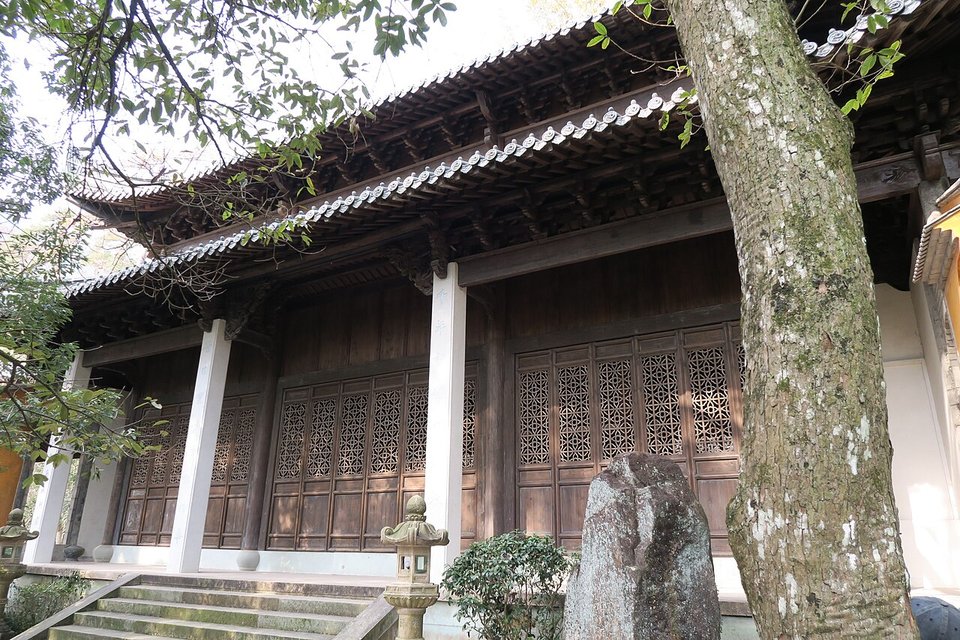
The main axis climbs through the gate halls to the Mahavira Hall, with side courts for the arhats, the monks' quarters and the dining hall. English Wikipedia describes the temple as covering about 23,000 square metres with some 600 rooms. Look for the Sui plum tree in a small courtyard, said to have been planted more than 1,300 years ago and revived during the restoration, and the release pond in the southwest corner with a stele inscribed by the Ming painter Dong Qichang.
This is a working monastery. Dress modestly, keep your voice down and do not photograph monks at prayer without asking.
Entry and hours
Entry is free. Taizhou Bendibao has described a free online booking through the Tiantai Mountain scenic area's WeChat account, and the rule has varied, so check before you go. Listings disagree on hours. Bendibao has given 8:00 to 17:00 in one notice and 8:00 to 16:00 in another, and travel listings give 7:00 to 16:00 with last entry at 15:30. The safe plan is to arrive in the morning. The temple serves vegetarian meals, and recent visitor notes say they need booking and are paid in cash.
Getting there
The temple is on the edge of Tiantai town. From Tiantaishan station on the Hangzhou to Taizhou high speed line, city bus 7 runs to the Guoqing scenic area, followed by about a kilometre on foot. A taxi takes 15 to 20 minutes. For the rest of the prefecture, see the Linhai Ancient City Wall, on the same railway line.
Frequently asked questions
Is Guoqing Temple free?
Yes. Some periods have needed a free advance booking.
How long should I allow?
Two hours for the temple and the Sui Pagoda.
Can I combine it with the rest of Mount Tiantai?
Yes. The other scenic areas of the mountain have separate tickets and are best reached by car.
Sources
Facts in this article were checked against the following sources, retrieved 22 October 2026.
- Guoqing Temple, English Wikipedia
- Mount Tiantai, English Wikipedia
- Taizhou Bendibao, Guoqing Temple booking
- Taizhou Bendibao, Taizhou Fucheng listing with Tiantai hours
- Qunar, Guoqing Temple morning visit notes
- Taizhou (Zhejiang) travel guide on this site
Photos are from Wikimedia Commons under the licences shown in each caption.