The Henan Museum and a Century of Digging on the Central Plains
The Henan Museum stands at 8 Nongye Road in Jinshui District, Zhengzhou. It holds more than 130,000 objects, over 5,000 of them graded first or second class by the state, and Chinese Wikipedia quotes the common claim that only the Palace Museum in Beijing outranks it among Chinese museums for its collection. The strength comes from the province. Excavations at Anyang, Xinzheng, Luoyang, Sanmenxia, Huixian and Xichuan have fed it for a century, so the galleries move from the Neolithic to the Song in one building. Entry is free with a real-name booking, and it closes on Mondays outside public holidays.
How the museum came to be
The story starts with a well. In the summer of 1923 a local gentleman named Li Rui was digging one in Xinzheng and broke into an ancient tomb that yielded more than a hundred bronzes. The warlord Wu Peifu ordered them sent to Kaifeng, then the provincial capital, for safekeeping. In July 1927, under Feng Yuxiang, a provincial museum was founded in Kaifeng partly to house them.
War split the collection. In November 1937 the museum packed 5,678 of its finest objects into 68 crates and sent them to Hankou, and in 1938 on to Chongqing. In 1949, 38 of those crates, holding 5,119 objects, went to Taiwan with Palace Museum material and became a core of the National Museum of History in Taipei. The rest came back to Henan in 1950. The provincial capital had moved to Zhengzhou in 1954, and the museum followed in 1961.
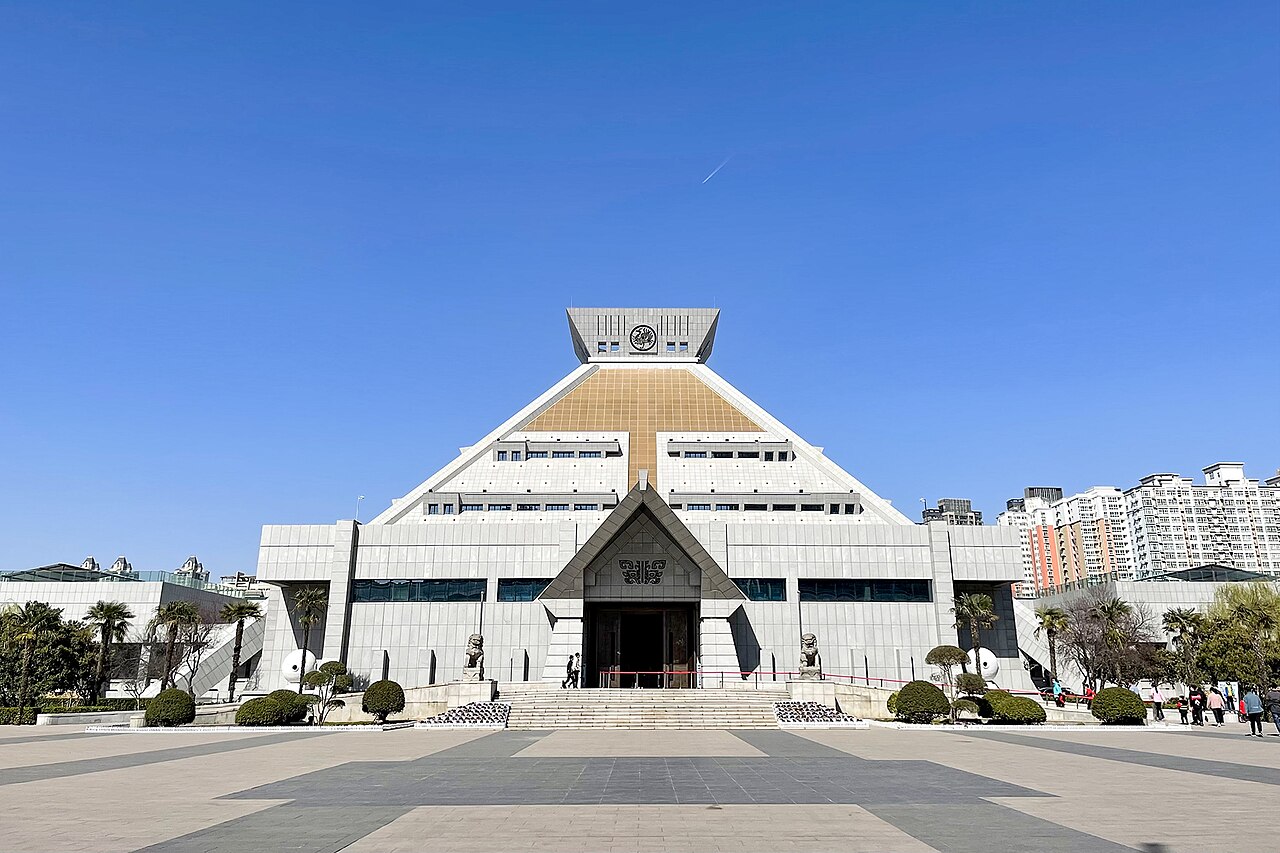
The present building was built from 1991 and opened in 1997, when the provincial museum merged with the Central Plains stone carving museum under the name Henan Museum. Its pyramid-like main hall takes the Yuan-era observatory at Dengfeng as its model, with a flared crown and yellow-brown walls meant to suggest the loess and the Yellow River. The main hall closed for structural repair in July 2015 and reopened in September 2020.
The galleries
The core exhibition fills the first three floors of the main hall in ten galleries, arranged in order from the Neolithic through Xia and Shang, Western Zhou, Eastern Zhou, Qin to the Northern and Southern Dynasties, Sui and Tang, and Song to Yuan. Separate permanent shows cover Ming and Qing Henan, Chu bronzes from the Danjiang and Xichuan area, Ming and Qing decorative arts, and Central Plains stone carving including Han pictorial reliefs and Buddhist figures. Temporary exhibitions rotate.
Two to three hours covers the core sequence at a steady pace. Half a day lets you add the Chu bronzes and the stone carving hall.
The nine treasures
The museum names nine objects as its headline pieces, and they are spread through the galleries, so it helps to know them before you go.
- Jiahu bone flute. Excavated at Wuyang in 1987 and about 8,000 years old, it is 23.1 cm long with seven holes and is made from a crane bone. Tests showed it can still play a scale.
- Duling square ding. An early Shang bronze cauldron 87 cm high, found in 1974 within the Zhengzhou Shang city.
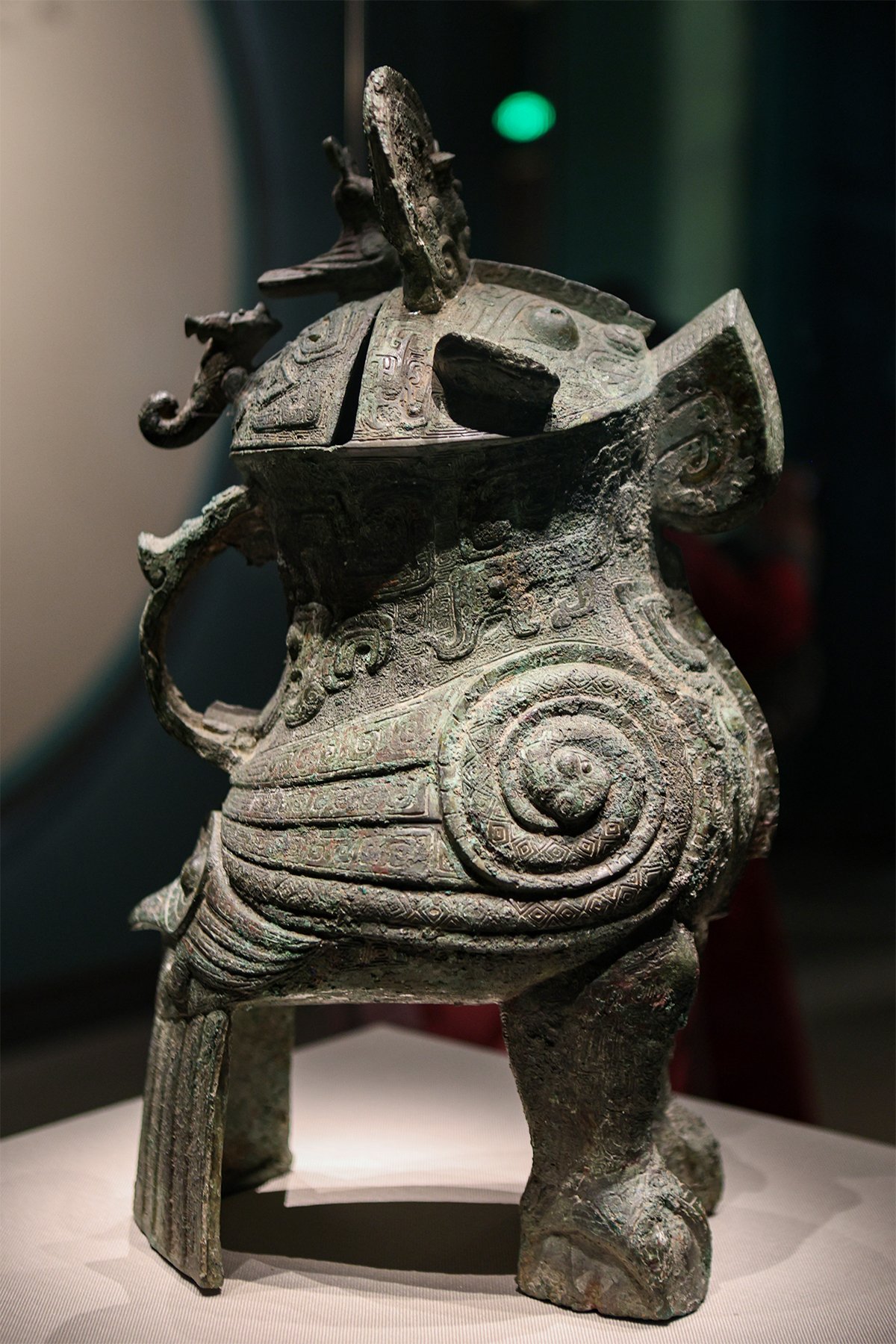
- Owl-shaped zun of Fu Hao. A late Shang wine vessel 45.9 cm high from the tomb of the royal consort Fu Hao at Anyang, excavated in 1976, with her name cast inside.
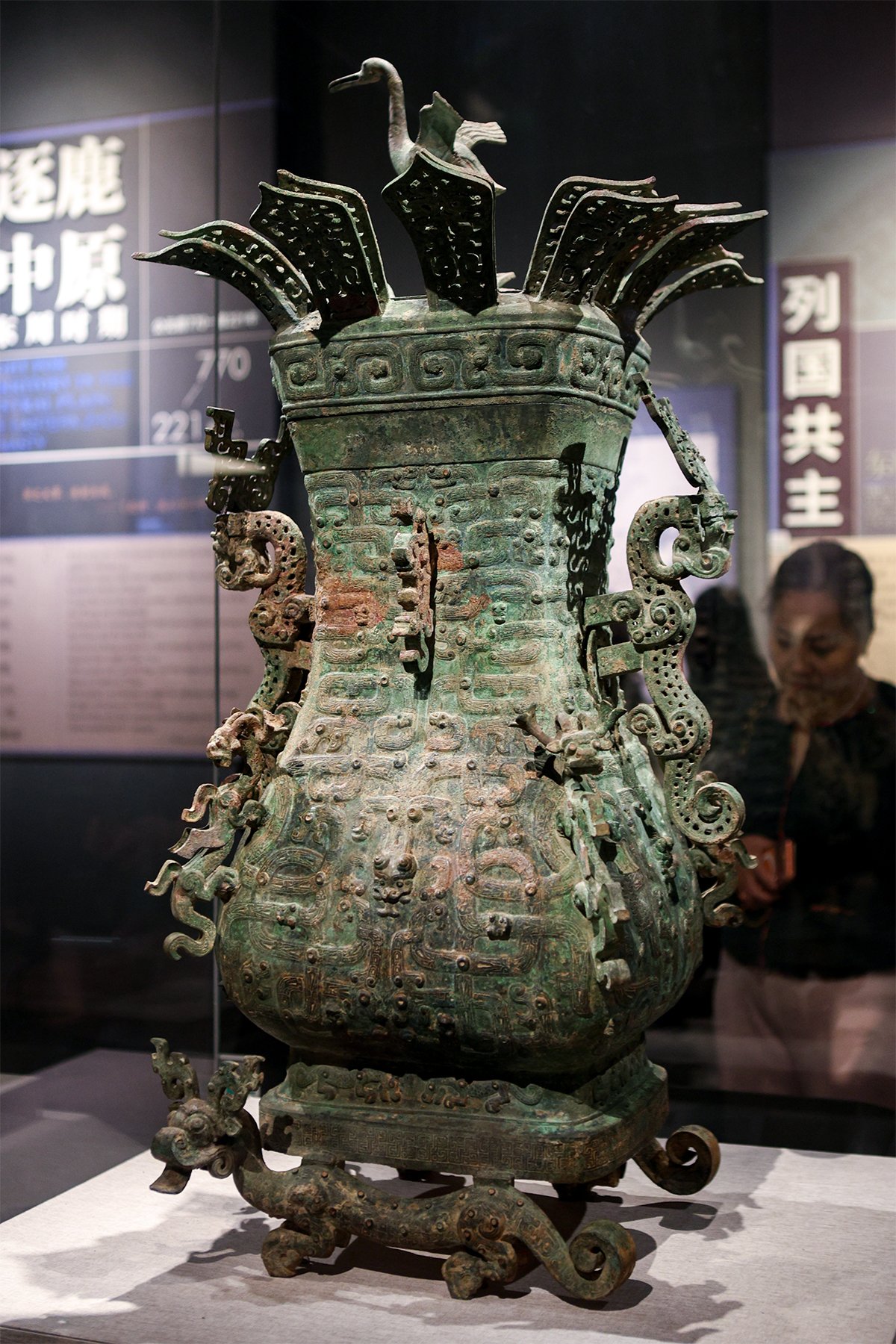
- Lotus and Crane Square Pot. A Spring and Autumn bronze 120 cm high from the 1923 Xinzheng tomb, crowned with lotus petals and a crane about to take off. It is one of the museum's founding objects.
- Cloud-pattern bronze jin. A lost-wax altar table from a Chu tomb at Xichuan, found in 1978 in hundreds of fragments and pieced together by the restorer Wang Changqing over more than two years. It is among the objects barred from leaving China for exhibition.
- Jade-handled iron sword. A late Western Zhou blade from the Guo state cemetery at Sanmenxia, important for the early history of iron.
- Four Deities mural. A Western Han tomb ceiling from Mangdang Mountain at Yongcheng, about 16.8 square metres.
- Wu Zhao gold slip. A gold tablet that Empress Wu Zetian's envoy left on Mount Song's Junji Peak in the year 700, found in 1982.
- Ru ware goose-neck vase. A sky-blue Northern Song vase excavated in 1987 at the Ru imperial kiln site at Baofeng.
Objects travel for loans and some galleries close for changeovers, so a treasure may be off display on any given day.
Booking and timing
Visits require a real-name reservation through the museum's official WeChat account or mini program, and holiday slots go quickly. The museum has been running extended evening hours, and its notices set release times for both daytime and evening tickets. Hours and release rules change by season, so check the day's notice. Bring the ID you booked with.
The Huaxia ancient music ensemble performs reconstructed early music in a hall on the ground floor of the main building, with sessions booked separately through the same mini program. Session times are posted by the museum.
Fitting it into Zhengzhou
The museum works best before Shaolin Temple, because the Mount Song gold slip and the Song ceramics give context for Dengfeng. It also pairs with the Shang city walls across town, since the Duling ding came out of that site. A city day might run Shang walls in the morning, the museum in the afternoon and the Erqi Tower at dusk. Kaifeng, where the museum began, is twenty minutes away by high-speed rail.
Things to confirm before you go
- Your reservation date and time slot.
- Monday closure and any holiday changes.
- Whether the treasure you most want is on display.
- Huaxia music session times if you want to attend.
Frequently asked questions
Is the Henan Museum free?
General admission is free with a real-name booking. Some special exhibitions and performances may have separate arrangements.
How long does it take?
Two to three hours for the core galleries, half a day with the side exhibitions.
Why are some Henan objects in Taipei?
In 1949 part of the collection that had been evacuated to Chongqing during the war was shipped to Taiwan. It now forms part of the National Museum of History there.
Is it closed on Mondays?
Yes, except on public holidays. Check the museum's notices for changes.
Sources
Facts in this article were checked against the following sources, retrieved 10 October 2026.
Photos are from Wikimedia Commons under the licences shown in each caption.