Tianning Temple
Tianning Chan Temple stands just east of the old city of Changzhou, and from almost anywhere in town you can see its pagoda. The Tianning Pagoda rises 153.79 metres in thirteen storeys and is described as the tallest pagoda in the world. The tower is modern. The monastery beneath it goes back to the Tang dynasty and was long counted among the great Chan houses of the lower Yangtze, and its old halls are the better reason to come.
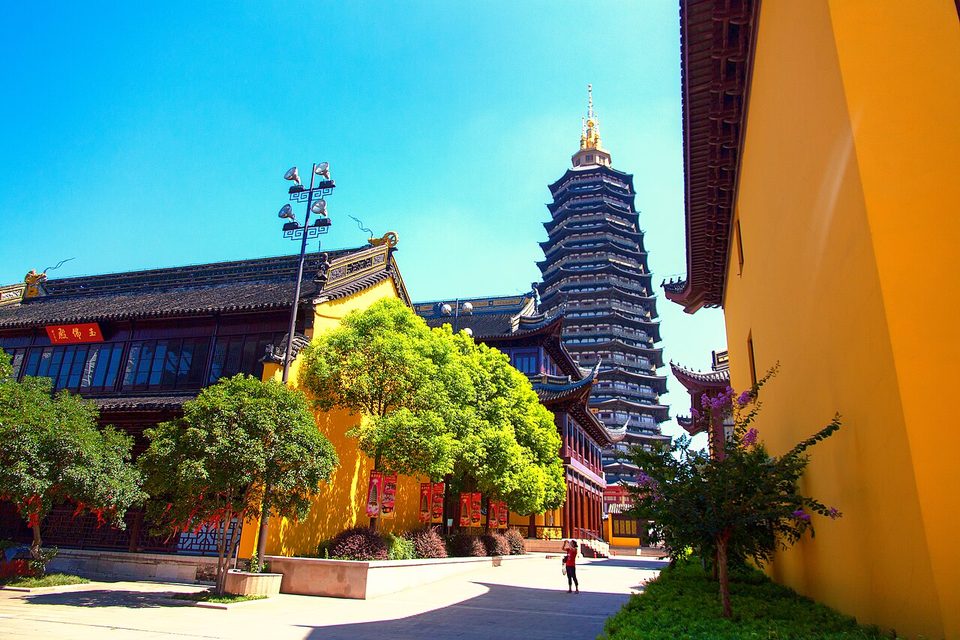
A Tang foundation
The temple was founded between the Zhenguan and Yonghui reigns of the Tang, between 627 and 655, under the name Guangfu Temple. Its first abbot was the Chan master Farong of Youqi Temple on Niutou Mountain near Nanjing, a founder of the Oxhead school of Chan. In 1111, the first year of the Zhenghe reign of the Northern Song, the temple took its present name. Changzhou Bendibao says Tianning is the largest and most complete old monastery left in the city, and lists it with Jinshan Temple in Zhenjiang, Gaomin Temple in Yangzhou and Tiantong Temple in Ningbo as the four great Chan monasteries of China. Its old nickname was the first monastery of the southeast.
The Qianlong emperor visited three times during his six tours of the south. He left a plaque reading Longcheng Xiangjiao. Longcheng, the Dragon City, is an old name for Changzhou, and xiangjiao, the teaching through images, is a classical term for Buddhism. The four characters are carved on the screen wall facing the main gate.
The twentieth century was hard on the temple. During the Cultural Revolution the Song-period statues were all destroyed. Restoration began in 1979, a committee to rebuild the temple was formed in January 1981, and in 1983 the State Council named Tianning a national key Buddhist temple of the Han Chinese areas. The temple is famous for its ordination ceremonies, which draw monks from across China and abroad.
The halls
Local sayings praise the temple for its five big things, the big halls, big Buddhas, big bell, big drum and big incense cauldron. Inside the mountain gate stands a four-faced, thousand-armed Guanyin, about four metres high and carved from camphor wood covered in gold leaf. The Hall of the Heavenly Kings is more than 23 metres tall. Its name board is by Zhao Puchu, the calligrapher and former head of the Buddhist Association of China, and the four painted Heavenly Kings inside stand 7.8 metres, or 9.1 metres with their bases.
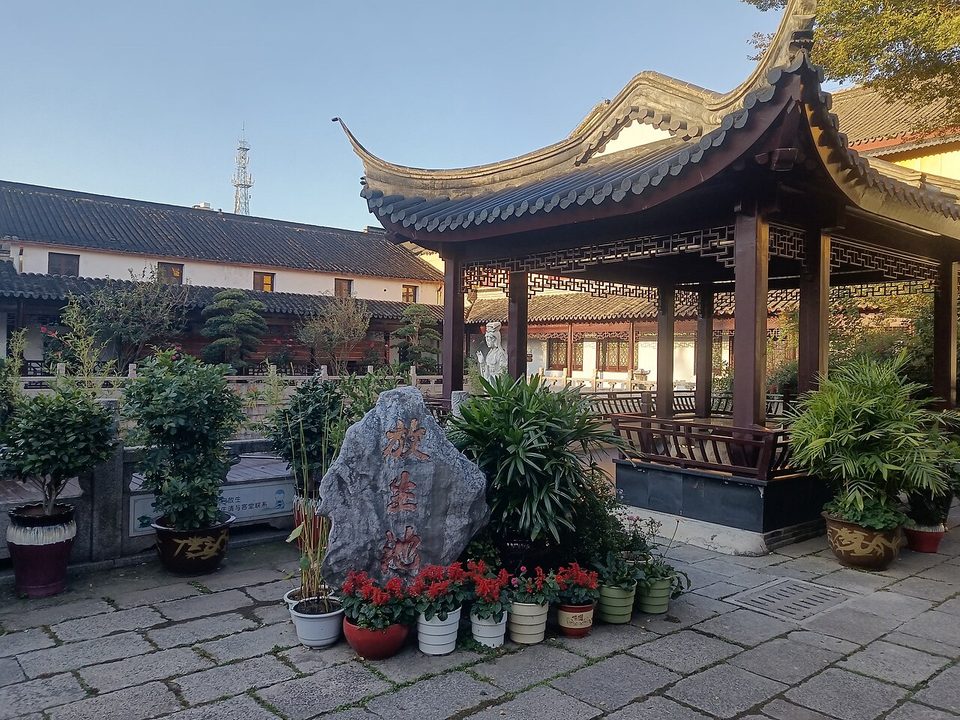
The real treasure is on the walls in front of the Mahavira Hall. Set into both sides are 518 brick panels carved with arhats, started in 1798, the third year of the Jiaqing reign. During the Cultural Revolution people covered them with lime plaster, which is why they survived intact. The 500 arhat statues in the arhat hall were modelled on rubbings of these panels. Look also for the pair of stone sundials in the courtyard. The originals were more than 180 years old when one was destroyed in the war with Japan and the other wore away, and the present pair were remade in 1991 to the old design after surveys by the Shanghai Astronomical Observatory.
The Mahavira Hall itself is the largest in the temple, 25.8 metres high with a double-eaved roof and tall ironwood columns, and its ridges are covered in openwork brick carving of figures, birds and flowers. The openwork lightens the roof and lets the wind pass through. Behind it, the Jade Buddha Hall keeps twelve jade Buddhas, the remainder of fifteen brought to the temple between 1990 and 1995, including reclining Buddhas in the pose of the Buddha's final nirvana. The temple's vegetarian kitchen has a long reputation.
The Tianning Pagoda
An older seven-storey pagoda here, the Puzhao Wang Pagoda of the Song, burned down long ago. The new pagoda was proposed in 2001 and its foundations were laid in April 2002. English Wikipedia gives an opening ceremony on 30 April 2007, and Changzhou Bendibao gives a consecration on 1 May 2008. A fire broke out in the lower floors on 25 May 2006 during construction without permanent damage. The tower stands on a 6,500 tonne steel frame clad in nanmu timber, bronze and brass, in the octagonal Tang and Song style, and the floor area is about 27,000 square metres.
Inside, each floor carries its own Buddhist theme in Dongyang wood carving, Yangzhou lacquer, Changzhou needlework and Hui'an stone. A bell hangs at the top. Bendibao gives its weight as 15 tonnes and says it hangs at about 118 metres, while English Wikipedia gives 30 tonnes, so treat the figure loosely. The top floor also holds a crystal Buddha said to date from sixteenth-century India, donated in 2003. Visitors describe taking a lift up and walking down floor by floor, and the views over the city and the neighbouring Hongmei Park are the main draw.
Tickets and hours
Changzhou Bendibao, updated in February 2026, says the temple opens free in the daytime from 7:00 to 17:00, with the pagoda excluded. The pagoda needs its own ticket, and Ctrip lists its hours as 8:00 to 16:30 with last entry at 16:00. Special arrangements apply at Spring Festival. Check the day's notice for the pagoda price and any holiday changes.
Getting there and pairing it
The temple's address is No. 636 Yanling East Road, east of the old centre and next to Hongmei Park. Taxis and the city's buses and metro cover the area, and Changzhou station and Changzhou North station both serve the city by rail. Give the temple and pagoda a morning, then walk west into the old city for Qingguo Lane and the canal in the afternoon. Jinshan Temple in Zhenjiang, another of the four great Chan monasteries, is a short train ride west.
Frequently asked questions
Is the temple free?
In the daytime, according to Bendibao in 2026. The pagoda has a separate ticket.
Is the pagoda old?
No. It was built between 2002 and 2007 on the site of a lost Song pagoda.
How long should I allow?
An hour for the temple halls and an hour or two for the pagoda.
Sources
Facts in this article were checked against the following sources, retrieved 21 October 2026.
- 天宁寺 (常州), Chinese Wikipedia
- Tianning Temple (Changzhou), English Wikipedia
- Changzhou Bendibao, Tianning Temple introduction, February 2026
- Ctrip listing for the Tianning Pagoda
- Changzhou, English Wikipedia
- Changzhou travel guide on this site
Photos are from Wikimedia Commons under the licences shown in each caption.