Jinshan Temple, Zhenjiang's Temple on the Hill
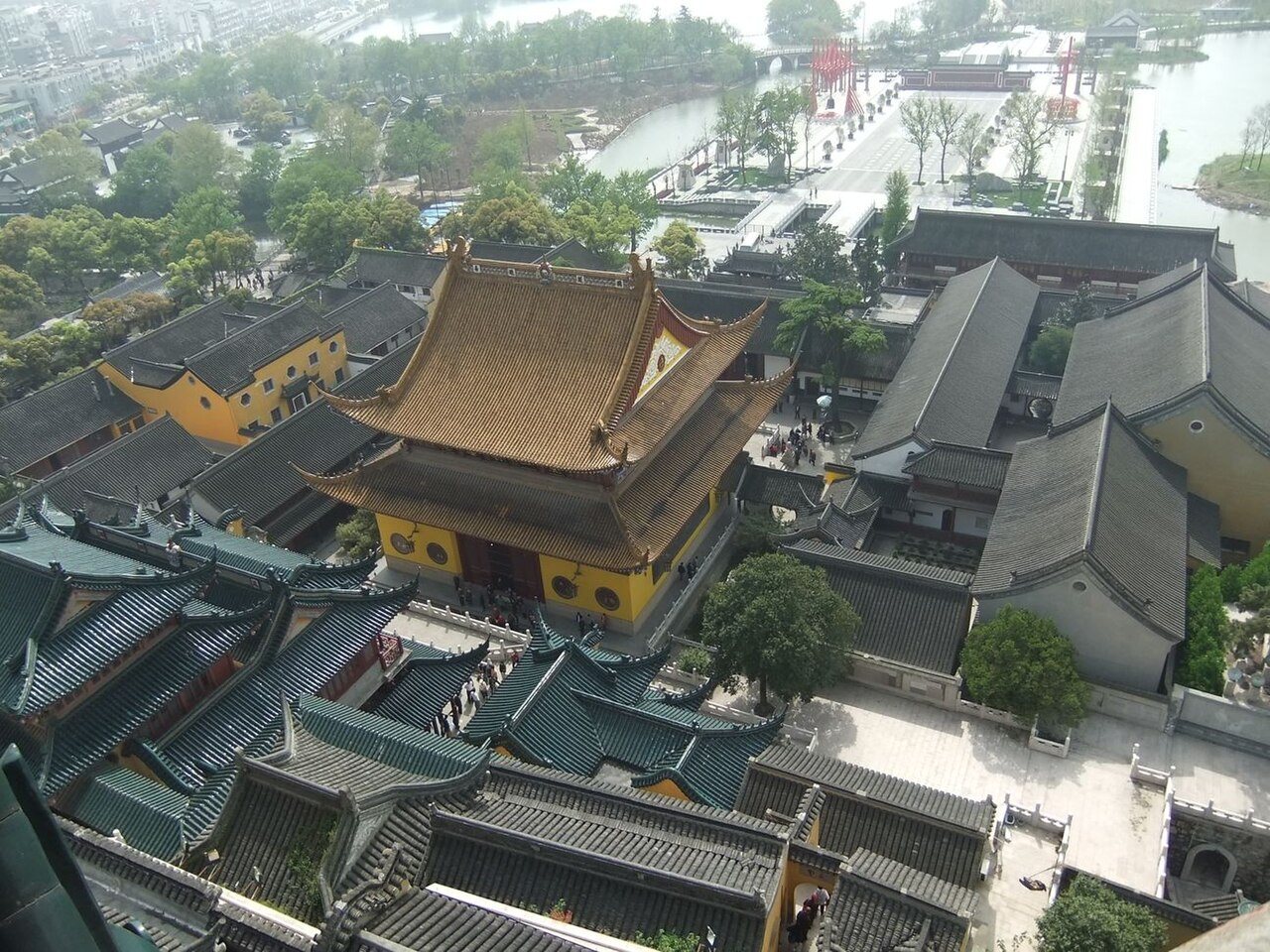
Jinshan Temple stands on Jinshan, a small hill about two kilometres northwest of central Zhenjiang. Its official name is Jiangtian Chan Temple, but almost everyone calls it Jinshan Si. Halls, galleries and stairways are built all over the hill, so densely that a Chinese saying describes it as the temple that wraps the hill, where you see temple and pagoda and no hill at all. It is also the setting of the best-known scene in the Legend of the White Snake, which is why many Chinese visitors know its name long before they arrive.
An island temple that came ashore
Jinshan was once an island in the Yangtze. The Tang poet Zhang Hu wrote of tree shadows seen in midstream and bells heard on both banks, and Su Shi described sailing out to it. As the river shifted, silt built up around the island, and by the Guangxu reign of the late Qing it had joined the south bank. For a while riding a donkey up to Jinshan became a fashionable outing. The hill rises only about 44 metres above sea level.
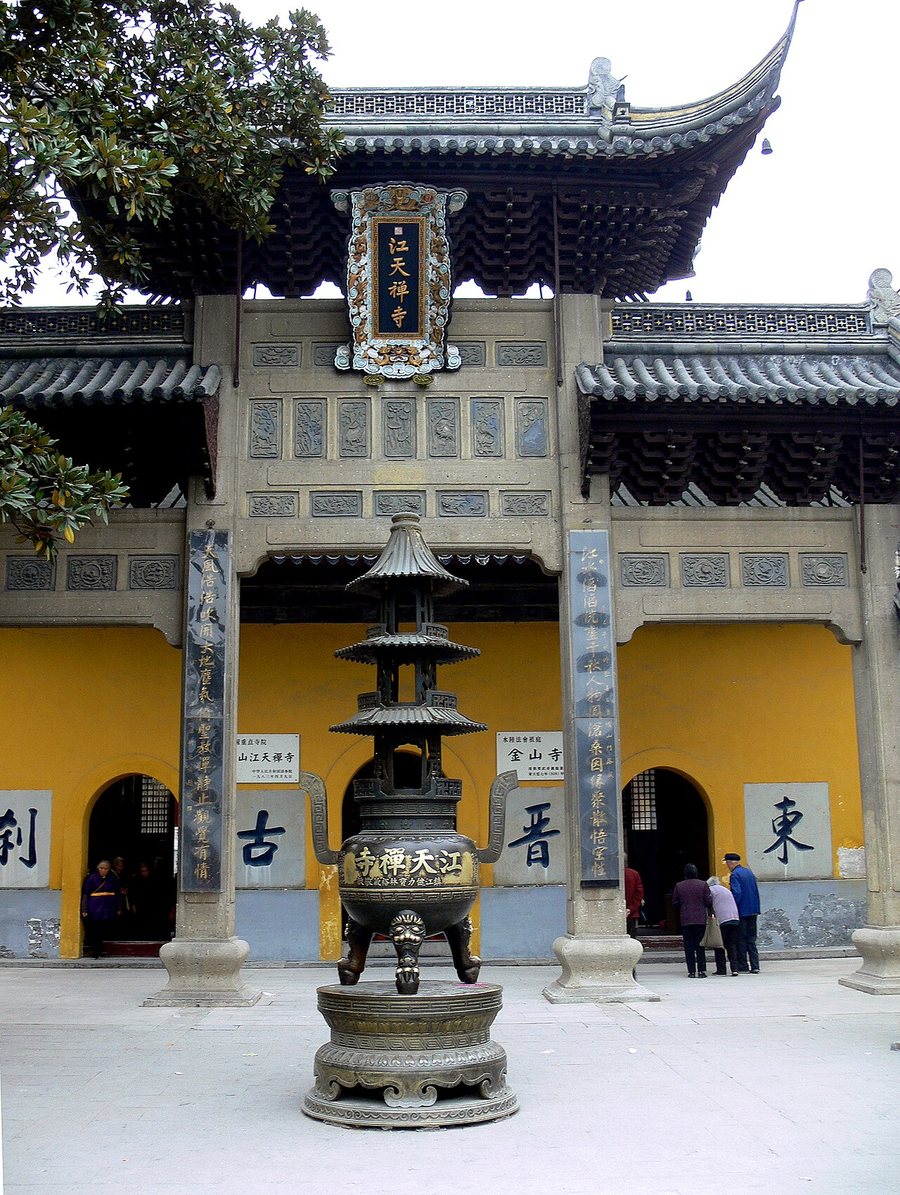
The temple's history is longer than the hill's life on land. According to the English Wikipedia it was founded as Zexin Temple between 323 and 325 under Emperor Ming of the Eastern Jin. The Chan master Lingtan revived it in the Tang, and local tradition says he subdued a serpent in a cave on the hill. In the Song the emperor Zhenzong renamed it Longyou Temple after a dream, and the abbot Foyin, a close friend of Su Shi, enlarged it in the 1080s. For a few years under the Taoist emperor Huizong it was even turned into a Taoist palace. The Kangxi Emperor, visiting on a southern tour in the 1680s, wrote the plaque Jiangtian Chan Si that gives the temple its formal name.
Modern history has been hard on it. A fire in 1948 destroyed more than 200 buildings, including the main hall, the sutra library and the abbot's quarters, and stupas were destroyed during the Cultural Revolution. The State Council listed Jinshan as a national key Buddhist temple in 1983, and much of what you see dates from rebuilding in the 1980s. The temple has run a Buddhist academy since 1995.
The halls and the pagoda
The complex faces west. From the main gate the route climbs through the Hall of the Heavenly Kings, first built in the Ming and rebuilt in 1869, to the Mahavira Hall, rebuilt in 1989 with a double-eaved roof. Inside are the Buddhas of the three ages with the Eighteen Arhats along the walls and Guanyin behind. Further up are the four-storey sutra library, completed in 1984, the Furong Tower and the Qifeng Pavilion.
At the top is Cishou Pagoda, the hill's landmark, an octagonal tower of seven storeys about 36 metres tall. A pagoda has stood here since the Southern Dynasties, and the present one was rebuilt in 1900. Views from the upper terraces take in the river plain and the city skyline. The temple's traditional four treasures are a jade belt said to have belonged to Su Shi, a Zhou bronze ding, a painting of Jinshan and a bronze drum.
Legends on the hill
The White Snake story ends here in its most famous version. The monk Fahai keeps the scholar Xu Xian at Jinshan, and his wife, the White Snake spirit Bai Suzhen, raises a flood to drown the temple and win him back. Caves and spots on the hill are labelled with scenes from the tale, and it is fine to enjoy them as folklore. The hill also has stories of Liang Hongyu beating war drums against the Jin army and of Yue Fei having a dream read here.
Beside the temple stands the Wenzong Library, one of three imperial libraries built in the south to hold copies of the Siku Quanshu. The original, built in 1779 on a river island beside the temple, burned in 1853 during fighting between Taiping and Qing forces. The present building was reconstructed from an old drawing and opened in October 2011 with a facsimile of the Siku Quanshu.
Visit order and timing
Go early, when the stairs are cooler and the main halls are quiet. Enter by the main gate, climb through the halls to Cishou Pagoda, then walk down the far side to the legend sites and the Wenzong Library. The whole loop takes two to three hours. Stairs are continuous, so wear good shoes, and in summer avoid the midday heat on the stone steps.
Afternoons work well for Xijin Ferry, the old ferry street a short taxi ride away, which is pleasant at dusk. The Zhenjiang travel guide compares Jiaoshan and Beigu Hill if you have time for a second hill.
Tickets and getting there
Jinshan is run as a scenic area with an entry ticket, and prices and opening times change by season and on festival days, so check the day's notice at the gate. The site is on the northwest side of the city and easy to reach by taxi or city bus from the centre and from Zhenjiang railway station.
Before you go
- Dress modestly and keep voices down in active halls.
- Expect crowds on Buddhist festivals and national holidays.
- Carry water in summer, as the climb is steady.
Frequently asked questions
Is Jinshan Temple an active monastery?
Yes. Monks live and study here, and the temple runs a Buddhist academy.
How long should I spend?
Two to three hours for the halls, the pagoda and the legend sites.
Is Jinshan still an island?
No. It joined the south bank of the Yangtze in the late Qing as the river silted up.
What is the White Snake connection?
In the best-known version of the legend, Bai Suzhen floods Jinshan to free her husband from the monk Fahai.
Sources
Facts in this article were checked against the following sources, retrieved 18 October 2026.
- Jinshan Temple (Zhenjiang), English Wikipedia
- Jiangtian Chan Temple, Chinese Wikipedia
- Zhenjiang travel guide on this site
Photos are from Wikimedia Commons under the licences shown in each caption.