Liuhe Pagoda (Six Harmonies Pagoda)
Liuhe Pagoda stands on Yuelun Hill above the north bank of the Qiantang River, at 16 Zhijiang Road, about 4 km south of West Lake. In 2026 entry to the grounds costs 20 yuan, climbing the pagoda costs another 10, and it opens 07:00 to 17:30. Tickets can be booked up to three days ahead through the 「西湖旅游」 WeChat account. Buses 4 and 318 stop at Liuhe Pagoda (六和塔) station. Allow one to two hours. It is the Hangzhou sight to drop on a short trip, unless you want a view of the river or you're in town for the tidal bore.
The rest of the city is in the Hangzhou travel guide.
Why it was built
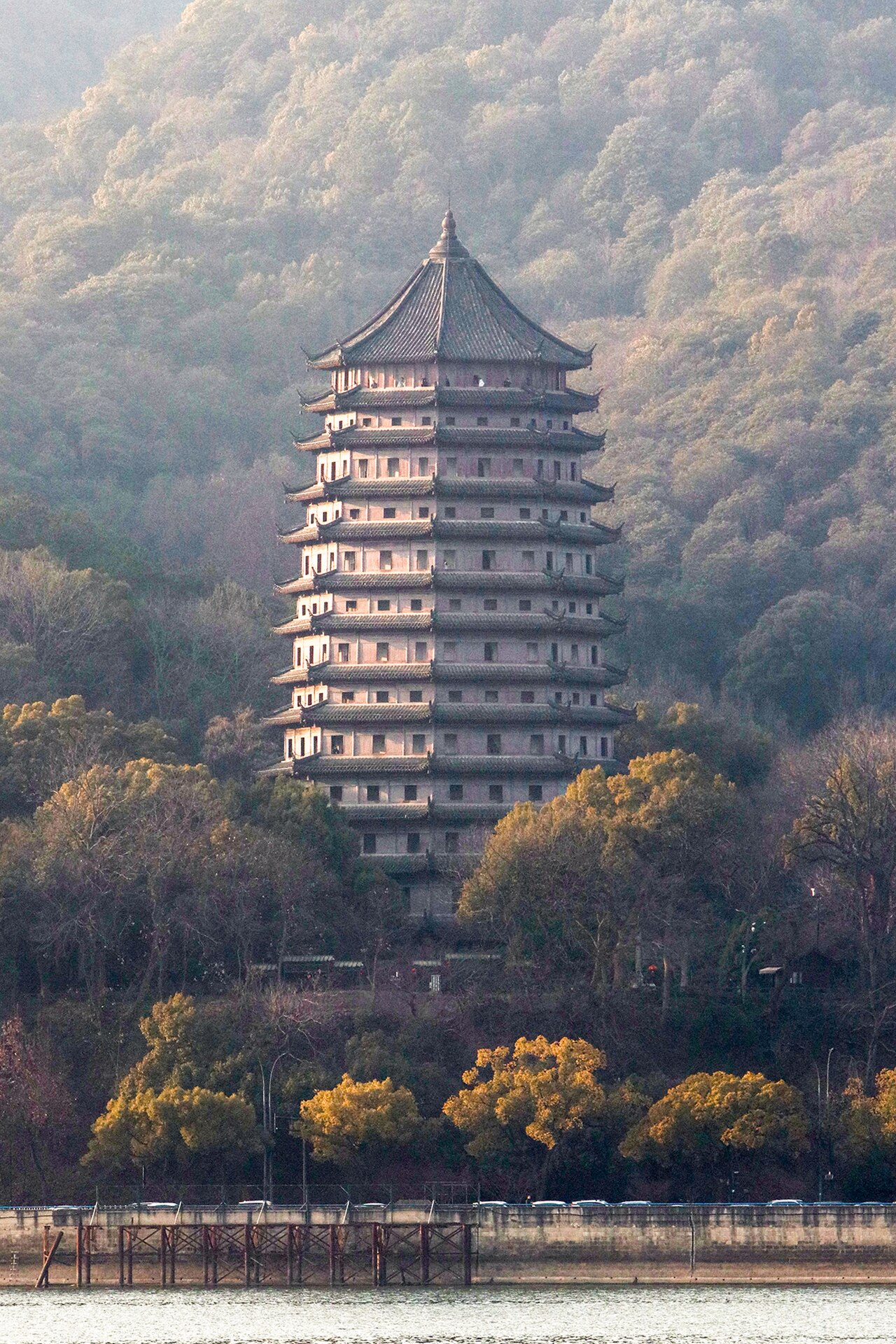
In 970, when Hangzhou was the capital of the Wuyue kingdom, the king had the monk Zhiyuan build a pagoda here to subdue the Qiantang's tides, which regularly flooded the riverbank. The name comes from the Buddhist "six harmonies", rules for living together in a community. It also puns on 六合, meaning heaven, earth and the four directions. The original was destroyed in war. The brick body standing today dates from the Southern Song rebuilding, with the wooden outer eaves added much later. It has been under national protection since 1961.
Seen from outside it has thirteen tiers of eaves, but inside there are only seven storeys. The stair inside the brick core is narrow and steep. Each level opens onto a gallery, and the higher you go, the better the view up and down the river. Inside, look for the Song brick carvings of flowers, birds and figures on the walls.
What you see from the top
Directly below is the Qiantang River Bridge, the first large road-and-rail bridge designed and built by Chinese engineers, led by Mao Yisheng. It opened in September 1937, was blown up that December to slow the Japanese advance, and was repaired after the war. Beyond it the river runs wide and brown towards Hangzhou Bay, with the new city of Binjiang on the far bank. It is a completely different Hangzhou from the lake.
Behind the pagoda, the grounds have a small garden of pagoda models from around China. It is worth a quick walk round if you have time.
The tidal bore
The Qiantang bore, a wave pushed upriver by the tide, is one of the world's largest, and it is biggest around the 18th day of the eighth lunar month, a few days after the Mid-Autumn Festival. The riverside around Liuhe is a traditional viewing spot. In Hangzhou itself the bore is smaller than at Yanguan in Haining, further downstream, where most dedicated bore-watchers go.
If you're coming for the bore:
- Check the official tide forecast for the day. Times vary daily and are published locally.
- Stay behind the barriers and off the steps and rocks. The bore and its backwash have swept spectators away, and the water can surge over the bank with little warning.
- Expect police crowd control and road closures on peak days.
Outside bore season, the river is calm and the pagoda is quiet, often with a breeze off the water.
Tickets
| Ticket | 2026 price |
|---|---|
| Grounds, adult | 20 yuan |
| Grounds, half price | 10 yuan (ages 6 to 18, children 1.2 to 1.5 m, full-time students, ages 60 to 69) |
| Climbing the pagoda | 10 yuan extra (5 yuan for concessions) |
| Free | Ages 70 and over, children 6 and under or 1.2 m and under, serving military, people with disability certificates |
Fitting it in
It works best as the first half of a day, then back into town. Take the bus out in the morning, climb the pagoda, walk along the river for a while, then return to the old town for lunch and Hefang Street in the afternoon. The Longjing tea villages are also nearby to the north-west, which makes a good pairing for a slower day.
Don't try to squeeze it into the same day as Lingyin Temple and the West Lake causeways. You'll spend most of the day in traffic. If you want only one pagoda, Leifeng Pagoda has the lake view and the sunset, while Liuhe has the river and an older building.
Frequently asked questions
How much is Liuhe Pagoda?
20 yuan for adults to enter the grounds in 2026, plus 10 yuan to climb the pagoda.
Can you climb Liuhe Pagoda?
Yes, for an extra 10 yuan. The stairs inside the brick core are narrow and steep, with seven storeys inside.
Is Liuhe Pagoda a good place to see the tidal bore?
It is a traditional viewing spot in Hangzhou, best around the 18th day of the eighth lunar month. Bigger bores are seen downstream at Yanguan in Haining.
Liuhe Pagoda or Leifeng Pagoda?
Leifeng for West Lake and the sunset. Liuhe for the Qiantang River, the old bridge and an original Song brick structure.